



He saw a man throw a wooden box into the river… But the newborn’s cry inside changed his life forever.
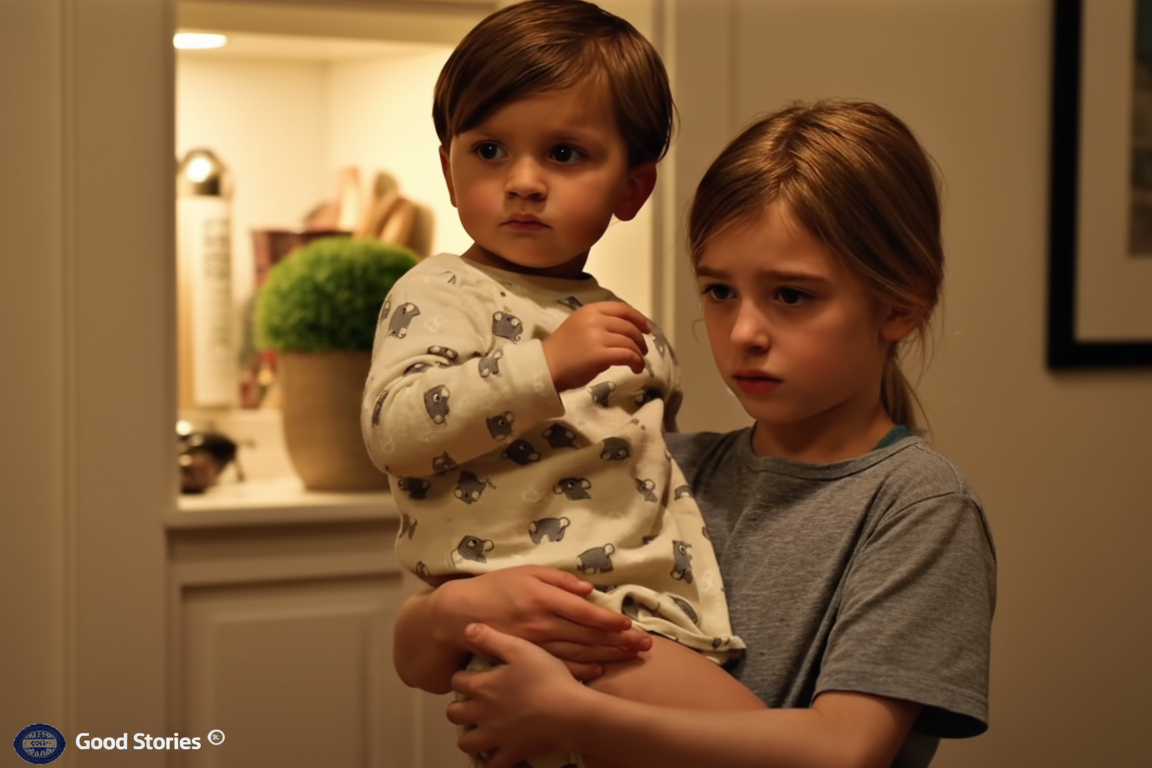
I was thirty-four when the fire took everything. My wife Tessa. Our three-year-old son Michael. One night, they were tucking him in with his favorite blue truck. The next, I was standing on the sidewalk in my warehouse parka, watching flames eat through our home.
Pastor Pierce found me at the funeral. “Don’t turn right or left,” he said. “Just walk straight.”
I wanted to punch him. But I started walking anyway.
Maren—Tessa’s younger sister—showed up three days later. She didn’t ask questions. Just left lasagna on the porch and sat on the steps until I opened the door.
“You don’t have to talk,” she said. “But you do have to eat.”
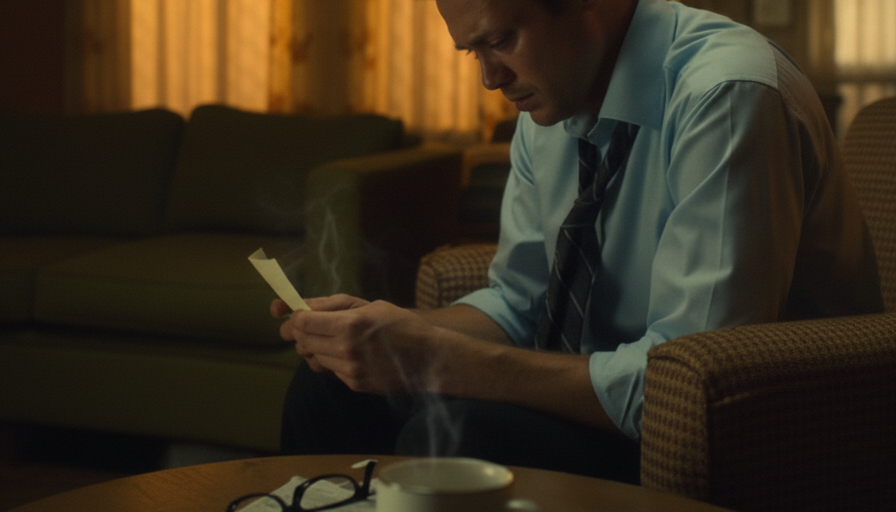
The nights were the worst. The hum of the fridge. The water heater clicking on. Every sound reminded me I was alone.
I kept Tessa’s wooden recipe box on the counter. Michael’s blue truck on the mantle. That was all I had left.
Six weeks passed. I worked the frozen food warehouse night shifts, let the cold numb everything else.
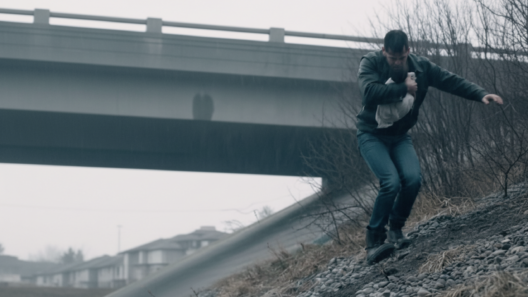
Then one Thursday, driving the back road under the state bridge, I saw hazard lights flashing.
A man in a gray sweatshirt stood by the guardrail. He looked around, then hurled something into the river.
A wooden box.
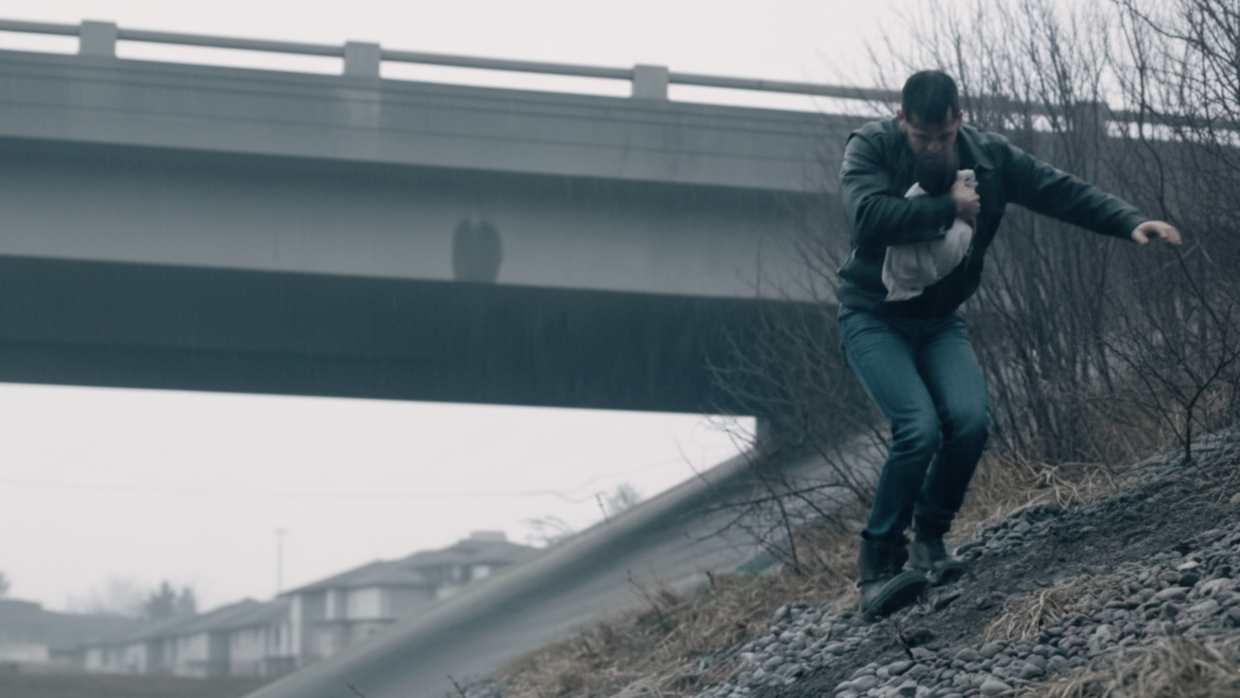
My feet were moving before I thought. Down the embankment, mud sucking at my boots, branches tearing my jacket.
The box bobbed in the current. I grabbed it, hauled it onto the rocks.
Inside—a baby. Blue-lipped. Eyes half-open. But breathing.
“Jesus Christ.” My hands shook as I pulled him out. He was cold. So cold.
I ran back to my truck, cranked the heat, pressed him against my chest. His tiny heartbeat fluttered against mine.
The hospital was twelve minutes away. I made it in eight.
“I found him in the river,” I said to the ER nurse. “He was in a box.”
They took him, efficient and calm. An hour later, a doctor emerged.
“He’s stable. Hypothermic, but he’ll make it.”
“What happens to him now?”
“Child services. Foster care, probably.”
I stayed in the waiting room. Couldn’t leave.
A social worker named Janet sat beside me. “You saved his life.”
“Someone threw him away.”
“I know.” She paused. “Would you consider temporary care? We’re short on infant placements.”
I looked at her. “Me?”
“You’re already attached.”
I brought him home two days later. They’d named him Lucas in the hospital records.
Lucas cried the first night. I walked circles in the living room, his small weight against my shoulder, and something shifted. The silence wasn’t empty anymore.
“It’s okay,” I whispered. “I’ve got you.”
Maren came over the next morning. She stopped in the doorway, staring.
“Is that—”
“I pulled him out of the river.”
She crossed the room, looked down at Lucas. “He’s beautiful.”
“His mother died. Childbirth complications. That’s what Janet told me.”
“And his father?”
“Threw him in the river.”
Her jaw tightened. “Bastard.”
Three weeks later, I got the call. “The grandparents want to meet you.”
Celeste and Gordon Eldridge sat across from me in Janet’s office. Celeste’s eyes were red-rimmed. Gordon’s hands gripped his knees.
“Our daughter Raina,” Celeste began. “She had Lucas alone. We didn’t even know she was pregnant. She died at home before we could get her help.”
“I’m sorry,” I said.
“We want to thank you,” Gordon said. “For saving our grandson.”
Celeste leaned forward. “But we need to know—do you want to keep him?”
The question hung in the air.
“Yes,” I said. “If that’s even possible.”
Celeste exhaled. “Raina’s boyfriend—Zayn Kinder—he’s been calling us. Demanding money. He says he raised Lucas.”
“He threw him in a river.”
“We know. But he’s threatening to fight for custody if we don’t pay him.”
Janet cleared her throat. “We’re building a case. The police are involved.”
Four days later, Zayn showed up at my house.
He pounded on the door. “Open up! That’s my kid!”
I opened it slowly. Kept my body blocking the entrance.
“You’re Zayn.”
“Damn right. Where’s Lucas?”
“Not here.”
“Bullshit. I’m his father. I got rights.”
“You threw him in a river.”
His face twisted. “Prove it.”
“I pulled him out myself.”
“Your word against mine.”
I stepped forward. He stepped back.
“Leave,” I said. “Or I call the cops right now.”
He jabbed a finger at me. “This ain’t over.”
But it was.
Detective Morris contacted me the next day. “We have surveillance footage from the bridge. Traffic camera caught everything. Zayn’s in custody.”
The preliminary hearing was swift. Zayn’s lawyer tried to argue temporary insanity, postpartum crisis by proxy. The judge wasn’t buying it.
“You threw an infant into a river,” Judge Henley said. “There’s no defense for that.”
Zayn got six years. Attempted murder of a minor.
The adoption hearing was scheduled for eight weeks later.
Celeste and Gordon came to my apartment the night before. We sat at my small kitchen table, Lucas asleep in his bassinet nearby.
“We’ve talked about this,” Celeste said. “Gordon and I—we’re not young. We can’t raise a baby.”
“But he’s your grandson.”
“And you’re his father,” Gordon said quietly. “The one who matters.”
Celeste reached across the table, squeezed my hand. “Raina would have wanted him with someone who loves him this much.”
“We’d like to be his grandparents,” Gordon added. “If you’ll let us.”
“Of course,” I said. “He should know you.”
The adoption hearing lasted forty-two minutes.
Judge Henley looked at me over his glasses. “Mr. Brennan, why do you want to adopt Lucas?”
I glanced at the bassinet beside me. Lucas’s tiny fist curled against his cheek.
“Because I already am his father. Have been since I pulled him out of that river.”
The judge nodded. “The court recognizes that this child would not be alive without your intervention. Adoption granted.”
The gavel came down.
Maren grabbed my hand. Celeste was crying. Gordon’s hand landed on my shoulder.
That night, I sat on my apartment terrace, Lucas sleeping in my arms, Maren beside me.
The city fog rolled in, softening the lights below. Stars barely visible but there.
“You okay?” Maren asked.
“Yeah.” I looked down at Lucas. “I still miss them. Tessa. Michael.”
“I know.”
“But this—” My voice caught. “I didn’t think I’d feel this again.”
“What?”
“Like my life matters.”
Maren leaned her head on my shoulder. “It always did.”
Inside, Tessa’s recipe box still sat on the counter. Michael’s blue truck on the mantle. But now Lucas’s bottles lined the drying rack. His tiny socks tumbled in the dryer. His soft breathing filled the silence.
I wasn’t replacing what I’d lost. That was impossible.
But I was walking forward. Not right. Not left. Straight ahead.
And I wasn’t walking alone.
Lucas stirred, made a small sound. I adjusted him, felt his warmth against my chest.
“Got you,” I whispered.
Celeste and Gordon visited every Sunday. They brought photo albums of Raina, stories of her childhood, pieces of her Lucas would carry forward.
Maren stayed close. Some nights she’d just show up with groceries. Other nights we’d sit in silence while Lucas slept between us.
“Think you’ll ever—” she started once.
“What?”
“Nothing.”
But her hand found mine in the dark.
Six months later, Lucas laughed for the first time. A real laugh, not just a baby sound. Pure joy.
I called Maren immediately. “He laughed.”
“What’d you do?”
“Made a stupid face. But he laughed, Maren.”
She came over. I did the face again. Lucas erupted.
Maren’s eyes shimmered. “Tessa would’ve loved him.”
“Yeah.” I kissed Lucas’s head. “She would have.”
The grief didn’t disappear. Some mornings I still woke up reaching for Tessa. Still heard Michael’s voice calling for me.
But the pain had changed. Softened into something I could carry.
Lucas started walking at eleven months. His first steps were toward me, arms outstretched, trust absolute.
“Come on, buddy,” I said, crouching. “You got this.”
He took three wobbling steps and crashed into my chest. I caught him, held him tight.
“There you go,” I said. “There you go.”
That night, Maren stayed late. We put Lucas down together, watched him sleep.
“You’re good at this,” she said.
“I’m terrified every day.”
“That’s what makes you good at it.”
We stood in the doorway, her shoulder against mine.
“Thank you,” I said. “For not letting me disappear.”
“You’re family.” She looked up at me. “You’ve always been family.”
Two years after I pulled Lucas from that river, we gathered at the cemetery. Celeste and Gordon. Maren. And Lucas, holding my hand.
I knelt beside Tessa’s headstone. Lucas watched, curious.
“This is your Aunt Tessa,” I told him. “And this is Michael. You would’ve been best friends.”
Lucas touched the stone, gentle.
“We miss them,” I said. “But we’re okay.”
Maren’s hand rested on my shoulder. Gordon nodded. Celeste wiped her eyes.
Lucas tugged my hand. “Home?”
“Yeah, buddy. Home.”
As we walked back to the car, Lucas between Maren and me, I felt it—the thing Pastor Pierce had talked about.
Not happiness, exactly. Not the absence of pain.
But the presence of something worth carrying forward.
Purpose. Love. Life.
I’d lost everything once. Thought I’d never recover.
But standing there, Lucas’s small hand in mine, I realized something:
You don’t recover from grief. You walk through it. And sometimes, on the other side, you find something you never expected.
Not a replacement. Not a do-over.
But a second chance. A new beginning.
A reason to keep walking straight.