


She was ripped and humiliated onstage at a charity gala… But the man who could destroy the accusers walked in with proof and turned the room on its head.
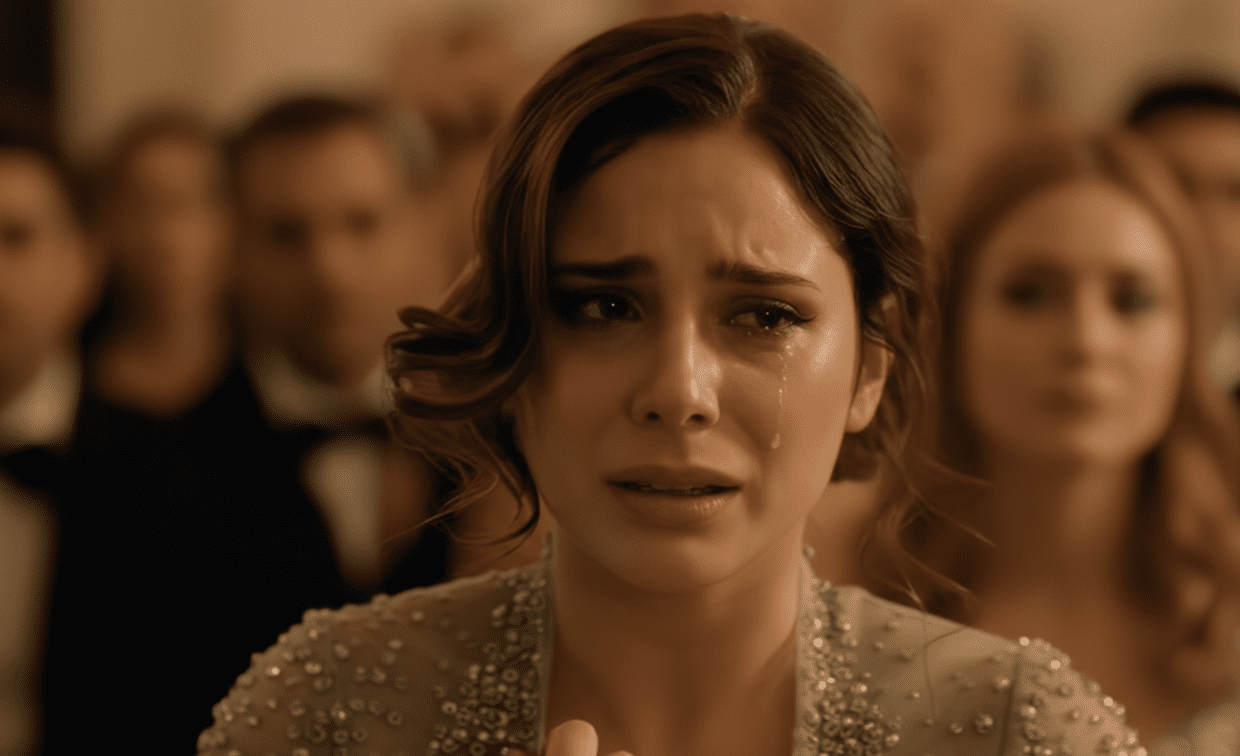
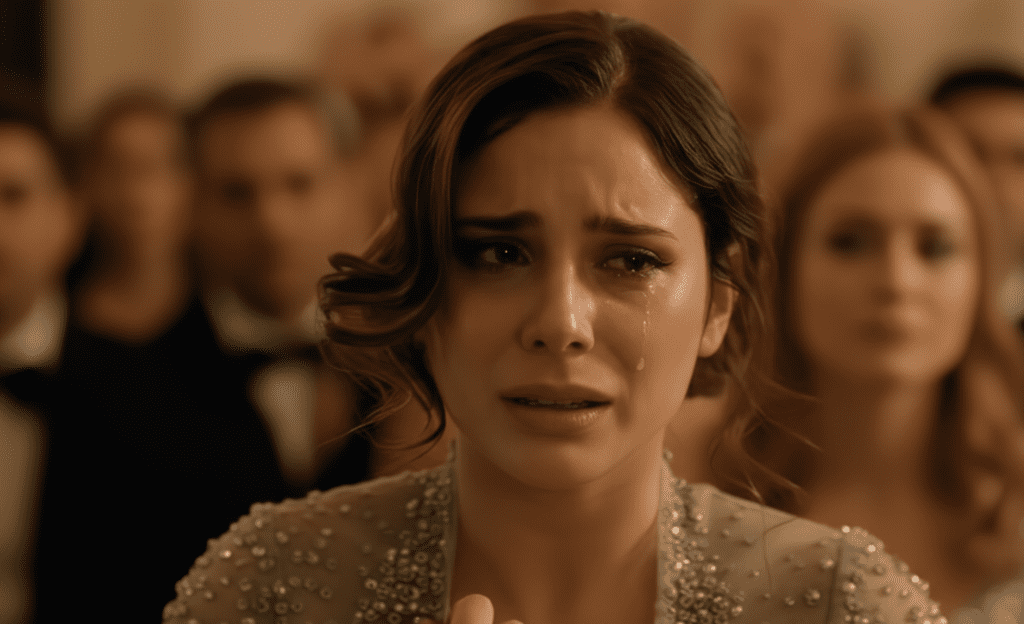
Hands grabbed Mia’s shoulders. Fabric ripped.
“Show everyone who she really is!” Clarissa screamed.
Mia pressed her hands over herself. “Please—” Her voice broke.
Phones rose like a wall. Flashlight glints. A woman near the edge of the crowd hissed, “Is that—?”
Adrian watched from the champagne table, glass steady. He didn’t move.
“Tear that off!” someone shouted. The crowd leaned in, hungry.
Mia staggered back. “Stop. Please,” she pleaded.
A man shoved forward. “She’s a fraud. She deserves this.”
Silence hit when the massive doors banged open. A cold draft cut through the heat.
Alexander Carter filled the frame in a charcoal coat, security flanking him. He scanned one second and then the whole room.
“Enough,” he said.
Clarissa’s face twisted. “Alexander—this is a private matter.”
Alexander’s eyes were flat. “Not anymore.”
“She’s a liar,” Clarissa spat. “She slept with donors, stole donations. We exposed her.”
Mia’s limbs trembled. “I didn’t—”
“Proof,” Alexander said. He lifted a slim tablet from his coat like a judge lifting evidence.
Clarissa laughed. “You have nothing. You were too late, Alexander.”
Alexander tapped the screen. “You told someone to rip her dress and to plant the footage.”
Heads turned. Phones dropped a beat.
“What?” Clarissa’s voice hitched.
“You confessed,” Alexander said. “And you signed it.” He projected a short clip; it played on the hush of a dozen mirrored screens in the room—Clarissa’s voice arranging the setup, her hands folded over cash, her instructions clear.
The crowd shuddered. A man swore. “You set her up.”
Adrian’s face went pale. “This is ridiculous.”
“You took a photo of the ledger,” Alexander continued. “You sent it to your lawyer and demanded hush money. We have the emails, the wire transfers, and the seamstress’s statement.”
“You’re lying,” Clarissa barked. She lunged; security caught her elbow.
“You’re under citizen’s arrest until the police arrive,” Alexander announced.
“You’re not—” Clarissa tried to wrench free.
A woman near the back whispered, “Call the cops.”
Mia’s knees nearly buckled. Alexander closed the space between them and put a hand at the small of her back—not to possess, but to steady.
“Are you okay?” he asked quietly.
Mia let out a laugh that wasn’t a laugh. “I am now.”
Adrian pushed through, voice low and sharp. “Alex, this is theater. You can’t—”
Alexander’s hand moved, fingers finding an email chain on his tablet. He flicked it at Adrian. Receipts, money transfers, a signature.
Adrian’s jaw tightened. “That was for consulting—”
“For a hush fund,” Alexander corrected. “You bought silence.”
A woman shouted, “Get security!”
Clarissa screamed, “You can’t do this to me! I’m a board member!”
“You’re also a thief and an accomplice to assault,” Alexander said. “And that’s not a rumor—it’s evidence.”
Two security men closed in. Someone in the crowd filmed Clarissa yelling as they cuffed her hands behind her back.
“You’re under arrest for conspiracy to commit assault and fraud,” one of the officers read as he arrived, breath steaming in the cold doorway air.
Mia sank into a chair, shoulders wringing with sobs. “They—” She glanced at Adrian. “He knew.”
Adrian’s face crumpled. “Mia, I—”
“You watched,” she said. “You watched me get torn apart.”
“I didn’t—” His voice faltered.
“You stood there with the glass,” she said. “You did nothing.”
Alexander stepped forward. “You will be removed from the board, Adrian. Your contract is terminated. There are witnesses; the board will act.”
Adrian’s mouth opened, closed. He reached for her hand and she pulled away.
“Don’t touch me,” Mia said.
Clarissa was escorted past them, her heels clacking. Cameras tracked her every motion. The crowd that had cheered moments ago murmured and shifted into shame.
A young reporter shoved a microphone out. “Ms. Carter, did you set this up?” she asked, breathless.
Alexander didn’t move. He handed the reporter a copy of Clarissa’s confession and the email chain.
“Sir, is Ms. Reed safe?” someone asked.
“She’s safe now,” Alexander said. “She’s coming with me.”
Mia looked up. “With you?”
“Yes,” he said softly. “You’re not going back out there.”
They walked out a side door where night bit at their faces. The air smelled like rain and the city.
“Do you want to press charges?” Alexander asked as they reached the car.
Mia blinked. “Against everyone.”
“What about Adrian?”
She let out a steadying breath. “Against anyone who helped, yes. Nobody should stand by and let this happen.”
Weeks later, the headlines came. “Board Member Arrested,” “Charity Gala Scandal,” “Carter Produces Smoking-Gun Evidence.” Clarissa’s viral rant was the lead on every channel, captioned by the confession clip Alexander had released to the board and the police.
At the hearing, the seamstress took the stand. “She paid me,” she said. “I thought it was a prank. I didn’t know she’d be stripped.”
“Why did you keep the receipt?” the prosecutor asked.
“I kept everything,” she said. “I was scared. I saved the text messages.”
Texts scrolled across the courtroom screen: instructions, threats, offers. The prosecutor watched the room as the jury read each message.
Clarissa’s attorney tried to spin it into a fight of reputations. “My client has been a charitable force for years—”
“That doesn’t justify assault,” the prosecutor cut in.
Adrian’s deposition was the last blow. He sat, eyes hollow, watching recordings of himself at the gala sipping champagne as Mia cried. The board moved quickly; his company lost two major donors within days and a partner resigned in disgust.
“Did you authorize the payment?” the prosecutor asked.
“No,” he whispered. “I signed it.”
“Who told you to sign?” the prosecutor pushed.
There was a pause as if a record had skipped.
In the civil suit, Mia’s lawyer was precise. “We seek damages for assault, emotional distress, and punitive penalties to deter this kind of orchestrated humiliation.”
The judge read the verdict on a gray afternoon: guilty on multiple counts for Clarissa, fines and restitution ordered, and a criminal sentence that included community service and a restraining order. Adrian was fined, removed from his company, and ordered to undergo counseling and public apology—court documents required.
Mia stood when the bailiff read the restitution amount and the official apology to be published in three newspapers and three online outlets.
“This will change me,” she said later to a reporter.
Alexander watched her, quiet.
“You did what I couldn’t,” she told him.
“You did what you had to do,” he said.
Weeks after, at a small press conference outside the courthouse, Mia spoke to a few gathered cameras, hands folded, eyes steady.
“I want to thank the people who believed me,” she said. “This was not about revenge. It was about accountability.”
People clapped. It wasn’t the roar of a gala crowd—but it was honest.
Clarissa’s name faded from invites and pages. Her social accounts vanished. Adrian’s firm rebuilt under new leadership, his actions a cautionary tale at HR conferences and nonprofit summits. The board rewrote policies about harassment and on-stage conduct, adding clearer protections and mandatory reporting.
Mia used her earnings from the settlement to start a small foundation to support victims of public shaming. “People weaponize humiliation,” she told the first advisory meeting. “We need a place to get help.”
Her first grant went to the seamstress, who had come forward with crucial evidence. “I didn’t know where else to go,” the seamstress said, wiping her eyes.
In the quiet that followed the storm, Mia walked past the old ballroom months later. A private event at dusk, lights warm inside. She paused, not to go in, but to feel the distance she’d crossed.
Adrian sent a letter—short, contrite, with terms he could not change. He wrote, “I am sorry.” The apology appeared in court filings; it could not erase the night, but it was on record.
Clarissa served her sentence, attended the mandated seminars, and after release, was barred from certain nonprofit boards under a legal injunction. The judge’s final remarks were unambiguous: “Public influence does not excuse private cruelty.”
On a clear morning, Mia opened a small envelope from the court: a check for the remainder of the restitution and a note—”Case closed.” She sat down, hands trembling less than before, and let herself breathe.
“You won,” Alexander said when he came to meet her at the small office she rented for the foundation.
“I didn’t win a prize,” she corrected. “I reclaimed my life.”
He smiled, a slow, relieved thing. “Then it’s enough.”
They walked outside. Cameras weren’t waiting. The city moved on. Mia felt something like release—the tight band around her chest uncoiling.
Justice had a cost: nights of testimony, invasive footage, a public reliving of the worst moment. But it also had closure.
When the foundation’s first client stepped into the office months later—a young woman with a jacket tied around her waist and eyes like old sorrow—Mia led her to a chair.
“You don’t have to do this alone,” Mia said.
The woman looked up. “Nobody helped me.”
Mia reached across the table and put a hand over hers. “We will.”
Karma had arrived not as spectacle but as consequence: Clarissa’s conviction, Adrian’s fall, restitution paid, policy changed, and a small foundation that would stand between future cruelty and its victims. Mia watched the young woman smile, tentative and real.
She closed the office door, turned off the old ballroom’s memory, and breathed out for the first time in months. The world had punished the guilty, rebalanced the ledger, and she—at last—felt the weight lift.