


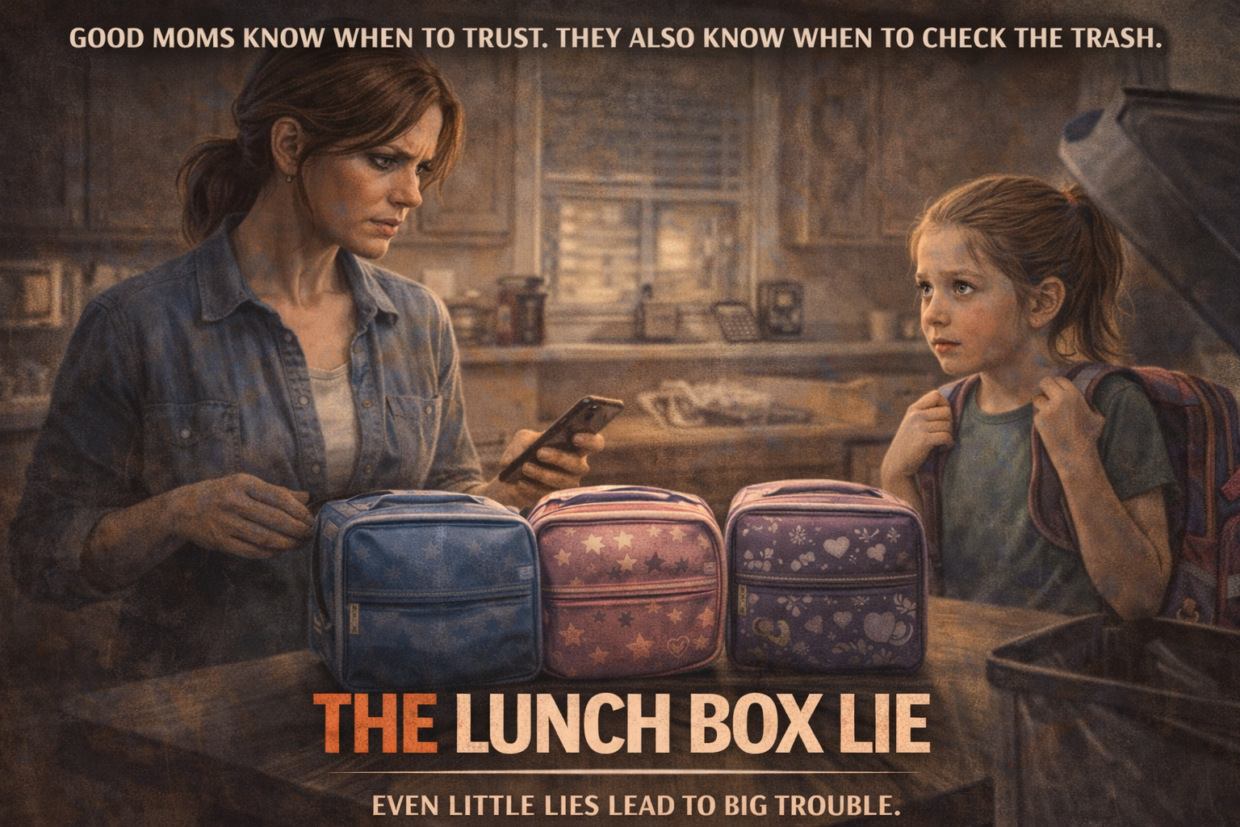
Sarah came home early and found the kitchen trash full of unopened lunch boxes… But Emma had been claiming she ate everything at school.
Sarah pulls into the driveway at 2:30, three hours earlier than usual. The client meeting got cancelled, giving her an unexpected afternoon at home.
She pushes open the front door and sets her purse on the counter. The kitchen feels different somehow.
The trash can lid sits slightly askew. Sarah lifts it and stares down at the contents.
Three lunch boxes rest on top of the garbage, their latches still sealed. The sandwiches inside look exactly as she packed them this morning.
Sarah: What the hell?
She pulls out the top lunch box and opens it. The turkey sandwich sits untouched, the apple still has its sticker, and the crackers remain in their sealed package.
The second lunch box contains yesterday’s ham and cheese, also pristine. The third holds Monday’s tuna salad, now starting to smell.
Sarah sets all three boxes on the counter and stares at them. Emma has been coming home every day talking about lunch, asking for different foods, complaining about being too full for dinner.
The phone rings. Sarah glances at the caller ID and sees the school number.
Sarah: Hello?
Rodriguez: Mrs. Patterson? This is Principal Rodriguez. I wanted to follow up on our conversation about Emma’s improved eating habits.
Sarah: I’m sorry, what conversation?
Rodriguez: Last week when Mrs. Patterson mentioned how well Emma’s been doing with her packed lunches. She’s been eating everything and seems much more focused in afternoon classes.
Sarah looks down at the unopened lunch boxes on her counter.
Sarah: Can you hold on just one moment?
She sets the phone down and opens the kitchen drawer where she keeps lunch supplies. The drawer is full of unused napkins, plastic forks, and juice boxes.
Sarah: I’m back. Can you tell me exactly what Mrs. Patterson said?
Rodriguez: She mentioned Emma always finishes her entire lunch and has been asking for seconds during lunch period. It’s wonderful to see such healthy eating habits.
The front door opens. Emma’s voice carries from the entryway.
Emma: Mom? Why are you home?
Sarah: We’ll continue this conversation later, Principal Rodriguez.
She hangs up and watches Emma walk into the kitchen. Emma’s eyes immediately lock onto the lunch boxes on the counter.
Emma: Oh.
Sarah: Oh is right. Want to explain these?
Emma shifts her backpack to her other shoulder and looks at the floor.
Emma: I can explain.
Sarah: I’m listening.
Emma: I’ve been eating lunch at school. In the cafeteria.
Sarah: With what money?
Emma: I’ve been trading.
Sarah: Trading what?
Emma: My lunch boxes. Other kids want homemade food, so I trade them for cafeteria trays.
Sarah sits down at the kitchen table and gestures for Emma to join her.
Sarah: Why didn’t you just ask me for lunch money?
Emma: Because you always say homemade is healthier and cheaper.
Sarah: So you’ve been throwing away the lunches I make and eating cafeteria food instead?
Emma: Not throwing away. Trading.
Sarah: Emma, I just found three lunch boxes in our trash can. Unopened.
Emma’s face changes. The confident explanation disappears.
Emma: Those are different.
Sarah: Different how?
Emma: Sometimes the trades don’t work out.
Sarah picks up her phone and scrolls to the school contact.
Sarah: I’m calling Mrs. Patterson.
Emma: Mom, please don’t.
Sarah: Why not?
The phone rings twice before someone picks up.
Patterson: Fourth grade classroom, this is Mrs. Patterson.
Sarah: This is Sarah Chen, Emma’s mother. I need to ask you about lunch period.
Patterson: Of course. Emma’s been doing wonderfully. She always finishes everything and seems so satisfied afterward.
Sarah: What exactly does she eat?
Patterson: Her packed lunches, of course. She sits with the same group every day and they all eat their homemade food together.
Sarah looks directly at Emma, who has gone pale.
Sarah: Mrs. Patterson, I’m looking at three unopened lunch boxes right now. They’re the ones I packed for Emma this week.
The line goes quiet for several seconds.
Patterson: I’m sorry, I don’t understand.
Sarah: Emma hasn’t been eating the lunches I pack. They end up in our kitchen trash, still sealed.
Patterson: That’s impossible. I see her eating lunch every day.
Sarah: What does she eat?
Patterson: Her lunch box contents. Sandwiches, fruit, crackers.
Sarah: Can you describe the lunch box?
Patterson: It’s blue with a unicorn pattern.
Sarah looks at Emma’s backpack. She unzips it and pulls out a blue lunch box with unicorns.
Sarah: Mrs. Patterson, I need to know exactly what you see Emma doing during lunch period.
Patterson: She sits at table four with Madison, Tyler, and Josh. She opens her lunch box and eats everything inside.
Sarah: And where does she get this lunch box?
Patterson: She brings it from home every morning.
Emma stands up from the table and walks toward the hallway.
Sarah: Emma, sit back down.
Emma: I need to use the bathroom.
Sarah: Now.
Emma returns to her seat, tears starting to form in her eyes.
Sarah: Mrs. Patterson, I’m going to ask Emma some questions while you’re on the line, if that’s okay.
Patterson: Of course.
Sarah: Emma, where do you get the lunch that Mrs. Patterson sees you eating?
Emma: I pack it myself.
Sarah: When?
Emma: In the morning before school.
Sarah: With what food?
Emma: Food from our kitchen.
Sarah: The same food I use to pack your lunch?
Emma: Yes.
Sarah: So you throw away the lunch I pack and make your own identical lunch?
Emma starts crying.
Emma: It’s not identical.
Sarah: What’s different?
Emma: I don’t put vegetables in mine.
Sarah: Mrs. Patterson, are you hearing this?
Patterson: Yes, and I’m very confused. Emma, honey, can you explain what’s happening?
Emma: I take the lunch Mom makes and I throw it away at home. Then I make a new lunch with just the parts I like.
Sarah: Why?
Emma: Because you always pack carrots and I hate carrots. And you put mustard on the sandwiches and I like them plain.
Sarah: So you’ve been wasting food and lying about it for weeks?
Emma: I wasn’t lying. I do eat lunch at school.
Sarah: You were lying about eating the lunch I made.
Emma: I guess.
Patterson: Emma, this is very concerning behavior. We need to have a conversation about honesty.
Sarah: Mrs. Patterson, I think we need to involve the counselor.
Patterson: I agree. Can you come in tomorrow morning?
Sarah: We’ll be there.
She hangs up and looks at Emma, who is now crying harder.
Sarah: Emma, I need you to understand how serious this is.
Emma: I know.
Sarah: You wasted food, you lied to me, and you made me think there was something wrong with your appetite.
Emma: I’m sorry.
Sarah: Sorry isn’t enough. We’re going to have consequences for this.
Emma: What kind of consequences?
Sarah: First, you’re going to help me calculate how much food you wasted. Then you’re going to pay for it out of your allowance.
Emma: All of it?
Sarah: Every penny. And second, you’re going to pack your own lunch every morning for the next month, with me watching.
Emma: Can I leave out the carrots?
Sarah: We’ll discuss that after you’ve earned back some trust.
The next morning, Sarah and Emma sit in the school counselor’s office. Chen, the counselor, has Emma’s file open on her desk.
Chen: Emma, I want to understand what happened. Can you tell me why you felt you couldn’t talk to your mom about the lunch contents?
Emma: She always says homemade food is better than cafeteria food.
Chen: And you were worried she’d be upset if you asked for changes?
Emma: Yeah.
Chen: Sarah, how do you feel about modifying Emma’s lunches?
Sarah: I had no idea she disliked anything I was packing. If she had just asked, we could have worked it out.
Chen: Emma, what do you think would have happened if you’d told your mom you didn’t like carrots?
Emma: She would have said they’re good for me.
Sarah: I would have found other vegetables you do like.
Emma: Really?
Sarah: Really. There are dozens of vegetables, Emma. We could have tried different ones.
Chen: This seems like a communication issue more than a deception issue.
Sarah: The deception is still a problem.
Chen: Absolutely. Emma, do you understand why throwing away food and lying about it was wrong?
Emma: Yes. It was wasteful and dishonest.
Chen: What could you have done differently?
Emma: Asked Mom to change the things I didn’t like.
Chen: And if she said no?
Emma: Asked her to explain why those foods were important.
Sarah: Emma, I want you to know that I care more about you eating healthy food than about being right about specific vegetables.
Emma: So we can change the lunches?
Sarah: We can negotiate. But no more throwing food away and no more lying.
Emma: Deal.
Chen: I think we have a path forward. Emma, I want you to check in with me once a week for the next month. We’ll talk about how the lunch situation is going and practice communicating about other issues.
Emma: Okay.
Sarah: Thank you, Mrs. Chen.
Chen: Sarah, I recommend having a weekly conversation with Emma about school, friends, and any problems she’s having. Sometimes kids need regular opportunities to bring up issues.
Sarah: That’s a good idea.
They walk out of the counselor’s office together. Emma carries her backpack and a new lunch box they picked out that morning.
Sarah: What did you pack for lunch today?
Emma: Turkey sandwich with no mustard, apple slices, crackers, and cherry tomatoes.
Sarah: You chose cherry tomatoes?
Emma: I like them better than carrots.
Sarah: See? We found a compromise.
Emma: Mom?
Sarah: Yes?
Emma: I’m sorry I wasted all that food.
Sarah: I know you are. And I’m sorry I never asked if you liked everything I was packing.
Emma: Can we make lunch together every morning?
Sarah: For the next month, definitely. After that, we’ll see how you’re doing with honesty and responsibility.
Emma: I’ll do better.
Sarah: I believe you will.
They walk toward the car, and Sarah feels the weight of the past week lifting. The lunch boxes are no longer a mystery, Emma is learning about consequences and communication, and they have a plan moving forward.
The school bell rings in the distance, signaling the start of another day.