



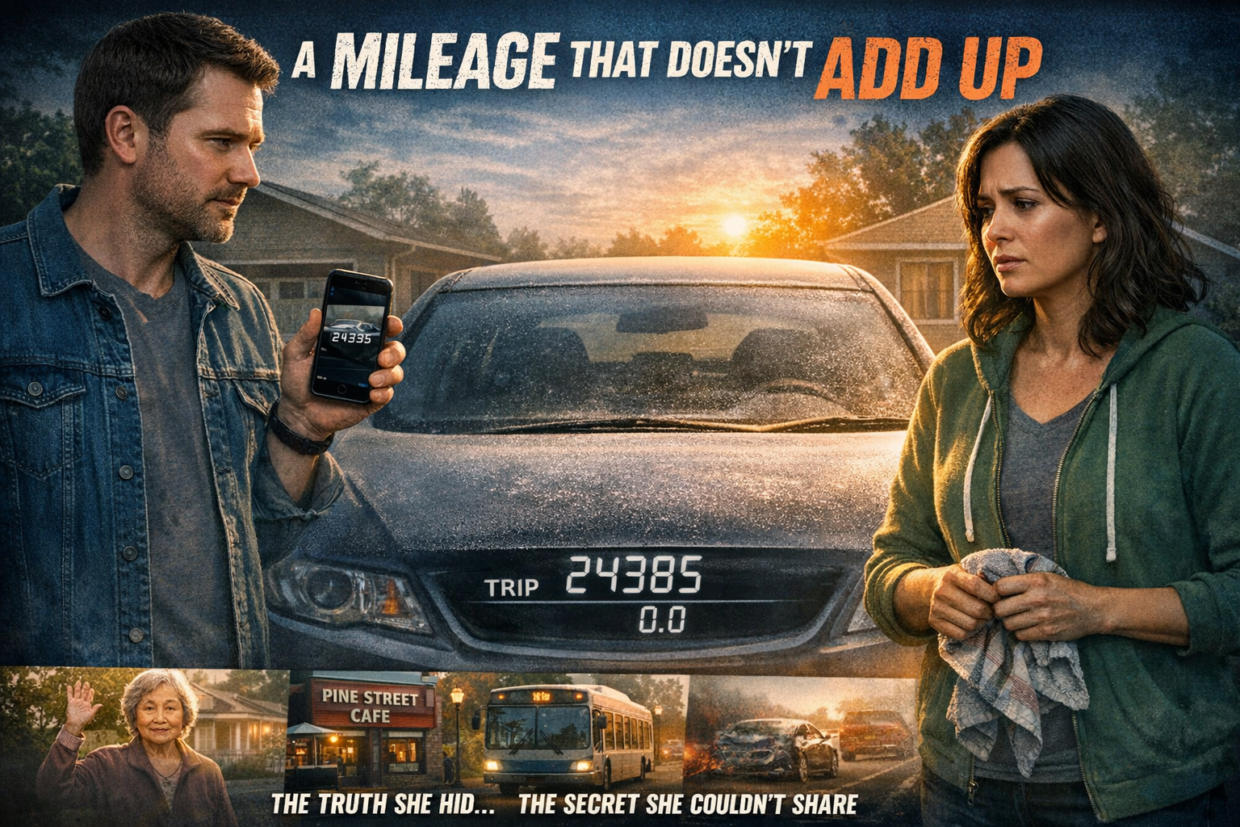
He checked the mileage on Tuesday morning… But the car hadn’t moved in three days.
Marcus checks the digital odometer display through the windshield. The numbers glow back at him: 47,832 miles.
The same reading from three days ago.
He pulls out his phone and scrolls to the photo he took Friday evening. The odometer in the image shows identical digits.
Marcus: Sarah, can you come out here for a minute?
Sarah emerges from the kitchen, dish towel in hand. Her smile appears practiced, automatic.
Sarah: What’s wrong? We need to leave soon.
Marcus: I’ve been tracking something. Look at this.
He shows her the phone screen displaying Friday’s photo, then gestures toward the current odometer reading.
Marcus: Same mileage. Exactly the same.
Sarah: That’s impossible. I drove to the grocery store yesterday, remember? And Monday I had that doctor’s appointment.
The morning sun catches the undisturbed dust layer across the hood. No finger marks, no disturbance patterns.
Marcus: The dust tells a different story.
Sarah: Maybe the odometer is broken. These digital displays malfunction all the time.
Marcus walks around to the driver’s side. The seat position remains exactly as he left it after his last drive.
Marcus: You’re five inches shorter than me. This seat hasn’t moved.
Sarah: I adjust it back when I’m done. You know I’m considerate about that.
The neighbor’s dog starts barking from the adjacent yard. Mrs. Chen waves from her garden.
Mrs. Chen: Good morning! Sarah, I saw you walking past my house again yesterday around ten.
Sarah’s face shifts almost imperceptibly. The practiced smile tightens.
Sarah: Mrs. Chen must be confused. I was driving, not walking.
Marcus: Walking where?
Mrs. Chen: Down toward Pine Street. Same route as always.
The revelation hangs in the air. Sarah’s fingers twist the dish towel into tight spirals.
Marcus: Pine Street is eight blocks away. Why would you walk there if you took the car?
Sarah: She’s an elderly woman. Her memory isn’t reliable.
Marcus opens the driver’s door and examines the pedals. No scuff marks on the rubber, no wear patterns from recent use.
Marcus: These pedals are clean. When did you last actually drive this car?
Sarah: I don’t appreciate this interrogation. What are you implying?
The gas gauge needle points to full. Marcus remembers filling the tank six days ago.
Marcus: Gas prices are four-fifty a gallon. You’ve been complaining about the cost all week.
Sarah: So?
Marcus: So if you’re driving twenty miles a day like you claim, where’s the gas going?
Sarah takes a step back toward the house. Her defensive posture becomes more pronounced.
Sarah: Maybe you didn’t fill it up as much as you thought.
Marcus: I have the receipt. Twelve point three gallons. The math doesn’t work.
The phone in his pocket buzzes. A text notification from their bank app.
Marcus: Transaction alert. Coffee shop on Pine Street. Yesterday, 10:15 AM.
Sarah: I can explain that.
Marcus: You bought coffee eight blocks from here. Mrs. Chen saw you walking. The car never moved.
Sarah: Fine. I walked to get coffee. Is that a crime?
The admission creates a crack in her story. Marcus presses forward with measured calm.
Marcus: What about Monday’s doctor appointment? Tuesday’s grocery run?
Sarah: I walked to those too. The weather was nice.
Marcus: Dr. Peterson’s office is three miles away. The grocery store is two miles.
Sarah: I like walking. It’s good exercise.
The explanation sounds hollow even to her. She shifts weight from foot to foot.
Marcus: You’ve been lying about driving for weeks. Why?
Sarah: It’s not lying. It’s just… I didn’t think you’d understand.
Marcus: Understand what?
The neighbor’s lawn mower starts up, creating background noise that somehow makes the silence between them more intense.
Sarah: I’ve been having panic attacks. When I drive. It started about a month ago.
The truth emerges gradually, like water seeping through a dam.
Marcus: Panic attacks?
Sarah: My hands shake. My vision gets blurry. I pulled over twice and couldn’t continue.
Marcus: Why didn’t you tell me?
Sarah: Because you’d worry. Because you’d want to fix it. Because I thought I could handle it myself.
The morning routine suddenly makes sense. The keys grabbed for show, the complaints about traffic and gas prices, the careful maintenance of normal appearances.
Marcus: So you’ve been walking everywhere?
Sarah: Or taking the bus. Sometimes I call rideshares and have them drop me off down the street.
Marcus: The bank transactions show purchases all over town.
Sarah: I know. I’ve been trying to keep everything normal. Keep the same schedule, same places.
The weight of sustained deception becomes visible in her posture. Shoulders sagging, the dish towel hanging limp in her hands.
Marcus: This must have been exhausting.
Sarah: I wake up at five-thirty now instead of seven. Walking takes so much longer.
Marcus: And you’ve been doing this alone for a month?
Sarah: I made an appointment with Dr. Peterson. That’s where I walked on Monday.
The pieces align into a picture of someone struggling privately with a condition that stripped away independence.
Marcus: What did she say?
Sarah: Anxiety disorder. Probably triggered by that accident we saw on Highway 9.
Marcus: The one with the overturned truck?
Sarah: I keep seeing it when I’m behind the wheel. My heart rate spikes and I can’t breathe properly.
The clinical explanation provides context for weeks of mysterious behavior.
Marcus: There are treatments for this.
Sarah: She prescribed medication and referred me to a therapist. I have an appointment Thursday.
Marcus: You were going to walk three miles to therapy?
Sarah: I researched the bus routes. There’s a transfer downtown, but it’s manageable.
The elaborate workarounds demonstrate both determination and the depth of her struggle.
Marcus: We could have figured this out together.
Sarah: I know that now. But admitting I couldn’t drive felt like admitting I was broken.
Marcus: You’re not broken. You’re dealing with trauma.
Sarah: The independence was important to me. Being able to go where I needed, when I needed.
The conversation shifts from interrogation to understanding. Marcus moves closer, reducing the physical distance between them.
Marcus: What can I do to help?
Sarah: Maybe drive me to appointments until the medication works? Dr. Peterson said it takes four to six weeks.
Marcus: Of course. What else?
Sarah: Don’t make me feel guilty for not telling you sooner.
The request carries the weight of someone who has been carrying a burden alone.
Marcus: I’m not angry about the condition. I’m concerned about you handling this by yourself.
Sarah: I thought I was protecting you from worry.
Marcus: Partnerships work better with shared information.
The morning sun has shifted, casting different shadows across the driveway. The undisturbed car sits as evidence of a month of hidden struggle.
Sarah: I’ll return the bus passes and rideshare credits to our joint account.
Marcus: Keep them as backup options. Recovery isn’t always linear.
Sarah: Dr. Peterson mentioned support groups for people with driving anxiety.
Marcus: That sounds helpful.
Sarah: There’s one that meets Tuesday evenings at the community center.
The path forward begins to take shape through practical steps and professional guidance.
Marcus: I’ll adjust my work schedule to handle transportation needs.
Sarah: Thank you for not making this about trust or deception.
Marcus: It’s about health and healing. The rest we can work through.
The crisis resolves not through confrontation but through understanding and practical support.