

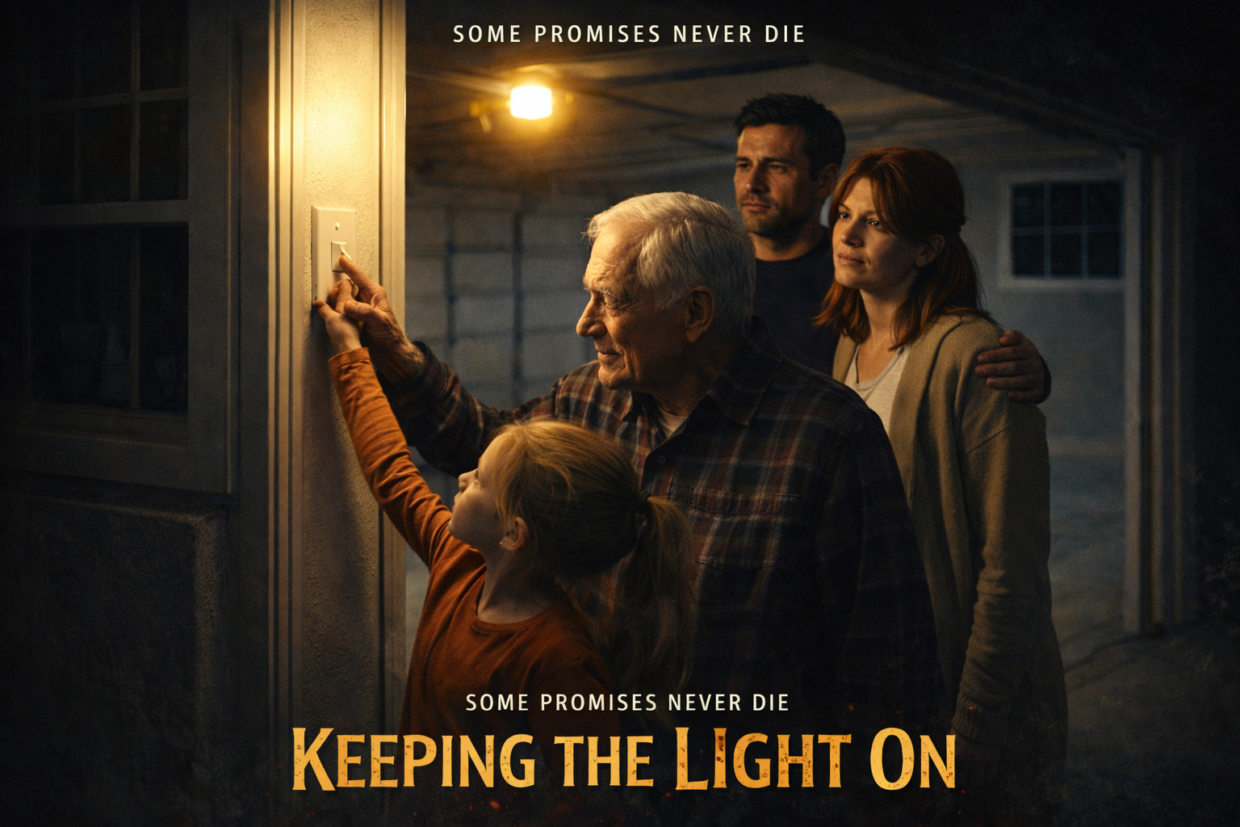
Grandpa flips the garage light on at 9:47 PM every single night… But the garage has been empty for three years.
The kitchen clock reads 9:46 PM when Grandpa pushes back from the dinner table.
His chair scrapes against the linoleum with the same sound it makes every night. The family continues their conversation about Emma’s upcoming school play, but their eyes track his movement.
Grandpa walks toward the side door that leads to the garage.
Sarah sets down her fork and watches her father-in-law’s familiar shuffle. Three years of this exact routine, and she still doesn’t understand it.
The door handle turns with a soft click.
Emma: Why does Great-Grandpa always go out there?
David: He just likes to check on things, sweetheart.
Sarah: There’s nothing to check on. The garage is empty.
The overhead light in the garage flickers to life through the small window. Yellow light spills across the empty concrete floor where David’s old Honda used to sit.
Grandpa stands in the doorway for exactly thirty seconds.
His silhouette remains perfectly still against the bright backdrop. The family can see him through the kitchen window, but his face stays hidden in shadow.
The light stays on for another minute before clicking off.
Emma: Can I ask him about it?
Sarah: Honey, we’ve all asked. He just changes the subject.
David: Maybe it’s just habit. You know how older people get set in their routines.
The side door opens and Grandpa returns to his seat. He picks up his coffee cup like nothing happened.
Grandpa: Emma, tell me more about this play you’re in.
Emma: Great-Grandpa, why do you turn on the garage light every night?
The coffee cup freezes halfway to his lips. His hand trembles slightly, causing ripples across the dark surface.
Grandpa: Just checking that everything’s secure out there.
Emma: But there’s nothing in the garage anymore.
Sarah: Emma, finish your vegetables.
David: Dad, you know you don’t have to do that every night. We have the security system now.
Grandpa sets down his cup without taking a sip. His weathered hands fold together on the table.
Grandpa: Some things are more important than security systems.
The kitchen falls quiet except for the hum of the refrigerator. Emma pushes peas around her plate while the adults exchange glances.
Sarah: Is this about Michael?
The question hangs in the air like smoke. Grandpa’s jaw tightens, and he stares at the salt shaker in the center of the table.
Grandpa: Michael’s been gone three years. This has nothing to do with him.
David: Dad, Michael used to park in that garage when he lived here.
Emma: Who’s Michael?
Sarah: Michael was your uncle, sweetie. Daddy’s brother.
The explanation comes out gentle but strained. Emma nods like she’s heard this before but never quite understood the weight of it.
Grandpa: Michael worked late shifts at the hospital. Emergency room nurse.
His voice carries a different tone now, softer but more deliberate. The family leans in slightly, sensing a crack in his usual deflection.
Grandpa: He’d come home at all hours. Sometimes 2 AM, sometimes later.
David: I remember. He was always exhausted.
Grandpa: The boy would pull into that garage, and I’d hear his car door slam. But he never came straight inside.
Sarah reaches across the table and covers Grandpa’s folded hands with her own. His fingers feel cold despite the warm evening.
Grandpa: He’d sit in that car for ten, fifteen minutes sometimes. Just decompressing from whatever he’d seen that night.
Emma: Was he sad?
Grandpa: He was tired, sweetheart. The kind of tired that sleep doesn’t fix.
The kitchen clock ticks toward 10 PM. Outside, streetlights cast long shadows across the empty driveway.
Grandpa: I started leaving the porch light on so he’d know someone was awake. That he wasn’t coming home to a dark, empty house.
David: You never told us that.
Grandpa: Didn’t seem important to mention. It was just something I did.
Sarah: But the porch light burned out months ago. You’ve been using the garage light instead.
The admission settles over the table like a heavy blanket. Grandpa’s eyes remain fixed on his hands.
Grandpa: The garage light is brighter. Covers more of the driveway.
Emma: But Uncle Michael isn’t coming home anymore.
The simple truth from an eleven-year-old cuts through years of unspoken grief. Grandpa’s shoulders sag slightly.
Grandpa: No, sweetheart. He’s not.
David: Dad, Michael died in that car accident three years ago. You know that.
Grandpa: I know exactly when my son died. I know exactly how many days it’s been.
His voice carries an edge now, defensive but not angry. More like someone protecting something precious and fragile.
Sarah: Then why do you keep turning on the light?
The question everyone has wanted to ask finally gets spoken aloud. Grandpa lifts his coffee cup again, but his hands shake too much to drink.
Grandpa: Because what if he comes home and the house is dark?
Emma: Great-Grandpa, people can’t come back after they die.
Grandpa: I know that, Emma. I’m not confused about death.
David: Then help us understand.
The refrigerator cycles off, leaving the kitchen in deeper quiet. Grandpa sets down his cup and looks directly at his daughter-in-law for the first time all evening.
Grandpa: For thirty-two years, I left a light on for that boy. Every single night he worked late.
Sarah: That’s beautiful, but—
Grandpa: Let me finish. Thirty-two years of making sure he never came home to darkness. And then one night, I forgot.
The confession comes out barely above a whisper. David’s fork clatters against his plate.
David: Dad, you didn’t forget the night Michael died.
Grandpa: March fifteenth. I fell asleep watching the news. Woke up at 3 AM and realized the porch light was off.
Sarah: Michael died on March sixteenth, not the fifteenth.
Grandpa: He died at 1:47 AM on the sixteenth. But he was driving home from work on the fifteenth.
The timeline clicks into place with horrible clarity. Emma looks between the adults, sensing the weight of something she doesn’t fully grasp.
Grandpa: The last night my son drove home from the hospital, the house was dark.
David: Dad, the accident wasn’t your fault. A drunk driver ran a red light.
Grandpa: I know what caused the accident. But I also know I broke a thirty-two-year promise.
Sarah: You couldn’t have known it would be his last shift.
Grandpa: That’s exactly why I should have kept the light on.
The kitchen clock chimes 10 PM. Through the window, they can see neighbors’ houses settling into their evening routines.
Emma: So you turn on the garage light every night now?
Grandpa: At 9:47. That’s when Michael’s shift ended at the hospital.
David: Dad, this isn’t healthy. Michael’s gone.
Grandpa: I’m not trying to bring him back. I’m trying to keep a promise I should never have broken.
Sarah: What promise?
Grandpa: That no matter how late, no matter how tired, no matter what kind of day he’d had—he’d never come home to darkness.
The explanation hangs in the air like a prayer. Emma slides off her chair and walks around the table to her great-grandfather.
Emma: Can I help you turn on the light tomorrow night?
Grandpa looks down at his great-granddaughter with surprise. Her small hand rests on his arm.
Grandpa: It’s not a game, sweetheart.
Emma: I know. It’s a promise.
David: Emma, you don’t understand—
Emma: Great-Grandpa made a promise to keep the light on. Promises are important.
Sarah wipes her eyes with her napkin. The simple logic of a child cuts through adult complications.
Grandpa: It would mean a lot to have help with such an important job.
Emma: What time do we turn it on?
Grandpa: 9:47 PM. Every night. No matter what.
David: Dad, I don’t think encouraging this is—
Sarah: David, stop.
Her voice carries quiet authority. David looks at his wife, then at his daughter holding his father’s hand.
Sarah: Maybe some promises are worth keeping, even when they seem impossible.
Grandpa: Michael always said the emergency room taught him that people need to know someone’s waiting for them.
Emma: So we wait with the light on?
Grandpa: We wait with the light on.
The next evening at 9:46 PM, three generations walk toward the garage door together.
Emma’s small hand reaches for the light switch alongside her great-grandfather’s weathered fingers. The garage fills with warm yellow light.
David: How long do we leave it on?
Grandpa: Until we’re sure anyone coming home knows they’re not alone.
Sarah: And how long is that?
Grandpa: As long as it takes.
They stand together in the illuminated garage, three generations keeping a promise to someone who will never come home. But for the first time in three years, Grandpa doesn’t stand alone in the light.
Emma: Great-Grandpa, I think Uncle Michael knows we’re waiting.
Grandpa: I think you’re right, sweetheart.
The light stays on for five minutes instead of one. When they finally turn it off and return to the house, the ritual has changed from solitary grief to shared remembrance.
David: Dad, thank you for telling us about the light.
Grandpa: Thank you for understanding why it matters.
Sarah: Tomorrow night, we’ll all be here at 9:47.
Emma: It’s our promise now.
The kitchen settles back into its evening rhythm, but something fundamental has shifted. The mysterious nightly routine has become a family tradition, transforming private sorrow into collective love.
Grandpa: Michael would like knowing the light’s not just for him anymore.
Emma: Who else is it for?
Grandpa: Anyone who needs to know someone’s waiting for them to come home.
The clock approaches 10 PM, but nobody moves to clear the dinner dishes. They sit together in the warm kitchen light, planning tomorrow’s promise.
Sarah: 9:47 PM sharp.
David: Every night.
Emma: No matter what.
Grandpa: No matter what.
Outside, the empty garage sits in darkness, but inside the house, four people have found a way to transform loss into love, mystery into meaning, and solitude into solidarity.