




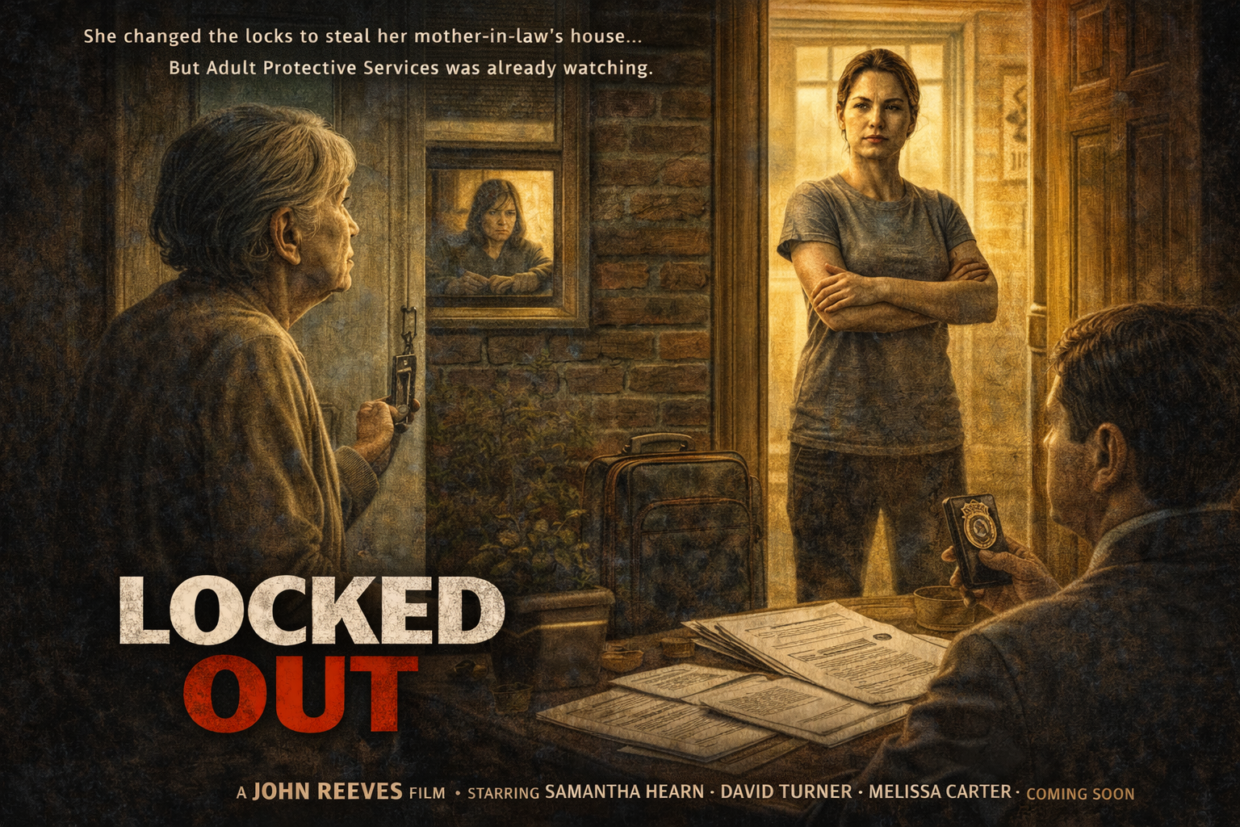
She changed the locks to steal her mother-in-law’s house… But Adult Protective Services was already watching.
Margaret fumbled with her key at the front door, confusion creasing her weathered face. The lock wouldn’t turn.
“That’s strange,” she murmured, checking the address. This was definitely her house—the one she’d lived in for thirty-seven years.
Across the street, Mrs. Chen watched from her window. She’d seen Brittany, Margaret’s daughter-in-law, calling a locksmith that morning while Margaret was at Bible study.
“Harold,” Mrs. Chen called to her husband. “Call that number I gave you. Something’s not right.”
Margaret tried her key again, then noticed the deadbolt had been changed too. Her heart sank as she realized what had happened.
The front door opened. Brittany stood there, arms crossed, blocking the entrance.
“What are you doing here?” Brittany demanded.
“I live here,” Margaret said quietly. “This is my house.”
“Not anymore. David and I discussed it. You’re too old to live alone. We found you a nice nursing home.”
Margaret’s hands shook. “David agreed to this?”
“He’ll understand once you’re settled. I already packed your things.” Brittany gestured to two suitcases on the porch.
“You can’t do this. I own this house.”
Brittany smirked. “Actually, you don’t. I had David sign some papers last month. Power of attorney. Very convenient when someone’s getting… forgetful.”
Margaret stepped back, stunned. “I’m not forgetful. And David would never—”
“David does what I tell him.” Brittany started closing the door. “The cab’s coming at six. Don’t make this harder than it needs to be.”
Twenty minutes later, a white sedan pulled up. But instead of a taxi, two people in business attire stepped out.
“Mrs. Margaret Henley?” The woman showed her badge. “I’m Sarah Martinez from Adult Protective Services. We received several calls about a possible elder abuse situation.”
Brittany appeared in the doorway, face pale. “There’s been a mistake.”
“Ma’am, I need to see some identification and documentation showing your authority to remove Mrs. Henley from her residence.”
“I… I have power of attorney.”
“May I see it?”
Brittany hesitated. “It’s… David has it at work.”
The APS investigator turned to Margaret. “Mrs. Henley, did you voluntarily give your daughter-in-law power of attorney?”
“No. I would never do that.”
“Ma’am,” Sarah addressed Brittany, “I need you to step aside. We’re conducting a welfare check.”
“You can’t just—”
“Actually, we can.” Sarah’s partner, Detective Morrison, stepped forward. “We also have questions about some unusual bank withdrawals from Mrs. Henley’s accounts.”
Brittany’s face went white. “I don’t know what you’re talking about.”
“Seventeen thousand dollars in the past two months. All withdrawn by someone claiming to be Mrs. Henley’s caregiver.”
Margaret gasped. “My savings account?”
“The bank has security footage,” Detective Morrison continued. “Very clear images.”
A car screeched into the driveway. David jumped out, still in his work clothes.
“Mom! Mrs. Chen called me. She said—” He stopped, seeing the official badges. “What’s going on?”
“Your wife locked your mother out of her own house,” Sarah explained. “And there’s evidence of financial exploitation.”
David stared at Brittany. “You said Mom agreed to move to assisted living.”
“She did! She’s confused, David. You know how she gets.”
“I’m not confused,” Margaret said firmly. “I never agreed to anything. And I certainly didn’t give her access to my bank account.”
David’s face hardened. “Brittany, what bank account?”
“The joint account we opened for emergencies—”
“What joint account?” Margaret interrupted. “I never opened any joint account with you.”
Detective Morrison held up his phone. “We have the forged signature on file. Bank fraud is a felony.”
Brittany backed toward the door. “This is ridiculous. David, tell them—”
“Tell them what?” David’s voice was ice cold. “That my wife forged my mother’s signature? That she stole seventeen thousand dollars? That she changed the locks on Mom’s house while she was at church?”
“David, please—”
“Give me Mom’s key. Right now.”
Brittany’s hands shook as she pulled the key from her pocket.
David unlocked the door and held it open for his mother. “Mom, I’m so sorry. I had no idea.”
Margaret walked past Brittany without a word.
“Mrs. Patterson,” Sarah said, “you’re under arrest for elder abuse and bank fraud.”
As the handcuffs clicked, Brittany looked desperately at David. “You can’t let them do this! We’re married!”
David was already on his phone. “Hello? I need to speak with a divorce attorney.”
Six months later, Margaret sat in her garden, reading a letter from her lawyer. The house was officially back in her name. The stolen money had been recovered with interest. And David visited every Sunday, just like before.
Mrs. Chen waved from across the street. Margaret waved back, grateful for neighbors who cared enough to act when something wasn’t right.
Some people learned the hard way that you don’t mess with grandma.
Six Months Later — The Reality
The handcuffs had looked decisive. Final, even. But that was before Margaret understood how the legal system actually worked.
Brittany was released on bail by nine o’clock that same night.
David sat at his mother’s kitchen table the next morning, hollow-eyed, coffee going cold in front of him. He hadn’t slept. The divorce attorney he’d called from the driveway had left a voicemail explaining that, actually, you couldn’t file papers quite that fast. There were processes. Forms. Waiting periods.
“She’s back home,” he said quietly. “Our home. I’m the one sleeping in a hotel.”
Margaret set a plate of toast in front of him without comment. She’d learned long ago that some pain needed to be fed before it could be spoken.
“The detective called,” she said, sitting across from him. “They’re saying the case could take eighteen months. Maybe two years.”
David looked up. “Two years?”
“Forged documents have to be verified by experts. The bank footage needs to be authenticated. And Brittany’s already hired a lawyer who’s claiming I had early-stage dementia when the joint account was opened — that I simply don’t remember agreeing to it.”
David’s jaw tightened. “That’s insane. You’re sharp as a tack.”
“I know that. You know that.” Margaret folded her hands on the table. “But now I have to prove it to a judge. My doctor is preparing documentation. I’ll likely need a cognitive evaluation.”
The word hung between them uncomfortably.
“Mom, I’m sorry. I should have seen what she was doing.”
“Maybe,” Margaret said, not unkindly. “But Brittany is clever. She didn’t become this person overnight, David. I need you to think about that.”
He stared at his coffee.
The truth was harder than the driveway moment had suggested. In the weeks that followed, David found himself cycling through anger, grief, and something uncomfortably close to doubt. He and Brittany had been married for nine years. There had been good years — genuinely good ones. He kept turning them over in his mind, looking for the lie hidden inside them, and not always finding it clearly.
Brittany’s lawyer was skilled. He reframed everything. The nursing home wasn’t exploitation — it was concern. The bank account wasn’t fraud — it was a misunderstanding between family members. The changed locks weren’t abuse — they were a safety measure for a woman living alone.
None of it was true. But it was all plausible enough to slow things down.
Eight Months In
The cognitive evaluation came back clean, which should have felt like a victory. Margaret sat in her living room reading the results and felt mostly tired.
Mrs. Chen brought over dumplings. She didn’t ask questions, which Margaret appreciated more than she could say.
David had moved into a small apartment. The divorce was proceeding, but slowly — assets tangled, accounts frozen, lawyers writing letters to other lawyers. He visited on Sundays, like always, but sometimes he arrived distracted and left early, and Margaret could see the weight of it on him.
One evening he admitted something he’d been holding for months.
“I found old messages on a shared tablet,” he said. “From before all this. Brittany was talking to someone — a friend — about how she’d ‘handle the house situation’ when the time came.” He paused. “It was from three years ago, Mom. She’d been planning this.”
Margaret was quiet for a long moment. “I know.”
“You knew?”
“I suspected. Small things. The way she’d ask about the deed. Questions about whether I’d updated my will.” She looked at her hands. “I told myself I was being uncharitable.”
They sat with that for a while.
“The money,” David said eventually. “Even if they convict her — the detective said recovering all of it isn’t guaranteed. Some of it’s already gone.”
“I know that too.”
“And you’re okay?”
Margaret considered the question seriously, the way it deserved. “I’m not okay in the way the story should end,” she said. “But I’m okay in the way real life ends things. Slowly. Imperfectly.” She looked out at her garden. “I still have the house. I still have you. Mrs. Chen still waves at me every morning.”
She paused.
“That’s enough to keep going on.”
Fourteen Months After the Arrest
Brittany pleaded guilty to a reduced charge — one count of financial exploitation, the forgery charge dropped in a plea deal that made Detective Morrison visibly frustrated when he called to explain it.
Margaret received restitution for eleven thousand of the seventeen. The remaining six were, legally speaking, complicated.
She planted roses where she’d always meant to and never gotten around to it.
David’s divorce was finalized on a Tuesday. He didn’t celebrate. He took his mother to lunch instead, and they talked about his father, who’d been gone twelve years, and about the trip to Portugal they’d always said they’d take someday.
“We should actually go,” David said.
Margaret smiled. “We should actually go.”
It wasn’t the clean ending of the original story. No handcuffs clicking with perfect justice, no savings fully restored with interest. But it was honest, and it was theirs, and some mornings that felt like more than enough.