


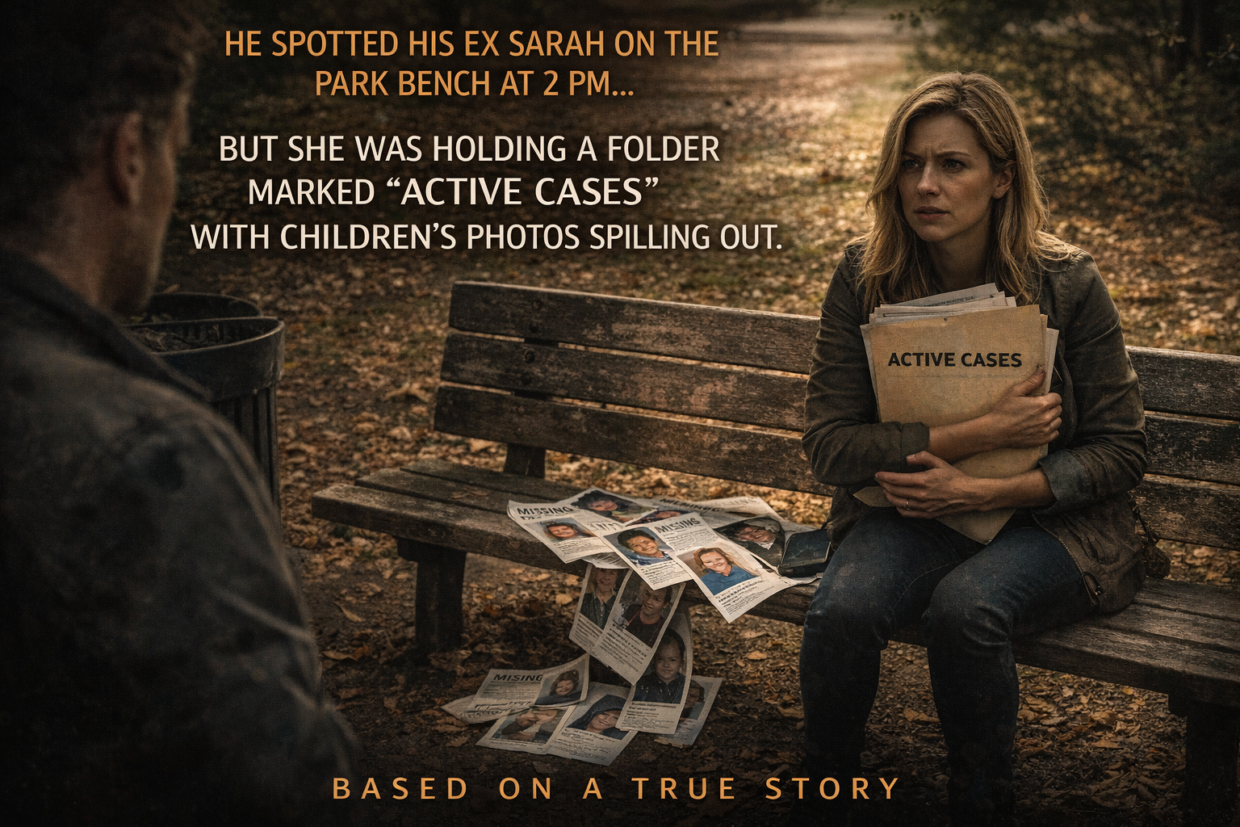
He spotted his ex Sarah on the park bench at 2 PM… But she was holding a folder marked “ACTIVE CASES” with children’s photos spilling out.
John spotted the familiar blonde hair from across the park. Sarah sat alone on the bench where they used to meet for lunch dates, but something felt wrong about the scene.
She held a manila folder against her chest, and papers kept sliding out despite her efforts to contain them. Even from fifty feet away, he could see photographs scattered on the ground around her feet.
John: Sarah? What are you doing here?
She looked up sharply, shoving the folder behind her back. But it was too late. He’d already seen the word “MISSING” printed in bold letters across multiple flyers.
Sarah: John, you can’t be here right now.
John: Can’t be here? This is where we used to eat lunch every Tuesday. You disappeared six months ago without a word, and now you’re telling me I can’t be in a public park?
The folder slipped from her grip. Dozens of photographs scattered across the bench and onto the grass. Children’s faces stared up from professional school portraits, each paired with vital statistics and last known locations.
John bent down to help gather the papers. The dates were recent – some from last week. The locations spanned three different counties, all within driving distance.
Sarah: Don’t touch those. Please.
John: These are missing children reports. Why do you have so many? Are you working for the police now?
Sarah: It’s complicated.
A black sedan pulled up to the curb. The driver remained behind tinted windows, but Sarah glanced toward the car with obvious recognition.
John: Who is that?
Sarah: Someone who’s been helping me with a situation.
John: What situation? You vanished from my life without explanation. Your apartment was cleaned out. Your phone went straight to voicemail for months. Now you’re sitting here with missing children files like some kind of detective.
The car door opened. A woman in a dark suit approached their bench, speaking into a small radio device.
Williams: Sarah, we need to move. The location’s been compromised.
John: Compromised? What the hell is going on?
Sarah stood quickly, gathering the remaining photographs. Her hands shook as she tried to organize the papers back into some kind of order.
Sarah: John, I can’t explain everything right now, but you need to trust me. And you need to stay away from me for your own safety.
John: My safety? Sarah, we dated for two years. You know everything about me. How could I possibly be in danger?
Williams: Ma’am, we really need to go.
The woman in the suit kept scanning the park perimeter. Her jacket was open just enough to reveal a shoulder holster.
John: You’re carrying a gun. You’re both carrying guns.
Sarah: John, please. Just forget you saw me here.
John: Forget? You’re carrying federal case files about missing children. There’s an armed agent telling you the location is compromised. I’m not forgetting anything until someone explains what’s happening.
A second vehicle arrived – a white van with government plates. Two more agents stepped out, positioning themselves at different angles around the bench.
Williams: Sarah, decision time.
Sarah looked between John and the agents. Her face showed the strain of months of pressure.
Sarah: He’s not supposed to know about any of this.
Williams: Well, he knows now. We can bring him in for debriefing, or we can relocate you immediately and hope he keeps quiet.
John: Debriefing? Relocate? Sarah, are you in witness protection?
Sarah: Not exactly. I’m working with a task force that investigates child trafficking networks. The man I was dating before you – Marcus – he wasn’t who I thought he was.
The pieces started connecting in John’s mind. Marcus had been Sarah’s previous relationship, the one she’d ended abruptly before they started dating.
John: Marcus was involved in trafficking?
Sarah: Marcus was running a network. When I found out, I went to the FBI instead of confronting him directly. They asked me to help build a case.
Williams: Which meant disappearing from your normal life to avoid suspicion.
John: So our entire relationship was part of some undercover operation?
Sarah: No. Meeting you was real. Falling for you was real. But when the investigation intensified, I had to choose between keeping you safe and staying close to you.
One of the agents from the van approached with a tablet computer. The screen showed surveillance footage of John’s apartment building.
Agent: Ma’am, we’ve got movement at his residence. Two vehicles, unknown occupants.
John: My apartment? Why would anyone be watching my apartment?
Williams: Because you were Sarah’s boyfriend. Marcus’s people have been tracking everyone in her life, looking for leverage.
Sarah: This is exactly what I was trying to prevent.
John: How long has this been going on?
Sarah: The investigation started eight months ago. I’ve been working with the task force for six months, since I officially disappeared from your life.
John: And you never thought to tell me I might be in danger?
Williams: We’ve had surveillance on you the entire time. You were never actually at risk until today.
The agent with the tablet looked up from his screen with obvious concern.
Agent: The vehicles at his building just moved to the parking garage. We need to assume they’re preparing for contact.
John: Contact? What kind of contact?
Sarah: The kind where they try to use you to get to me.
Williams: Which is why we’re leaving. Now.
Sarah gathered the last of the case files and stood to follow the agents toward their vehicles.
John: Wait. You can’t just walk away again. Not after explaining all this.
Sarah: John, if you come with us, your normal life is over. If you stay here, you’ll be questioned by people who won’t be as polite as we are.
John: What if I don’t want my normal life? What if I want to help?
Williams: Civilians don’t help with operations like this.
John: But I’m already involved. You said they’re watching my apartment. They know who I am.
Sarah stopped walking and turned back toward him. The conflict was clear on her face.
Sarah: The network we’re investigating has connections in law enforcement, social services, and private security. They’ve been operating for years without detection.
John: How many children?
Sarah: Over forty confirmed cases in the past two years. Probably more we haven’t found yet.
The radio on Williams’ belt crackled with static and urgent voices.
Williams: Base, this is Williams. We have a civilian exposure situation at the park location.
Voice on radio: Copy, Williams. What’s your assessment?
Williams: Subject’s former boyfriend. He’s seen the case files and knows about the operation. Recommend immediate extraction for all parties.
John: I’m not going anywhere until someone explains how I can help.
Sarah: John, you can help by staying alive and staying away from this.
John: These are children, Sarah. If there’s something I can do to help find them or stop whoever took them, then that’s what I’m going to do.
Williams looked at Sarah, then at John, then spoke into her radio again.
Williams: Base, civilian is requesting involvement. He has potential value as someone Marcus’s people might approach for information.
Voice on radio: Negative on civilian involvement. Extract all parties to safe location for full debriefing.
The agents began moving toward their vehicles with clear urgency. Sarah hesitated, looking back at John one more time.
Sarah: If you come with us now, everything changes. Your job, your apartment, your family relationships. Everything.
John: It already changed six months ago when you disappeared. I just didn’t know why.
Williams: Thirty seconds, people.
John walked toward the van where the agents were waiting. Sarah fell into step beside him.
Sarah: There’s something else you need to know about Marcus.
John: What?
Sarah: He knows about you. He’s known about you since we started dating. The investigation team thinks he might have been planning to use you as leverage against me from the beginning.
The van doors opened. John could see computer equipment and communication devices mounted inside.
John: Use me how?
Williams: Get in the vehicle first. We’ll explain everything once we’re secure.
John climbed into the van, followed by Sarah and the other agents. As they pulled away from the park, he watched his normal life disappear through the rear window.
Williams: The trafficking network operates by identifying vulnerable families and children, then using a combination of manipulation and force to remove children from their homes.
Sarah: Marcus was responsible for the recruitment side. He would identify targets and coordinate the initial contact.
John: How did you find out what he was doing?
Sarah: I found files on his computer when I was using it to check my email. At first, I thought they might be legitimate social work cases. But the details were wrong.
Williams: What kind of details?
Sarah: Home addresses that didn’t match the family names. School records that had been altered. Financial information that suggested the families were being paid for something.
The van turned onto a highway heading out of the city. John realized he had no idea where they were taking him.
John: Where are we going?
Williams: Safe house about an hour from here. We’ll do a full debriefing and assess your situation.
John: My situation?
Sarah: Whether Marcus’s people have been watching you, whether you’ve noticed anything unusual in the past few months, whether you have information that could help the investigation.
John: What kind of information?
Sarah: Did Marcus ever ask you questions about your work, your schedule, your family?
John thought back to the few times he’d met Marcus, usually when Sarah was transitioning between relationships.
John: He asked about my job a few times. And he wanted to know if I had any siblings with children.
Williams and Sarah exchanged glances.
Williams: What did you tell him?
John: That I work in database management for the county school system. And that my sister has two kids in elementary school.
The van went silent except for the sound of highway traffic.
Sarah: John, your job gives you access to student records across the entire county.
John: So?
Williams: So Marcus’s network would need exactly that kind of access to identify potential targets and track their movements.
The realization hit John like physical force. Marcus hadn’t been making casual conversation. He’d been evaluating John as a potential asset.
John: You think he was planning to recruit me?
Sarah: Or use you without your knowledge. Someone with your database access could provide information about vulnerable families without ever realizing what the information was being used for.
Williams: Have you noticed any unusual requests for information at work? Any new procedures or system changes?
John: Actually, yes. About three months ago, we got new software that tracks student attendance patterns and family contact information. It flags cases where children have irregular pickup schedules or emergency contact changes.
Sarah: That’s exactly the kind of information trafficking networks use to identify targets.
The van exited the highway and turned onto a rural road. John could see a large house surrounded by security fencing in the distance.
Williams: John, we need you to think carefully about everyone who has had access to your work computer or asked you questions about the new system.
John: There have been several people. IT support, supervisors, even some social workers who said they needed data for case management.
Sarah: Did any of them give you specific names or addresses to look up?
John: Yes. I ran reports for about a dozen families over the past two months. I assumed it was routine welfare checks.
Williams spoke into her radio as the van approached the security gate.
Williams: Base, we have a priority situation. The civilian has been unknowingly providing target information to the network for months.
Voice on radio: Copy. Prepare for immediate tactical briefing upon arrival.
The security gate opened and the van drove through. John could see multiple vehicles parked around the house and people in tactical gear positioned at various points.
Sarah: John, I need you to understand something. The children in those files I was carrying – some of them might have been targeted because of information from your database.
John felt sick. The possibility that his work had contributed to children being taken was overwhelming.
John: How do we fix this?
Williams: By using your access to help us track the network’s operations and identify children who might be at risk.
The van stopped in front of the house. As they got out, John could see the scope of the operation. This wasn’t just a small investigation – it was a major federal task force.
Sarah: Are you ready for this?
John: I’ve been ready since I saw those missing children photos in the park.
Williams: Then let’s get started.
They put John in a room with a table, two chairs, and a paper cup of coffee that went cold while he stared at it.
Through the window he could see agents moving between rooms with purpose, carrying tablets and talking in low voices. A world that had existed parallel to his for months without him knowing.
Sarah came in twenty minutes later and sat across from him.
Neither of them spoke immediately.
“Twelve families,” John said finally.
“We don’t know that all of them—”
“Twelve families, Sarah.” He looked at his hands. “I ran those reports and went home and made dinner and watched television. I didn’t think about it once.”
“You had no way of knowing.”
“That’s not actually making me feel better right now.”
Sarah wrapped both hands around her own cup. “I know.”
Outside the window an agent pinned something to a corkboard. John couldn’t see what it was from where he sat, but he had a reasonable guess. He looked away.
“When you disappeared,” he said, “I thought I’d done something wrong. I went back through every conversation we’d ever had trying to find the moment I’d said the wrong thing or missed something important.” He paused. “Turns out I was missing something important. Just not what I thought.”
“John—”
“I’m not angry at you.” He said it carefully, making sure it was true before he finished saying it. “I think I understand why you did it the way you did. I just need a minute to catch up to everything.”
Sarah nodded. She didn’t try to fill the silence, which he appreciated.
“The twelve families,” he said. “Are any of the children still missing?”
She hesitated just long enough to tell him the answer before she said it.
“Seven.”
He picked up the cold coffee and drank it anyway.
“Okay,” he said. “Tell me what you need from me.”