


He finds a stroller outside his penthouse door… But the missing child poster inside has his address written on it.
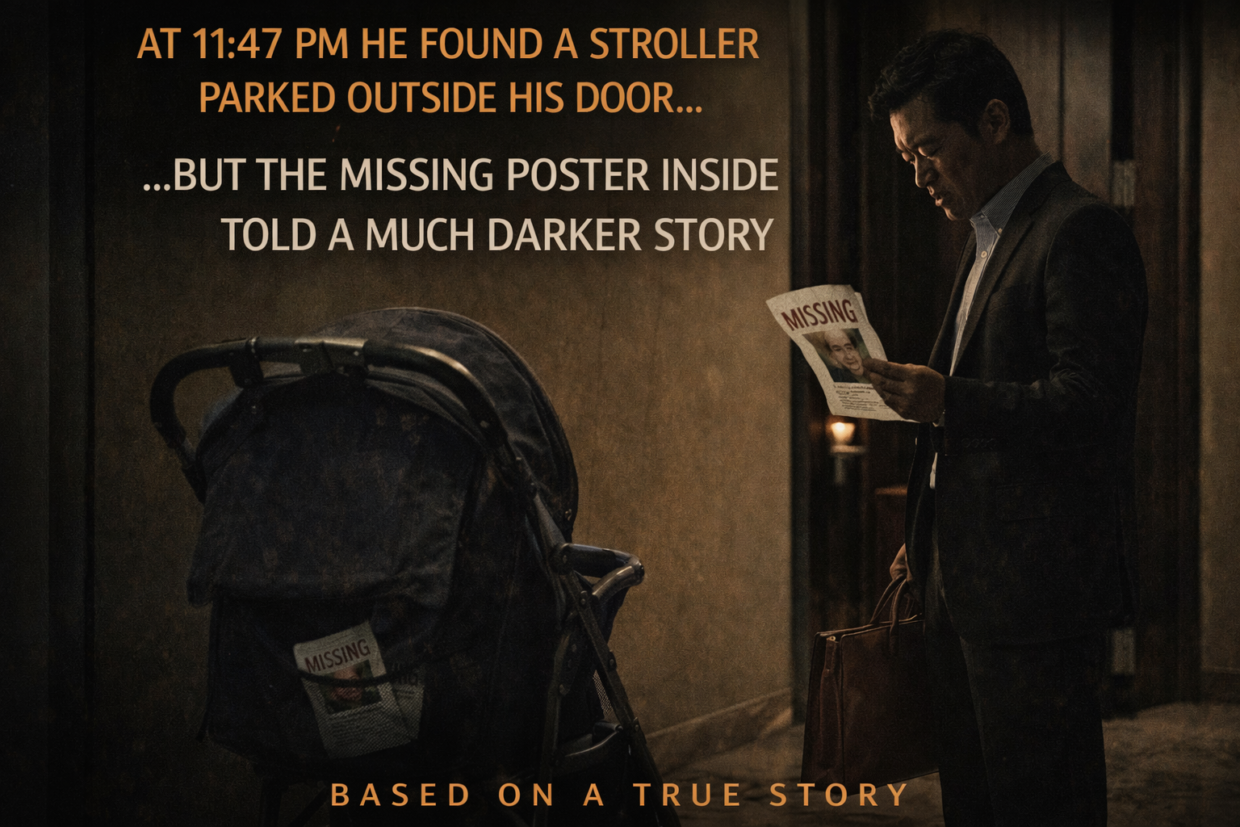
Michael stepped off the elevator at 11:47 PM, his leather briefcase heavy with contracts from the merger meeting that ran six hours over schedule. The hallway lights dimmed automatically as he approached his penthouse door.
A navy blue stroller sat directly in front of his entrance.
He stopped three feet away. The building’s marble floors reflected the overhead lighting, casting shadows through the stroller’s mesh storage compartment. Something white caught his attention in the side pocket.
Michael: What the hell?
He pulled out a folded piece of paper. The edges were worn soft, creased from repeated handling. At the top, bold letters spelled MISSING in red ink.
The photograph showed a baby with dark hair and Michael’s distinctive cleft chin. Birth date: March 15th. Last seen: March 20th. The address listed below made his hands shake.
1247 Riverside Drive, Penthouse A. His address.
Michael fumbled for his phone and dialed building security.
Michael: This is Michael Chen in Penthouse A. There’s a stroller outside my door that doesn’t belong to me.
The security guard’s voice crackled through the speaker.
Lopez: Mr. Chen, that stroller was delivered for you this afternoon. The woman had building access and your unit number.
Michael: What woman? I didn’t authorize any deliveries.
Lopez: Let me check the logs. She’s been coming every Tuesday for the past four months. Elizabeth Mitchell. Says she’s your… hold on… says she’s the mother of your child.
The phone slipped from Michael’s grip, clattering against the marble floor.
Elizabeth. His ex-girlfriend who disappeared eighteen months ago after their explosive breakup. The woman who told him she was pregnant, then claimed she lost the baby, then vanished entirely.
Michael: Pull the security footage from today. I want to see exactly what happened.
He wheeled the stroller inside his apartment, his hands trembling as he examined its contents. The storage basket held neatly folded baby clothes, all in newborn sizes. A receipt from Riverside Pediatrics dated three weeks ago. Prescription bottles with his last name on the labels.
The elevator chimed in the hallway.
Michael opened his door to find Lopez approaching with a tablet in his hands.
Lopez: Mr. Chen, you need to see this. The footage goes back months.
The screen showed Elizabeth entering the building every Tuesday at 2 PM. She wore different clothes each week, but carried the same oversized purse. In the first video from four months ago, she pushed an empty stroller.
Michael: She told me she moved to Portland. Said she never wanted to see me again.
Lopez: Sir, she’s been using a keycard registered to this address. The system shows it was activated the day after your breakup.
Michael’s chest tightened. He’d never given Elizabeth a keycard. She’d returned his spare key the night she left, throwing it at his feet before storming out.
Lopez swiped to the next video. Elizabeth placed a small wrapped package in the stroller, then stood motionless for several minutes. Her lips moved as if she were speaking to someone.
Michael: Can you enhance the audio?
Lopez: There’s no sound, but watch her hands.
Elizabeth’s right hand rested on the stroller’s handle while her left hand stroked something in the seat. Her movements were gentle, rhythmic. Maternal.
The next video showed her removing the package and replacing it with fresh flowers. White roses tied with a blue ribbon.
Michael: How did she get building access? I never authorized her keycard.
Lopez: The registration shows your signature, Mr. Chen. Dated March 22nd, two days after the baby’s listed disappearance date.
Michael examined the signature on Lopez’s screen. The handwriting looked like his, but the pen pressure was too light. Someone had traced over his signature from another document.
Michael: I was in Singapore that entire week for the Morrison acquisition. Check my passport records.
Lopez pulled up another screen. Michael’s passport showed departure on March 20th and return on March 28th. Impossible for him to have signed anything in New York during that time.
Michael: Someone forged my signature. Elizabeth has been accessing my building illegally for months.
The tablet showed another video. Elizabeth sat in the stroller’s seat, cradling a bundle of blankets. She rocked back and forth, her face twisted with grief.
Lopez: Mr. Chen, there’s something else. The missing child poster… we found copies posted throughout the building. The doormen have been instructed to call this number if anyone sees the baby.
He handed Michael a business card. The phone number belonged to Elizabeth, but the address listed was Michael’s penthouse.
Michael: She’s been telling people I have her missing baby?
Lopez: The poster says the child was last seen leaving this building with his father. That would be you, according to the description.
Michael’s vision blurred. Elizabeth had constructed an elaborate fiction where he’d kidnapped their child. The weekly visits, the forged keycard, the missing posters – all designed to make him look guilty of a crime that never happened.
Michael: I need to call the police. This is harassment and fraud.
Lopez: Sir, there’s one more thing. The stroller… it’s registered in your name. Purchased with your credit card on March 18th.
Michael checked his credit card statements on his phone. The charge was there: $347.99 to Baby Boutique Manhattan. He’d never made that purchase.
Michael: My credit card was stolen two weeks before I left for Singapore. I reported it to the bank.
Lopez: The purchase was made in person, sir. The store has security footage of you buying the stroller.
Michael’s apartment suddenly felt smaller, the walls pressing inward. Elizabeth had been planning this for months. The stolen credit card, the forged signature, the fake missing posters – she’d created evidence of a crime that existed only in her mind.
His phone buzzed with a text message from an unknown number.
“Stop hiding him from me. I know he’s in there.”
Michael: She’s outside the building right now.
Lopez checked his security monitors. Elizabeth stood across the street, staring up at Michael’s windows. She held a phone in one hand and a fresh missing poster in the other.
Michael: How long has she been watching my apartment?
Lopez: The exterior cameras show her posted across the street every night this week. She leaves around 3 AM and returns the next evening.
Michael called 911. The operator took his information and promised to send officers immediately. While he waited, Michael examined the stroller more carefully.
Hidden beneath the baby clothes, he found a photo album. The first page showed Elizabeth’s positive pregnancy test. The second showed ultrasound images with Michael’s name written in the corner. The dates matched their relationship timeline.
But the final pages told a different story. Medical records from Portland General Hospital. Elizabeth had given birth on March 15th, exactly as the missing poster indicated. The baby’s death certificate was dated March 20th.
Sudden Infant Death Syndrome. No foul play suspected.
Michael’s hands shook as he read the hospital documentation. Elizabeth hadn’t lost the baby during pregnancy. She’d given birth to their son and lost him five days later.
The grief had driven her to create an alternate reality where the baby was still alive, hidden away by Michael in their old apartment.
Michael: Lopez, I need you to see this.
He showed the security guard the death certificate. Lopez’s expression shifted from suspicion to sympathy.
Lopez: Mr. Chen, I’m sorry. I didn’t know.
Two police officers arrived within minutes. Officer Anderson examined the forged documents while Officer Williams interviewed Michael about Elizabeth’s harassment.
Anderson: Mr. Chen, your ex-girlfriend has been filing police reports claiming you kidnapped her child. We’ve had three welfare checks at this address in the past month.
Michael: The baby died in Portland. She’s been living in a delusion for months.
Williams: We’ll need to take her into custody for psychiatric evaluation. The forged documents and stolen credit card constitute multiple felonies.
Through his window, Michael watched the officers approach Elizabeth across the street. She didn’t resist when they placed her in handcuffs, but she kept pointing up at his apartment.
Elizabeth: He’s up there! My baby is up there! Check the penthouse!
Her voice carried across the street, desperate and broken.
Anderson returned to Michael’s apartment an hour later.
Anderson: We found her hotel room filled with baby supplies. Cribs, toys, clothes in every size from newborn to toddler. She’s been buying gifts for a child who died eighteen months ago.
Michael: What happens now?
Anderson: She’ll be evaluated at Bellevue. The district attorney will decide about pressing charges, but given her mental state, she’ll likely be committed for treatment rather than prosecuted.
Williams: Mr. Chen, we recommend you change your locks and install additional security. Grief can make people unpredictable, even after treatment.
Michael nodded, exhaustion weighing down his shoulders. The stroller sat in his living room like a monument to tragedy he’d never known existed.
After the officers left, Michael wheeled the stroller back into the hallway. He couldn’t keep it in his apartment, but throwing it away felt cruel.
Lopez: Mr. Chen, what should I do with it?
Michael: Donate it to the children’s hospital. Someone else might need it.
Lopez: And the keycard access?
Michael: Revoke it immediately. Change all the security codes.
Michael closed his apartment door and leaned against it. His phone showed seventeen missed calls from Elizabeth’s number and forty-three text messages, all variations of the same plea.
“Please let me see him. Just once. I know he misses his mommy.”
Michael blocked the number and poured himself three fingers of bourbon. Outside his window, the city lights blurred together like stars through tears he didn’t realize he was crying.
The baby would have been walking by now. Maybe saying his first words. Michael had lost a son he never knew existed and grieved a relationship that ended in tragedy rather than anger.
His phone rang. The caller ID showed Portland General Hospital.
Michael: Hello?
Dr. Harris: Mr. Chen, this is Dr. Harris from Portland General. Elizabeth Mitchell listed you as her emergency contact. She’s been admitted to our psychiatric unit.
Michael: She’s in New York. She was just arrested here.
Dr. Harris: Sir, Elizabeth has been a patient here for the past six months. She’s been receiving treatment for complicated grief and psychotic episodes.
Michael: That’s impossible. She’s been in New York, harassing me.
Dr. Harris: Mr. Chen, Elizabeth hasn’t left our facility since October. She’s been under constant supervision.
The bourbon glass slipped from Michael’s hand, shattering against the hardwood floor.
Michael stood in the broken glass for a full ten seconds before his brain started working again.
“Dr. Harris, that’s not possible. I watched officers arrest her twenty minutes ago.”
“Mr. Chen, I’m looking at Elizabeth’s chart right now. She’s been here since October 14th. She had a dissociative episode this evening around 11 PM and we’ve been trying to reach her emergency contacts.”
“What kind of dissociative episode?”
“I’m not able to share details beyond what’s necessary. But I need to ask — has anyone contacted you recently claiming to be Elizabeth? Someone acting on her behalf?”
Michael walked slowly to his window. The street below was empty now. The police car gone. Elizabeth gone.
“Send me your direct number,” he said. “I’ll call you back in ten minutes.”
He hung up and immediately called Officer Anderson.
Anderson: Mr. Chen?
Michael: The woman you just arrested. What’s her name?
Anderson: Elizabeth Mitchell. Matched the ID in her purse.
Michael: Can you send me a photo? Right now?
A pause. Then an image came through on his phone.
Michael stared at it for a long time.
The woman in the photograph had Elizabeth’s hair. Elizabeth’s approximate height and build. She was even wearing a coat similar to one Elizabeth used to own.
But it wasn’t Elizabeth.
Michael: Officer Anderson, I need you to run that ID. The real Elizabeth Mitchell has been hospitalized in Portland for six months. Whoever you have in custody — that’s not her.
The silence on the other end stretched long enough to tell him Anderson was already pulling up something on his screen.
Anderson: Mr. Chen, stay in your apartment. We’re coming back.
Anderson arrived forty minutes later with a second detective named Park, who said very little and wrote down everything.
The woman in custody had given her name as Elizabeth Mitchell. She carried Elizabeth’s ID, Elizabeth’s credit cards, and Elizabeth’s phone — still active, still receiving messages from Michael’s old texts that she’d apparently been reading for months.
Her real name was Dana Reyes. She was Elizabeth’s younger sister.
Park laid out what they’d pieced together so far, speaking in the careful flat tone of someone assembling a puzzle out loud.
Dana and Elizabeth had been close until the baby died. After that, Elizabeth’s grief had become total and consuming — the delusions, the alternate reality where the baby was alive and Michael had taken him. When Elizabeth was hospitalized in October, Dana had initially been relieved.
Then something shifted.
Dana had begun visiting Elizabeth less. Had started spending more time in Elizabeth’s apartment, surrounded by Elizabeth’s things. Had begun, slowly and then completely, stepping into the shape of her sister’s obsession. Not out of malice — or not only out of malice. Out of her own grief, her own guilt, her own need to do something when there was nothing to be done.
She’d forged Michael’s signature using documents she found in Elizabeth’s files. Stolen his credit card information from Elizabeth’s old emails. Come to the building every Tuesday because that was the day Elizabeth always used to meet Michael for lunch, a detail she’d read in Elizabeth’s journal.
She’d been grieving her nephew by pretending to be her sister grieving her son.
Michael: Does Elizabeth know what she’s been doing?
Park: We don’t know yet. That’s a conversation for the hospital and the lawyers.
Michael: What happens to Dana?
Park: Fraud, identity theft, forgery. It’s significant. But—
He paused in a way that suggested the but was doing a lot of work.
Park: She lost a nephew she apparently loved. And her sister at the same time, functionally. That doesn’t excuse any of it. But it’ll factor into how the DA approaches it.
After they left, Michael sat in his apartment for a long time without turning on any lights.
He thought about the baby he’d never known existed. A boy with his cleft chin, according to the missing poster. Five days old. He tried to picture five days and found he couldn’t — it was too short to hold a shape in his mind.
He thought about Elizabeth in a hospital room in Portland, possibly not knowing that her sister had been living out her delusion in the streets of New York. He wondered if knowing would help her or destroy whatever fragile ground she’d managed to find.
He thought about Dana standing across the street every night until 3 AM, staring up at a window, holding missing posters for a child who was buried in Portland.
Around 2 AM he called Dr. Harris back.
Michael: I want Elizabeth to know I’m sorry. Not for what Dana did. For not being there when it happened. For being in Singapore. For the fact that she went through all of that alone.
Dr. Harris: Mr. Chen, I can’t promise she’s in a place to receive that message right now.
Michael: I know. Whenever she is. If she ever is.
A pause.
Dr. Harris: I’ll note it in her file.
Michael thanked him and hung up.
He didn’t sleep. When the city outside his window started turning gray with early light he made coffee and stood at the window drinking it, watching the street where Dana had stood every night that week.
It was just a street now. Taxis and delivery trucks and a man walking a dog in the cold.
He thought about calling his lawyer. About pressing charges fully or not at all, about the versions of justice available to him and which one he could actually live with.
He didn’t make any decisions that morning.
Some things, he was learning, needed more than one night to become clear. Some losses arrived late and had to be grieved out of order. Some stories didn’t end so much as they settled, slowly, like a building finding its foundation after something had shaken it.
He finished his coffee.
He called his assistant and moved his first three meetings.
Then he sat down and started writing a letter he wasn’t sure he’d ever send, to a woman in Portland who had lost everything, beginning with the only honest sentence he had.
I didn’t know. I’m sorry I didn’t know.