

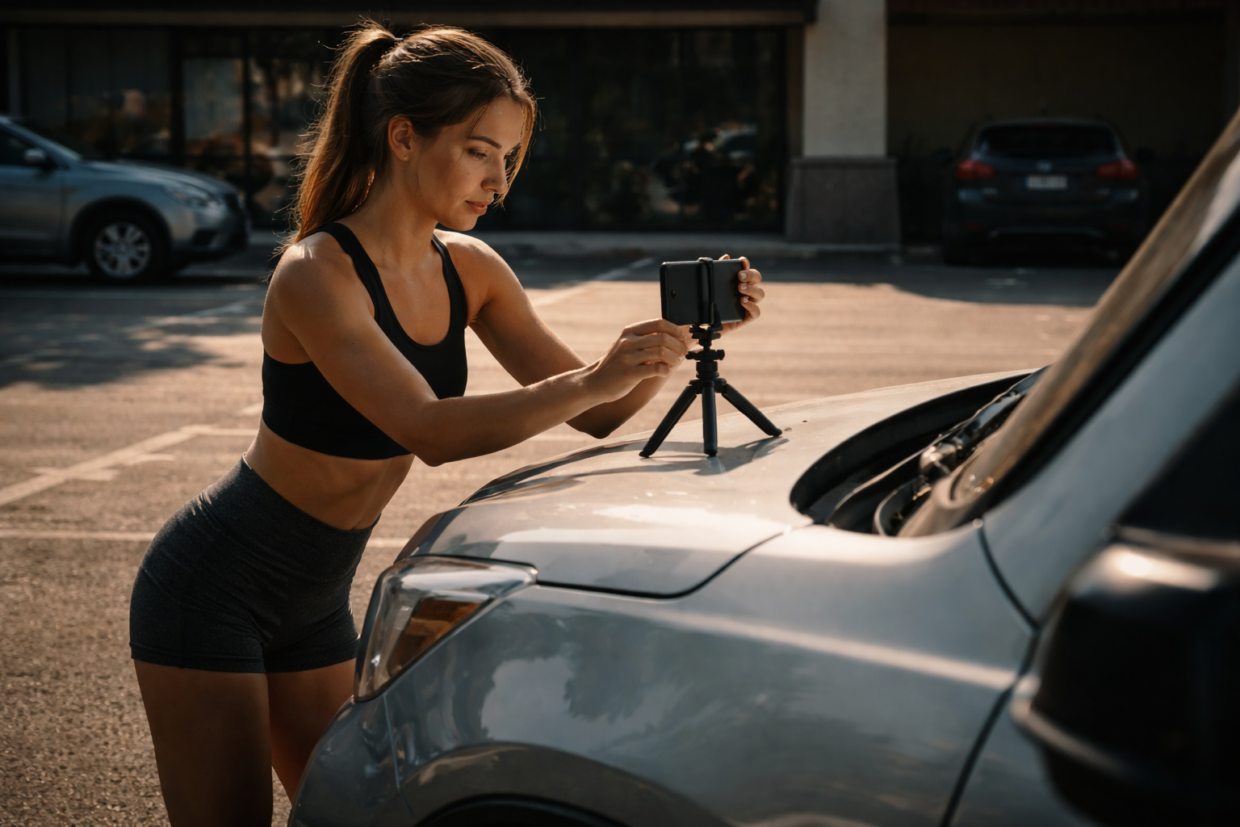
She was filming her dance routine in the parking lot… But someone was recording her too.
Isabella parks her silver SUV in the far corner of the shopping center lot. The afternoon sun beats down on the asphalt as she checks her phone for the third time.
Isabella: Perfect lighting out here. This is going to look amazing.
She adjusts her rearview mirror to check her makeup, then glances back at the car seat. The tinted windows make it hard to see inside from this angle.
Isabella: Mommy will be right back, baby. Just need to get this shot.
She steps out of the vehicle, leaving the engine running. The air conditioning hums quietly as she walks ten feet away from the car.
Paul sits on a bench outside the coffee shop, scrolling through his phone during his lunch break. The parking lot stretches out in front of him, mostly empty except for a few scattered vehicles.
Isabella sets up her phone against a light pole, positioning herself in frame. The music starts playing from her phone speaker as she begins her routine.
Paul looks up from his phone, drawn by the music. He watches for a moment as the woman goes through her choreographed dance moves.
Isabella: Come on, get the angle right. This has to be perfect.
She restarts the video twice, adjusting her position each time. The sun reflects off her car’s windows behind her.
Paul notices something that makes him pause. He squints toward the SUV, trying to see through the tinted glass.
A faint sound carries across the parking lot between songs. Paul stands up from the bench, walking closer.
Paul: Is that… crying?
Isabella continues dancing, her back to the car. She’s completely absorbed in her performance, checking her phone screen between takes.
Isabella: One more time. The followers are going to love this one.
Paul approaches the SUV slowly. The crying becomes clearer as he gets closer to the vehicle.
Paul: Excuse me. Ma’am?
Isabella doesn’t hear him over her music. She’s recording her fourth attempt at the dance routine.
Paul walks around to the driver’s side of the SUV. Through a small gap in the tinted window, he can see a car seat with a small child inside.
Paul: Hey! There’s a baby in this car!
Isabella stops mid-dance and turns around. Her phone is still recording.
Isabella: What are you talking about?
Paul: There’s a baby crying in your car. How long have you been out here?
Isabella: Just a few minutes. She’s fine, the air conditioning is on.
Paul checks his watch, then looks back at the bench where he’d been sitting.
Paul: I’ve been watching you dance for at least fifteen minutes. That baby has been crying the whole time.
Isabella: Mind your own business. She’s my daughter.
Paul pulls out his phone and dials 911. Isabella rushes toward him.
Isabella: What are you doing? Put that phone away.
Paul: 911? I need to report a child left unattended in a vehicle at the Westfield Shopping Center.
Isabella: Hang up that phone right now. You don’t understand the situation.
The 911 dispatcher’s voice is audible as Paul provides the location details. Isabella tries to grab his phone.
Paul: The mother is here, but she’s been filming videos while the baby cries in the car.
Isabella: I was only out here for a minute. You’re making this into something it’s not.
Paul: Ma’am, I work in that coffee shop. I’ve been on break for twenty minutes, and you were already dancing when I came outside.
Isabella returns to her car and opens the door. The crying intensifies as she reaches for the car seat.
Isabella: Shh, mommy’s here. Everything’s okay.
Paul stays on the line with 911, describing the scene. Other shoppers begin to notice the commotion.
A police cruiser pulls into the parking lot within five minutes. Officer Mitchell steps out and approaches the group.
Mitchell: I’m Officer Mitchell. Someone called about a child welfare concern?
Paul: Yes sir. I witnessed this woman leave her baby in the car while she filmed videos for at least twenty minutes.
Isabella: That’s not true. I was only out of the car for a few minutes. My daughter is fine.
Mitchell: Ma’am, can you step away from the vehicle please? I need to check on the child’s condition.
Isabella: She doesn’t need checking. She’s my baby.
Mitchell approaches the car and looks inside. The interior temperature gauge on his radio shows the outside temperature at 89 degrees.
Mitchell: How old is your daughter, ma’am?
Isabella: Eighteen months.
Mitchell: And you left her alone in the vehicle while you were filming?
Isabella: The car was running. The AC was on. She was perfectly safe.
Paul: Officer, she has it all on video. Her phone was recording the whole time.
Mitchell turns to Isabella, who is still holding her phone.
Mitchell: Ma’am, I’m going to need to see that video.
Isabella: I don’t have to show you anything. This is harassment.
Mitchell: Actually, if there’s evidence of child endangerment, I do need to see it. You can show me voluntarily or I can obtain a warrant.
Isabella: Fine. But you’ll see I did nothing wrong.
She opens her phone and shows the officer her recent videos. The timestamp shows the first video started 23 minutes ago.
Mitchell: This shows four different videos, all filmed in the last twenty-three minutes. Where was your daughter during this time?
Isabella: In the car. But it was running, and it was only for a few minutes between videos.
Mitchell: Ma’am, these videos show continuous filming. There’s no break where you checked on your child.
Paul: Officer, I have video too. I started recording when I realized what was happening.
Paul shows his phone to Officer Mitchell. The video clearly shows Isabella dancing while crying can be heard in the background.
Mitchell: Ma’am, I need you to place your hands behind your back.
Isabella: What? You can’t arrest me. I didn’t do anything wrong.
Mitchell: You’re being detained for investigation of child endangerment. You have the right to remain silent.
Isabella: This is insane. Every parent leaves their kid in the car for a minute.
Mitchell: Twenty-three minutes is not a minute, ma’am. And not while filming social media videos.
A second police car arrives. Officer Lee steps out and approaches the group.
Lee: What’s the situation here?
Mitchell: Child left unattended in vehicle while mother filmed videos. I need you to call Child Protective Services.
Isabella: You can’t take my baby. She’s fine. Look at her, she’s fine.
Lee: Ma’am, the child’s safety is our priority. CPS will determine the appropriate next steps.
Mitchell: Sir, can you provide a statement about what you witnessed?
Paul: Absolutely. I have the timeline documented and video evidence.
Isabella: Those people don’t know what they’re talking about. They’re strangers making assumptions.
A CPS worker arrives within thirty minutes. Social worker Martin approaches the scene.
Martin: I’m Martin from Child Protective Services. I understand there’s a welfare concern?
Mitchell: Child left unattended in a vehicle for over twenty minutes while the mother filmed social media content.
Martin: I’ll need to interview all parties and examine the evidence.
Isabella: My daughter is healthy and happy. This is all a misunderstanding blown out of proportion.
Martin: Ma’am, leaving a child unattended in a vehicle is serious regardless of the circumstances.
Paul: I have timestamps and video showing the duration and the child’s distress.
Martin reviews the evidence on both phones, comparing timestamps and audio.
Martin: The evidence shows a pattern of prioritizing social media content over child supervision.
Isabella: One mistake doesn’t make me a bad mother. Everyone makes mistakes.
Martin: This appears to be deliberate behavior, not an accident or emergency.
Mitchell: Ma’am, you’re being charged with child endangerment. Your daughter will be placed in protective custody pending investigation.
Isabella: No, you can’t take her. She needs her mother.
Martin: The child will be placed with relatives if available, or in temporary foster care.
Isabella: My mother lives across town. She can take her.
Martin: We’ll contact your mother to assess that option.
Two hours later, Isabella’s mother arrives at the police station. The grandmother, Mrs. Lopez, speaks with the CPS worker.
Lopez: I can provide care for my granddaughter while this is resolved.
Martin: We’ll need to complete a background check and home assessment.
Isabella sits in the holding cell, her phone confiscated as evidence. The TikTok videos have been downloaded and preserved.
Mitchell: Ma’am, your preliminary hearing is scheduled for tomorrow morning.
Isabella: This whole thing is ridiculous. Parents film videos all the time.
Mitchell: Not while leaving toddlers unattended in vehicles, ma’am.
The next morning, Isabella appears before Judge Harris for her preliminary hearing.
Harris: Ms. Rodriguez, you’re charged with child endangerment in the third degree. How do you plead?
Isabella: Not guilty, Your Honor. This is all blown out of proportion.
Harris: The evidence shows you left an eighteen-month-old child unattended in a vehicle for twenty-three minutes while filming social media content.
Isabella: The car was running, Your Honor. The air conditioning was on.
Harris: That doesn’t address the abandonment issue, Ms. Rodriguez.
The prosecutor presents the TikTok videos and Paul’s witness video as evidence.
Harris: The court finds probable cause. You’re released on your own recognizance with conditions.
Isabella: What conditions?
Harris: No unsupervised contact with your daughter pending CPS investigation. Parenting classes are required.
Isabella: Your Honor, please. She’s my baby.
Harris: The child’s safety is the court’s priority. These conditions are non-negotiable.
Six weeks later, Isabella completes court-ordered parenting classes and undergoes psychological evaluation.
The TikTok videos have been viewed over two million times, with thousands of comments condemning her behavior.
Isabella: I never thought it would go this far. I just wanted to create content.
Her lawyer reviews the case file with her before the final hearing.
Isabella: Can I get my daughter back?
Lawyer: That depends on the CPS recommendation and your compliance with court orders.
The final hearing determines that Isabella can have supervised visitation while continuing parenting education.
Harris: Ms. Rodriguez, social media is not more important than your child’s safety. Remember that going forward.
Isabella: Yes, Your Honor. I understand now.
Isabella deletes her social media accounts and focuses on rebuilding her relationship with her daughter.
The viral videos serve as a cautionary tale about the dangers of prioritizing online attention over parental responsibility.
Paul continues to work at the coffee shop, knowing he made the right choice to speak up.
Sometimes the most important moment is when someone decides to act instead of just watching.