


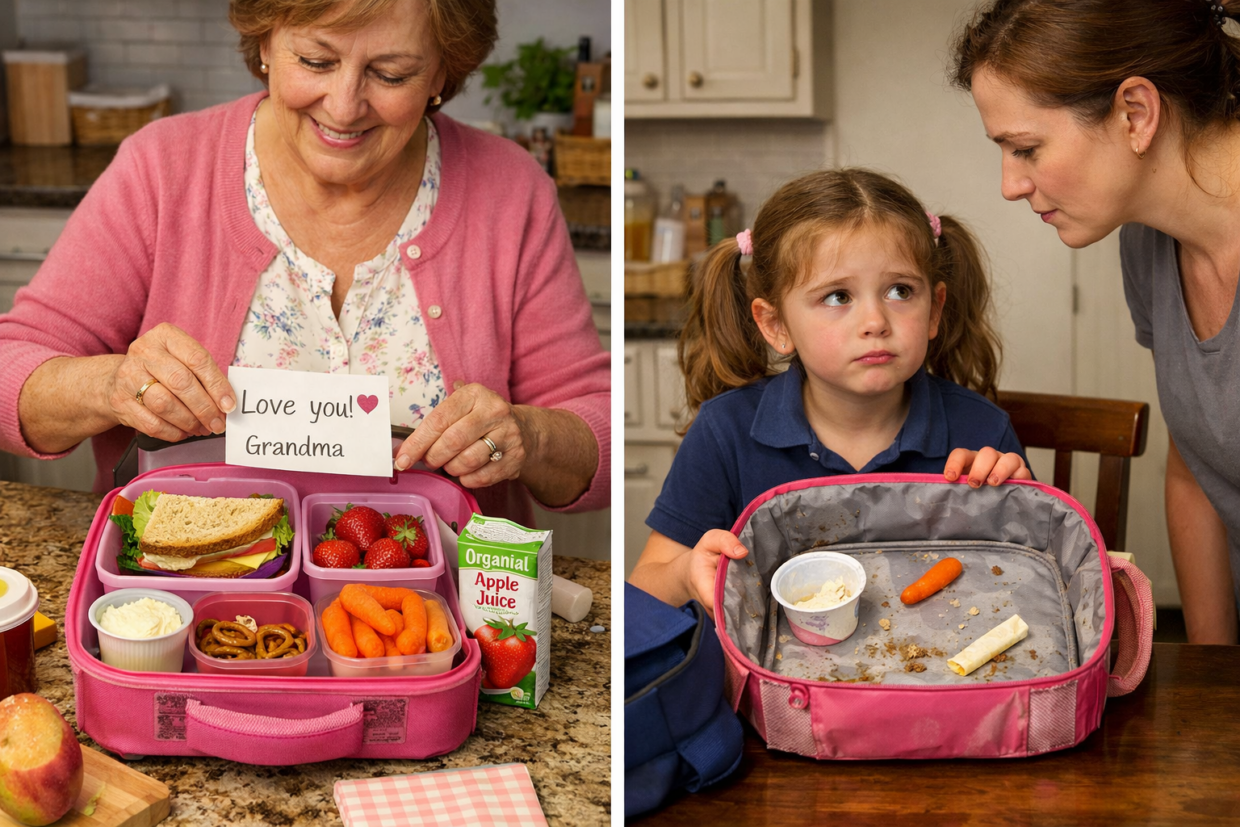
Every morning she packed her granddaughter’s lunch with love… But the child kept coming home starving.
Miriam wrapped the last samosa in wax paper and tucked it beside the container of rice and dal. The mango slices went in the side compartment, cut into perfect crescents the way Zara liked them.
Seven years old and already her granddaughter’s favorite person in the world. The thought made her smile as she zipped the insulated lunchbox closed.
Zara bounded into the kitchen, backpack bouncing against her small frame.
Zara: Grandma, is there extra today?
Miriam: Always extra for my love. You eat everything, okay?
Zara: Okay!
The school bus rumbled away, leaving Miriam at the window. She watched until the yellow disappeared around the corner, then returned to her morning tea.
At three-thirty, Zara trudged through the front door. Her shoulders sagged, and dark circles shadowed her eyes.
Miriam: How was school, beta?
Zara: Good.
But she headed straight for the kitchen, opening cabinets with the desperate hunger of someone who hadn’t eaten all day.
Miriam followed, studying her granddaughter’s face.
Miriam: Did you eat your lunch?
Zara: It was gone again.
The same answer. For three weeks now, the same answer.
Miriam: Gone where?
Zara: I don’t know. Mrs. Calloway says I probably forgot it somewhere.
Miriam knelt beside her granddaughter, brushing a strand of dark hair from her forehead.
Miriam: You don’t forget things, Zara. You’re very careful.
Zara: Maybe I’m not careful enough.
That night, Miriam checked the backpack herself. The lunchbox sat in the main compartment, completely empty. Not even crumbs remained.
She opened every zipper, searched every pocket. Nothing.
The next morning, she packed the lunch with extra attention. A small note tucked between the containers: “Enjoy your food, my darling. Love, Grandma.”
At pickup time, she arrived fifteen minutes early and positioned herself near the classroom window. Through the glass, she watched Mrs. Calloway organize papers at her desk.
The teacher glanced up, noticed Miriam watching, and offered a bright smile. But something in her eyes remained cold, calculating.
When Zara emerged, Miriam checked her backpack immediately.
Empty again.
Miriam: Mrs. Calloway, could I speak with you for a moment?
The teacher approached with that same practiced smile.
Mrs. Calloway: Of course! What can I help you with?
Miriam: Zara’s lunch keeps disappearing. She says you mentioned she might be forgetting it?
Mrs. Calloway: Oh yes, children that age are so forgetful. She probably leaves it on the bus or drops it somewhere. You know how kids are.
The response came too quickly, too rehearsed. Miriam had raised four children and helped raise six grandchildren. She knew the difference between a teacher who cared and one who was covering something up.
Miriam: She’s never been forgetful with important things.
Mrs. Calloway: Well, lunch isn’t always important to children. They get distracted.
Miriam: It’s important to her. And to me.
Mrs. Calloway: I understand your concern, but I really can’t watch every child’s belongings every moment. Perhaps you could pack something simpler? Something more… normal?
The word hung in the air between them. Normal.
Miriam felt something cold settle in her chest, but she kept her voice steady.
Miriam: What do you mean by normal?
Mrs. Calloway: You know, regular lunch food. Sandwiches, chips. Things the other children eat.
Miriam: The food I pack is regular food. It’s what we eat.
Mrs. Calloway: Of course, of course. I just meant… well, you understand.
But Miriam didn’t understand. Or rather, she was beginning to understand something she didn’t want to believe.
That evening, she called the school.
Miriam: I’d like to speak with Principal Burke about my granddaughter’s lunch situation.
The secretary transferred her immediately.
Principal Burke: Mrs. Patel, how can I help you?
Miriam: My granddaughter Zara’s lunch disappears every day. Her teacher says she’s forgetting it, but I don’t believe that’s true.
Principal Burke: That’s concerning. Let me look into this.
Miriam: I don’t need you to look into it. I need you to check your security cameras.
A pause.
Principal Burke: That’s… that’s a serious request.
Miriam: It’s a serious problem.
Principal Burke: Can you come in tomorrow morning? We’ll review the footage together.
Miriam sat in the principal’s office, her hands folded in her lap. Principal Burke adjusted his computer screen so she could see it clearly.
Principal Burke: This is from yesterday morning, about ten-thirty. Lunch time for the second graders.
The black and white footage showed Mrs. Calloway’s classroom. Children sat at their desks, some eating from lunch boxes, others with cafeteria trays.
Miriam spotted Zara immediately, sitting alone at a desk near the back. Her granddaughter opened the familiar lunchbox and smiled at the contents.
Then Mrs. Calloway approached.
On screen, the teacher said something to Zara. The child looked confused, then nodded reluctantly. Mrs. Calloway picked up the lunchbox and walked toward the front of the room.
Miriam: What is she doing?
Principal Burke: Just watch.
Mrs. Calloway opened the lunchbox at her desk. Her face twisted into an expression of disgust. She looked around the classroom, then walked to the trash can.
And dumped everything inside.
The samosas. The rice and dal. The carefully cut mango slices. All of it went into the garbage.
Miriam’s hands began to shake.
Miriam: Go back. Show me the day before.
Principal Burke rewound the footage. The same scene played out. Mrs. Calloway approaching Zara’s desk, taking the lunchbox, throwing away the food.
Miriam: The day before that.
Again. And again. Days of footage showing the same routine.
Mrs. Calloway would wait until Zara opened her lunch, then confiscate it under some pretense. Then she would throw away every item, sometimes making faces of revulsion as she did it.
Principal Burke: Mrs. Patel, I am so sorry. This is completely unacceptable.
Miriam: What did she tell my granddaughter?
Principal Burke: We’ll need to ask Zara, but based on what I can see, it looks like she was telling her the food was inappropriate for school.
Miriam: Inappropriate.
Principal Burke: I’ve already called Mrs. Calloway. She’ll be here within the hour.
Miriam: I want to hear what she has to say.
Mrs. Calloway entered the office with her chin raised, defensive.
Mrs. Calloway: I don’t understand why this is such a big deal. The food was disruptive.
Principal Burke: Disruptive how?
Mrs. Calloway: It smelled. The other children were complaining. It was affecting the learning environment.
Miriam: My granddaughter’s lunch was affecting the learning environment.
Mrs. Calloway: Look, I’m not trying to be difficult, but some foods are just not appropriate for a classroom setting. The smell was very… ethnic.
The word hung in the air like a slap.
Principal Burke: Mrs. Calloway, are you telling me you threw away a child’s lunch because you didn’t like the smell?
Mrs. Calloway: I was thinking of the other students. Their comfort matters too.
Miriam: And my granddaughter’s comfort? Her hunger?
Mrs. Calloway: She could have brought normal food. I suggested that to you.
Miriam: Normal food.
Mrs. Calloway: You know what I mean.
Miriam: I know exactly what you mean.
Principal Burke: Mrs. Calloway, you’re suspended immediately pending a full investigation.
Mrs. Calloway: This is ridiculous. I was doing my job.
Miriam: Your job is to educate children. Not to throw away their food because it doesn’t smell like a peanut butter sandwich.
Mrs. Calloway: I don’t have to listen to this.
She stormed out, leaving Miriam and Principal Burke in heavy silence.
Principal Burke: Mrs. Patel, I cannot express how sorry I am. This behavior is completely against our policies and our values.
Miriam: How long has this been happening?
Principal Burke: Based on what we’ve seen, at least three weeks. Possibly longer.
Miriam: Three weeks of my granddaughter going hungry because her teacher thinks our food is too ethnic.
Principal Burke: We’ll be recommending immediate termination to the school board.
Miriam: I want to speak at that meeting.
Principal Burke: Of course. It’s scheduled for Thursday evening.
Miriam picked up Zara from school that afternoon. Her granddaughter climbed into the car, the same defeated expression on her small face.
Zara: My lunch was gone again today.
Miriam: I know, beta. But it won’t happen anymore.
Zara: Did I do something wrong?
Miriam: No, my love. You did nothing wrong. Your teacher did something very wrong.
Zara: Is she in trouble?
Miriam: Yes. She’s in trouble.
That evening, Miriam called her son.
Miriam: Amir, I need you to come to the school board meeting on Thursday.
Amir: What happened?
Miriam: Your daughter’s teacher has been throwing away her lunch every day for three weeks.
Amir: What?
Miriam: She said it smelled too ethnic.
The silence on the other end of the line stretched for a long moment.
Amir: I’ll be there.
Thursday evening, the school board meeting room was packed. Word had spread through the community, and parents filled every seat.
Miriam sat in the front row, Zara beside her holding the lunchbox that had been empty so many times.
The board chairman called her name.
Miriam: My name is Miriam Patel. I’ve lived in this community for thirty years. I raised four children in these schools.
She stood slowly, her voice carrying clearly through the room.
Miriam: Three weeks ago, my granddaughter started coming home hungry every day. Her teacher told her she was forgetting her lunch. But children don’t forget being hungry.
The room was completely silent.
Miriam: When I asked the teacher about it, she suggested I pack normal food. Normal food. As if the food my family has eaten for generations, the food I prepare with love every morning, is somehow abnormal.
She paused, looking directly at the board members.
Miriam: The security cameras show Mrs. Calloway throwing away my granddaughter’s lunch every single day. Not because it was spoiled. Not because it violated any policy. But because she decided it smelled too ethnic.
Murmurs rippled through the crowd.
Miriam: I came to this country with nothing. I worked in factories, cleaned offices, saved every penny so my children could have better lives. I taught them to be proud of who they are, where they come from.
Her voice grew stronger.
Miriam: This teacher taught my seven-year-old granddaughter that her heritage is something to be ashamed of. That her food belongs in the trash. That she should go hungry rather than bring something that doesn’t smell normal.
She looked down at Zara, who was staring up at her with wide eyes.
Miriam: But my granddaughter is not abnormal. Her food is not abnormal. Her culture is not something to be thrown away.
The applause started slowly, then built until the entire room was on its feet.
The board chairman called for order.
Board Chairman: Mrs. Calloway, do you have anything to say in your defense?
Mrs. Calloway stood reluctantly.
Mrs. Calloway: I was trying to maintain a positive learning environment for all students.
Board Member Chen: By throwing away a child’s lunch?
Mrs. Calloway: The smell was disruptive.
Board Member Chen: More disruptive than a hungry seven-year-old?
Mrs. Calloway: I don’t think you understand the situation.
Miriam: I understand the situation perfectly. You decided my granddaughter’s culture was disposable.
The board deliberated for less than ten minutes.
Board Chairman: Mrs. Calloway, your employment with this district is terminated immediately.
The crowd erupted in applause again.
Outside the meeting, a lawyer approached Miriam.
Diana Okafor: Mrs. Patel, I’m Diana Okafor. I specialize in discrimination cases. What happened to your granddaughter is illegal.
Miriam: I just want it to never happen again.
Diana Okafor: A lawsuit would ensure that. And it would send a message to other teachers who might think this behavior is acceptable.
Miriam: Will it help other children?
Diana Okafor: Yes. It will.
Miriam: Then we’ll do it.
The next morning, Miriam packed Zara’s lunch with extra care. Samosas, rice and dal, mango slices, and a small container of her homemade chutney.
At the breakfast table, Zara watched her grandmother work.
Zara: Grandma, can I really take this to school?
Miriam: Every day, beta. Every single day.
Zara: What if the new teacher doesn’t like it?
Miriam: Then the new teacher will learn to like it. Or she’ll find a different job.
Zara giggled, the first real laugh Miriam had heard from her in weeks.
At school pickup, the new substitute teacher approached them.
Ms. Vega: Mrs. Patel? I’m Ms. Vega, Zara’s temporary teacher.
Miriam tensed, preparing for another confrontation.
Ms. Vega: I wanted you to know that Zara shared her lunch with another student today. The samosas were delicious. Would you mind sharing the recipe?
Miriam felt tears prick her eyes.
Miriam: I’d be happy to.
That evening, Zara helped her grandmother prepare the next day’s lunch.
Zara: Can I take extra tomorrow? Lucas wants to try the mango.
Miriam: Of course.
Zara: And maybe some of those little cookies you make?
Miriam: As many as you want.
She watched her granddaughter carefully arrange the containers in the lunchbox, taking pride in each item.
The lawsuit would take months to resolve. The new policies would take time to implement. But this moment, watching Zara pack her lunch with joy instead of shame, was already a victory.
Miriam sealed the lunchbox and handed it to her granddaughter.
Miriam: Your food is beautiful, Zara. Your culture is beautiful. Don’t let anyone tell you otherwise.
Zara: I won’t, Grandma.
And for the first time in weeks, Miriam believed her.