


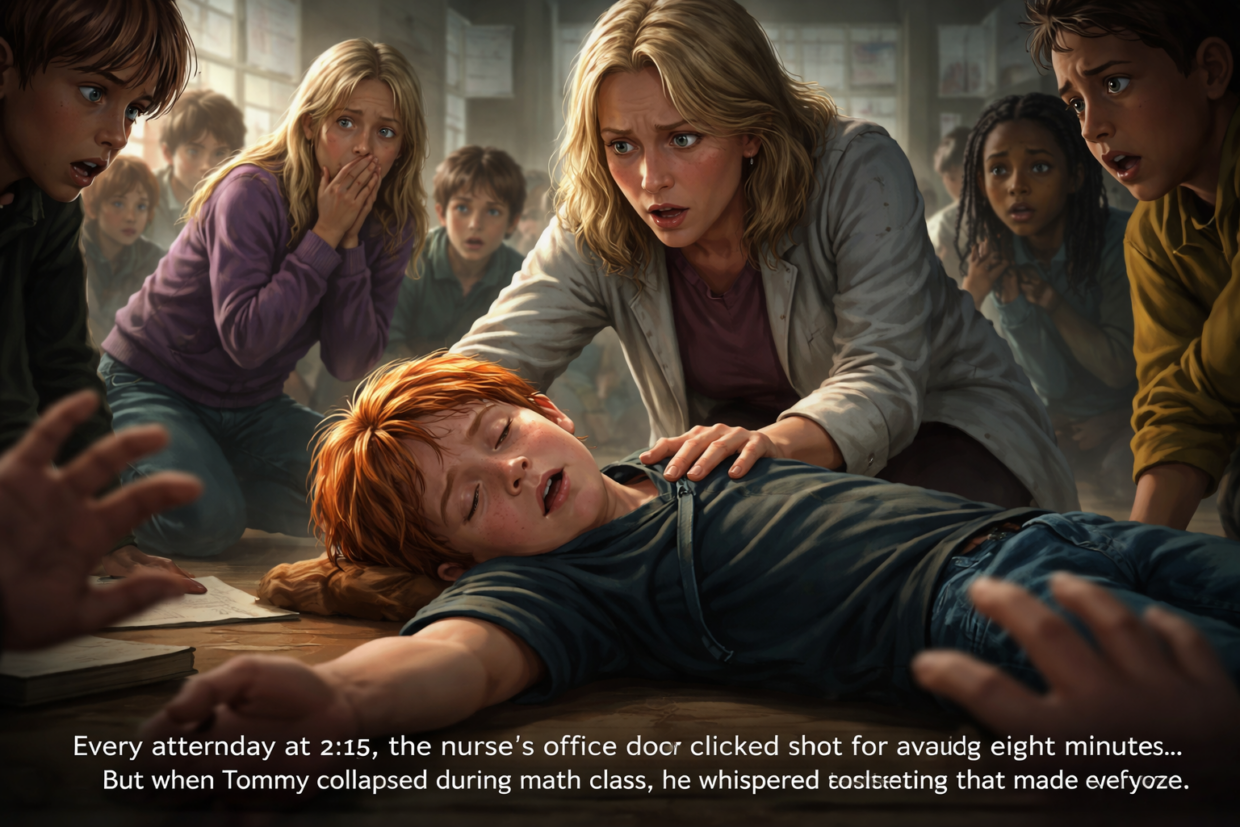
Every afternoon at 2:15, the nurse’s office door clicked shut for exactly eight minutes… But when Tommy collapsed during math class, he whispered something that made everyone freeze.
Benjamin adjusted his tie in the rearview mirror before walking into Jefferson Middle School. As a substitute teacher, he’d worked at dozens of schools, but something felt different here.
The morning passed normally until sixth period math. Benjamin was explaining fractions when Tommy Martinez suddenly swayed and grabbed his desk.
Benjamin: Tommy, are you feeling alright?
Tommy: I’m fine, Mr. Benjamin. Just tired.
The clock on the wall read 2:12 PM. Tommy’s eyes darted to it, then back to his worksheet. His hands were shaking.
Benjamin: Why don’t you sit down for a minute?
Tommy: No, please. I’m okay. Really.
At 2:14, Tommy’s face went pale. He gripped the edge of his desk so hard his knuckles turned white.
Benjamin: That’s it. You need to see the nurse.
Tommy: No! Please don’t send me there. I’ll be fine. Just give me a minute.
The desperation in Tommy’s voice made Benjamin pause. Several other students had turned to stare.
Benjamin: Tommy, you look like you’re about to faint.
Tommy: I can’t go there. Not now. Please.
The intercom crackled to life at exactly 2:15 PM.
Principal Harris: Attention staff. Nurse Adams will be unavailable for medical consultations for the next eight minutes. Please hold all non-emergency referrals.
Tommy visibly relaxed. Color returned to his cheeks.
Benjamin: What was that about?
Tommy: Nothing. I feel better now.
Benjamin watched Tommy return to his worksheet as if nothing had happened. The transformation was immediate and complete.
After class, Benjamin walked past the nurse’s office. A handwritten sign hung on the door: “In Session – Do Not Disturb 2:15-2:23 PM.”
The hallway was empty except for a girl sitting on the floor outside the office door. She was about eleven, with dark hair and a school uniform that looked too big for her small frame.
Benjamin: Are you waiting to see the nurse?
Sophia: She’s busy right now.
Benjamin: Are you feeling sick?
Sophia: I have a stomach ache. But I have to wait.
Benjamin: The sign says she’ll be available in a few minutes.
Sophia nodded but didn’t look up from her shoes. Her hands were folded tightly in her lap.
Benjamin: What’s your name?
Sophia: Sophia Green.
Benjamin: I’m Mr. Benjamin. I’m substituting for Mrs. Patterson today.
At 2:23 PM exactly, the door handle turned. Nurse Adams emerged, smoothing down her hair.
Adams: Sorry for the wait, sweetheart. Come on in.
Sophia stood slowly and followed the nurse inside. The door closed behind them.
Benjamin returned to the main office to sign out for the day.
Benjamin: That’s an interesting policy about the nurse being unavailable for eight minutes every afternoon.
The secretary, Kumar, looked up from her computer.
Kumar: Oh, that. Nurse Adams does her daily equipment checks then. State requirement.
Benjamin: Equipment checks?
Kumar: You know, making sure everything’s sterile and properly functioning. Very important for student safety.
Benjamin nodded, but something nagged at him. In fifteen years of teaching, he’d never heard of such a specific daily protocol.
The next morning, Benjamin arrived early. He had a full day of classes covering for Mrs. Patterson, who was still out sick.
During lunch, he walked past the nurse’s office. Through the small window, he could see Adams organizing supplies. Nothing seemed unusual.
At 2:10 PM, Benjamin positioned himself near the hallway water fountain with a clear view of the nurse’s office.
Students began gathering outside the door at 2:12. First Tommy Martinez, then Sophia Green, then two other kids Benjamin didn’t recognize.
Adams: I’ll be with you all in just a few minutes. Please wait quietly.
At 2:15, Adams hung the “Do Not Disturb” sign and locked the door from the inside.
Benjamin counted four students sitting on the floor outside. They all looked nervous, checking the clock repeatedly.
At 2:23, the door opened. Adams called the first student inside.
Benjamin approached Tommy, who was still waiting.
Benjamin: How are you feeling today, Tommy?
Tommy: Better. The stomach thing comes and goes.
Benjamin: Have you seen a doctor about it?
Tommy: Nurse Adams takes good care of us. She knows what we need.
The way Tommy said “us” made Benjamin’s skin crawl.
That evening, Benjamin called his sister Taylor, who worked as a school counselor in the next district.
Benjamin: Have you ever heard of a nurse being unavailable for exactly eight minutes every day?
Taylor: That’s oddly specific. What’s the reason?
Benjamin: Equipment checks, supposedly.
Taylor: Benjamin, equipment checks don’t require locking the door. And they certainly don’t happen at the same time every single day.
Benjamin: That’s what I thought.
Taylor: Are you seeing anything else unusual?
Benjamin: Kids seem scared to go to the nurse’s office. But then they wait outside anyway.
Taylor: That’s a red flag. Scared but compelled to return? You need to document this.
The next day, Benjamin started keeping notes. He tracked which students appeared outside the nurse’s office and when.
Tommy Martinez – every day at 2:12
Sophia Green – three times this week
Marcus Johnson – twice this week
Riley Chen – once this week
All of them showed the same pattern: anxiety before 2:15, relief after 2:23.
During his prep period, Benjamin walked to the main office.
Benjamin: Kumar, I’m curious about the nurse’s daily routine. Is there a written policy about the afternoon unavailability?
Kumar: I’d have to check with Principal Harris about specific medical protocols.
Benjamin: Where is Principal Harris during that time?
Kumar: She usually handles administrative duties in her office.
But when Benjamin walked past the principal’s office at 2:20, it was dark and empty.
Thursday afternoon, Benjamin decided to test something. At 2:16, he approached the nurse’s office with a fake emergency.
Benjamin knocked on the door.
Benjamin: Nurse Adams? I have a student who cut himself in woodshop.
No response. He knocked louder.
Benjamin: This is urgent. The student needs immediate attention.
Still nothing. Benjamin tried the door handle. Locked.
He could hear muffled voices from inside, but couldn’t make out words.
Benjamin: Hello? Anyone in there?
The voices stopped completely.
At 2:23, the door opened. Adams appeared, slightly out of breath.
Adams: Mr. Benjamin? Is everything alright?
Benjamin: I had a student emergency, but it’s resolved now.
Adams: Good. I was just… finishing up my equipment inventory.
Benjamin: The door was locked. What if there had been a real emergency?
Adams: We have protocols for true emergencies. The office always knows how to reach me.
But Kumar had never mentioned any emergency protocols.
That evening, Benjamin called Taylor again.
Benjamin: I tested it today. She won’t respond to emergencies during those eight minutes.
Taylor: That’s completely against medical protocol. Benjamin, you need to report this.
Benjamin: To who? The principal seems to be part of it.
Taylor: Then go to the district office. Or the state education department.
Benjamin: I need more evidence first.
Friday morning, Benjamin arrived at school to find Tommy Martinez in the hallway, crying.
Benjamin: Tommy, what’s wrong?
Tommy: My parents want to transfer me to Roosevelt Middle School.
Benjamin: How do you feel about that?
Tommy: I want to go. But Nurse Adams says I still need treatment for my stomach problems.
Benjamin: What kind of treatment?
Tommy: She gives me special medicine. It helps with the anxiety.
Benjamin: Tommy, does your parents know about this medicine?
Tommy looked confused.
Tommy: I… I don’t know. Nurse Adams handles all my medical stuff.
Benjamin: When do you take this medicine?
Tommy: During her equipment checks. When the door is locked.
Benjamin felt his heart rate spike.
Benjamin: Tommy, I want you to tell your parents exactly what happens during those appointments.
Tommy: I can’t. Nurse Adams says it’s private medical information.
Benjamin: Tommy, your parents have the right to know about any medication you’re taking.
Tommy: She says they wouldn’t understand. That they might stop my treatment.
At lunch, Benjamin pulled Sophia aside.
Benjamin: Sophia, can I ask you about your visits to the nurse?
Sophia: I have stomach problems. Like Tommy.
Benjamin: What does Nurse Adams do to help?
Sophia: She gives me medicine. And she talks to me about my feelings.
Benjamin: During the time when her door is locked?
Sophia: She says it’s important that we’re not interrupted. So the medicine works properly.
Benjamin: What kind of medicine?
Sophia: Little white pills. They make me feel sleepy and happy.
Benjamin: Do your parents know about these pills?
Sophia: Nurse Adams says they don’t need to know. It’s just between us.
Benjamin excused himself and immediately went to the bathroom. His hands were shaking as he dialed Taylor’s number.
Benjamin: I think she’s drugging kids.
Taylor: What?
Benjamin: The nurse. She’s giving kids medication without parental consent. During those eight minutes when the door is locked.
Taylor: Benjamin, you need to call the police. Right now.
Benjamin: I need to be sure first.
Taylor: You are sure. Kids are being given unauthorized medication in a locked room. That’s enough.
Benjamin: What if I’m wrong?
Taylor: What if you’re right and you do nothing?
At 2:10 PM, Benjamin positioned himself across from the nurse’s office with his phone ready to record.
The usual group of students gathered. Tommy, Sophia, Marcus, and Riley.
At 2:15, Adams hung her sign and locked the door.
Benjamin started recording through the small window. He could see Adams opening a small metal box and removing several pill bottles.
Tommy was called in first. Through the window, Benjamin watched Adams hand Tommy a small white pill and a cup of water.
Tommy took the pill and sat in the chair next to Adams’ desk. Within minutes, his posture relaxed completely.
Adams began speaking to Tommy, but Benjamin couldn’t hear the conversation. Tommy nodded frequently, his movements slow and deliberate.
After exactly two minutes, Adams helped Tommy to his feet and walked him to the door.
Adams: Remember, this is our special time together. Just between us.
Tommy: Yes, Nurse Adams.
Sophia was called in next. The same routine: pill, water, relaxed conversation, dismissal.
Benjamin had seen enough. He stopped recording and immediately called 911.
Benjamin: I need to report suspected child endangerment at Jefferson Middle School.
Dispatcher: What is the nature of the endangerment?
Benjamin: A school nurse is giving unauthorized medication to students in a locked room.
Dispatcher: Are you certain about this?
Benjamin: I have video evidence.
Dispatcher: Units are being dispatched. Please remain on the line.
Benjamin: The nurse’s office is currently locked with a student inside.
Dispatcher: Do not approach the area. Wait for police arrival.
Within ten minutes, three police cars pulled into the school parking lot.
Officer Patterson approached Benjamin in the hallway.
Patterson: You’re the one who called this in?
Benjamin: Yes. The nurse’s office is locked right now with a student inside.
Patterson: How long has the door been locked?
Benjamin: About six minutes. She does this every day for exactly eight minutes.
Patterson knocked firmly on the nurse’s office door.
Patterson: Police. Open the door immediately.
The door opened within seconds. Adams appeared with Marcus Johnson standing behind her, looking dazed.
Patterson: Ma’am, I need you to step outside.
Adams: Is there a problem, officer?
Patterson: We’ve received reports of unauthorized medication being administered to students.
Adams: I’m a licensed school nurse. All my treatments are within protocol.
Patterson: Do you have documentation of parental consent for medications?
Adams hesitated.
Adams: The medications are over-the-counter supplements for anxiety and stomach issues.
Patterson: Ma’am, any medication given to minors requires documented parental consent.
Principal Harris appeared in the hallway.
Harris: Officers, what seems to be the problem?
Patterson: We’re investigating reports of unauthorized medication administration.
Harris: I’m sure there’s been a misunderstanding.
Benjamin: Principal Harris, were you aware that Nurse Adams locks her office daily and gives medication to students without parental consent?
Harris: The nurse’s medical protocols are confidential.
Patterson: Not when it comes to medicating minors without parental knowledge.
A second officer was examining the metal box on Adams’ desk.
Officer Roberts: We have multiple prescription bottles here. Lorazepam, Zolpidem, Alprazolam.
Patterson: Those are controlled substances. Ma’am, you’re under arrest.
Adams: You don’t understand. These children need help. Their parents don’t know how to handle their anxiety.
Patterson: You have the right to remain silent.
Harris: Officers, I had no knowledge of any improper medication practices.
Benjamin: Then why did you block out 2:15 to 2:23 on your calendar every day?
Harris: I… that was for administrative duties.
Roberts: Ma’am, we’ll need to speak with you as well.
Within an hour, both Adams and Harris were in custody. The school went into lockdown as police interviewed students and staff.
Benjamin called the parents of Tommy, Sophia, Marcus, and Riley. Each conversation was heartbreaking.
Tommy’s mother, Walsh: How long has this been going on?
Benjamin: Based on what I observed, at least several weeks.
Walsh: My son has been having nightmares and mood swings. We thought it was normal middle school adjustment.
Benjamin: The police will want to speak with you and Tommy.
Sophia’s father, Nelson: She’s been so different lately. Withdrawn and sleepy.
Benjamin: She was being given sedatives without your knowledge.
Nelson: How is that even possible?
Benjamin: The nurse convinced the children it was private medical treatment.
The investigation revealed that Adams had been drugging students for three months. She told each child their parents wouldn’t understand their “special medical needs.”
The controlled substances were stolen from her previous job at a private clinic. She had been terminated for similar behavior but had falsified her references.
Principal Harris was charged with criminal negligence for failing to supervise Adams despite receiving complaints from parents about their children’s behavioral changes.
Six students in total had been victimized. All required medical evaluation and counseling to recover from the effects of unauthorized sedation.
The school district implemented new protocols requiring two-person oversight for all medication administration and mandatory parent notification for any medical treatment.
Benjamin completed his substitute assignment and received commendations from both the police department and the state education board for his intervention.
Tommy Martinez transferred to Roosevelt Middle School as planned. His anxiety improved significantly once the unauthorized medication was out of his system.
Sophia Green required several months of counseling but made a full recovery. Her parents sued the school district and won a significant settlement.
The nurse’s office at Jefferson Middle School was completely renovated. The new nurse, Patterson, maintained an open-door policy and required written parental consent for even basic first aid.
The eight-minute lockdown never happened again.