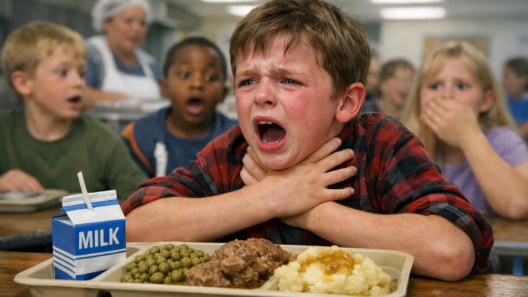



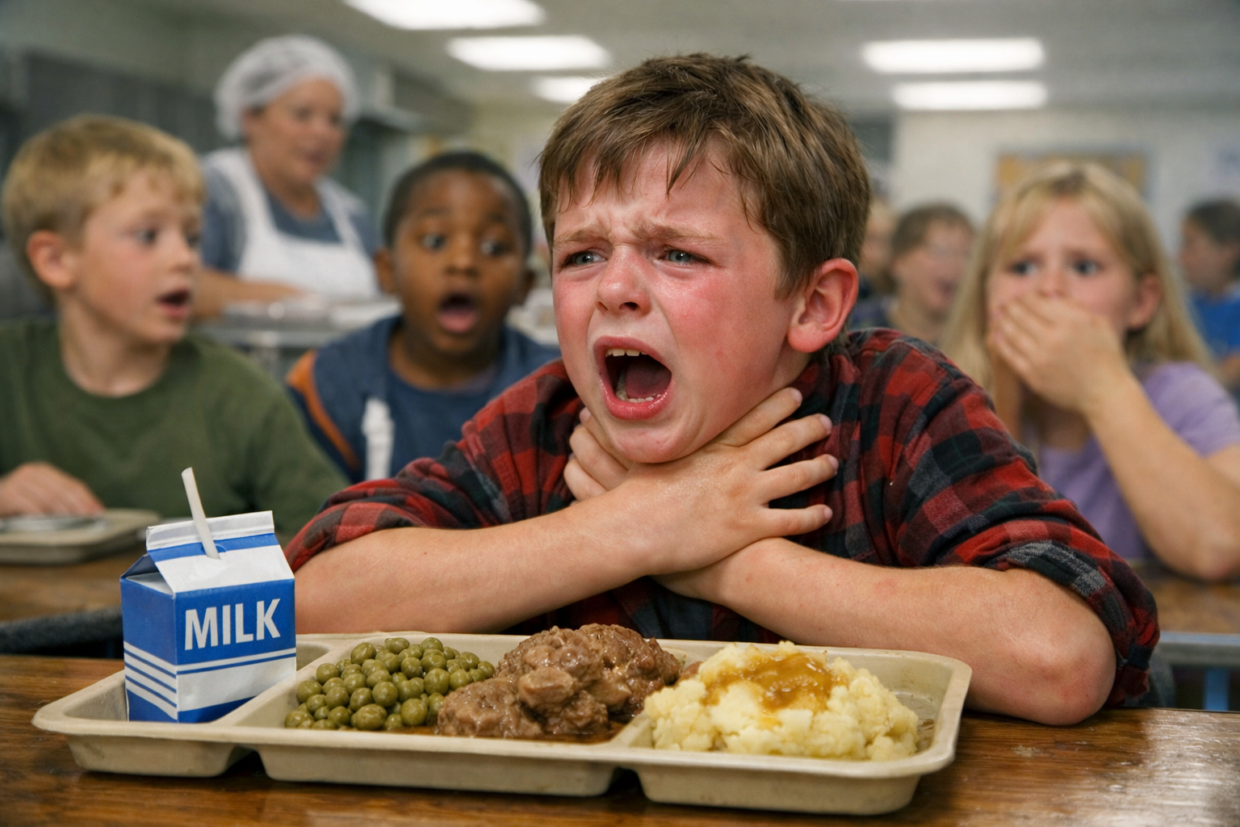
The lunch lady said “just eat what’s there”… But thirty seconds later, Mason couldn’t breathe.
Paul stood in the cafeteria doorway, watching Mason navigate the lunch line with his usual careful precision. His eleven-year-old son knew the routine better than most adults—scan the menu board, locate his name on the special dietary list, wait for the designated safe meal.
Mason approached the serving counter where Thompson, the cafeteria manager, was ladling soup into bowls with mechanical efficiency.
Mason: Mrs. Thompson, I need my allergy meal please.
Thompson glanced up briefly, her expression already showing irritation.
Thompson: We’re out of those special meals today. Just pick something else.
Paul felt his stomach drop. He stepped closer to the serving line, close enough to hear every word but still maintaining the distance Mason had requested—he wanted to handle lunch interactions independently when possible.
Mason: But my dad talked to Principal Kumar yesterday. There’s supposed to be a safe meal for me every day.
Thompson continued serving other students, barely acknowledging Mason’s presence.
Thompson: Look, kid, I don’t have time for this. Just eat what’s there like everyone else.
Paul’s hands clenched involuntarily. The casual dismissal in Thompson’s voice triggered every protective instinct he possessed, but he forced himself to wait. Mason was learning to advocate for himself.
Mason: I can’t eat what’s there. I have a severe peanut allergy. It’s in my file.
Thompson finally stopped ladling soup and fixed Mason with an exasperated stare.
Thompson: Severe peanut allergy. Right. You kids and your made-up food problems. When I was your age, we ate what we were given.
Paul stepped forward, no longer able to remain silent.
Paul: Excuse me, but my son’s allergy is documented with the school. We have a 504 plan specifically covering his dietary needs.
Thompson turned her attention to Paul, her expression shifting to barely concealed hostility.
Thompson: And you are?
Paul: Paul Hughes, Mason’s father. We met during orientation in August when we went over his medical requirements.
Thompson’s eyes narrowed as if trying to place him, but Paul could see she had no recollection of their previous conversation.
Thompson: Well, Mr. Hughes, I’m telling you we don’t have any special meals today. Your son can eat a regular sandwich or go hungry.
The lunch line behind Mason was growing longer, and other students were beginning to stare. Paul could see his son’s shoulders tensing with embarrassment.
Paul: Could you please check your computer system? There should be an alert for Mason Hughes regarding his allergy.
Thompson sighed dramatically and turned to the computer terminal behind the serving counter. She pecked at the keyboard with two fingers, squinting at the screen.
Thompson: I don’t see anything here about allergies.
Paul moved closer to the counter, his voice remaining level despite his rising frustration.
Paul: The alert should be under his student ID number. Mason, what’s your ID?
Mason: 847291.
Thompson typed the numbers, paused, then shook her head.
Thompson: Nothing. No alerts, no special dietary needs. Looks like someone made a mistake in your paperwork.
But Paul caught a glimpse of the screen over Thompson’s shoulder. A red banner across the top clearly read “SEVERE NUT ALLERGY – NO EXCEPTIONS” in bold letters.
Paul: Mrs. Thompson, I can see the alert from here. It’s right there at the top of his profile.
Thompson’s face flushed slightly, but she didn’t back down.
Thompson: I don’t see any alert. And even if there was one, we’re out of special meals today. That’s just how it is.
The situation was escalating beyond Paul’s comfort zone. Other cafeteria staff were beginning to notice the commotion, but none stepped forward to assist.
Paul: Then Mason won’t eat lunch today. We’ll figure out another solution.
Paul placed his hand gently on Mason’s shoulder, preparing to guide him away from the serving line.
Thompson: Wait a minute. You can’t just leave. The kid needs to eat something.
She reached under the counter and pulled out a pre-wrapped sandwich, placing it on Mason’s tray with a satisfied smile.
Thompson: Here. Peanut butter and jelly. Classic kid food. He’ll be fine.
Paul’s blood turned to ice water. The sandwich Thompson had just placed on his son’s tray contained the one ingredient that could kill him within minutes.
Paul: Absolutely not. Remove that sandwich immediately.
Thompson crossed her arms, her stance becoming defiant.
Thompson: This is ridiculous. It’s just a sandwich. Stop being so dramatic.
Mason looked between his father and the cafeteria manager, confusion and fear evident in his young face.
Mason: Dad, I don’t want to eat it. It smells like peanuts.
Thompson laughed, a harsh sound that carried across the increasingly quiet cafeteria.
Thompson: It smells like peanuts because it IS peanuts. That’s what peanut butter is made of. You kids today are so sheltered.
Paul reached across the counter and removed the sandwich from Mason’s tray, his hands shaking slightly with controlled anger.
Paul: We’re done here. Mason, let’s go to the office and call your mother.
Thompson stepped around the serving counter, blocking their path to the exit.
Thompson: You’re not going anywhere. That boy is going to eat lunch, and he’s going to eat what I give him. I’m not running a restaurant here.
The confrontation had drawn the attention of nearby teachers and students. Paul noticed Ms. Carter, Mason’s homeroom teacher, approaching from across the cafeteria.
Carter: Is everything okay over here?
Paul: Mrs. Thompson is trying to force Mason to eat a peanut butter sandwich despite his documented severe allergy.
Carter’s expression immediately shifted to alarm.
Carter: Mason has a severe peanut allergy. It’s noted in all his files. Mrs. Thompson, you should have his special meal prepared.
Thompson’s defiance wavered slightly under Carter’s professional concern.
Thompson: We don’t have any special meals today. The delivery was short.
Carter: Then you contact the main office immediately. Mason cannot consume anything with peanuts or peanut oil. This is a life-threatening situation.
But Thompson’s pride had been challenged in front of too many witnesses. Instead of backing down, she doubled down on her position.
Thompson: Life-threatening. Sure it is. These helicopter parents have convinced their kids that every little thing will kill them.
She grabbed the sandwich from Paul’s hands and unwrapped it, holding it toward Mason.
Thompson: One bite. That’s all. Prove to your dad that you’re not going to die from a sandwich.
Paul stepped between Thompson and his son, his voice dropping to a dangerously quiet level.
Paul: If you come one step closer to my child with that sandwich, I will have you arrested for assault.
The threat hung in the air like a physical presence. Other conversations in the cafeteria had stopped entirely, and Paul could feel dozens of eyes focused on their confrontation.
Thompson: Assault? For offering a kid lunch? You people are insane.
She moved around Paul, still holding the sandwich, and placed it directly in front of Mason on the lunch table.
Thompson: Eat it, kid. Stop being such a baby.
Mason stared at the sandwich with genuine terror. His breathing had become shallow, and Paul could see the beginning signs of an anxiety response.
Paul: Mason, step away from the table. Now.
But in the chaos of the moment, with adults arguing around him and other students staring, Mason’s coordination faltered. His elbow bumped the sandwich, and a small piece of peanut butter transferred to his skin.
The reaction was almost instantaneous.
Mason’s hand began to redden and swell where the peanut butter had made contact. He looked down at his skin with the dawning realization of what was happening.
Mason: Dad, my hand is burning.
Paul’s training as a parent of a severely allergic child kicked in immediately. He grabbed Mason’s backpack and retrieved the emergency EpiPen from the front pocket.
Paul: Sit down, Mason. Right now. Don’t touch your face.
Carter: I’m calling 911.
She pulled out her cell phone and began dialing while Paul assessed Mason’s condition. The redness was spreading up his arm, and Mason’s breathing was becoming labored.
Thompson stood frozen, the sandwich still in her hands, as the reality of the situation finally penetrated her stubborn denial.
Thompson: It’s just a little red spot. He’s being dramatic.
Paul ignored her completely, focusing on his son’s rapidly deteriorating condition.
Mason: Dad, I can’t breathe right.
Paul: I know, buddy. I’m going to give you the EpiPen now. It’s going to help.
He removed the safety cap and positioned the auto-injector against Mason’s thigh. The familiar click of the mechanism engaging was followed by Mason’s sharp intake of breath.
Paul: Ten seconds, Mason. Count with me.
They counted together, Paul’s voice steady despite his racing heart. Around them, the cafeteria had erupted into controlled chaos as staff members cleared other students away from the immediate area.
Carter: Ambulance is on the way. ETA four minutes.
Principal Kumar appeared at Paul’s shoulder, having been summoned by the emergency call.
Kumar: What happened here?
Paul: Mrs. Thompson ignored Mason’s documented allergy and tried to force him to eat a peanut butter sandwich. He had contact exposure.
Kumar’s face went pale as he processed the information.
Kumar: Mrs. Thompson, is this accurate?
Thompson: I didn’t force him to do anything. He bumped into the sandwich himself.
The EpiPen was beginning to take effect, and Mason’s breathing was slowly improving. But Paul knew they weren’t out of danger yet—secondary reactions were always possible.
Paul: The ambulance needs to take him to Children’s Hospital. Dr. Roberts is his allergist there.
Kumar: Of course. Mrs. Thompson, we need to discuss this situation immediately after the paramedics arrive.
Thompson: Discuss what? It was an accident. The kid barely touched the sandwich.
Carter: Mrs. Thompson, there’s a red alert on Mason’s file specifically warning about peanut exposure. How did you miss that?
Thompson: I looked at his file. There was nothing there.
But Carter had already pulled up Mason’s information on her tablet, and she turned the screen toward Kumar.
Carter: The allergy alert is right here. It’s been in the system since August.
Kumar studied the screen, his expression growing increasingly grave.
Kumar: Mrs. Thompson, this alert is impossible to miss. It appears at the top of every page in Mason’s file.
The sound of sirens was growing louder outside, and Paul felt some of his tension ease. Professional medical help was almost there.
Mason: Dad, the burning is getting better.
Paul: Good, buddy. The paramedics are going to check you over and make sure everything’s okay.
Two paramedics entered the cafeteria with their equipment, moving efficiently toward Mason’s location. Paul provided them with a quick summary of the exposure and treatment while they began their assessment.
Paramedic Johnson: Blood pressure’s elevated but stable. Respiratory function is improving. We’ll transport for observation.
Paul: I’ll ride with him.
Kumar: Mr. Hughes, I want you to know that we take this incident extremely seriously. There will be a full investigation.
Thompson: Investigation? Over a sandwich? This is completely blown out of proportion.
Kumar: Mrs. Thompson, please report to my office immediately. Do not discuss this incident with anyone else until we’ve completed our review.
The paramedics had Mason ready for transport within minutes. As they wheeled him toward the exit, Paul turned back to address Kumar.
Paul: Principal Kumar, I’ll be contacting our attorney once Mason is stable. This level of negligence is unacceptable.
Kumar: I understand completely. We’ll cooperate fully with any investigation.
Thompson: Attorney? You’re suing the school because your kid has a food allergy?
Paul: I’m protecting my son from staff members who ignore medical alerts and endanger student safety.
The ambulance ride to Children’s Hospital took twelve minutes. Mason’s condition remained stable, but the paramedics maintained continuous monitoring as a precaution.
At the hospital, Dr. Roberts met them in the emergency department. She had been Mason’s allergist since he was diagnosed at age three.
Dr. Roberts: How much contact exposure?
Paul: Small amount on his hand. Reaction started within thirty seconds. I administered the EpiPen immediately.
Dr. Roberts: Good response time. We’ll keep him for observation for four hours to monitor for any secondary reactions.
While Mason was being settled into an observation room, Paul called his wife to explain the situation. Her reaction was immediate and furious.
Mark: She did what? After we specifically met with her in August?
Paul: The principal is conducting an investigation, but I think we need to consider legal action.
Mark: I’m leaving work now. I’ll be there in twenty minutes.
Dr. Roberts returned with Mason’s test results and treatment plan.
Dr. Roberts: All his vitals are stable. The EpiPen prevented the reaction from progressing to anaphylaxis. He was very lucky.
Paul: Lucky that I was there to intervene. If this had happened when I wasn’t present…
Dr. Roberts: I understand your concern. I’ll document everything in his medical record. This information may be useful if you decide to pursue legal action.
Mark arrived at the hospital with a folder full of documentation—copies of Mason’s 504 plan, medical records, and correspondence with the school district.
Mark: I’ve been on the phone with our attorney. She wants to meet with us tomorrow morning.
Paul: What did she say about the case?
Mark: That ignoring documented medical alerts constitutes negligence, especially when it results in injury to a student.
Dr. Roberts discharged Mason after four hours of observation. His condition had returned to normal, but she prescribed additional emergency medications as a precaution.
Dr. Roberts: I’m also writing a letter to the school district recommending additional staff training on allergy management.
The family returned home that evening emotionally exhausted but grateful that Mason’s reaction had been contained quickly.
The next morning, Paul received a call from Principal Kumar.
Kumar: Mr. Hughes, I wanted to update you on our investigation. Mrs. Thompson has been placed on administrative leave pending a full review.
Paul: What did the review find?
Kumar: That she deliberately ignored the allergy alert on Mason’s file and attempted to force him to consume a known allergen despite multiple warnings.
Paul: And what consequences will she face?
Kumar: That decision will be made by the district office, but I can tell you that her employment with our school system is under serious review.
The meeting with their attorney confirmed what Paul and Mark had suspected—they had a strong case for negligence against both Thompson and the school district.
Attorney Lewis: The documentation is clear. The school had a duty to protect Mason’s safety, and that duty was breached through deliberate indifference to his medical needs.
Lewis: We’ll file suit against the district and pursue both compensatory and punitive damages.
Paul: We want to make sure this doesn’t happen to another child.
Lewis: That’s exactly what punitive damages are designed to accomplish—to deter future negligent behavior.
The lawsuit was filed within a week of the incident. The local news picked up the story, and community reaction was overwhelmingly supportive of the Hughes family.
Three months later, Thompson was terminated from her position with the school district. The district also implemented mandatory annual training on food allergy management for all cafeteria staff.
The legal case settled out of court for an undisclosed amount, with the district admitting no wrongdoing but agreeing to enhanced safety protocols for students with severe allergies.
Mason returned to school with a renewed sense of confidence in his ability to advocate for his safety needs. The incident had been traumatic, but it had also demonstrated that adults would take action to protect him when his safety was threatened.
Paul: How do you feel about eating lunch at school now?
Mason: Better, I guess. The new cafeteria manager actually knows my name and always has my safe meal ready.
Paul: And you know that if anyone ever ignores your allergy again, you can call me immediately.
Mason: I know, Dad. But I think people will take it more seriously now.
The experience had changed their family’s relationship with Mason’s allergy management. What had once felt like a private medical concern was now understood as a community responsibility requiring vigilance from everyone involved in Mason’s care.