




Kenichi Ebina introduces his act as a “dance ish performance.” Then he drops his head below his shoulders, falls flat toward the floor and springs back up. By the time he bends backward in slow motion, as though dodging a bullet in The Matrix, the modest description has become part of the joke.
“I thought your head had come off your body,” one judge tells him. “It was that convincing.” Ebina has used his own body to create the kind of effect audiences expect a filmmaker to build in an editing room.
That gap between an ordinary introduction and an extraordinary performance runs through this nearly 83-minute talent-show compilation. A juggler, twin domino builders and a man with a ladder arrive with familiar tools. The judges have seen those tools before. What they struggle to anticipate is how far each performer can take them.
A body that refuses to behave
Ebina says he began with one step, the running man. People cheered when he did it, and he liked the feeling. His audition takes that early reward much further: each apparent collapse requires him to remain in control, while his slow-motion movement makes the audience wait for a fall that never quite arrives.
The judges praise his storytelling as much as his technique. One describes the routine as an entire Matrix movie compressed into ninety seconds. After four yeses, Ebina still needs someone backstage to explain that he is going to Vegas. His bewilderment gives the performance a second, gentler ending.
The Mayyas, a dance troupe from Lebanon, create their illusions through collective control. Standing in formation, they seem to give one dancer a multitude of arms. Later, they spread feather props into a peacock-like tail behind the lead performer. Each dancer has to hold her place for the audience to see the larger shape.
Before dancing, a member explains that the group’s name refers to the proud walk of a lioness. She also describes the limited support for female Arab dancers and says they want to show “the arts we can create, the fights we fight.” Their ambition gives the formation another dimension: individual women working together to claim a stage.
Simon Cowell tells them the performance will “make a difference” in positive ways. Sofia Vergara answers with the Golden Buzzer. Confetti falls over the dancers who, moments earlier, had moved with such exact agreement.
The ladder and the falling balls
Uzeyer arrives with a different model for holding an audience. He says he discovered Charlie Chaplin at fifteen and admired how much Chaplin could communicate through movement. Now thirty-nine and living in Las Vegas, he apologizes for his speech while explaining that he will perform on a freestanding ladder.
He has spent fifteen or twenty years climbing ladders, he says. The years become easier to understand when he balances high above the stage without a support, then pushes into a handstand atop two stilts on the ladder. His comic uncertainty at the microphone has given way to an exacting physical task.
“If Charlie Chaplin and Mister Bean had a child that ran off to join the circus,” a judge tells him, “I think that would be you.” The comparison fits the combination of awkward charm and practiced balance. He earns four yeses.
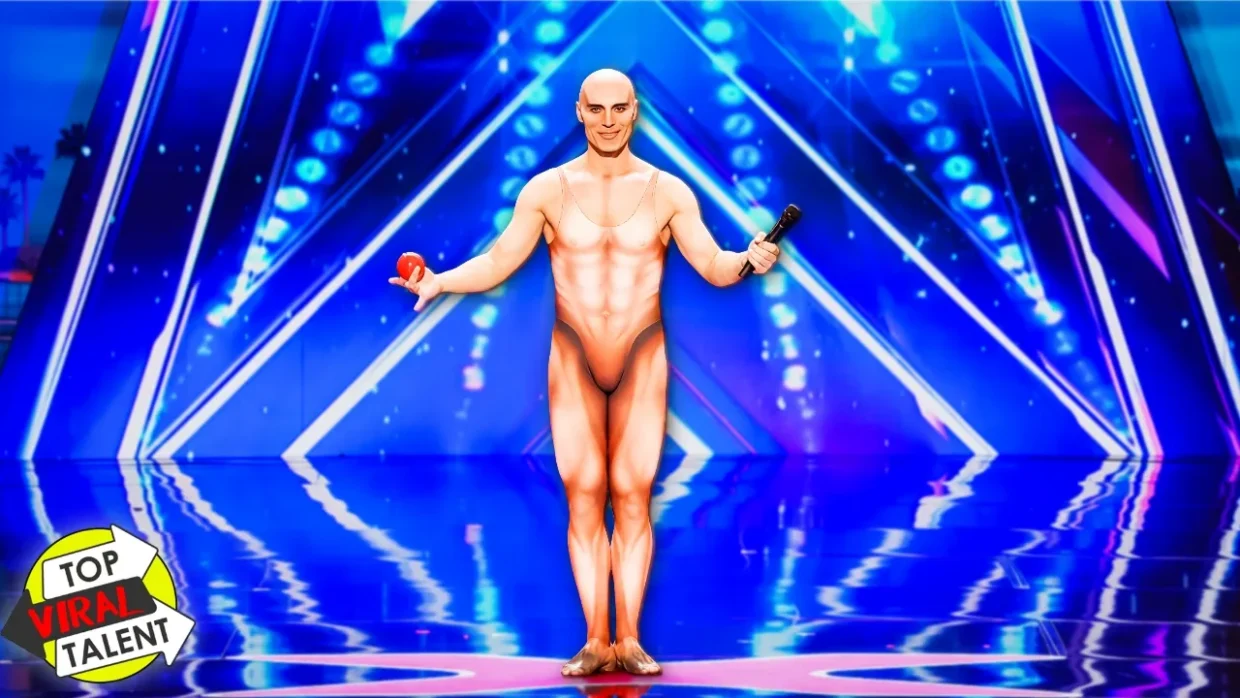
Viktor Kee, introduced as Victor, makes juggling equally difficult to dismiss. Born in Ukraine, he says his brother took him out of kindergarten to see a juggling show when he was five. At forty-five, he performs in a full-body muscle-illusion suit, combining white balls, body rolls and acrobatic flips.
Cowell admits that he normally hates jugglers. Watching Kee, he says, felt like watching an Olympic athlete win gold. Heidi Klum is captivated by the balls descending from overhead. Kee has made catching and throwing feel strange again, even to people paid to watch performers every day.
When the audience has to stay quiet
Derek and Alex, twenty-three-year-old twins from Sioux Center, Iowa, ask for something most contestants would dread: an empty theater. Their act, DAX Domino’s, requires an overnight build with 10,000 dominoes. They estimate thirteen or fourteen hours of work.
The brothers work in marketing and build domino arrangements as a side business. Here, the preparation becomes part of the performance. They worry about stray movement, inspect connections and argue as the deadline approaches. One accidental touch could send whole lines down before anyone returns to watch.
When the audience comes back, the host asks people not to applaud the judges’ entrance. The judges walk through the course. Paper cups topple, prompting alarm, though the domino setup survives. Someone points out that the floor is bouncy.
By then, the viewer has seen enough of the work to understand the brothers’ nerves. The danger is losing a night’s labor in a second. After the countdown, a heavy red ball rolls into an American flag made of dominoes. Later, a small firework burst triggers tall towers to collapse through smoke.
The brothers say this particular build is not a record. They would like to attempt one if they advance. Having watched them check the final connections under pressure, it is possible to picture what a larger attempt would demand.
What the judges cannot explain
Other performers make the judges question what they can verify from their seats. Mel B covers Marina’s eyes with both hands. Later, James unfolds a dollar bill and confirms Marina’s exact recitation of its serial number. The confirmation gives the audience something specific to puzzle over: a string of digits on a bill.
Darcy Oake works with more traditional stage-magic materials. He lights a paper match and appears to turn the flame into a live dove. Later, he drops a cloth over an empty table; a woman appears standing on it. The visible change happens far faster than the audience can account for it.
Balloon Taro takes a less dignified route to disbelief. He removes his tracksuit to reveal a bodybuilder’s physique, then squeezes his whole body inside a giant red balloon. An assistant uses an oversized mallet to knock foam blocks from beneath it. The spectacle depends on a ridiculous object and the performer’s willingness to disappear inside it.
A voice, a piano and a sword
The video also gives space to performers whose work needs no apparent disappearance. Lost Voice Guy delivers comedy through a tablet synthesizer. Kodi Lee sings while playing piano. Gabrielle Union presses the Golden Buzzer for Lee, and golden confetti falls around him and his family.
Physical balance returns in other forms. Young Darby stands on one foot in a coach’s raised palm. A couple performs synchronized contemporary dance while clinging to an upright climbing wall. The wall changes the conditions for every movement: holding a position becomes part of the choreography.
Aaron Crow brings the compilation to a more uneasy test of trust. He pours candle wax over his eyes and wraps his head in foil. Later, blindfolded, he swings a sword through a pineapple resting directly on Howie Mandel’s head. Mandel’s proximity gives every movement a consequence the audience can immediately grasp.
Watch the full video for the buildup as well as the feats: Ebina’s hesitant definition of his act, the twins checking their last domino connections and Uzeyer explaining his devotion to Chaplin. Those introductions give you time to form an expectation before each performer gets to work.