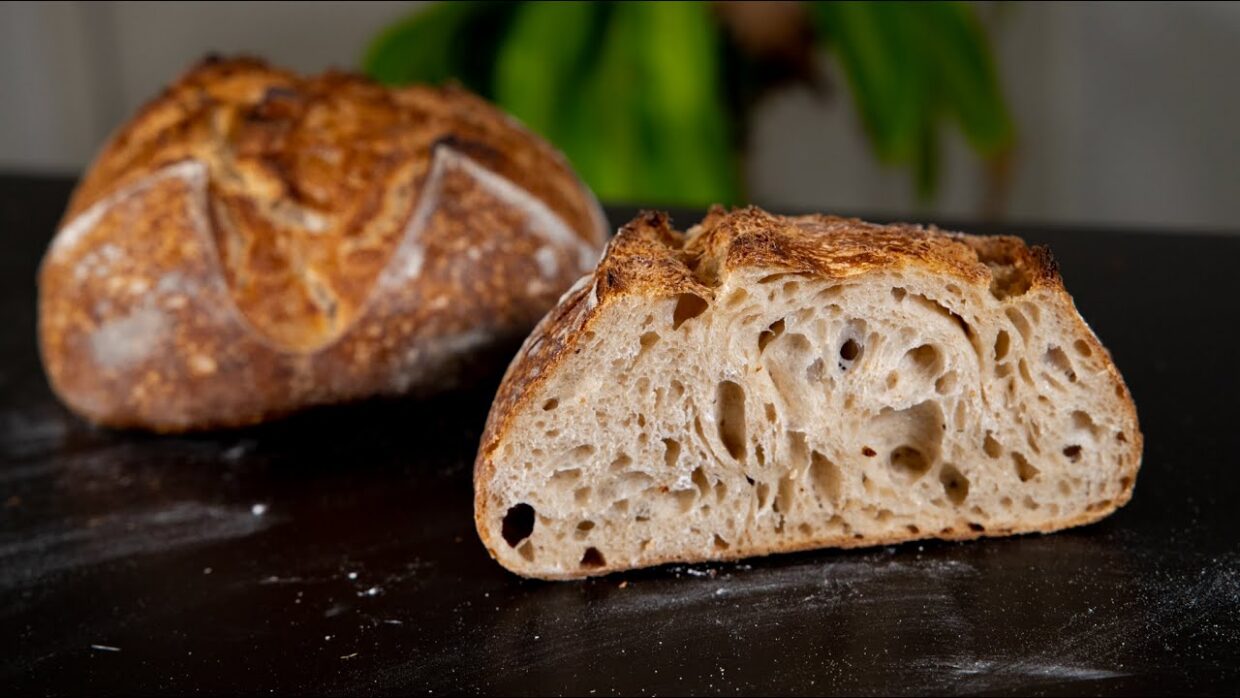
Good sourdough does not require a bakery or a commercial steam oven. This loaf follows the Tartine-style country bread method, and the process is deliberately simple: build a levain the night before, mix a soft dough, develop strength with folds, shape, chill, and bake in a Dutch oven. The dough is 77% hydration, a friendly starting point that is slack enough for an open crumb but still manageable. The batch is divided into three smaller loaves rather than two larger ones, so there is plenty to share. Most of the clock is hands-off. Once the rhythm is clear, the same steps can be repeated and adjusted.
Why This Method Works
The levain is the engine. A small amount of active starter is refreshed with whole wheat flour, white flour, and water, then left at about 70°F for roughly 12 hours until doubled and able to float. That ripe levain goes into the dough at about 200 grams, so fermentation begins evenly instead of relying on a tired starter.
An autolyse of 20 to 40 minutes lets the flour hydrate before salt arrives. Salt is dissolved in the final 50 grams of water and added afterward because it hinders the flour's ability to absorb water. The finished dough lands near 77% hydration, meaning 77 grams of water for every 100 grams of flour. Five sets of folds, starting with stretch and folds and moving to gentler coil folds, build tension while preserving the air the dough develops. In a hot Dutch oven, trapped steam keeps the crust soft long enough for oven spring; removing the lid later dries and darkens the crust.
Ingredients and Practical Swaps
Use a scale if you can; sourdough rewards precision. For the levain, combine 50 grams active starter with 40 grams whole wheat flour, 40 grams unbleached white flour, and 80 grams water. The white flour can be bread flour or all-purpose. For the dough, use 700 grams water at about 85°F, the full levain, 900 grams unbleached bread flour, and 100 grams whole wheat flour. Finish with 50 grams water mixed with 20 grams salt.
The whole wheat is there to give the yeast more nutrition during fermentation, not to make a heavy loaf. The main dough calls for unbleached bread flour, while the small amount of white flour in the levain can be bread flour or all-purpose. The 20 grams of salt is a solid starting point and can be adjusted to taste over time. Rice flour is the best choice for dusting proofing baskets and loaves, though other flour can work. Higher hydration can be explored later, but it makes the dough stickier and harder to handle.
Tips for a Reliable Rise
Keep the dough warm during bulk fermentation, ideally around 85°F. An oven with the light on is a workable substitute, as long as the oven stays off. After the third set of stretch and folds, the dough becomes softer and airier, so switch to coil folds and handle it gently. Let the bulk rise run about two hours, with a fold every 25 minutes, until the dough is 20 to 30 percent larger. If it is not there, give it another 25 minutes and another set of coil folds.
During shaping, create tension without tearing the surface. A taut ball holds its structure; a slack one spreads into a pancake. Rest the shaped balls for 20 to 30 minutes, then shape into batards or boules. Put them seam side up in a well-floured proofing basket and cover them so they do not dry out. The cold proof can last 3 to 12 hours. Four hours gives a moderate tang and a strong rise; longer makes the bread more sour, but past 12 hours the yeast activity declines. Preheat the Dutch oven at 500°F for at least 30 minutes, score the loaf about half an inch deep, and bake covered for 20 minutes. Then remove the lid, reduce to 450°F, and bake 15 to 20 minutes more, rotating halfway, until deeply browned. Do not fear a little char; it brings flavor and crackle. Cool on a wire rack for at least 30 minutes before cutting.
Storing the Loaves
The recipe makes three loaves, giving you extra to share. Let every loaf cool completely on a wire rack; the interior is still finishing as it cools, and cutting early can leave it undercooked. Wait at least 30 minutes, or up to a few hours. Once fully cool, keep the loaves whole and slice only what you plan to eat so the crumb stays moist and the crust stays crisp. A crisp crust suffers when a loaf is wrapped while warm, so wait until there is no warmth left. Reheat slices in a hot oven or toaster to bring back the crackle.
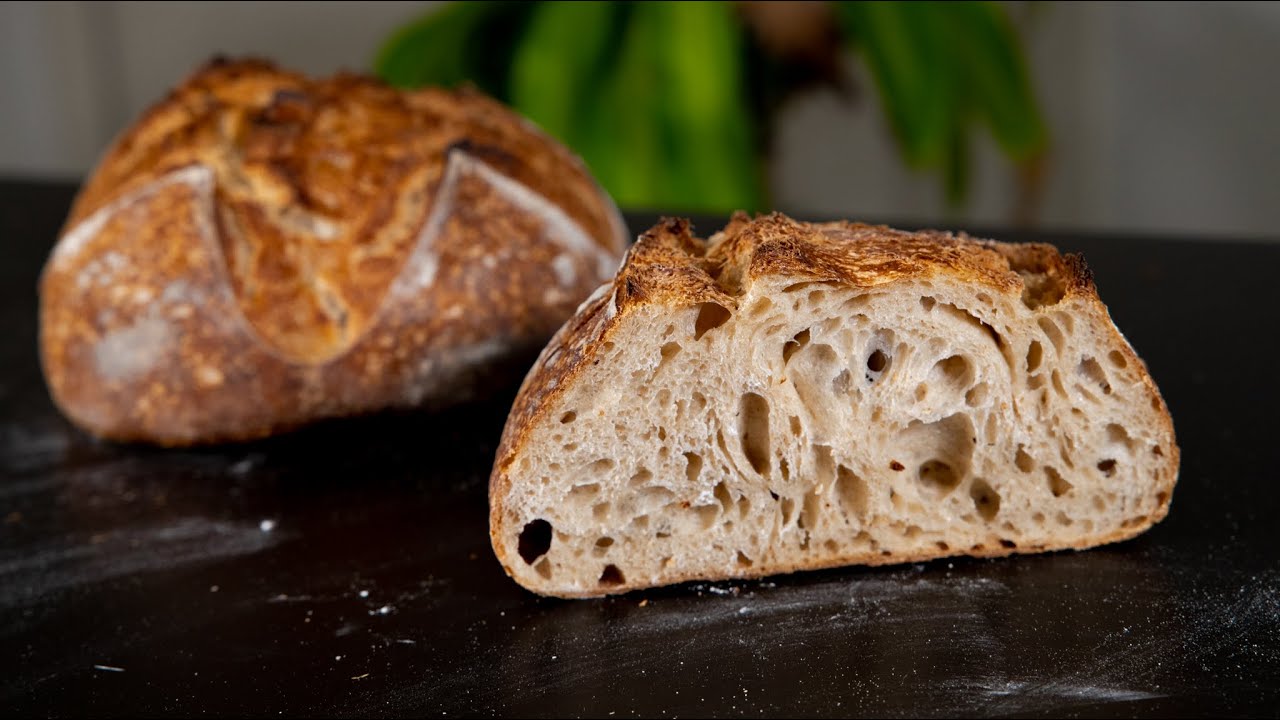
Easy Sourdough Bread: Tartine-Style Country Loaves
Ingredients
Method
- Mix 50 g active starter, 40 g whole wheat flour, 40 g unbleached white flour, and 80 g water in a clean jar until incorporated. Leave at about 70°F (21°C) for roughly 12 hours, until doubled and a small spoonful floats in water.
- In a large bowl, combine 700 g water at about 85°F (30°C) with the full levain, about 200 g, and stir to disperse. Add 900 g bread flour and 100 g whole wheat flour and mix until the flour is saturated and a shaggy ball forms. Cover and autolyse for 20 to 40 minutes in a warm spot near 85°F (29°C).
- Dissolve 20 g salt in 50 g water. After the autolyse, dimple the dough, add the salt mixture, and fold it in until evenly incorporated. The final hydration is about 77 percent.
- Transfer the dough to a clear container or leave it in the bowl. Cover and bulk ferment for about 2 hours in a warm place, performing five sets of folds every 25 minutes. Use eight stretch-and-folds around the perimeter for the first three sets; after the third, flip the dough and use gentler coil folds for the last two sets.
- At the end of bulk fermentation the dough should look soft, airy, and 20 to 30 percent larger. If it is not ready, give it another 25 minutes and another set of coil folds. Let it relax for about 10 minutes.
- Turn the dough onto a very lightly floured surface and divide it into three pieces. Shape each piece into a taut ball with a bench scraper, using a quarter turn and scrape motion. Cover and rest for 20 to 30 minutes.
- For final shaping, dust the tops, flip the loaves unfloured side up, and lightly wet the work surface if needed for traction. For a batard, spread the dough into a wide rectangle, fold the near edge over the middle, fold the left and right sides in, then fold the two far corners toward the middle like a paper airplane. Roll and tuck into a tight loaf, drag it on the surface to build tension, and close the seam. For a boule, pull the far corners all the way over as you flip the dough right side up, then drag it to round it out.
- Flour a proofing basket generously with rice flour, or use a towel-lined bowl. Place the loaf seam side up, pinch any open seams closed, dust with more rice flour, and cover with a food-safe plastic bag. Repeat with the remaining loaves.
- Refrigerate the loaves for 3 to 12 hours. About 4 hours gives a moderate tang and a reliable rise; longer proofing increases sourness, but past 12 hours the yeast activity declines.
- Place a Dutch oven in the oven and preheat to 500°F (260°C) for at least 30 minutes. Unwrap one loaf, dust it with rice flour, and place it in the hot pan. Score a batard with one half-inch-deep slash down the middle, or score a boule in a cross. Cover and bake for 20 minutes.
- Remove the lid, reduce the oven to 450°F (230°C), and bake for 15 to 20 minutes more, rotating halfway, until the crust is deep dark brown with charred edges. Bake the remaining loaves the same way, reheating the Dutch oven to 500°F between batches.
- Transfer the bread to a wire rack and cool for at least 30 minutes, or up to a few hours, before slicing. The loaf should sound hollow when tapped on the bottom.
Video: "EASY SOURDOUGH BREAD RECIPE | TARTINE BASIC COUNTRY BREAD" by The Regular Chef (https://www.youtube.com/watch?v=hNzJLP61nnQ), licensed under Creative Commons Attribution license (reuse allowed) — https://creativecommons.org/licenses/by/3.0/