Patricia sat at her desk. She pulled out Ethan’s grade report and stared at the row of red marks she’d given him over the last three weeks. Missing assignments. Incomplete work. Distracted behavior.
She opened her desk drawer and took out a red pen. Then she stopped.
No. Not red.
She took out a blue pen and began writing notes next to each assignment. “Excused – family emergency.” “Excused – extenuating circumstances.” One by one, she cleared the marks that had punished a child for grieving.
When the bell rang, she didn’t move. The students filed out. The classroom emptied.
Her phone buzzed. A text from an unknown number.
“This is David Chen. Principal Warren called. Thank you for letting Ethan leave early. He’s with his wife now. She loved the drawing.”
Patricia closed her eyes. She typed back: “I’m so sorry I didn’t know sooner. Please let me know if there’s anything I can do.”
The reply came a minute later. “You already did.”
That evening, Patricia sat at her kitchen table and wrote an email to the entire staff. She explained what had happened. She outlined a new protocol: any family emergency reported to the school would be immediately forwarded to all teachers, with a follow-up call to confirm receipt. No more messages lost in inboxes. No more children slipping through cracks.
She copied the superintendent.
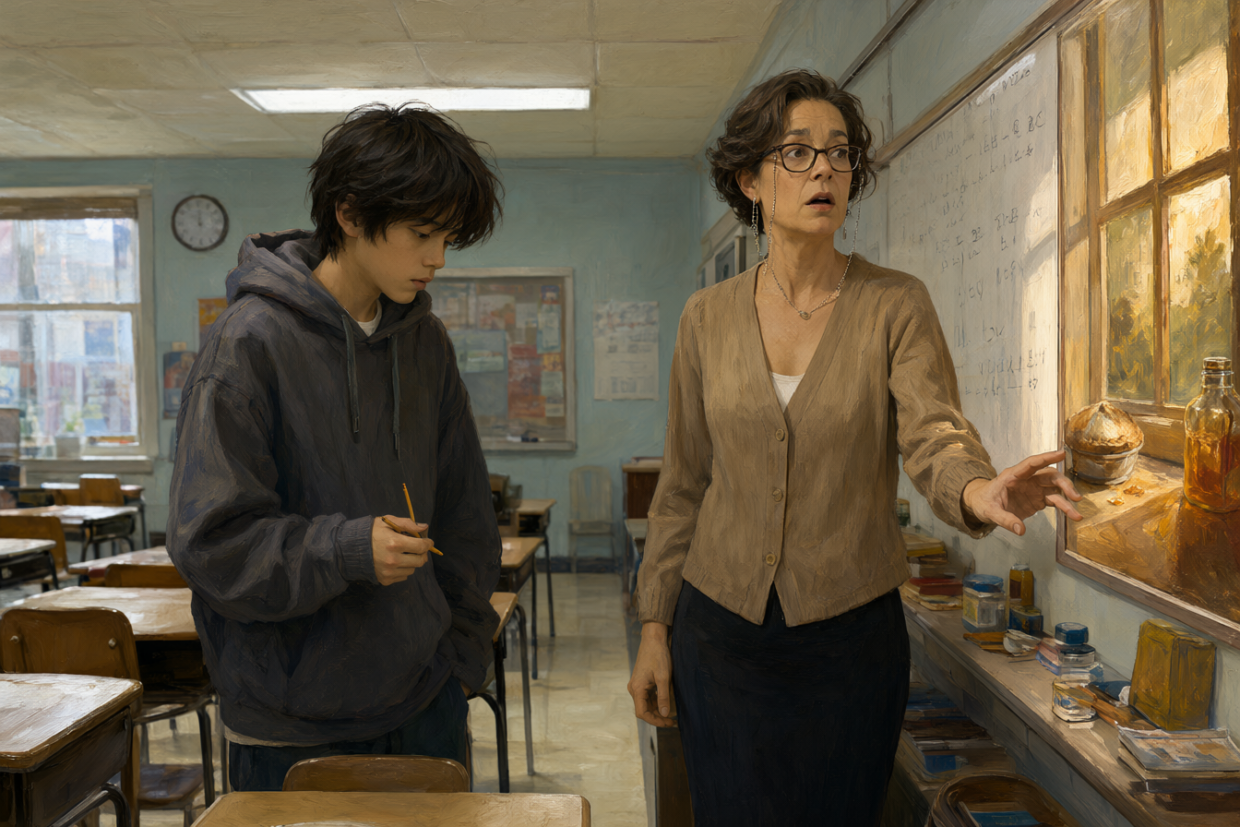
The next morning, she arrived at school an hour early. She went to the art supply closet and pulled out a stack of sketch paper, a new set of pencils, and a wooden drawing box. She wrote Ethan’s name on the box and placed it on his desk.
When Ethan walked in at 8:15, he stopped. He stared at the box.
“You can draw whenever you need to,” Patricia said. “In my class. Any time.”
Ethan’s eyes filled with tears. He didn’t say anything. He just nodded.
For the next two weeks, Ethan drew every day. Sometimes during lessons. Sometimes during independent work. Patricia never stopped him. She adjusted his assignments, gave him extensions, and checked in with him quietly at the end of each day.
The other students noticed. At first, they whispered. Then one girl, Aisha, asked why Ethan got to draw when they didn’t.
Patricia took a breath. “Ethan’s mom is very sick. Drawing helps him feel close to her. If any of you ever need to do something like that, you can. My job is to teach you. But it’s also to make sure you’re okay.”
Aisha went quiet. She nodded. So did the rest of the class.
On April 3rd, Ethan didn’t come to school.
Patricia knew before the office called. She felt it in her chest the moment she saw his empty desk.
David Chen called her that afternoon. “Lily passed away last night. Ethan was with her. He showed her every drawing he’d made. She remembered all of them.”
Patricia’s voice broke. “I’m so sorry.”
“She told him he was the best artist she’d ever seen,” David said. “She told him to keep drawing. No matter what.”
“He will,” Patricia said. “I promise.”
The funeral was on April 7th. Patricia attended. So did Principal Warren. So did Aisha and three other students from the class, with their parents.
Ethan stood at the front of the service and held up a drawing. It was his mother in the garden behind their house, surrounded by flowers, smiling in the sun. No hospital bed. No IV. Just her, whole and happy.
“This is how I’m going to remember her,” Ethan said.
The room was silent except for the sound of people crying.
After the service, Ethan walked up to Patricia. He handed her a small folded piece of paper.
“This is for you,” he said.
Patricia unfolded it. It was a drawing of her, standing in front of a classroom, smiling. At the bottom, in careful letters: “Thank you for letting me remember.”
Patricia hugged him. She didn’t care who saw. She held him while he cried into her shoulder, and she cried too, for all the time she’d wasted not seeing him.
When the school year ended in June, Ethan’s grades had recovered. He passed fifth grade. On the last day, he gave Patricia a drawing of his mother holding a diploma. “She wanted to see me graduate fifth grade,” he said. “Now she has.”
Patricia framed it. She hung it in her classroom, right next to her desk, where she would see it every single day.
And every year after that, on the first day of school, Patricia told her new students the same thing: “If you’re going through something hard, tell me. If you need to draw, or write, or just sit quietly, tell me. I’m not just here to teach you math. I’m here to see you.”
She never assumed again.
And she never confiscated another drawing.
The end