
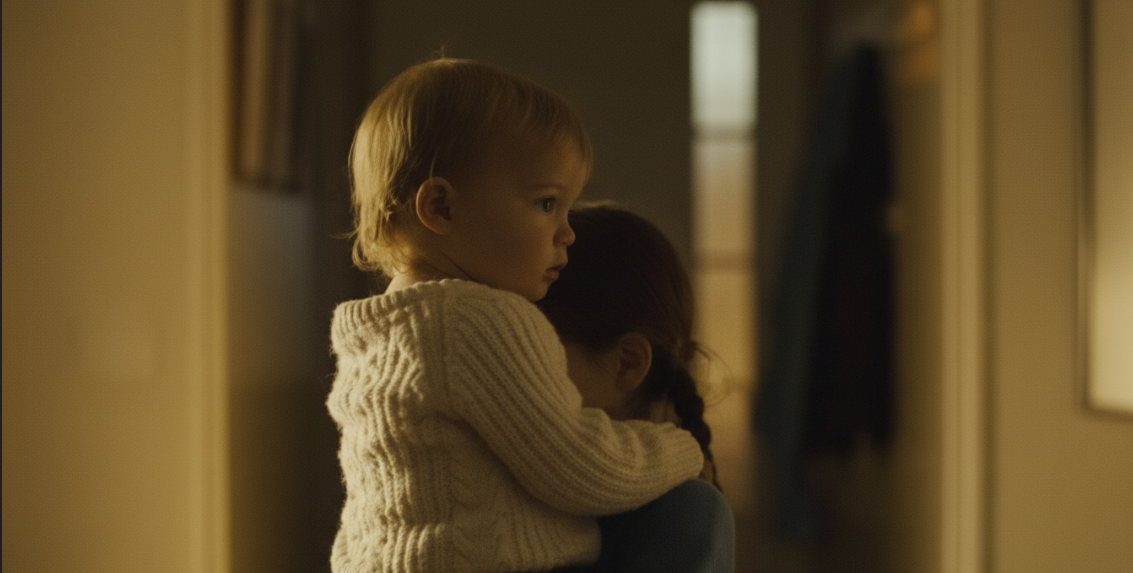
The house was too quiet for evening. The kind of silence that comes not because everyone is asleep, but because no one knows what to say.
Lena held her brother tightly, but carefully. She already knew the difference. If she held him too loosely, he would start searching the room for their mother. If she held him too tightly, he would feel fear. He was only two years old, but he already knew how to read the air.
He was looking toward the hallway. The place where their mother always appeared. Tonight, there were no footsteps.
“It’s okay,” Lena whispered, though she wasn’t sure who she was saying it to. Her brother, or herself.
She grew older that evening. Not in years, but in responsibility. In the quiet decision that no one spoke out loud, but everyone accepted. She became the one who holds. The one who stays calm while everything inside tightens.
Her brother placed his small, warm hand on her arm. He wasn’t crying. He was just watching. The way children watch when they don’t yet have words for what they feel.
Somewhere in another room, adults were talking. In whispers. Sharply. With pauses. Lena didn’t listen to the words. She listened to the tone. That was enough.
She thought that if she let her brother go, the world might fall apart.
So she didn’t.
Sometimes love looks exactly like this:
not like a smile,
not like a promise,
but like a quiet “I’m here,”
when no one else is.
And that was enough to keep the night from becoming frightening.
Children hear everything. They just pretend they don’t.
Lena sat on the edge of the couch, Noah asleep against her chest. His breathing was slow now. Safe. She focused on it the way people focus on waves when they’re afraid of drowning.
Voices came from the kitchen. Low. Tight. Broken into pieces.
“You can’t just—”
“I didn’t have a choice—”
“They’re children.”
Lena didn’t need the rest.
She stared at the wall and memorized a crack shaped like a lightning bolt. If she remembered it long enough, maybe the moment would pass.
She felt something unfamiliar settle in her chest. Not panic. Not sadness.
Responsibility.
It didn’t ask permission. It just arrived.
The next morning, Noah asked the question.
“Where mama?”
Lena froze for half a second. That was all childhood gave you before answers were required.
“She’s busy,” Lena said.
It was the first lie she told for love.
Noah nodded. He accepted it. That hurt more than if he hadn’t.
She made him cereal. Too much milk. He liked it that way. She learned details fast now. Preferences mattered when stability didn’t exist.
When he smiled at her with milk on his lip, something twisted in her chest. A promise formed without words.
She would not let him feel alone.
Not if she could help it.
Days passed. Then more.
Lena learned how to carry groceries and a toddler at the same time. She learned how to wake up when Noah cried at night before anyone else did. She learned how to listen for footsteps that might never return.
Adults talked less now. Silence grew thicker.
One evening, Noah reached up and touched her cheek.
“You sad?”
Lena swallowed.
“No,” she said.
The second lie.
He hugged her anyway. His arms were small. They were enough.
Lena stood in front of the bathroom mirror one night, Noah asleep in the next room. She barely recognized the girl staring back.
Her face looked older. Not in years. In knowing.
She understood now that some people leave not because they don’t love, but because they don’t know how to stay. That understanding hurt more than anger ever could.
She turned off the light and walked back to Noah.
She lay down beside him on the floor, just in case he woke up scared.
If childhood had to end early, she decided, then she would make something stronger out of it.
Not perfect. Not easy. Just enough.