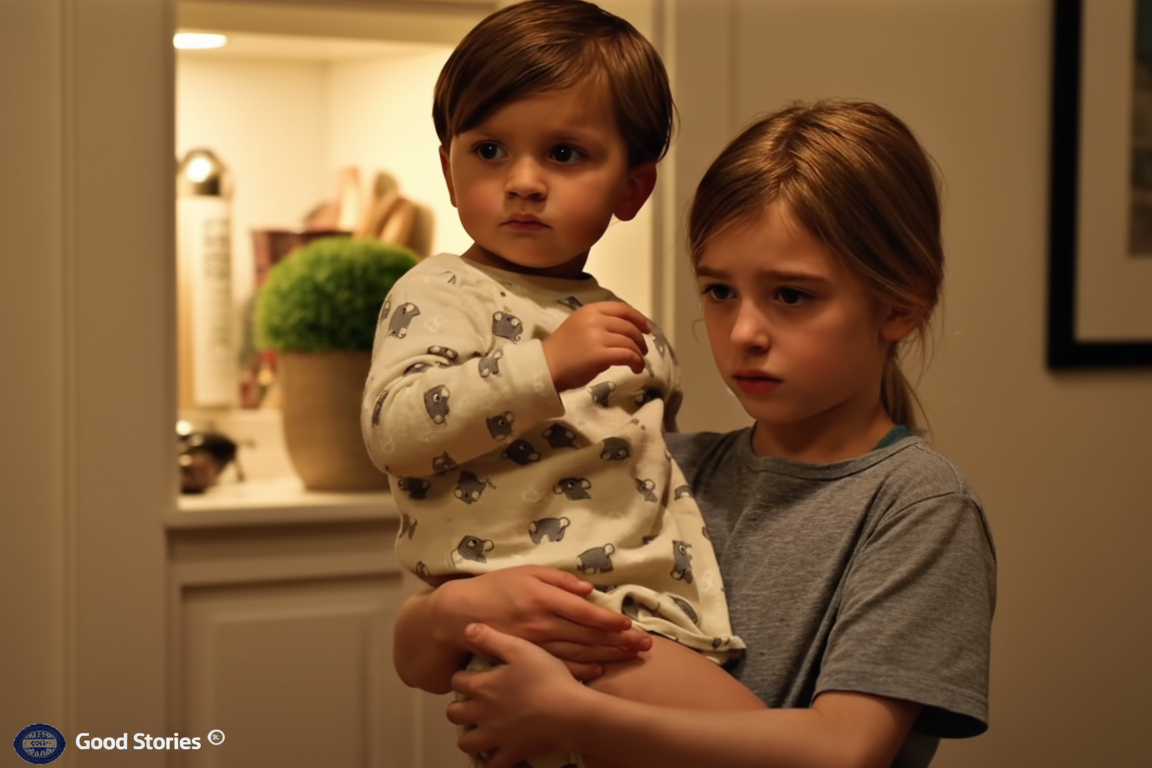


First Episode(Story) CEO Returns Home Early—What His Wife Did to Their Kids Left Him Frozen here.
5 Years Later, She Sent ONE Letter That Made His Blood Run Cold Again
The park smelled of fresh grass and damp earth. Thomas sprinted down the path like he was proving the world one simple rule: he was alive.
I stood by the bench with a paper cup of coffee, pretending I was relaxed. In reality, I was still counting exits, cameras, faces. A habit doesn’t die. It just learns how to smile.
Emma sat beside me, sketching in her notebook. At first glance she looked like a normal teenager: headphones, hood up, that “don’t talk to me” expression. But I saw what other people didn’t. The way she automatically chose a seat with a full view of the playground. The way she noted anyone who lingered too long. The way she scanned.
Her childhood hadn’t disappeared. It had simply turned into a skill.
Thomas ran back, stopped in front of us, and panted,
“Dad, look!”
He lifted a stick like it was a sword.
“I won!”
“I saw,” I said, ruffling his hair. “You’re a champion.”
He took off again, and I exhaled deeper than usual.
Emma looked up from her notebook.
“You’re counting again,” she said quietly.
“Counting what?”
“How many people are around. Where the cars are. Where the exits are.”
I didn’t answer right away. Because truth sounds too loud when you say it out loud.
“Sometimes,” I said, “your brain thinks that if it controls everything… nothing bad will happen.”
Emma nodded, not arguing. Then she flipped the page and showed me a drawing.
Three figures. Me, her, and Thomas. Holding hands. But around us there weren’t walls. There was a circle. Like a boundary. Like protection.
“What’s that?” I asked.
“That’s… safe,” she said. “That’s what it looks like.”
My throat tightened. That feeling rose up inside me, the one you can’t name. Too much all at once.
And then my phone buzzed.
A message from Harold. One sentence.
“They’re transferring her. There’s a parole hearing.”
I read it twice. Then again. The words didn’t change.
Emma noticed the shift in me.
“Who?”
I wanted to lie. I wanted to keep this day normal. I wanted to pretend the past didn’t know how to come back.
But one of our rules was: we don’t keep inside what makes us small again.
“They’re moving Victoria,” I said. “There’s a chance she’ll ask for leniency. Or… release.”
Emma didn’t go pale. She just went still.
“Can she get out?” she asked.
“Not right now,” I said quickly. “It’s a process. And we have evidence. We have people. She won’t be able to play the victim like before.”
Emma dropped her eyes to the notebook.
“She’ll try anyway.”
“Yeah,” I said. “She’ll try.”
Thomas laughed in the distance. Pure. Loud.

And I understood the real problem.
The past comes back not because it’s stronger.
But because it wants to take what you built.
I looked at Emma.
“We’ll do everything right,” I said. “But together. You hear me?”
She nodded. Then asked, almost in a whisper,
“Will I have to speak?”
“Only if you want to,” I said. “And only if it’s safe for you.”
Emma clenched her pencil.
“I don’t want Thomas to know at all.”
I shook my head.
“He knows you saved him. He just doesn’t know what from yet.”
We both went quiet.
Then Emma tore a sheet out of her notebook, folded it in half, and handed it to me.
A short sentence was written in her handwriting, like a contract:
“If she comes back, we won’t be scared in silence again.”
I took it, my fingers trembling.
“Deal,” I said.
For the first time in the whole conversation, Emma smiled for real.
“Deal.”
Thomas ran up to us, glowing.
“Dad, can we go home? I want more pancakes.”
I looked at him. At Emma. At the paper in my hand.
“Home,” I said. “And the pancakes will be normal. No ‘rustic’ ones.”
Emma snorted.
We walked to the car, and I noticed the cameras, exits, faces again.
But for the first time in a long time, it wasn’t from fear.
It was because I was truly guarding my life.
We got home, and the house greeted us the way only “new” houses can: silence without memories, and the smell of pancakes I promised would be normal (and of course I almost ruined the first batch).
Thomas sat at the table, swinging his legs and telling Emma how he “outran the wind.” Emma listened, nodded, but her fingers kept twisting the edge of her sleeve. Her body was doing what it did best: checking if it was safe.
I placed my phone face-down on the counter.
As if that could undo Harold’s message.
But it couldn’t.
An hour later
Harold showed up in person. That was a bad sign. Harold doesn’t come in person unless something smells like fuel.
He stepped into the kitchen, saw the three of us at the table, and paused for a second. His face softened. Then it snapped back into “lawyer.”
“The parole hearing is set for three weeks from now,” he said. “Technically that doesn’t mean she’ll be released. It means she’s going to try.”
“She always tries,” Emma said.
Harold looked at her with a kind of respect adults rarely give kids. Because he could see it: she wasn’t a child. She was someone who survived.
“Yeah,” Harold said. “And she has a new plan.”
He opened a folder. On the top page was a printed headline:
“Billionaire’s ex-wife asks for case review. New details.”
That old wave of rage rose up in me. The kind that makes the world narrow.
“She’s going to the press again,” I said.
“Through intermediaries,” Harold corrected. “Again. The usual: ‘she changed,’ ‘she got treatment,’ ‘she was in crisis,’ ‘she’s asking forgiveness,’ ‘it was more complicated.’ They’ll try to sell her as… a tragic figure.”
“She’s not tragic,” I said. “She’s dangerous.”
Harold nodded.
“So we do two things. First: legal. Second: security.”
Emma looked up.
“Can she come to us?”
“There’s a no-contact order,” Harold said. “But orders only work on people who have a conscience.”
I rubbed the bridge of my nose.
“What about security?”
“Cameras,” Harold listed. “Alarm system. School check. Routes. And one important thing: no freelance hero moves. No ‘I’ll handle it myself.’ Everything goes through police and through me.”
I looked at Emma.
She looked at me.
We both knew that was the hardest rule.
The next day
I met Detective Morrison at a small café where the coffee was bad, but the cameras worked.
“Is she trying to play ‘new Victoria’?” Morrison asked.
“Yeah.”
Morrison smirked with one corner of her mouth.
“They all do. In prison they learn the right words. ‘Trauma.’ ‘Mistakes.’ ‘Growth.’ ‘Awareness.’ It’s a dictionary for people who want out without becoming different.”
She scrolled through a file on her tablet.
“Good news: that PR contractor who helped her before… he’s cooperating. And another thing: we have info someone from her circle tried asking about your kids’ school.”
Something inside me went cold.
“Asking how?” I asked.
“Indirectly. Through third parties. ‘Just curious.’ But people are rarely curious out of love for education.”
I squeezed my cup.
“What do I do?”
Morrison looked straight at me.
“What you’re doing now: stay close. Keep the system switched on. The most dangerous time is when victims start living normally again. Abusers hate that.”
I nodded without speaking.
“And one more thing,” she added. “We can strengthen the no-contact order and include indirect attempts. If she tries through someone else, it becomes a violation. It’s a good trap.”
“Do it,” I said. “Please.”
Two weeks before the hearing
The strangest part was how normal life kept going.
Thomas was learning multiplication and proudly getting every other answer wrong. Emma started going to an art class. She wasn’t drawing people. She drew doors. Windows. Spaces.
One evening she came to me with a sheet of paper.
“I wrote it,” she said.
“What?”
“A statement for court. If needed.”
I took it. My hands suddenly felt heavy.
There was no hysteria. No “feel sorry for us.” Just truth.
And one line that hit harder than everything else:
“I don’t want my silence to be used against me again.”
I set the paper down slowly.
“You don’t have to,” I said.
“I know,” she answered. “But I want them to hear it. Not her. Me.”
I nodded.
And for the first time in a long while, I felt more than fear. I felt pride.
The day before the hearing
Late at night, a letter arrived. Paper. No return address.
Inside was one sentence, printed:
“You won’t be able to keep them forever.”
The world narrowed again.
I didn’t show the letter to the kids.
I drove to Morrison.
She looked at it without changing expression and said,
“Thanks. This is very convenient.”
“Convenient?” I repeated, not believing her.
“Convenient,” she said. “Because it’s pressure. Pressure right before the hearing. We’ll file it as an incident and add it to the record. It’s not a ‘scare note.’ It’s evidence.”
She lifted her eyes.
“And yes: it means her ‘new version’ is starting to crack.”
Hearing day
The room wasn’t like the movies. No dramatic music. Just air conditioning, paper, and people tired of other people’s stories.
They brought Victoria in wearing neat clothes. Hair pulled back. Calm face. She looked… correct. Like a “rehabilitation” poster.
She saw me and smiled. Small. Warm.
Like we’d met at a gala, not after what she did.
I didn’t smile.
Harold leaned in:
“Don’t react. She wants emotion. Any emotion.”
I nodded.
The chair asked about prison work, therapy, “awareness,” “plans.” Victoria answered perfectly. Too perfectly.
“I want to start over,” she said softly. “I want to heal. I want to be useful. I understand I caused pain.”
The words were pretty. Empty.
Like a staged house with no furniture.
Then it was our turn.
Harold presented medical documents, reports, recordings, financial trails. Dry. Point by point. Exactly how it should be when it’s reality, not theater.
And then… Emma stood.
I wanted to stop her.
But she was already walking.
She took the microphone, a small figure in an oversized room.
She didn’t look at Victoria.
She looked at the board.
And she started to read.
Her voice trembled at first, but after a few lines it steadied. Not because it was easy. Because she decided: no one would take her voice again.
She spoke about fear. About how hard it is to believe in safety. About how easily adults believe “beautiful words” when they’re spoken in the right tone.
And at the end she said:
“I’m not asking for revenge. I’m asking for boundaries. So she’s not near us. Ever.”
When Emma stepped back, the room went quiet.
Not movie quiet.
Real quiet.
The kind where everyone suddenly feels ashamed they ever doubted.
Victoria still sat straight. But her fingers clenched so hard her knuckles turned white.
The chair looked at the documents, then raised his eyes.
“We have additional material regarding intimidation and indirect contact attempts,” he said. “This is inconsistent with the rehabilitation you claim.”
For the first time all day, Victoria lost control.
Just for a second.
Her eyes turned sharp. Cold.
“That’s… not true,” she said. And her voice cracked, the anger under the velvet showing. “He’s destroying me. He turned the children against me. He…”
Harold whispered,
“There she is.”
The chair raised a hand.
“Enough.”
Decision
Denied.
No drama. No applause.
Just: parole not approved, the no-contact order expanded, any attempts through third parties will be treated as violations.
As they led her away, Victoria tried to put the smile back on.
But it didn’t fit anymore.
She leaned close as she passed, quiet enough that only I could hear:
“You think this is the end?”
I didn’t answer.
Because the ending didn’t belong to her.
The ending belonged to us.
That evening
We were back in the kitchen.
Thomas ate a pancake and bragged about how he “defeated the court with his breathing” (he had no idea where we’d been, and it was better that way).
Emma sat nearby, exhausted. But there was something new in her eyes.
Not fear.
Silence without panic.
I took the paper she’d given me earlier.
And I pinned it to the fridge next to our “house rules.”
Emma noticed.
Snorted.
But didn’t take it down.
“You did good,” I said.
“Don’t make it a holiday,” she muttered. Then a pause. “But… thanks. For showing up. And for not speaking for me.”
I nodded.
“I’m learning.”
Thomas поднял вилку:
“Can we go to the park tomorrow?”
I looked at both of them.
“We can,” I said. “And I’ll be watching.”
Emma raised an eyebrow.
“You always watch.”
“Yeah,” I admitted. “But now it’s not from fear.”
I pretended the pancake was perfect.
It wasn’t.
But we ate, laughed, and in this house there was something you couldn’t buy with any amount of money: