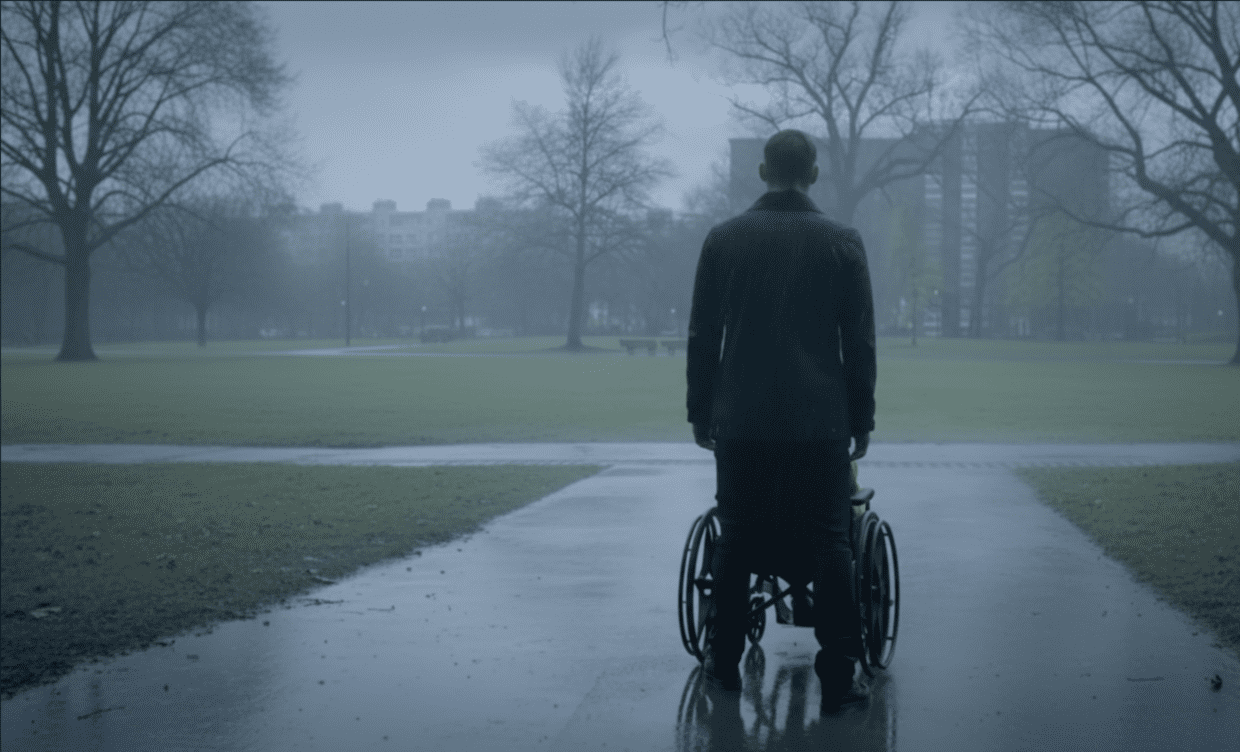
A homeless kid collapsed after making Lily’s toes move… But the “neighborhood watch” leader who called him a fraud got exposed as the real criminal cover-up.
Lily hadn’t walked in three years.
“Incomplete spinal injury,” the neurologist said. “We don’t know what you’ll get back.”
Mark heard something else: “This is your new life.”
Every Sunday, Mark pushed Lily to the same downtown Phoenix park bench like it was a job.
“Don’t stare at the kids,” Mark said gently.
“I’m not,” Lily lied, watching a little girl sprint across the grass.
Mark adjusted Lily’s blanket even though it wasn’t cold. “We’re fine.”
“We’re not,” Lily whispered.
A shadow fell across them.
A boy stood in front of the bench—maybe ten, maybe eleven. Torn shirt. Barely any shoes. Dirt in the lines of his face like he’d slept in it.
Mark didn’t even let him speak. “We don’t have money.”
The boy shook his head once. “I don’t want money.”
“Then go.”
“I can help her walk.”
Lily’s breath caught like she’d been punched.
Mark stood up so fast the bench scraped. “No. Absolutely not.”
The boy didn’t flinch. “I’ve done it before.”
“Doctors couldn’t fix her,” Mark snapped. “Specialists. Surgery consults. Millions we didn’t have.”
“I’m not a doctor,” the kid said.
“Then what are you?”
The boy pulled a worn photograph from his pocket. Two images taped together. A girl in a wheelchair. Then the same girl standing, smiling like she owned the sun.
“My sister,” he said quietly.
Lily reached out, hands shaking. “Can I…?”
The boy held it out carefully. “Yeah.”
Mark wanted to tear it in half. “Pictures prove nothing.”
“I know,” the boy said. “I’m not asking you to believe me. I’m asking for five minutes.”
Mark laughed, but it came out raw. “Five minutes buys us what? Another heartbreak?”
Lily’s voice cracked. “Dad… please.”
Mark looked at his daughter’s face—that careful hope she tried to hide so it wouldn’t get crushed again.
“Five minutes,” Mark said. “That’s it. You touch her, I call the cops.”
The boy nodded fast. “I won’t touch her.”
They moved to a quieter patch of grass. Mark stayed close enough to grab the kid by the collar if he tried anything.
“What’s your name?” Mark asked.
“Eli.”
“Where are your parents, Eli?”
Eli’s eyes flicked away. “Not here.”
Mark clenched his jaw. “Tell me exactly what you’re doing.”
Eli crouched in front of Lily, hands visible, palms up like he was surrendering. “I’m going to help her brain talk to her legs again.”
Mark scoffed. “That’s called physical therapy.”
“Yeah,” Eli said, and for a second he looked older than ten. “But you stopped believing it could work.”
Lily swallowed. “I never stopped.”
Mark glanced at her. “Lil—”
“I didn’t,” she insisted. “I just… got tired.”
Eli picked up a small stone and pressed it gently against the toe of Lily’s sneaker.
“Can you feel that?” he asked.
Lily frowned hard. “Barely.”
“That’s good,” Eli said. “That means the line isn’t cut. It’s just quiet.”
Mark crossed his arms. “Doctors said the same thing.”
Eli looked up at him. “Then they were right. It’s still there.”
He turned back to Lily. “Close your eyes.”
Lily hesitated. “What if this is… stupid?”
“Then you open them and you tell me to get lost,” Eli said. “No harm.”
Lily shut her eyes.
Eli’s voice dropped, soft but steady. “Don’t think about walking. Think about your feet. Like they’re still yours.”
Mark muttered, “Her feet are still hers.”
Eli didn’t look away from Lily. “Not if she stopped talking to them.”
Mark’s anger flared—and then died when Lily’s breathing changed. Slower. Deeper. Like she was dropping into water.
“I feel warm,” Lily whispered.
Mark leaned forward. “Lily?”
“Heavy,” Lily said. “My legs feel… heavy.”
Eli exhaled like that was the goal. “Heavy means awake.”
Mark swallowed. “This is insane.”
Eli’s eyes flicked up. “Then stop me.”
Mark didn’t move.
“Try to move your toes,” Eli said. “Just one. Not your whole foot. One toe.”
Lily’s face tightened. Her fingers curled around the wheelchair armrest so hard her knuckles went white.
Seconds passed.
Nothing.
“That’s enough,” Mark said, sharp. “We’re not doing this.”
Lily whispered, “Wait.”
Eli held up a hand—still not touching her. “Don’t force it. Just ask.”
Mark blinked. “Ask?”
“Like they’re a scared animal,” Eli said. “You don’t chase it. You invite it.”
Lily’s voice was almost silent. “Come on.”
Mark stared at her shoes like if he stared hard enough he could will a miracle.
Lily gasped. “I— I felt something.”
Mark’s heart slammed. “Where?”
“My toe,” Lily said, tears spilling. “It— it twitched.”
Mark saw nothing. “Lil, are you sure?”
“I’m sure,” she said. “I swear.”
Eli leaned back like his knees might give out. Sweat dotted his forehead.
“That’s how it starts,” Eli whispered. “That’s all for today.”
Mark’s suspicion snapped back. “Why ‘today’? Why not keep going?”
Eli’s jaw tightened. “Because it takes… energy.”
“Your energy?” Mark challenged.
Eli stood too fast, swaying. “Not yours.”
Lily opened her eyes. “Eli, are you okay?”
“I’m fine,” he said, too quick.
Mark stepped between Eli and Lily. “What happened to your sister?”
Eli’s face went flat. “People didn’t let her finish.”
Mark’s stomach turned. “Who didn’t?”
Eli looked past Mark at the park, at the families, the strollers, the people who’d walk right by a kid like him and call it normal. “People who get scared when something doesn’t fit.”
Lily reached for Mark’s hand. “Dad… don’t send him away.”
Mark didn’t want to. That’s what terrified him.
“Where do you sleep?” Mark asked.
Eli’s voice went quiet. “Wherever there’s a light.”
Mark swallowed hard. “Be here tomorrow. Same time.”
Eli’s eyes widened like Mark had handed him a key. “You mean it?”
Mark nodded once. “Five minutes. Again.”
That night, Mark stared at the ceiling while Lily slept.
He kept replaying Lily’s voice: I felt it.
He kept hearing Eli: Heavy means awake.
He told himself it was placebo, desperation, wishful thinking.
But his hands shook anyway.
The next day, Eli was already waiting by the trees.
Mark didn’t let Lily see how relieved he was.
“You’re late,” Eli said.
Mark checked his watch. “I’m on time.”
Eli shrugged. “I got here early.”
Lily whispered, “Hi.”
Eli smiled at her like she mattered. “Hey.”
They did the same routine.
Stone. Shoe. Questions. Breath.
“Can you feel that?” Eli asked.
“More,” Lily said, stunned.
Eli nodded. “Good.”
Mark watched Eli’s face. The kid looked… thinner today. Like the wind could move him.
“Close your eyes,” Eli said.
Lily did.
“Ask your toe,” Eli whispered.
Lily’s lips trembled. “Please.”
Mark stared at her sneaker.
This time, he saw it.
A tiny movement. A twitch so small it could’ve been a lie—except it happened again, like the toe was answering.
Mark’s mouth fell open. “Oh my God.”
Lily sobbed. “I did it. Dad, I did it.”
Eli swayed like he might fall. He put a hand on the grass, breathing hard.
“Eli,” Mark said, voice suddenly careful. “You okay?”
“I’m fine,” Eli lied again, and Mark knew it was a lie because Eli couldn’t even lift his head.
A woman walking her dog slowed down. “Did you just—?”
A man on the path stopped, phone already rising. “Yo, that’s crazy.”
Mark’s instincts screamed. “We’re done. Now.”
Lily protested, “But—”
“Now,” Mark repeated, and Lily heard the fear in it.
Eli stood up too fast again. “Same time tomorrow?”
Mark hesitated. “Yeah.”
Eli’s eyes brightened for half a second. “Okay.”
On the third day, a police cruiser sat at the curb.
Mark’s stomach dropped before he even pushed Lily past the fountain.
Two officers stood near a small crowd. And at the center of it, like she’d arranged the whole scene, was Carol Henderson—fifty-three, the neighborhood watch coordinator who treated the park like her personal kingdom.
Carol’s voice carried. “There he is.”
Eli stood near the trees, frozen, hands tucked close to his body like he was trying to take up less space in the world.
Mark rolled Lily forward anyway. “What’s going on?”
One officer raised a hand. “Sir, we got reports of a child performing medical procedures.”
Mark barked, “He’s not doing procedures.”
Carol pointed sharply. “He’s telling disabled people he can cure them. That’s fraud. That’s predatory.”
Lily’s face flushed. “He’s helping me.”
Carol looked at Lily with fake sympathy. “Honey, he’s giving you false hope. That’s cruel.”
Mark snapped, “You don’t know my daughter.”
Carol leaned in like she was speaking to the crowd, not to them. “I know exploitation when I see it.”
The officer stepped forward. “Ma’am, sir, please stay calm.”
Eli took a small step back.
“Don’t move,” the second officer said, voice firm.
Eli’s breathing went shallow.
Mark saw it—panic rising in the kid’s throat like water.
The first officer softened his tone. “Son, where are your parents?”
Eli didn’t answer.
“Okay,” the officer said slowly. “We’re going to take you to child services, get you looked at.”
Eli’s eyes locked on Lily. “If I stop now… she won’t finish.”
Mark’s chest tightened. “Finish what?”
“Waking up,” Eli said, and his voice broke on the last word.
Carol threw her hands up. “Listen to him! This is sick!”
Mark took a step toward Eli. “Eli, look at me. What do you mean?”
Eli blinked too fast. His face went gray.
Then his knees buckled.
“Eli!” Lily screamed.
Mark lunged and caught him before his head hit the ground.
The kid weighed almost nothing. Just bones and heat.
“He’s burning up,” Mark shouted. “Call an ambulance!”
Carol backed up like illness was contagious. “This is exactly what I warned about. He’s a danger.”
Mark swung his head at her, eyes wild. “Shut your mouth.”
One officer was already on the radio. The other knelt. “Kid, stay with me.”
Eli’s lips moved. Mark leaned closer.
Eli whispered, “Don’t… let them… stop her.”
Mark swallowed hard. “I won’t.”
Lily cried, “Eli, please, please don’t die.”
Eli didn’t answer. His eyes rolled halfway closed.
The ambulance came fast.
As paramedics loaded Eli, Carol spoke to a man filming. “Make sure you get this. People need to see what happens when you let vagrants near families.”
Mark snapped, “Turn that off.”
The man hesitated. “It’s public—”
Mark stepped in, voice low and dangerous. “Turn. It. Off.”
The man lowered his phone.
At the ER, everything became doors and waiting.
Lily got rushed to neuro. Mark got told to sit. Mark didn’t sit.
A doctor finally approached, flipping through a chart like it offended her.
“Mr. Wilson?” she asked.
Mark stood instantly. “My daughter?”
The doctor looked unsettled. “She has voluntary motor function that wasn’t present in prior records.”
Mark’s throat closed. “You’re saying… it’s real.”
“I’m saying it’s documented,” the doctor replied carefully. “We’re repeating imaging and tests.”
“And Eli?” Mark asked, almost afraid to hear it.
The doctor’s face tightened. “The boy is severely malnourished. Dehydrated. Electrolytes are dangerous. His body is shutting down.”
Mark felt the room tilt. “He’s ten.”
“We’re doing everything we can,” she said.
Mark found Lily in a hospital bed, toes moving under the sheet like they couldn’t stop now that they’d started.
She laughed through tears. “Dad, look!”
Mark grabbed her hand. “I’m looking.”
Her smile vanished. “Eli?”
Mark forced the words out. “They’re working on him.”
Lily’s eyes filled. “He was sweating. I saw it.”
Mark swallowed. “Yeah.”
“Why didn’t you tell him to stop?” Lily whispered.
“Because I didn’t know,” Mark said, voice cracking. “I didn’t know what it cost him.”
Hours crawled.
Near dawn, a nurse walked in with a face that made Mark stand before she spoke.
“Mr. Wilson…” Her voice softened.
Mark stared at her. “No.”
The nurse shook her head once. “I’m sorry. His heart gave out.”
Lily made a sound Mark had never heard from her—a broken, animal sob—and Mark pulled her against his chest.
“I’m sorry,” Mark whispered into her hair, like saying it could do anything.
Lily choked, “He wanted nothing. He wanted nothing.”
Two weeks later, Mark sat in the hospital administrator’s office.
A man in a tie tapped a folder like it mattered more than what was inside it. “We need to discuss the incident.”
Mark’s eyes were dead tired. “What incident?”
“The child,” the administrator said. “Complaints were filed. Mrs. Henderson is claiming your family endangered a minor and allowed… unlicensed medical activity.”
Mark leaned forward. “He wasn’t unlicensed. He was starving.”
The administrator hesitated. “Regardless, we have liability concerns.”
Mark’s laugh was sharp. “Liability. That kid died in your ER and you’re worried about paper.”
The administrator’s jaw tightened. “Sir—”
Mark cut him off. “My daughter is walking.”
The administrator blinked. “That’s wonderful.”
“It’s because of Eli,” Mark said. “And Carol Henderson wants to turn him into a monster so she can feel righteous.”
The administrator spread his hands. “What do you want, Mr. Wilson?”
Mark didn’t answer right away.
He pictured Eli’s hands held up—palms open—like he knew the world wanted to accuse him.
He pictured the weight of Eli’s body in his arms.
“A memorial clinic,” Mark said finally. “Downtown. Free medical care. Shelter referrals. Food. Showers. Real help for homeless kids. And it’s in Eli’s name.”
The administrator stared. “That’s… a large request.”
Mark’s voice went ice-calm. “You’re a hospital. You take donations all day. Take one that matters.”
Silence stretched.
The administrator cleared his throat. “We can bring this to the board.”
Mark stood. “Bring it. And bring the complaints, too. Because if you put Eli on trial after he’s dead, I’ll make sure the public sees what you’re doing.”
Outside, in the therapy courtyard, Lily stood between parallel bars.
Mark watched through the glass as she took a step. Then another.
Her face twisted with pain and joy at the same time.
“Keep going,” her therapist said.
Lily whispered, “I am.”
Three months later, the clinic opened in a renovated building near the bus lines.
No fancy sign. No donor wall. Just a clean place with lights on and staff who didn’t look away.
On opening day, Carol Henderson showed up with a handmade protest sign and three friends who looked uncomfortable being there.
“This glorifies fraud!” Carol shouted. “That boy was a con artist!”
News cameras turned like sharks smelling blood.
Mark stood on the clinic steps.
Lily stood beside him.
No wheelchair.
Just a cane—and she barely leaned on it.
Carol pointed at Lily. “He died! That proves it was fake! He was sick and you let him—”
Mark’s voice boomed across the sidewalk. “He was sick because he was starving while you were busy policing parks like you owned them.”
Carol’s cheeks reddened. “How dare you.”
Lily lifted her chin. “How dare you talk about him like that.”
Carol smirked. “Sweetheart, you’re being manipulated.”
Lily’s grip tightened on her cane. “I can move my legs because he believed I could. You want to call that manipulation? Fine. I’ll take it.”
A reporter stepped in. “Mrs. Henderson, do you have proof he was committing fraud?”
Carol snapped, “He had no credentials.”
Mark said, “He had no bed.”
The crowd murmured.
Carol’s voice rose. “We have to protect families!”
Lily took one careful step forward, then another, putting herself closer to Carol than Mark liked.
Her voice stayed steady. “Protect them from what? A hungry kid who asked for five minutes and gave me my life back?”
Carol’s eyes darted to the cameras. “This is a stunt.”
Mark held up his phone. “Want to talk about stunts?”
Carol froze. “What is that?”
Mark turned the screen outward. “Security footage.”
Carol sneered. “From where?”
“From your neighborhood watch storage room,” Mark said. “The city auditor pulled it yesterday.”
Carol’s mouth opened—and nothing came out.
The reporter’s eyes widened. “City auditor?”
Mark nodded once. “Turns out when you file enough bogus complaints, you get attention.”
Carol barked, “That has nothing to do with—”
“It does now,” Mark said, and his voice cut like a blade. “Because while you were screaming about a homeless kid, your office was moving money.”
Carol’s face went tight. “That’s a lie.”
Mark tapped his screen. “It’s video of your son, Ryan Henderson, walking out with an envelope. Same day the neighborhood watch ‘donation jar’ went missing.”
Carol’s head snapped. “Ryan doesn’t—”
“And here,” Mark continued, swiping, “are the bank records the city subpoenaed. Deposits that match the missing amounts. Over eight thousand dollars.”
The crowd shifted.
Carol’s voice shook. “You can’t— you can’t show that.”
A second reporter pushed in. “Mrs. Henderson, is your son under investigation?”
Carol snapped at the officer standing nearby. “You. Do something.”
The officer didn’t move. His expression was blank in that way that meant: you’re not in charge here.
Mark looked at Carol, eyes hard. “You wanted to make Eli the villain because it was easy.”
Carol’s lips trembled with rage. “You’re disgusting.”
Lily said quietly, “No. You are.”
Carol jabbed a finger at Lily. “You think you’re so noble? You’re parading your disability for attention.”
Lily’s face went hot, but she didn’t break.
“I was paralyzed,” Lily said, loud enough for every camera mic. “I lived through the part where people pretended I wasn’t there. Don’t tell me what attention looks like.”
Mark lowered his phone. “You’re done, Carol.”
Carol lunged toward Mark like she might try to snatch the phone.
“Ma’am,” the officer warned.
Carol ignored him.
The officer stepped in and caught her wrist. “That’s enough.”
Carol shrieked, “Let go of me!”
The officer spoke into his radio. “I need a unit. Confirming subject is Carol Henderson. Connection to active embezzlement case.”
Carol went rigid. “Embezzlement? That’s— that’s not—”
A patrol car rolled up like it had been waiting around the corner.
One of Carol’s protest friends backed away, muttering, “I’m not part of this.”
Mark didn’t smile.
He just watched as Carol’s world finally treated her the way she’d treated a starving kid—like she was a problem to remove.
Carol hissed at Mark as the officer guided her toward the car. “You’re using that boy’s death!”
Mark stepped closer, voice low. “No. You did. You tried to weaponize him.”
Lily’s voice cut in, clear and shaking with anger. “Eli asked for five minutes. You tried to take his name away forever.”
Carol’s eyes flashed. “He was nobody.”
Lily lifted her cane like a pointer, not a weapon, and said, “He was somebody to me.”
The officer opened the car door.
Carol’s voice cracked. “You’ll regret this.”
Mark said, “I regretted not feeding him sooner.”
Carol was shoved into the back seat, still shouting, still trying to turn the cameras into her shield.
The door shut.
The sound was final.
The crowd went quiet.
A reporter turned to Mark. “Mr. Wilson… what do you want people to remember about Eli?”
Mark’s throat tightened, but he answered anyway.
“He didn’t ask for money,” Mark said. “He asked for time. And he gave everything back.”
Lily stepped forward without help.
Her cane stayed at her side, unused for three steps straight.
She faced the cameras. “If you want to be loud,” she said, voice firm, “be loud about the kids sleeping outside tonight. Be loud about the shelters that are full. Be loud about the way we look away.”
She looked toward the clinic doors.
“And if you want to honor Eli,” Lily finished, “walk in.”
Mark turned and opened the clinic door.
Inside, staff waited. Fresh blankets folded on a table. Hot food in warming trays. A nurse with kind eyes and tired hands.
A skinny teenage girl hovered at the entrance, clutching a backpack like it was her whole life.
She stared at Lily’s legs like she couldn’t process what she was seeing.
Lily smiled gently. “You hungry?”
The girl nodded once.
“Come on,” Lily said. “You’re safe in here.”
The girl stepped inside.
Then another kid.
Then another.
The cameras kept rolling, but Mark didn’t care anymore.
He followed Lily into the clinic and stopped by a framed photo on the wall near the front desk.
It was the worn picture Eli had shown them.
Two images taped together.
A girl in a wheelchair.
Then the same girl standing.
Under it, a simple plaque:
ELI’S FIVE MINUTES — FREE CARE FOR YOUTH IN CRISIS
Mark touched the frame lightly.
Lily stood beside him and whispered, “I’m going to walk every day.”
Mark’s eyes burned. “Good.”
“And I’m going to tell them his name,” Lily said.
Mark nodded. “Every time.”
Outside, the patrol car pulled away with Carol Henderson in the back seat, her shouting swallowed by glass and distance.
Inside, Lily walked—ten steps without the cane—straight toward a kid who needed help.
Mark finally let himself exhale.
Eli got his justice.
Lily got her legs back.
And Carol, the loudest accuser in the park, lost the only thing she ever truly wanted—control—while Eli’s name became a door that stayed open.