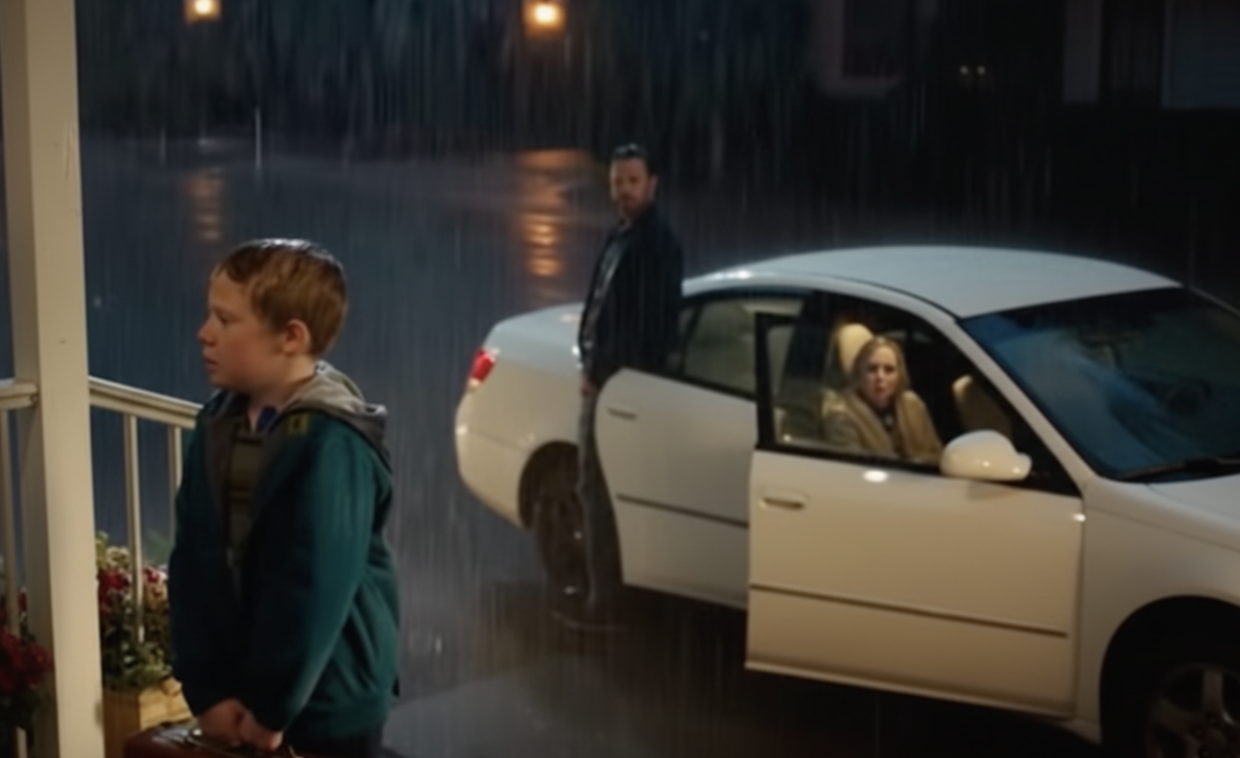
He dumped his seven-year-old stepson on a rainy porch… But twenty-one years later, the “bad luck kid” became the only man who could decide his fate. Full story in the comments.
The rain was so loud it swallowed everything else.
I was seven, buckled into the backseat, my forehead pressed to the cold window while streetlights smeared into orange lines.
Tom Harris drove like he had a deadline.
My mom sat up front like a statue, hands locked together, knuckles white.
I whispered, “Mom? Where are we going?”
Neither of them answered.
The windshield wipers squeaked like they were the only ones brave enough to talk.
When we stopped, I saw my grandparents’ porch through the downpour.
Tom killed the engine. No goodbye. No sigh.
He got out and yanked my little suitcase from the trunk.
He opened my door and said, “Out.”
I stared at him. “Did I do something?”
“Out,” he repeated, flat as a hammer.
I looked past him to my mom. “Mom?”
She finally turned, and her eyes were already wet.
“It’s better for you, Ethan,” she whispered.
My throat tightened. “Better how?”
Her voice broke. “You… you bring bad luck.”
I blinked like I could clear it away. “What does that even mean?”
Tom grabbed my suitcase and set it on the porch like it was a bag of trash.
My mom didn’t move from the seat.
I tried one more time, small and shaking. “Mom, please. Come with me.”
She didn’t look at me again. She just whispered, “I’m sorry.”
Then Tom got back in, the door slammed, and the car pulled away.
The taillights shrank until they were swallowed by rain.
I stood there until my sneakers filled with water and my teeth clacked.
The porch light flicked on. My grandpa opened the door, took one look at my face, and didn’t ask a single question.
He just said, “Hey, buddy,” like he’d been waiting.
My grandma wrapped me in a blanket and sat me by the heater.
She stroked my hair and whispered, “You’re safe.”
I didn’t cry that night.
Not because I was brave.
Because I couldn’t figure out how to breathe.
They never came back.
Not the next day. Not the next week. Not for birthdays, school plays, broken bones, or graduations.
I stopped asking after a while because asking felt like digging my own hole.
By fourteen, I learned two rules: never need anyone, and never let anyone see you bleed.
By eighteen, I was stacking boxes at dawn and washing dishes at night.
By twenty-two, I was driving freight runs in borrowed trucks, learning routes by heart, teaching myself contracts and fuel costs off YouTube and library books.
By twenty-eight, Northline Freight Solutions was doing thirty million a year.
People called me “self-made.”
They said, “Man, you’re lucky.”
I’d smile like that word didn’t make my stomach twist.
Lucky.
I’d been called the opposite my whole childhood.
Then last spring, I was in a quarterly briefing when my assistant buzzed me.
Her voice came through the intercom, thin and careful. “Ethan… there’s a couple here without an appointment.”
I didn’t look up from the numbers. “Tell them to schedule.”
She hesitated. “They said… they’re family. Their names are Tom and Linda Harris.”
My hand stopped moving.
The room felt like it lost oxygen.
I stared at the spreadsheet until the digits swam, then I heard my own voice like it belonged to someone else.
“Send them in.”
The conference room emptied. The glass walls suddenly felt like an aquarium.
When they walked in, time did a weird stutter.
Tom looked older, shoulders still squared like he was trying to threaten the air into respecting him. His hair had thinned, his face pinched.
My mother—Linda—looked smaller than I remembered, like the years had eaten her from the inside. Her eyes flicked around my office, landing on the framed articles, the awards, the skyline view.
Then she looked at me and started crying like it was reflex.
“Ethan,” she whispered, one hand over her mouth. “Oh my God.”
Tom didn’t cry.
He just nodded once, like we were at a hardware store and ran into each other in aisle three.
I stayed seated. I let the silence stretch until Linda’s sobs got quieter.
Finally, I said, “So you found me.”
Linda’s voice shook. “We didn’t know if we could.”
Tom cleared his throat. “We did.”
I nodded slowly. “Why are you here?”
Linda stepped forward, then stopped like she hit an invisible wall. “We need help.”
Tom’s jaw tightened, but he didn’t deny it.
I gestured to the chairs without warmth. “Sit.”
They sat like they were afraid the chairs might accuse them.
I didn’t offer water. I didn’t offer coffee.
Linda wiped her cheeks. “I’ve wanted to come for years.”
I let out a short laugh. “No you didn’t.”
Her face crumpled. “I did. I was just… scared.”
“Scared of what?” I asked. “The rain? The porch? Or my face?”
Tom’s eyes snapped to mine. “Watch it.”
I leaned back. “You don’t get to tell me what to watch.”
Linda whispered, “Please. We’re not here to fight.”
“You’re here to take,” I said. “So let’s not pretend this is a reunion.”
Tom’s hands clenched on his knees. “I had a stroke.”
I stared at him, expression flat. “Sorry to hear that.”
Linda flinched like I slapped her. “Ethan—”
I held up a hand. “Keep going. Tell me what you want.”
Linda drew in a shaky breath. “Tom lost his job five years ago. We tried to stay afloat, but…” She swallowed. “The house is gone. Foreclosure. We’re renting a room now. The bills… they don’t stop.”
Tom said, “We’re drowning.”
I nodded, as if he’d just told me the weather. “And you came to me because…”
Linda said it fast, like ripping off tape. “Because you’re our son.”
I felt the word land in my chest like a brick.
I leaned forward. “I’m your son?”
Linda’s face flushed. “I know what I said that night. I know what I did.”
Tom stared at the carpet.
I asked, “Do you remember the exact words?”
Linda’s eyes closed. “Yes.”
“Say them,” I said.
Tom snapped, “Don’t—”
I cut him off. “Say them.”
Linda’s voice came out thin. “I told you you brought bad luck.”
Silence.
Tom’s throat bobbed. He still didn’t look up.
I nodded slowly. “So here’s what I’m wondering. Did my luck change… or did your luck run out?”
Linda started crying harder. “We didn’t mean it like that.”
I stood up. The chair scraped, loud in the quiet room.
“I was seven,” I said. “There’s no ‘like that.’ There’s only what you did.”
Tom finally looked up, and for a second I saw something in his eyes—shame, maybe. Or fear.
He said, “We made mistakes.”
“Mistakes are leaving the oven on,” I said. “You abandoned a kid.”
Linda whispered, “I was trapped. Tom—”
Tom’s head snapped toward her. “Don’t put that on me.”
I stared at both of them. “Oh, now we’re honest?”
Linda grabbed her purse like it was a life raft. “Ethan, please. We don’t want money if you don’t want—”
Tom cut in, voice rough. “We do. We need it.”
Linda’s eyes widened. “Tom.”
He stared at me. “We came because we heard you’re doing well. We figured… you owe your mother something.”
My whole body went cold.
I stepped closer until the edge of the conference table pressed into my thighs.
“You want to talk about what I owe?” I said quietly.
Tom swallowed.
I nodded once. “Okay. I’ll make you a deal.”
Linda looked up, hope flickering like a match.
Tom said, “What kind of deal?”
I held their gaze. “Meet me tomorrow morning. I’ll show you something.”
Tom narrowed his eyes. “Show us what?”
I smiled without teeth. “The truth.”
They arrived early the next day in a dented sedan that coughed when it idled.
I met them in my truck—plain, no flex. I didn’t want spectacle. I wanted control.
Linda kept twisting her hands. “Thank you for seeing us again.”
Tom stared straight ahead. “Where are we going?”
“You’ll see,” I said.
We drove west, past industrial streets and fenced lots, until a massive construction site rose up behind chain-link.
Steel beams. Concrete. Workers in hard hats moving like ants.
I parked and got out.
Linda stepped into the wind and stared. “Oh my… Ethan.”
Tom’s eyes widened just a fraction. “This is yours?”
“Northline’s new headquarters,” I said. “Expansion. Nationwide.”
Linda’s voice got small. “You did all this.”
“Yeah,” I said. “I did.”
Tom’s posture softened a millimeter, the way men do when they see something they want to claim.
He said, “So you can help us.”
I walked them toward the site office trailer.
A foreman nodded at me. “Morning, boss.”
“Morning,” I said.
Linda flinched at the word boss.
Inside the trailer, I opened a folder on the table and slid it toward Tom.
He looked down. “What’s this?”
“Job applications,” I said. “Two positions open starting Monday.”
Linda leaned in. “A job?”
Tom flipped the pages, reading fast. Then his face went red.
He shoved the folder back like it burned him. “Janitorial. Cafeteria.”
“Yes,” I said.
Tom’s voice rose. “Are you kidding me?”
Linda whispered, “Ethan—”
Tom stood, anger shaking him. “You bring us here just to humiliate us?”
I didn’t move. “No. I brought you here to give you the only thing you never gave me.”
Tom sneered. “And what’s that?”
“A chance,” I said. “A real one. Earned. Not begged for.”
Linda’s eyes darted between us. “We’re older, Ethan. We can’t—”
I cut in. “You were old enough to abandon a kid. You’re old enough to mop a floor.”
Tom’s hands curled into fists. “You think you’re better than us now.”
I tilted my head. “No. I think I survived you.”
Linda reached for my arm, then stopped herself like she remembered she didn’t have the right. “Please. We just need stability.”
I nodded. “Then take the jobs. Three months probation. No special treatment. You get paid like everyone else.”
Tom’s lip curled. “And if we refuse?”
I looked him dead in the eye. “Then you walk out that door and we go back to being strangers. Like you wanted.”
Linda’s breath hitched. “Ethan… we didn’t want that.”
I held her gaze. “You did it anyway.”
Tom stared at the applications like they were an insult written in ink.
Then, quietly, he said, “You’ll really make us work for you.”
“I’m not making you do anything,” I said. “I’m offering you a ladder. You decide if your pride is heavier than your debt.”
Tom’s face twitched. Linda was crying silently.
Finally, Linda nodded. “We’ll do it.”
Tom whipped toward her. “Linda—”
She wiped her face and said, “We lost everything. I’m not losing this too.”
Tom’s shoulders sagged like the fight leaked out of him.
He picked up the pen with a shaking hand and signed.
Monday came.
I didn’t visit the site the first day. I didn’t want them performing for me.
But by Wednesday, my foreman called.
“Ethan,” he said, “your new janitor… Tom? He’s solid. Doesn’t talk much, but he’s here before anyone. Works through breaks.”
“And Linda?” I asked.
“She’s in the cafeteria. Quiet. Polite. Little shaky, but she’s trying.”
I hung up and sat in my office, staring at the rain streaking down the window, surprised by the ache behind my ribs.
Two weeks later, I walked the site unannounced.
I found Tom in a corridor of the warehouse frame, sweeping concrete dust into a pile. His back was bent more than I remembered. His left hand trembled, fighting the broom handle.
He noticed me and froze.
The broom stopped moving, dust settling like snow.
He swallowed hard. “You checking up on me?”
I shrugged. “I’m checking on the site.”
Tom nodded toward the floor like it mattered more than his pride. “It’s clean.”
I looked at him. “How’s your hand?”
His eyes flickered with something like embarrassment. “It does that.”
I waited.
He sighed. “Stroke. Nerve damage.”
I nodded once. “You should take breaks.”
His laugh was bitter. “You worried about me now?”
I kept my voice even. “I’m practical. If you drop, OSHA shuts me down.”
He stared, then his mouth twitched like he almost smiled but didn’t dare.
He looked down. “You hate us.”
I answered honestly. “I hated you. A long time.”
Tom’s throat worked. “Do you still?”
I thought of the porch. The cold. My grandmother’s blanket.
“I don’t know,” I said. “Some days it feels like I do. Some days it feels like I hate the kid version of me for believing you’d come back.”
Tom’s eyes reddened fast.
He set the broom down carefully, like he was putting away a weapon.
“I think about that night every morning,” he said, voice rough. “Rain. Your suitcase. The way you said ‘Mom?’ like one word could fix it.”
I didn’t respond.
He swallowed. “I was a coward.”
A few workers passed nearby and glanced at us, sensing something heavy. Tom didn’t care.
He said, “I told myself I was doing the right thing. That you’d be better off. Truth is…” He looked at his shaking hand. “I just didn’t want the responsibility.”
My stomach tightened. “You didn’t want me.”
Tom flinched. “Yeah.”
That single word hit harder than any excuse.
Because it was clean. No spin.
Linda came in later carrying a tray of sandwiches for the crew, hair tucked under a cap.
When she saw me, she froze like she wasn’t sure if she was allowed to exist in the same space.
Then she walked over slowly.
Her voice shook. “Hi.”
I nodded. “Hi.”
She set the tray down, hands trembling. “I’ve been saving. Every check. We’re paying down the hospital bill first.”
“Good,” I said.
She blinked. “That’s it? ‘Good’?”
I met her eyes. “You want applause for doing what adults are supposed to do?”
Her face crumpled, but she didn’t argue.
She whispered, “I deserve that.”
Tom muttered, “Linda.”
She ignored him, eyes locked on me. “I’m not asking you to forgive me,” she said. “I’m asking you to let me tell you the truth.”
I crossed my arms. “Go ahead.”
Her breath shook. “That night… Tom told me if I didn’t get rid of you, he’d leave. And I…” She pressed a fist to her mouth. “I chose him.”
Tom’s head snapped up. “Linda—”
She turned on him, furious tears spilling. “Don’t. Don’t you ‘Linda’ me now. We’re here because of what we did. All of it.”
Tom’s face went pale.
I stared at my mother. “You chose him.”
She nodded, tears dripping. “I did. And I hated myself for it every day after. But I kept going because admitting it would mean admitting I was a monster.”
Tom’s voice cracked. “You weren’t a monster. We were… broke. Stressed.”
Linda spat the words out, trembling. “We were selfish.”
Silence pressed in.
My chest felt tight, but in a different way—like something stuck was finally moving.
I said quietly, “You told me I brought bad luck.”
Linda nodded. “I needed a reason. If it was your fault, then I wasn’t evil. I was just… ‘protecting the family.’”
Tom looked down, ashamed.
I stared at the steel beams outside the trailer window. “So I was the sacrifice.”
Linda whispered, “Yes.”
The honesty was uglier than any lie.
But it was real.
I nodded slowly. “Okay.”
Linda wiped her face with her sleeve. “Okay?”
“I can work with truth,” I said. “I can’t work with excuses.”
Tom’s voice went low. “What do you want from us?”
I looked at both of them. “Work. Consistency. And no more ‘family’ speeches until you earn the right to say that word.”
Linda nodded hard. “Done.”
Three months passed.
Tom didn’t miss a day.
Linda learned every worker’s name and packed extra lunches for the guys who couldn’t afford the food truck.
One afternoon, a supervisor pulled me aside near the site office.
He said, “Heads up—Tom got into it with two guys in the break area.”
My blood went cold. “What happened?”
“He didn’t swing,” the supervisor said quickly. “But he stepped in. They were talking about you.”
I walked toward the break area.
Tom stood between two younger workers and a third guy backed into a table, face angry.
I heard one of the workers say, “Man, you’re his dad or something?”
Tom’s voice was sharp. “No.”
The worker scoffed. “Then why you acting like his bodyguard?”
Tom’s jaw clenched. “Because he earned what he has.”
The third guy laughed. “You mean he got lucky.”
Tom turned like the word slapped him.
His voice shook, but it held. “Don’t say that.”
The guy rolled his eyes. “Why? You gonna mop me to death?”
Tom stepped closer, hands trembling. “You don’t know what that kid went through.”
The guy sneered. “Kid? He’s a millionaire.”
Tom’s eyes flashed. “He was a kid when we left him in the rain.”
The break area went silent.
Every head turned.
I froze in the doorway.
Linda appeared behind me, tray in her hands. When she heard it, she made a sound like her lungs stopped working.
Tom realized what he’d said and went pale.
He turned and saw me standing there.
His voice broke. “Ethan… I didn’t—”
I walked in slowly.
The workers stared at Tom like he’d confessed to a crime, because he had.
I looked at the guy who’d been running his mouth.
“Clock out,” I said.
The guy blinked. “What?”
I pointed toward the gate. “Clock out and go home. We’re done.”
He raised his hands. “Come on, man. It was a joke.”
I stepped closer. “Not here. Not about that.”
He muttered under his breath and left, avoiding my eyes.
The room stayed silent.
Tom looked like he might fold in half. “You gonna fire me?”
Linda whispered, “Ethan, please—”
I held up a hand.
I stared at Tom. “You just told them.”
He nodded, shame burning in his face. “Yeah.”
“Why?” I asked.
His eyes were wet. “Because I heard him say ‘lucky’ and I saw your face in the rain again.”
The words hit my throat hard.
I nodded once. “Everybody out. Ten-minute break.”
The workers filed out fast, sensing they’d stepped into something private.
When the door shut, it was just the three of us.
Linda’s hands shook so badly the tray rattled.
She whispered, “We ruined your reputation.”
I shook my head. “No. You told the truth. Big difference.”
Tom swallowed. “So what now?”
I stared at him. “Now you live with it.”
He flinched.
I continued, voice steady. “You don’t get to confess and feel clean. You carry it. You earn what you can. And you accept what you can’t fix.”
Linda whispered, “Do you hate us more now?”
I thought about it.
Oddly, the secret being out made my shoulders feel lighter.
“I hate what you did,” I said. “I hate that I had to become hard to survive it.”
Tom nodded, tears slipping down his cheeks without a sound.
Linda covered her mouth and sobbed quietly.
Then I said, “But I’m not going to let what you did keep controlling my life.”
Tom looked up, hope flickering.
I killed it gently. “That doesn’t mean we’re good. It means I’m done being seven.”
The next week, the rumor made its way through the site.
Then it made its way through Portland.
Someone’s cousin worked at Northline. Someone heard the CEO was abandoned as a kid. Someone posted about it online.
A local reporter emailed my PR team asking for comment.
My assistant asked, “Do you want me to shut it down?”
I stared at the email for a long moment.
Then I said, “No.”
She blinked. “No?”
“Schedule an interview,” I said.
The interview happened in my office, simple and clean.
The reporter asked, “Is it true you were abandoned by your mother and stepfather?”
I looked straight into the camera. “Yes.”
The reporter hesitated. “And they work for you now?”
“Yes,” I said again.
“Why?”
I didn’t glance at my mother. I didn’t glance at Tom.
I said, “Because I’m not interested in pretending pain didn’t happen. I’m interested in what happens after.”
The clip went viral in a day.
The comments were brutal.
Some called me soft. Some called me cruel for “humiliating” them with low jobs. Some called me inspiring.
Tom didn’t read any of it. Linda did, and she looked like she’d been slapped a hundred times.
One morning she approached me outside the site trailer, eyes red.
She held out her phone with shaking hands. “They’re calling me evil.”
I looked at the screen for half a second, then back at her.
“Yeah,” I said. “They are.”
She whispered, “I can’t take it.”
I kept my voice level. “You took it when you left me.”
Her shoulders shook. “I know. I know. I’m not asking for pity.”
“Then what are you asking for?” I said.
She lifted her chin, tears still falling. “I’m asking… what do I do now?”
I studied her for a long moment.
Then I said, “You tell the truth without asking to be forgiven for it.”
Linda nodded hard, like she’d been waiting for an order.
That afternoon, she asked my assistant for the reporter’s contact.
She sat in a small room with no makeup, no staged lighting, just raw face.
And she said it.
On camera.
“I abandoned my son,” Linda told the reporter. “I blamed him because I couldn’t stand blaming myself. He didn’t bring bad luck. I brought it into his life.”
The reporter asked, “Why come forward now?”
Linda swallowed. “Because hiding was the last selfish thing I had left. And I’m done being selfish.”
When the clip aired, the public didn’t suddenly love her.
But the narrative shifted from rumor to accountability.
Tom watched it in the break area, alone.
When I walked in, he didn’t look up. He just said, “She’s braver than me.”
I sat across from him.
“You want to do your part?” I asked.
He nodded once, jaw tight.
Two days later, Tom signed an agreement with my legal team.
He was quiet as he did it.
“What is it?” my assistant asked after he left.
I said, “A public statement and a restitution plan.”
She frowned. “Restitution?”
I nodded. “Twenty percent of every paycheck goes into the Second Chance Initiative fund. In their names.”
My assistant blinked. “That’s… a lot.”
“It should hurt,” I said. “Not to punish them forever. To remind them what responsibility feels like.”
The grand opening of the Second Chance Initiative came in October.
A modest community center attached to the new Northline HQ—tutoring rooms, counseling offices, job training space.
Kids who’d been bounced through foster homes lined up with their guardians, looking wary and hopeful in the same breath.
The local press came again, cameras ready.
My PR team asked, “Do you want Tom and Linda there?”
I stared at the ribbon, bright red against gray morning.
“Yes,” I said. “I do.”
Tom arrived in a clean shirt, hands shaking.
Linda wore a simple dress and kept wiping her palms on the fabric.
They stood off to the side like they didn’t deserve the sun.
I stepped to the microphone.
The crowd quieted.
I saw a kid near the front—maybe eight years old—clutching a backpack like it was armor.
My throat tightened.
I said into the mic, “When I was seven, I was left on a porch in the rain.”
Murmurs rippled.
Tom’s face went rigid.
Linda’s eyes filled.
I continued, “People called me bad luck.”
Silence sharpened.
I looked toward my mother and Tom.
“They’re here today,” I said, “because the story doesn’t end at the worst thing you’ve done.”
Tom flinched like he expected boos.
Instead, the crowd stayed quiet, listening.
I said, “They don’t get a clean slate. They don’t get a makeover. They get accountability.”
I gestured toward the building.
“This center exists because kids need proof that what happened to them isn’t the end of them.”
I paused, then said clearly, “Tom and Linda have worked here for months. They’ve paid into this program. They’ve told the truth publicly. And they will keep doing it.”
Linda’s shoulders shook. Tom stared at the ground.
I looked back at the crowd. “If you’re waiting for life to be fair, you’ll wait forever. But if you build fairness where you can…” I nodded toward the ribbon. “You change the ending.”
I cut the ribbon.
Applause broke out—real, heavy, earned.
A kid near the front clapped the hardest.
After the ceremony, Tom didn’t come up for a photo.
He walked straight to a trash can and threw away his cigarette pack, hands trembling like he was breaking up with a ghost.
Linda approached me slowly when the crowd thinned.
She stood in front of me with her hands clasped.
“I’m not going to ask you to call me Mom,” she said, voice hoarse. “I lost that right.”
I studied her face, the years, the regret that finally looked like action instead of tears.
“What do you want?” I asked.
She swallowed. “I want you to know… you weren’t bad luck. You were a good kid. And I was wrong.”
My eyes burned.
For a second I hated that it took her twenty-one years to say it.
Then I remembered the seven-year-old on the porch, needing one sentence to hold onto.
I exhaled slowly.
“I know,” I said.
Linda broke down, covering her face.
Tom walked over, stopping a few feet away like he didn’t deserve closeness.
He cleared his throat. “Ethan… I signed the restitution plan.”
“I saw,” I said.
He nodded, eyes wet. “I’m going to keep working. Until I can’t.”
I looked at him. “That’s what you owe.”
He swallowed. “And… I’m sorry.”
The words were plain, no decoration.
I nodded once. “Good.”
Linda looked up, mascara streaking. “Does this mean… you’ll let us be in your life?”
I held her gaze and chose my words like stepping across glass.
“It means you’ll be in the truth,” I said. “That’s the only place I’m willing to meet you.”
Tom wiped his face with the back of his hand and nodded like that was more mercy than he deserved.
A week later, my legal team finalized the paperwork: Tom and Linda’s wages, their restitution contributions, and a clause that if they ever tried to claim inheritance, sue, or smear my company, they’d forfeit everything and face fraud charges.
They signed without argument.
That’s how I knew it was real.
Because the old them would’ve demanded a reward.
The new them accepted the consequence.
Months later, I visited my grandparents’ graves with a bouquet and a thermos of coffee.
It rained lightly, Oregon doing what it does.
I stood there and said out loud, “I’m okay.”
The words didn’t feel like a wish.
They felt like a fact.
Tom and Linda kept working.
They paid into the fund every payday, no excuses.
Linda volunteered evenings at the center, helping kids with resumes and homework.
Tom fixed broken chairs and kept the place spotless, never asking anyone to notice.
And me?
I stopped flinching when it rained.
Because the night I got left on a porch finally got what it was owed: the truth, the consequences, and the kind of justice that doesn’t just punish— it ends the power the past had over me.