A businessman screamed at a “lazy faker” in a handicap spot… But the “healthy” woman’s invisible disability and her Medal of Honor dad turned his rage into public karma.
The grocery store parking lot was already a circus—carts rattling, kids crying, engines idling, everyone trying to steal the closest space.
Maya eased her sedan into a handicapped spot and killed the engine with both hands locked on the wheel.
“Okay,” she whispered to herself. “List. Milk. Eggs. Chicken. In and out.”
Her fingers tapped her thigh in a steady beat, like she was counting down something no one else could see.
In the passenger seat, her father shifted. The wheelchair was folded in the back, waiting.
“You good, kiddo?” he asked.
Maya nodded too fast. “Yep. Totally.”
Her dad studied her face like he was reading a map. “If you feel it coming on—”
“I know,” she cut in. “Breathe. Anchor. Five things I can see.”
“Atta girl.”
They opened their doors at the same time.
That’s when a sharp voice sliced through the noise.
“Hey! HEY!”
Maya froze with one foot on the pavement.
A man in a pressed button-down and shiny shoes marched toward them like he owned the asphalt. He held a phone like a weapon, already recording.
“Are you kidding me?” he snapped. “That’s a handicapped spot.”
Maya blinked. “I… I have a placard.”
The man pointed at her legs. “You’re standing. You’re walking. Don’t play dumb.”
A couple pushing a cart slowed down. Someone else stopped near a minivan. Phones lifted.
Maya’s stomach dropped. The edges of her vision tightened, like someone was drawing a circle around her.
“Sir,” she said, forcing her voice to stay level, “I’m allowed to park here.”
He scoffed. “Allowed? By who—your imagination? I see this all the time. People fake it because they’re lazy.”
Maya swallowed. “Please, just—”
He stepped closer, invading the space between her and the open car door. “Or what? You’re gonna cry? I’m tired of frauds stealing spots from people who actually need them.”
Her father’s door stayed open. He didn’t speak yet, but his eyes hardened.
Maya tried to shift her weight and felt the ground tilt. The parking lot got too bright.
A cart clanged somewhere behind her and her shoulders jumped like she’d been struck.
The businessman smirked like he’d won something.
“See?” he said louder, turning to the onlookers. “Perfectly fine. Just caught. She’s embarrassed.”
Maya’s lips parted, but nothing came out.
Her fingers fluttered, searching for something. Key. Seatbelt. Handle. Something solid.
“Maya,” her dad said, calm and firm. “Look at me.”
The businessman rolled his eyes. “Oh, now the dad’s getting involved. Great.”
Maya’s gaze tried to lock onto her father, but the man’s voice kept pulling her away like a hook.
“Let me guess,” the businessman said. “Anxiety counts now? Everybody’s got something these days.”
Maya’s throat tightened.
Her father’s voice sharpened just a notch. “Back up.”
The businessman finally glanced at him. “Or what? You gonna lecture me?”
Maya’s hands trembled as she touched the edge of the door for balance.
A woman near a cart whispered, “She doesn’t look okay.”
“Because she got caught,” the businessman shot back without even turning. “That’s what guilt looks like.”
Maya tried to breathe in through her nose like her therapist taught her.
One. Two. Three.
But the businessman kept going.
“You know what I do?” he said, waving his phone. “I send these videos to corporate. I send them to the DMV. I make sure people like you lose your placards.”
Maya’s vision narrowed again. Her heart thudded hard enough it hurt.
“Sir,” she managed, “please stop recording me.”
He grinned. “No. I want everyone to see this. You should be ashamed.”
Her dad’s hand moved to the seat, bracing. “That’s enough.”
Maya’s brain snagged on the word enough like it was a rope in a storm.
Enough. Enough. Enough.
The businessman leaned closer to Maya, lowering his voice as if he was doing her a favor. “Move your car. Now. Or I call the cops.”
Maya’s body betrayed her—her knees unlocked, then stiffened. Her mouth went numb.
“I can’t,” she whispered, not because she couldn’t move the car, but because in that moment she couldn’t remember what moving safely felt like.
The businessman laughed. “You can’t. Sure.”
Maya’s father’s expression changed—something old and dangerous flickered behind his eyes.
“Son,” he said, voice like gravel, “step away from my daughter.”
The businessman bristled. “Don’t call me son.”
Maya flinched at the word daughter. It grounded her for half a second.
The businessman angled the phone toward Maya again. “Look at the camera. Tell everyone why you think you deserve this spot.”
Maya’s breath stuttered. The sky seemed too close.
A teen with braces whispered to his friend, “Dude, her eyes… she’s not faking.”
“Ma’am?” an older shopper called softly. “You okay?”
The businessman snapped at them. “Mind your business.”
Maya’s dad shifted carefully, reaching behind his seat. Metal clicked—he was retrieving something.
The businessman saw the movement and puffed up. “Oh, what, you got a weapon? You threatening me?”
Maya’s dad didn’t answer.
The click was a wheelchair latch.
He pulled the folded chair out and set it on the pavement with controlled precision.
The businessman paused, thrown off for the first time.
Maya’s dad opened it, the frame unfolding with a solid, familiar sound.
Maya’s chest loosened a fraction. That sound was routine. That sound meant stability.
The businessman forced a laugh. “So? You got a wheelchair in your trunk. Congrats. Doesn’t mean—”
Her father’s eyes lifted. “Doesn’t mean what?”
The businessman’s gaze flicked to the interior of the car.
A dress uniform jacket hung carefully in the back seat, protected in a garment bag. On the dash, a faded base access pass. On the passenger seat, a small velvet case.
The businessman’s confidence stuttered.
Maya’s dad spoke gently, but every word landed heavy. “Maya, hand me your water.”
Maya fumbled, then found the bottle and passed it, her fingers clumsy.
Her father took it and placed it in her hands. “Sip. Small.”
Maya obeyed. Cold water helped her find the edge of the present.
The businessman tried to recover. “Look, I’m not saying—”
“You are,” Maya’s dad said. “You’re saying my kid is a liar.”
Maya’s tongue felt thick. “Dad…”
Her dad leaned closer to her. “Honey, look at that blue SUV across the aisle.”
Maya forced her eyes toward it.
“Tell me five things you see,” he said.
Maya swallowed. “A… blue SUV. A… cart return. A… red balloon in a cart. A… man with a hat. A… a white line.”
“That’s it,” her father said. “Keep going.”
The businessman scoffed, but his voice had lost some bite. “This is ridiculous. If she can do all that, she can walk into the store like everyone else.”
Maya’s head turned slightly toward him, and the movement made her dizzy.
Her father’s jaw flexed. “She can walk,” he said. “And she can fall. And she can forget where she is.”
The businessman threw his hands up. “Oh my God. So what, she has bad memory? That gets you a handicapped placard now?”
A murmur rose through the crowd.
“Dude, shut up,” someone said.
“Just leave them alone,” a woman added.
The businessman snapped back, “I’m trying to protect people who actually need these spots.”
Maya’s father’s voice stayed level. “You’re trying to feel powerful.”
The businessman’s cheeks flushed. “Excuse me?”
Maya’s dad pointed to the phone. “Turn that off.”
The businessman lifted his chin. “No.”
Maya’s pulse jumped again.
Her father’s hand touched her shoulder, grounding her. “Maya, keep your eyes on the SUV.”
Maya nodded, breathing shallow.
Her father addressed the businessman again. “My daughter was in a car wreck last year.”
The businessman blinked. “Okay?”
“She looks ‘fine’ because she’s young,” her dad continued. “She has a traumatic brain injury. Her seizures aren’t the movie kind. Sometimes it looks like she’s just… gone.”
Maya’s throat tightened. “Dad…”
“It’s okay,” he murmured. “They can hear it.”
The businessman’s mouth opened, then closed.
Maya’s dad added, “Loud, aggressive confrontation can trigger an episode.”
The businessman scoffed weakly. “That’s convenient.”
The crowd reacted—audible disgust.
“Man, you’re gross,” someone muttered.
Maya’s hands started trembling again. Her dad saw it instantly.
He leaned in. “Maya, look at my face.”
Maya tried, but the businessman’s phone kept hovering at the edge of her vision like a threat.
Her father’s voice hardened. “I said turn. It. Off.”
The businessman laughed, too loud. “Or what? You’re gonna—”
A store employee in a yellow vest hurried over, eyes wide. “Sir, what’s going on?”
The businessman pivoted like a performer spotting a new audience. “Finally. An employee. This woman is abusing a handicapped spot.”
The employee looked at the placard hanging from the mirror. “She has a placard.”
“Those are easy to get,” the businessman snapped. “She’s walking.”
The employee hesitated, glancing at Maya’s face—pale, strained, unfocused.
“Ma’am,” the employee said gently, “do you need medical assistance?”
Maya tried to answer, but words slid away.
Her dad cut in. “She needs space. And she needs this man to back off.”
The businessman jabbed a finger toward Maya’s dad. “And he’s trying to intimidate me. He’s pulling out equipment like he’s—”
“Like he’s disabled?” the employee said, stunned.
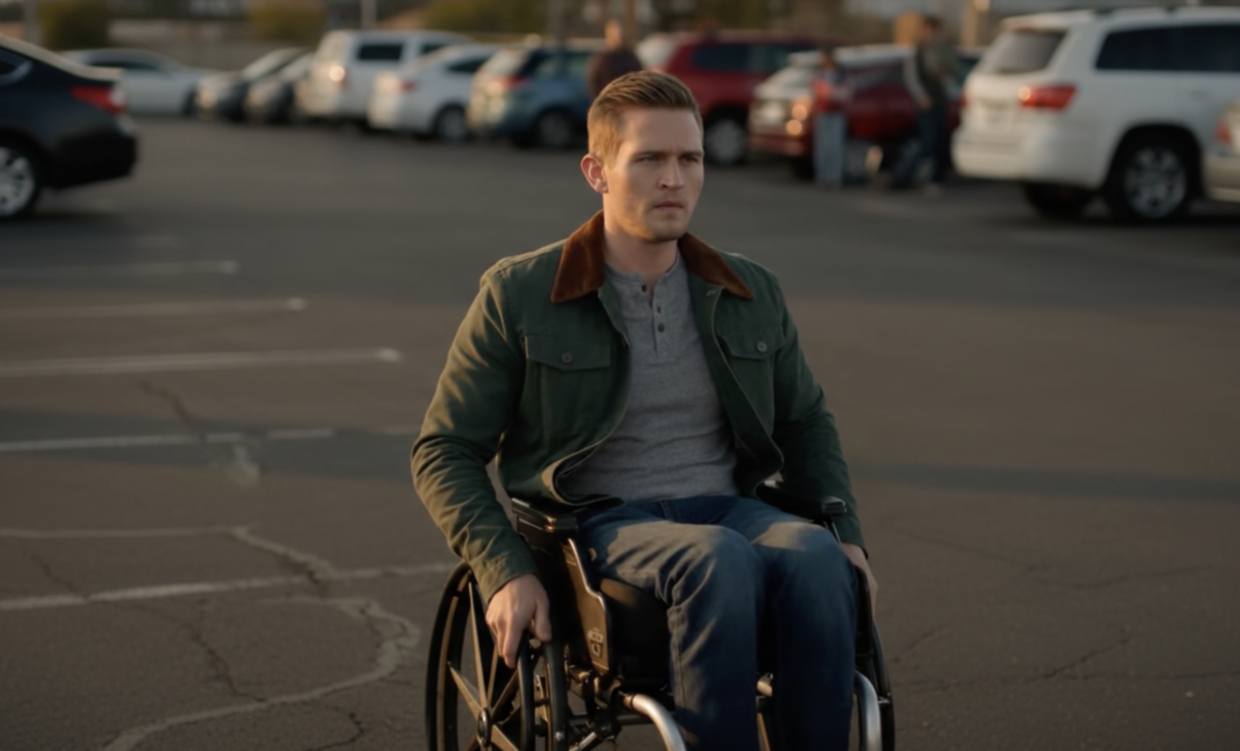
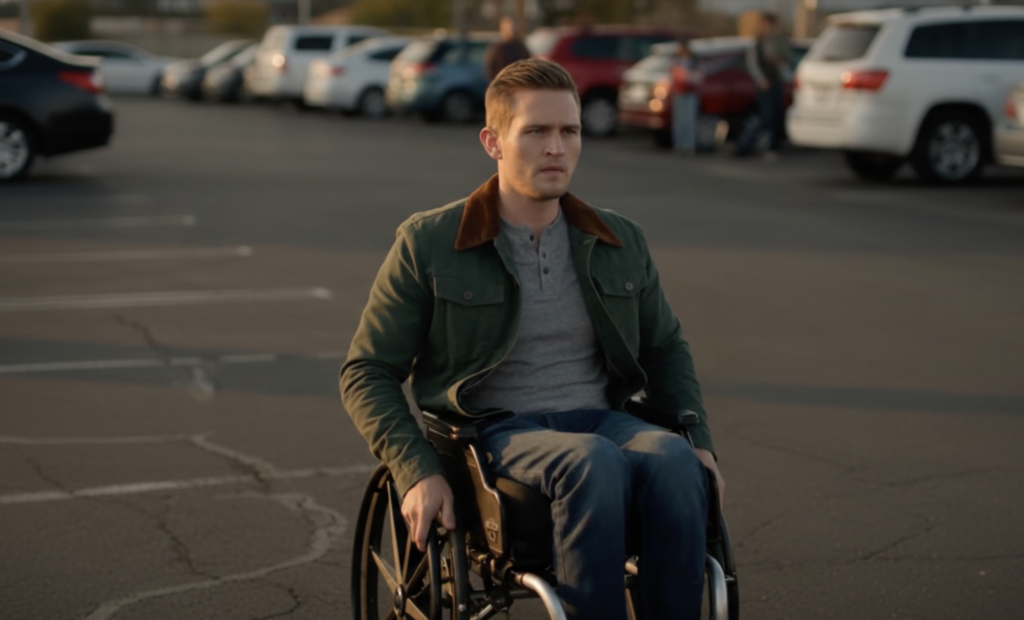
Maya’s father transferred slowly from the passenger seat into the wheelchair with practiced ease. The movement was controlled, but it carried a lifetime of discipline.
Phones lifted higher.
The businessman’s voice faltered. “Okay… so you’re in a wheelchair. That doesn’t explain her.”
Maya’s dad set the brakes with a click. “It explains why I drove three hours to get here.”
The businessman’s brows knit. “Three hours for groceries? That’s—”
“Because she can’t always do it alone,” her dad said. “Because when she gets overwhelmed, she gets lost. Because she’s had episodes in public and strangers like you think they’re entitled to judge her body.”
Maya’s eyes watered, not from sadness—just from overload.
The businessman’s face tightened, defensive. “I didn’t know.”
“You didn’t ask,” Maya’s dad replied. “You accused.”
The employee held up both hands. “Sir, I’m going to need you to step back. You’re causing a disturbance.”
The businessman lifted his phone. “I’m within my rights to record.”
A woman in the crowd snapped, “Not her medical crisis, you creep.”
Another man called out, “Put the phone down.”
The businessman spun on them. “Don’t tell me what to do.”
Maya’s dad wheeled forward slightly, putting his chair between Maya and the businessman like a shield.
“Dad,” Maya whispered, voice thin, “I’m… I’m slipping.”
Her father immediately pivoted toward her. “Okay. Sit in the car.”
Maya nodded, but her legs didn’t cooperate right away.
Her dad took her hand—firm, warm, steady. “One step. That’s all. One step.”
Maya took one step backward.
The businessman muttered, “This is unbelievable.”
Maya’s father snapped his eyes up. “What’s unbelievable is you think you’re the victim here.”
The businessman pointed at the wheelchair. “So what, you’re some kind of hero? That gives her a free pass?”
Maya’s father’s voice dropped, icy calm. “No. Her neurologist gives her the placard.”
The employee cleared their throat. “Sir, if you don’t leave, I’m calling security.”
“Call them,” the businessman barked. “Call the cops. I’ll tell them about the fraud.”
Maya’s father didn’t flinch. “Please do.”
That confidence landed like a punch.
The businessman hesitated, but his pride pushed him forward. “Fine. I will.”
He jabbing his screen, dialing.
Maya’s father leaned closer to Maya. “Sweetheart, you’re safe. Get in the car, lock the door, and keep breathing.”
Maya managed to slide into the driver’s seat and shut the door with shaking hands. The world muffled.
Outside, through the glass, she saw her father facing the businessman.
The businessman spoke loudly into his phone. “Yeah, I need an officer. There’s someone abusing a handicapped spot, and now the crowd is harassing me for calling it out.”
The employee said sharply, “Sir, stop.”
The businessman talked over them. “It’s at the front of the store—”
A police cruiser rolled into the lot faster than expected, lights flashing once, then steady.
The crowd parted like water.
Maya’s heart jumped. Sirens were one of her triggers. Her fingers pressed into her palms.
Her dad raised a hand toward her—slow, calming. He pointed at her dashboard, then held up five fingers again.
Maya forced herself to whisper, “Steering wheel. Air vent. Keys. Placard. Dad.”
The officer stepped out, white American man in his forties, calm posture. He looked from the businessman’s phone to the small crowd to the wheelchair.
“Alright,” the officer said, voice even. “What’s happening?”
The businessman thrust his phone forward. “Officer, finally. This woman is faking a disability. She’s parked in the handicapped spot and she’s perfectly able-bodied.”
The officer glanced at the placard, then at the car. “Sir, do you know her?”
“No,” the businessman said. “But I have eyes.”
The officer’s gaze shifted to Maya’s father. “And you are?”
Her dad held out his driver’s license without drama. “Daniel Hart. That’s my daughter.”
The officer took it, then looked at the wheelchair. “Mr. Hart, are you the placard holder?”
Her dad nodded toward the mirror. “Placard is hers.”
The businessman pounced. “See! It’s hers, and she’s walking.”
The officer looked at him. “Do you understand that not all disabilities are visible?”
The businessman scoffed. “Come on.”
Maya’s father spoke clearly. “She has a documented traumatic brain injury. She qualifies. You’re escalating her into an episode.”
The officer’s eyes narrowed slightly. “Is she in distress right now?”
The store employee answered first. “Yes. She’s shaking. She’s struggling to speak.”
The businessman snapped, “Because she’s guilty.”
The officer turned fully toward him. “Sir, lower your phone.”
The businessman stiffened. “I have the right—”
The officer cut in. “Lower. The phone.”
The businessman slowly lowered it, jaw clenched.
The officer asked, “Did you approach her and accuse her?”
“I confronted her,” the businessman said. “Because someone has to.”
The officer’s voice stayed calm, but colder. “Did you prevent her from leaving?”
“I stood near the door,” he admitted. “So she wouldn’t drive off before—”
“So you blocked her,” the officer said.
“I didn’t touch her,” the businessman snapped.
Maya’s father spoke, controlled anger. “You don’t have to touch someone to trap them.”
The officer nodded once, like that settled something. “Sir, what’s your name?”
The businessman hesitated. “Why?”
“Because I’m asking,” the officer replied.
He gave his name.
The officer asked, “Do you work nearby?”
“I’m headed to a meeting,” the businessman said quickly, like that made him important.
The employee murmured, “He was screaming at her.”
A woman from the crowd stepped forward. “I got it on video. He called her a fraud.”
A man added, “I heard him threaten to send her video to corporate and the DMV.”
The businessman snapped, “Everyone’s recording now, but I’m the bad guy?”
The officer held up a hand to the crowd. “Anyone who has video, hang onto it. Ma’am,” he said to the woman, “you may be asked to share it.”
The businessman’s face tightened. “Officer, are you serious? You’re taking their side?”
The officer looked straight at him. “I’m taking the side of the law and public safety.”
Maya watched from inside the car, breathing in short bursts, trying not to spiral.
Her dad rolled closer to the officer. “Can you ask him to leave? He’s making it worse.”
The officer nodded and turned. “Sir, you need to leave this area immediately.”
The businessman laughed in disbelief. “I’m the one who called.”
“And you’re the one causing the disturbance,” the officer said. “If you continue to harass them, you can be cited.”
The businessman’s voice rose. “Harass? I’m protecting disabled people!”
Maya’s dad’s tone sharpened. “By attacking my disabled daughter?”
The businessman pointed at Maya through the windshield. “She’s sitting in a car. She’s fine.”
The officer stepped closer to him. “Sir. Last warning.”
The businessman’s eyes darted to the crowd—too many phones, too many witnesses. He swallowed.
“Unbelievable,” he muttered, turning to stomp away.
The officer called after him, “And delete any footage of that woman. You do not have consent to distribute medical-related harassment.”
The businessman snapped back, “That’s not a law.”
The officer replied, “But stalking and harassment laws are. Keep walking.”
The businessman kept walking, shoulders rigid.
Maya’s father exhaled slowly, then rolled to Maya’s window.
He tapped lightly.
Maya cracked it an inch.
“You did good,” he said softly. “You stayed with me.”
Maya’s voice shook. “I hate this.”
“I know,” he said. “But you’re still here. That’s the win.”
The officer approached too, posture less formal now. “Ma’am, are you okay?”
Maya forced words out. “I… I will be. He just… he got in my face.”
The officer nodded. “I’m sorry that happened. You didn’t do anything wrong.”
Maya blinked hard. Tears finally slid down, silent and hot.
Her dad’s hand rested on the door frame. “Can we get some space? I want to get her inside before she fully crashes.”
The officer turned to the crowd. “Alright, everyone, disperse. Please stop recording. Give them privacy.”
Some people lowered their phones immediately, embarrassed. A few still lingered.
The woman with the video stepped closer to the officer. “I’ll send it if you need it.”
The officer nodded. “Thank you.”
Maya’s father looked at her. “Ready to go in?”
Maya swallowed. “I’m scared I’ll blank out.”
Her dad’s eyes didn’t leave hers. “Then we go slow.”
The employee stepped forward. “We can have someone walk with you. Or we can do curbside and bring groceries out.”
Maya let out a shaky breath. “Curbside… sounds good.”
Her dad nodded. “Curbside it is.”
The employee smiled gently. “I’ll get a manager. We’ll take care of it.”
As the employee hurried off, the officer remained, watching the businessman’s retreating back.
The businessman stopped near his car and started typing furiously on his phone.
The officer’s gaze sharpened.
He walked over, not rushing—just certain.
Maya could see it through the windshield: the officer spoke to him again, hand gesturing down, commanding.
The businessman shook his head.
The officer’s posture changed. His hand moved toward his belt—not drawing anything, just signaling consequence.
The businessman’s shoulders slumped.
He held his phone out, screen facing the officer.
The officer watched him tap. Delete. Confirm.
Then the officer pointed toward the exit.
The businessman got in his car, face red, and peeled out of the lot—too fast.
A second cruiser that had pulled in behind him flipped on its lights and followed.
Maya’s mouth fell open slightly.
Her dad’s eyebrows lifted. “Well.”
The first officer returned, expression neutral but satisfied. “He left recklessly. The other unit’s going to handle that.”
Maya whispered, “So… he’s in trouble?”
The officer nodded. “He’s getting a ticket at minimum. Possibly more if he keeps arguing.”
Maya’s shoulders sagged with relief so intense it felt like weakness.
Her dad squeezed the door frame. “Thank you, officer.”
The officer nodded to him, then looked at Maya. “Ma’am, you didn’t owe him an explanation. You never do.”
Maya’s voice cracked. “He made me feel like… like I had to prove I’m broken enough.”
Her dad’s face tightened. “You’re not broken. You’re healing.”
The officer added, “And for the record, the placard is valid. If anyone gives you trouble, you call. Don’t engage.”
Maya nodded slowly. “Okay.”
The manager came out with a tablet and a calm smile. “Hi. We can do curbside right now. Someone can shop your list. You can wait in your car.”
Maya’s breath finally deepened. “Thank you.”
The manager glanced at her dad’s wheelchair. “And we can load everything for you.”
Her dad gave a short nod. “Appreciate it.”
They took Maya’s list through the cracked window. Maya’s hands still shook, but now it was easing—like the storm was moving on.
A few lingering shoppers looked ashamed as they walked away.
One older man paused and called softly, “Ma’am, I’m sorry that happened.”
Maya managed, “Thanks.”
The lot settled back into normal life.
Ten minutes later, the manager returned with bags and another employee pushing a cart. They loaded the trunk carefully.
Maya watched her father check each bag like he always did, making sure nothing would roll around and startle her on the drive.
“You got the milk?” Maya asked.
Her dad held it up. “Secured.”
Maya’s lips trembled into a real smile, small but certain.
Then her father’s phone buzzed.
He glanced at it, and his expression turned grimly satisfied.
“What?” Maya asked.
Her dad angled the screen toward her. It was a message from the officer, relayed through the manager: the other unit had stopped the businessman at the exit. Reckless driving citation. And because the businessman refused to calm down and tried to approach another shopper while filming, he was also cited for disorderly conduct. Court date set.
Maya stared. “He actually got consequences.”
Her dad nodded. “That’s what happens when you try to bully someone in public and it’s all on video.”
Maya let out a shaky laugh that turned into a sob halfway through. She covered her mouth.
Her dad rolled closer. “Hey. Let it out.”
“I’m so tired,” Maya whispered. “I’m tired of being afraid of parking lots.”
Her dad’s eyes softened. “Then we’ll keep practicing. Together. Until parking lots are just parking lots.”
Maya wiped her cheeks. “He made me feel like I didn’t deserve help.”
Her dad’s voice turned firm. “You do deserve it. You earned it by surviving what happened to you.”
Maya nodded, breathing steadier now.
Across the lot, the businessman’s fancy car sat pulled over near the exit, an officer beside the driver’s window. The businessman gestured wildly, like consequences were an insult.
Maya watched him for a moment, then looked away.
She didn’t need to watch him fall apart to feel whole again.
Her dad locked the wheelchair brakes and leaned in. “Ready to head home?”
Maya swallowed, then nodded. “Yeah.”
He smiled—quiet pride. “Good. Because we’re getting ice cream on the way.”
Maya let out a real laugh this time. “Doctor’s orders?”
“Dad’s orders,” he said.
As they pulled out, Maya saw the businessman step out of his car briefly—hands on his head, face pale—while the officer wrote the final ticket.
Phones weren’t pointed at Maya anymore.
They were pointed at him.
And for the first time all morning, Maya’s chest felt light—justice served, danger gone, and her father beside her, steady as a seatbelt.