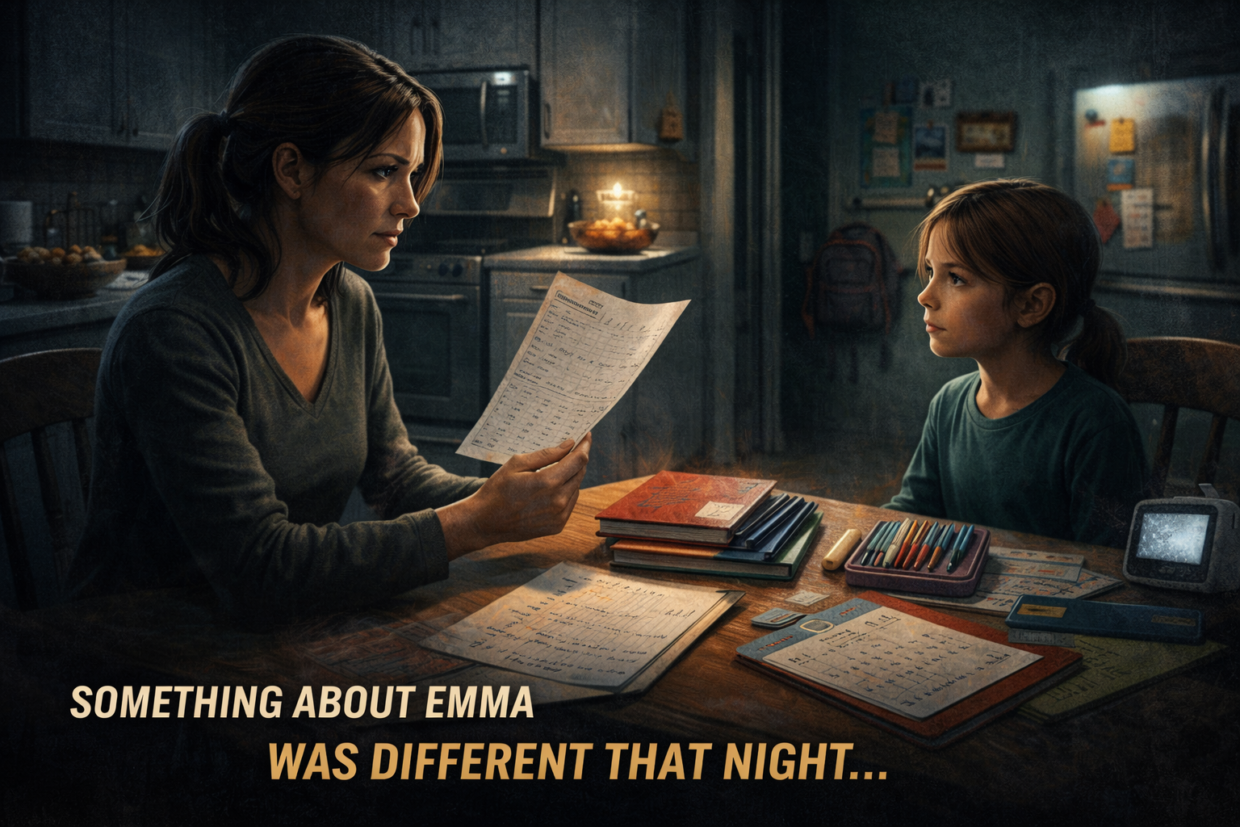
She looked in the sink — dishes were freshly washed… But her daughter never does chores without being asked.
Michelle walked through the front door at 5:47 PM, keys still jingling in her hand. The house felt different somehow.
The kitchen counter gleamed. Every surface had been wiped down, and the dishes sat perfectly arranged in the drying rack.
Michelle: Emma? I’m home.
Emma appeared from the living room, backpack already hanging neatly on its designated hook.
Emma: Hi Mom. How was work?
Michelle set down her purse, studying her daughter’s face. Emma’s homework folder sat open on the kitchen table, assignments completed and organized by subject.
Michelle: Did you finish everything already?
Emma: Yes. Math, reading log, and the science worksheet.
The handwriting looked unusually neat. Each letter formed with careful precision, nothing like Emma’s typical rushed scrawl.
Michelle opened the math homework. Every problem showed work in tidy columns, numbers aligned perfectly. Yesterday, Emma had struggled with basic organization.
Michelle: This looks really good, honey. Did someone help you?
Emma: No, I just took my time.
Michelle flipped through the reading log. Each entry contained detailed summaries written in the same careful penmanship. The vocabulary words were spelled correctly without any eraser marks.
The phone rang. Michelle glanced at the caller ID before answering.
Michelle: Hello, Mrs. Patterson.
Patterson: Hi Michelle. I wanted to follow up about Emma’s behavior in class today. She seemed unusually focused during our math lesson.
Michelle watched Emma organize her pencils by length in her pencil case.
Michelle: Focused how?
Patterson: She completed the worksheet without any help and raised her hand to answer several questions. It was quite different from her usual participation level.
Emma looked up from her pencils, meeting her mother’s gaze directly.
Michelle: That’s wonderful to hear.
Patterson: Yes, though I did notice she seemed a bit tired. She mentioned staying up late to practice her handwriting.
Michelle felt something cold settle in her stomach.
Michelle: I see. Thank you for calling.
She hung up and walked to Emma’s backpack. Inside, every folder was labeled and color-coded. The assignment planner showed completed tasks checked off in green ink.
Michelle: Emma, can you show me how you organized your folders?
Emma: I used the system Mrs. Patterson taught us. Color-coding helps with organization.
Michelle pulled out the science folder. The latest worksheet contained detailed diagrams of the water cycle, each label written in block letters.
Michelle: When did you learn to draw diagrams like this?
Emma: We practiced in class yesterday.
But Michelle remembered Emma’s confusion about the water cycle just two days ago. She had struggled to understand evaporation and condensation.
The doorbell rang. Michelle opened it to find Mrs. Chen from next door.
Chen: Hi Michelle. I hope you don’t mind me stopping by. I wanted to return Emma’s library book.
Michelle took the book, noting it was a fifth-grade level text about advanced mathematics.
Michelle: Emma was reading this?
Chen: She borrowed it yesterday afternoon. Said she wanted to get ahead in math. Very impressive for someone her age.
Emma appeared beside Michelle.
Emma: Thank you, Mrs. Chen. I learned a lot from it.
Chen smiled and waved goodbye. Michelle closed the door and examined the book. Several pages had been bookmarked with sticky notes containing detailed annotations.
Michelle: Emma, this math is pretty advanced. How did you understand it?
Emma: I just read carefully and took notes.
Michelle flipped to one of the bookmarked pages. The margin notes explained complex concepts in handwriting that looked distinctly different from Emma’s homework.
The phone buzzed with a text message from Emma’s teacher.
“Emma left her jacket in my classroom. She can pick it up tomorrow. Also wanted to mention she asked very sophisticated questions about fractions today.”
Michelle looked at Emma, who was now reading a chapter book at the kitchen table.
Michelle: What book are you reading?
Emma: Charlotte’s Web. We’re supposed to read it for English class.
Michelle knew Emma had finished Charlotte’s Web two months ago. She had written a book report about it that was still hanging on the refrigerator.
Michelle: Didn’t you already read this one?
Emma: I wanted to read it again to understand it better.
Michelle walked to the refrigerator and pointed to the book report.
Michelle: You wrote about this book in September.
Emma looked at the report, her confident expression flickering for just a moment.
Emma: I forgot about that one.
Michelle sat down across from Emma at the table.
Michelle: Emma, I need you to tell me what really happened today.
Emma: Nothing happened. I just had a good day at school.
Michelle opened Emma’s math homework again. She pulled out a magnifying glass from the junk drawer and examined the handwriting closely.
The pencil pressure was inconsistent. Some letters showed the hesitant strokes of someone copying carefully, while others flowed with practiced confidence.
Michelle: This handwriting looks different in some places.
Emma: I was trying to write neater.
Michelle pulled out a sample of Emma’s usual homework from the previous week. The letter formation was completely different.
Michelle: Emma, did someone help you with your homework?
Emma: No, I did it myself.
Michelle noticed Emma’s hands. There were faint smudges of pencil graphite on her fingertips, but also traces of blue ink. Emma never used blue ink for homework.
Michelle: Can you show me how you solved this math problem?
Emma looked at the worksheet. The problem involved multiplying fractions, a concept they hadn’t covered in class yet.
Emma: I just… followed the steps.
Michelle: What steps?
Emma stared at the problem, her confidence evaporating.
Emma: The ones we learned in class.
Michelle: But Mrs. Patterson said you haven’t learned fraction multiplication yet.
Emma’s face flushed. She looked down at her hands.
Michelle: Emma, I’m not angry. I just need to understand what happened.
Emma: I really did try to do it myself.
Michelle: I believe you tried. But did someone help you?
Emma nodded slowly.
Emma: Mrs. Wilson helped me during lunch.
Michelle knew Mrs. Wilson was the fifth-grade teacher, not Emma’s third-grade instructor.
Michelle: Why were you with Mrs. Wilson?
Emma: She saw me struggling with my math homework in the cafeteria. She sat with me and showed me how to do the problems.
Michelle: And the handwriting practice?
Emma: She said my handwriting needed work. She showed me how to make my letters neater.
Michelle felt relief wash over her, followed immediately by concern.
Michelle: Emma, it’s wonderful that Mrs. Wilson wanted to help you. But why didn’t you tell me?
Emma: I thought you’d be proud that I did better work.
Michelle: I am proud of your effort. But I was worried because your work looked so different.
Emma: I’m sorry I didn’t tell you about Mrs. Wilson helping.
Michelle: It’s okay, sweetheart. Next time, just let me know when a teacher gives you extra help.
Emma: Will you still be proud of my homework?
Michelle: I’m proud that you asked for help when you needed it. That shows real maturity.
Emma smiled, her shoulders relaxing.
Michelle: Now, let’s work on your real homework together. The work you can do at your grade level.
Emma: Can we still practice neat handwriting?
Michelle: Absolutely. But we’ll practice with words and problems that are right for third grade.
Emma: And can I still read Charlotte’s Web again?
Michelle: Of course. Reading books multiple times helps you understand them better.
Emma: I really did want to do good work.
Michelle: You always do good work, Emma. Even when it’s messy or difficult, your effort is what matters most.
Emma: Thanks, Mom.
Michelle: Now, let’s see what homework you actually have for tomorrow.
Emma pulled out her real assignment sheet. The handwriting was her familiar scrawl, but the effort was genuine.
Michelle: This looks perfect. Let’s tackle it together.
Emma: Can Mrs. Wilson still help me sometimes?
Michelle: I’ll talk to her about the best way to support your learning. Extra help is great, but I want to make sure it matches what you’re ready for.
Emma: That makes sense.
Michelle: The most important thing is that you’re honest with me about school.
Emma: I will be. I promise.
Michelle: Good. Now, let’s work on these spelling words.
Emma: The real ones this time?
Michelle: The real ones. They’re perfect for you.
Emma opened her spelling book and began practicing her words, her natural handwriting improving with each attempt.
Michelle watched her daughter work, grateful for teachers who cared enough to help, and relieved that the mystery had a simple, innocent explanation.
The evening settled into its normal rhythm, homework completed at an appropriate pace, with mistakes and corrections that showed genuine learning in progress.