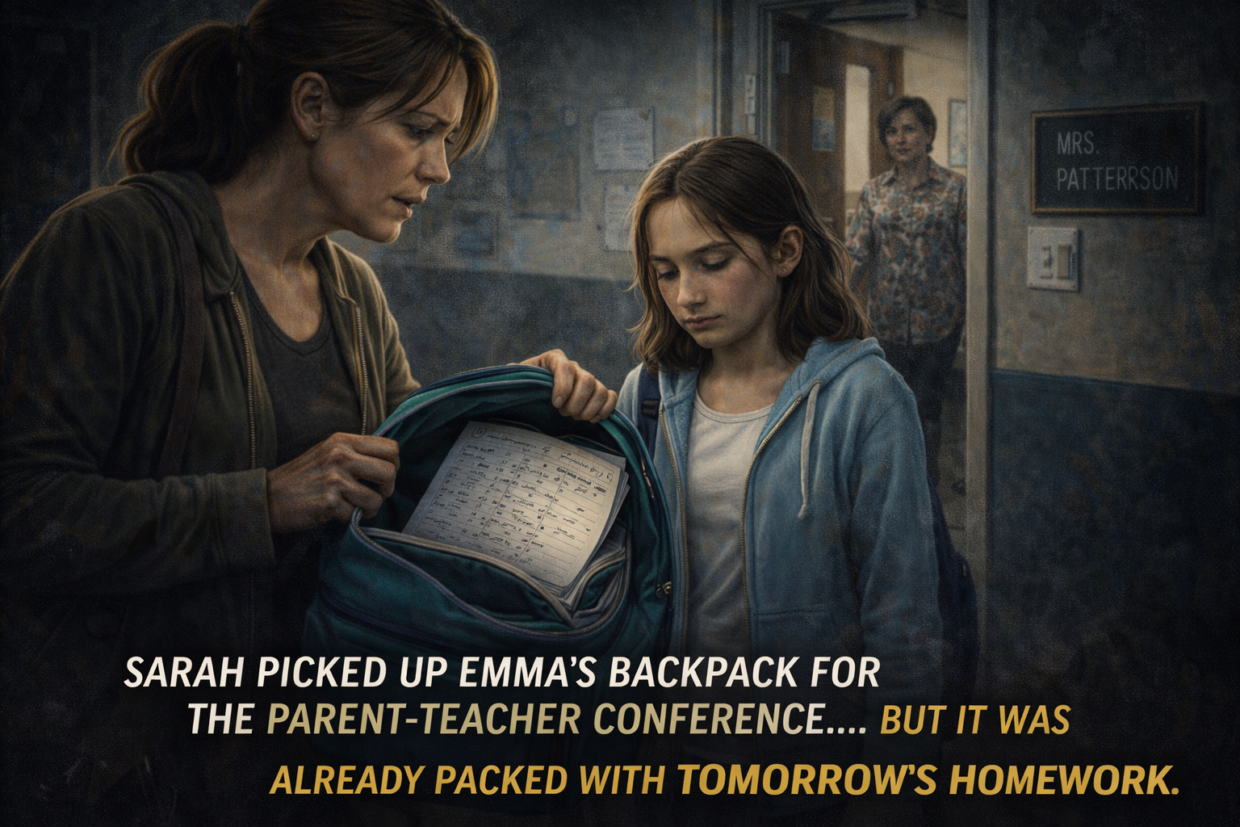
Sarah picked up Emma’s backpack for the parent-teacher conference… But it was already packed with tomorrow’s homework.
Sarah pulls into the school parking lot fifteen minutes early for the parent-teacher conference. The notification email had been specific about timing.
She grabs Emma’s backpack from the passenger seat to return it after the meeting. The weight feels wrong—heavier than usual.
Sarah: I thought you forgot this at home this morning.
Emma shifts in her seat, not making eye contact.
Emma: Yeah, I must have grabbed the wrong one.
The backpack zipper is already open. Inside, Sarah finds tomorrow’s math homework—completed in Emma’s handwriting.
Sarah: Emma, how did you finish tomorrow’s assignment? Mrs. Patterson hasn’t even taught this chapter yet.
Emma: I just… worked ahead.
Sarah examines the worksheets more closely. The problems are advanced, covering material from next week’s lesson plan.
Emma: Can we just go inside? I don’t want to be late.
They walk through the main entrance. The secretary immediately waves from behind the front desk.
Secretary: Sarah! So good to see you again. Emma, your mom was just here yesterday picking up your science fair materials.
Sarah stops walking. She’d been in court depositions all day yesterday.
Sarah: I’m sorry, there must be some mistake. I wasn’t here yesterday.
Secretary: Oh, you must have forgotten. You signed out the microscope for Emma’s project around 2 PM.
The secretary pulls out a sign-out sheet. Sarah’s signature is clearly visible, dated yesterday at 2:17 PM.
Sarah: That’s not my signature.
Emma tugs at Sarah’s sleeve.
Emma: Mom, we should go find Mrs. Patterson’s room.
Sarah studies the signature more carefully. The handwriting is nearly identical to hers, but the ‘S’ curves slightly different.
They walk down the hallway toward the classroom. Another parent approaches with a friendly smile.
Parent: Sarah! Emma did such a wonderful job helping with the book fair last week. You must be so proud.
Sarah: Book fair?
Parent: When you volunteered to help set up? Emma was right there beside you, organizing the picture books.
Sarah looks down at Emma, who is staring intently at the floor tiles.
Sarah: Emma, what book fair?
Emma: I don’t remember.
They reach Mrs. Patterson’s classroom. The teacher greets them warmly at the door.
Patterson: Sarah! Come in, come in. I’m so glad we could finally meet in person after all our phone conversations.
Sarah: Phone conversations?
Patterson: Well, yes. We’ve spoken at least four times this month about Emma’s reading progress.
Sarah pulls out her phone to check the call log. No calls to or from the school appear in her recent history.
Patterson: Please, have a seat. I wanted to discuss Emma’s remarkable improvement in mathematics.
Sarah sits across from the teacher’s desk. Emma takes the chair beside her, unusually quiet.
Patterson: Ever since you started helping with her homework in the evenings, her test scores have jumped two grade levels.
Sarah: I work until nine most nights. I’m rarely home for homework time.
Patterson: Oh, but Emma always tells me about your study sessions. She describes them in such detail during our morning check-ins.
The teacher opens Emma’s file folder, revealing several progress reports.
Patterson: Look at this improvement chart. Emma’s been consistently scoring in the 95th percentile since you began your tutoring sessions.
Sarah examines the dates on the progress reports. They correspond with her busiest work weeks—times when she barely saw Emma awake.
Sarah: Mrs. Patterson, I think there’s been a misunderstanding. I haven’t been helping Emma with homework.
Patterson: That’s strange. Emma provides very specific details about your methods. She even mentioned the special calculator you bought her.
Emma’s backpack sits on the floor beside her chair. Sarah notices a corner of something metallic peeking out.
Sarah: Emma, what’s in your backpack?
Emma: Just normal school stuff.
Sarah reaches down and pulls out a scientific calculator—far more advanced than anything a fourth-grader would need.
Sarah: Where did this come from?
Emma: You… you bought it for me. Remember?
Sarah checks the price tag still attached to the device. Forty-seven dollars—more than she’d ever spend on a school supply without remembering.
Patterson: Emma also mentioned your plans to volunteer for the upcoming field trip to the science museum.
Sarah: What field trip?
Patterson: The permission slip you signed last week. Emma turned it in with your contact information and emergency numbers.
The teacher produces a yellow permission slip from Emma’s file. Sarah’s signature appears at the bottom, along with her phone number and work address.
Sarah: I never signed this.
She compares the signature to her driver’s license. The handwriting matches perfectly, down to the specific way she dots her i’s.
Patterson: Sarah, are you feeling alright? You seem confused about things we’ve discussed multiple times.
Emma reaches over and touches Sarah’s arm.
Emma: Mom, maybe you just forgot. You’ve been working really hard lately.
Sarah studies her daughter’s face. Emma’s expression is carefully neutral, but her eyes dart away when they make contact.
Sarah: Emma, I need you to tell me the truth. Have I really been helping you with homework?
Emma: Yes. Every night after dinner.
Sarah: What did we work on last Tuesday?
Emma: Long division. You showed me the trick with the remainders.
Sarah: I was in Chicago last Tuesday. I didn’t get home until Thursday morning.
Patterson shifts uncomfortably in her chair.
Patterson: Perhaps we should focus on Emma’s current academic needs rather than—
Sarah: No. Something isn’t right here.
She opens Emma’s backpack completely, emptying the contents onto the desk. Along with the calculator, she finds several completed assignments for next week, a library book checked out in Sarah’s name, and a small notebook.
Sarah opens the notebook. The pages are filled with Emma’s handwriting, but the content makes her stomach drop.
The first page reads: “How to write like Mom – practice signatures.”
Sarah: Emma, what is this?
Emma: It’s nothing. Just practicing my handwriting.
Sarah flips through more pages. Each one shows Emma’s attempts to replicate Sarah’s signature, getting progressively more accurate.
Patterson: Emma, did you forge your mother’s signature on school documents?
Emma: I didn’t forge anything. I just… helped.
Sarah: Helped how?
Emma: You’re always too busy for school stuff. I didn’t want to bother you.
Sarah finds another section in the notebook titled “Mom’s Schedule.” Emma has detailed notes about Sarah’s work meetings, court dates, and travel plans.
Sarah: How do you know about my depositions?
Emma: I listen when you talk on the phone. And I check your calendar on the kitchen computer.
The teacher looks increasingly uncomfortable with the direction of the conversation.
Patterson: Emma, have you been pretending your mother was involved in school activities?
Emma: I wasn’t pretending. I was just… making it easier for everyone.
Sarah discovers more items in the backpack: a fake volunteer badge with her name, several forged excuse notes, and a detailed script of answers for parent-teacher phone calls.
Sarah: Emma, have you been answering the school phone calls pretending to be me?
Emma: Only when you were at work. I used the voice you use when you talk to your boss.
Patterson: Emma, this is very serious. Impersonating a parent is not acceptable.
Emma: But it worked! My grades got better, and everyone thought you cared about school.
Sarah feels a mix of guilt and concern wash over her.
Sarah: Emma, I do care about school. But you can’t pretend to be me.
Emma: You’re never here for school stuff. Other kids’ parents come to everything.
The weight of Emma’s words hits Sarah immediately. She realizes how her work schedule has affected her daughter’s perception of her priorities.
Patterson: We’ll need to discuss appropriate consequences for this behavior, as well as support resources for Emma.
Sarah: What kind of support?
Patterson: Our school counselor, Mr. Chen, specializes in helping children who feel overwhelmed by family dynamics.
Emma: I don’t need a counselor. I just wanted people to think you cared.
Sarah: Emma, I do care. I work hard to provide for us, but I can see I’ve missed important things.
She reaches over and takes Emma’s hand.
Sarah: From now on, we’ll figure out a better balance. No more pretending to be me, okay?
Emma: Does this mean I’m in trouble?
Patterson: We’ll need to correct the forged documents and have honest conversations about your academic progress. But the most important thing is making sure you feel supported.
Sarah: What’s Emma’s actual performance level without the… extra help?
Patterson: She’s a solid B student with strong creative skills. The advanced work was clearly beyond her grade level.
Sarah: So she was doing homework she couldn’t possibly understand?
Emma: I copied answers from online videos and older kids at after-school care.
The full scope of Emma’s deception becomes clear. She’d created an elaborate system to maintain the illusion of parental involvement.
Patterson: Moving forward, we’ll need authentic parent-teacher communication and realistic academic expectations for Emma.
Sarah: Absolutely. And I’ll adjust my schedule to be more present for school events.
Emma: Really?
Sarah: Really. But no more forging signatures or pretending to be me. If you need help, you ask directly.
Emma: I’m sorry, Mom. I just wanted you to be proud of me.
Sarah: Emma, I’m always proud of you. But I’m prouder when you’re honest than when you get perfect grades.
Patterson: I think this conversation has been very productive. Let’s schedule a follow-up meeting in two weeks to check on progress.
Sarah: That works. And this time, I’ll actually be the one signing the calendar appointment.
Emma manages a small smile.
Emma: Can we go get ice cream after this? Like other families do after parent meetings?
Sarah: Yes. And we can talk about better ways to handle school situations in the future.
They gather Emma’s belongings, leaving behind the forged documents and fake calculator.
Patterson: Emma, you’re clearly a very intelligent and resourceful child. Let’s channel that creativity into honest academic work.
Emma: Okay, Mrs. Patterson. And I’m sorry for lying about my mom helping me.
Sarah: We’ll both do better going forward.
As they walk toward the parking lot, Sarah feels a mixture of guilt and determination. Emma’s actions revealed gaps in their communication that needed immediate attention.
Sarah: Emma, starting tonight, we’re going to have thirty minutes of homework time together, no matter how late I get home.
Emma: Even when you’re tired?
Sarah: Especially when I’m tired. That’s when you need to know I’m prioritizing you.
They reach the car, and Sarah helps Emma buckle her seatbelt.
Emma: Mom? Are you mad at me?
Sarah: I’m not mad. I’m sad that you felt like you had to handle grown-up responsibilities by yourself.
Emma: I just wanted people to think I had a normal mom.
Sarah: Emma, what we have is normal for us. And from now on, I’ll make sure the school knows who I really am—not a perfect parent, but one who loves you enough to show up.
They drive toward the ice cream shop, both of them understanding that this conversation marked the beginning of a more honest relationship.
Six Months Later
Sarah sits in the same classroom, but this time she’d arrived twenty minutes early by choice.
Patterson: Sarah, thanks for coming in. I wanted to show you Emma’s latest project.
The teacher pulls out a science poster titled “Working Parents: A Photo Essay.” Emma’s handwriting fills the margins with honest observations about balancing family and careers.
Patterson: She interviewed you, your paralegal, and three other working parents. It’s surprisingly mature work.
Sarah studies the photos Emma had taken—including one of Sarah reviewing case files at the kitchen table while Emma did homework beside her.
Sarah: She never mentioned this project.
Patterson: She wanted to surprise you. And Sarah, her grades have stabilized at a solid B+ average. More importantly, she’s been completely honest about her work.
Sarah notices Emma’s backpack hanging on a hook by the door—normal weight, no hidden secrets.
Patterson: She still struggles sometimes when you travel for work, but she talks to Mr. Chen about it now instead of… improvising solutions.
Sarah: We have a system. Video calls during homework time, and my paralegal picks her up from after-school care when I’m away.
Patterson: It shows. Emma seems much happier.
The classroom door opens. Emma walks in, surprised to see her mother already there.
Emma: Mom? The meeting isn’t until 3:30.
Sarah: I know. I finished my deposition early and thought I’d wait here.
Emma’s face lights up.
Emma: Did you see my project?
Sarah: I did. I’m very proud of you.
Emma: Even though I only got a B+?
Sarah: Especially because you earned it honestly.
Patterson smiles as she watches them.
Patterson: Emma, why don’t you show your mom the part about your interview with her?
Emma flips to a page filled with her notes: “Mom says she wishes she could be at every school event, but she’s teaching me that work matters too. She shows up when she can, and that’s enough.”
Sarah feels her throat tighten.
Sarah: Emma, that’s beautiful.
Emma: It’s just the truth. And Mrs. Patterson says truth is more important than perfect.
They gather Emma’s things to leave. Sarah notices the practice signature notebook is gone, replaced by a regular assignment planner with Emma’s own handwriting.
Sarah: Ice cream?
Emma: Can we go to the new place? And can you tell me about your case? The real one, not the made-up version I used to imagine?
Sarah: Absolutely.
As they walk to the car, Emma slips her hand into Sarah’s—no longer trying to be anyone but herself.