




A fisherman checks his nets at dawn… But the crying sound isn’t coming from above the water.
The flashlight beam cut through the pre-dawn darkness beneath Miller’s Pier. Frank had worked these waters for two decades, but the sound drifting up from the support beams made him pause.
A soft whimpering echoed between the wooden posts.
Frank: Must be a gull with a broken wing.
He adjusted his position on the dock, trying to locate the source. The crying grew more distinct as the tide receded. Something was wedged between the pier supports, just above the waterline.
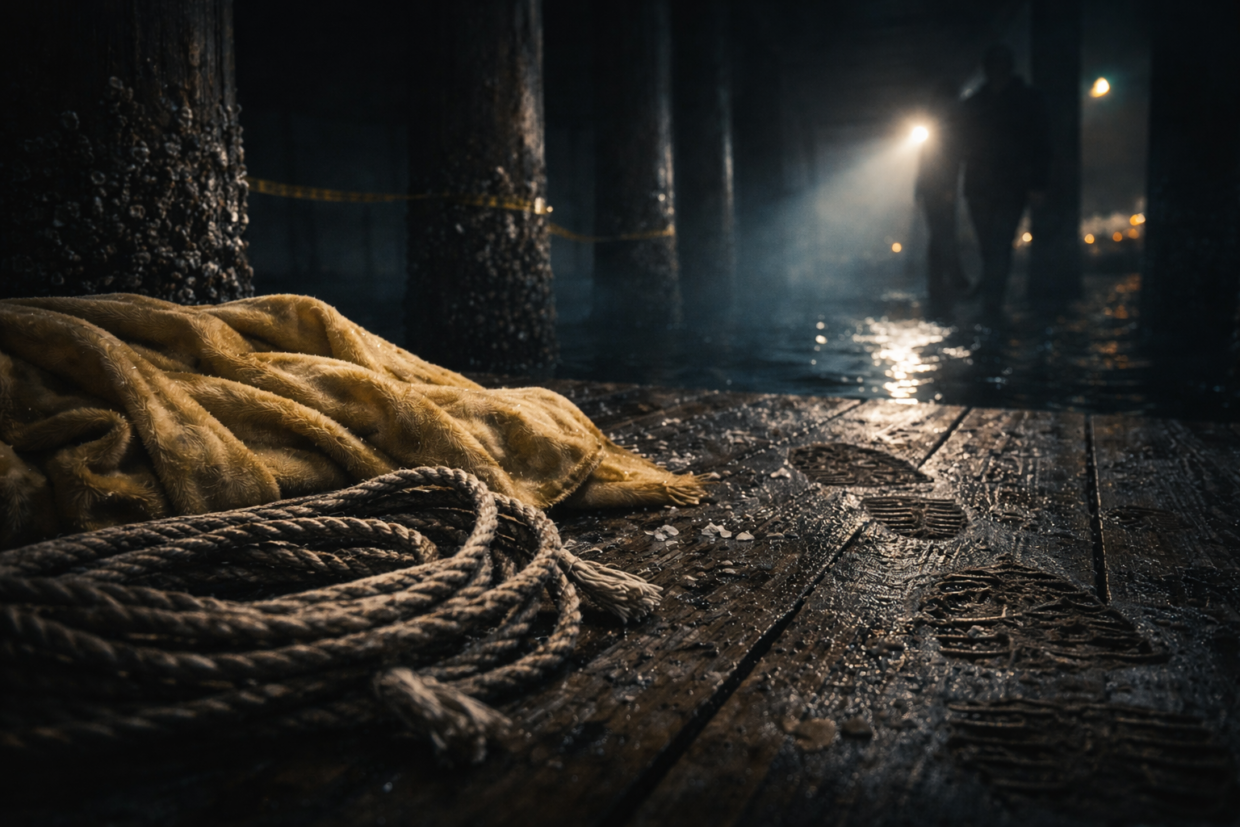
The beam revealed a small bundle wrapped in what looked like a yellow blanket.
Frank: What the hell?
He climbed down the ladder built into the pier’s side. The bundle moved slightly, and a tiny hand emerged from the fabric. Frank’s breath caught in his throat.
A baby, maybe six months old, was secured between two support beams with rope.
Frank: Jesus Christ. Hey there, little one. How did you get down here?
The infant’s cries intensified when the flashlight hit its face. Frank worked quickly to untie the ropes, his hands shaking as he lifted the child from its precarious position.
The baby was cold but breathing steadily.
Frank: You’re okay now. You’re safe.
He wrapped his jacket around the bundle and climbed back up to the dock. The yellow blanket was soaked with seawater and morning dew. Frank pulled out his phone and dialed 911.
Dispatcher: 911, what’s your emergency?
Frank: I found a baby. Under Miller’s Pier. Someone tied it to the support beams.
Dispatcher: Sir, can you repeat that?
Frank: There’s an infant here. Maybe six months old. Someone left it to die.
The dispatcher’s voice remained steady as she gathered details. Frank paced the dock, keeping the baby close to his chest for warmth.
Within minutes, sirens echoed across the harbor.
Detective Sarah Chen arrived with the paramedics. She photographed the rope still hanging from the support beams while EMTs examined the infant.
Chen: How long do you think it was down there?
Frank: Hard to say. Tide was coming in around midnight. If it had been there then, the water would’ve reached it.
Chen: So someone placed it there after midnight?
Frank: Had to be. That spot’s underwater at high tide.
The paramedic confirmed the baby was hypothermic but stable. Chen bagged the yellow blanket and rope as evidence.
Chen: Did you see anyone around here last night?
Frank: I left around six yesterday evening. Pier was empty then.
Chen: Security cameras?
Frank: None that work. City’s been promising to fix them for months.
The ambulance departed with the baby while Chen continued documenting the scene. She measured the distance from the water to where the infant had been secured.
Chen: Whoever did this knew the tide schedule.
Frank: You’d have to. Otherwise the kid would’ve drowned hours ago.
Chen: Or that was the point, and they miscalculated.
The morning sun revealed additional evidence on the pier’s surface. Chen photographed several footprints in the damp wood, including what appeared to be a woman’s shoe print.
Chen: Size seven, maybe eight. Heel mark suggests dress shoes, not sneakers.
Frank: Lot of people walk this pier during the day.
Chen: But not many at two in the morning wearing heels.
Chen’s phone buzzed with a text from the hospital. The baby had been stabilized and was responding well to warming treatment.
Chen: Good news. Kid’s going to make it.
Frank: Thank God. Who does something like this?
Chen: Someone desperate. Or someone who wanted it to look like an accident.
The detective collected additional evidence from the support beams, including fibers that didn’t match the yellow blanket.
Chen: These look like they came from different fabric. Maybe the person’s clothing.
Frank: Could help identify them.
Chen: If we get a suspect to compare it to.
By noon, Chen had completed her evidence collection. The rope showed signs of being cut with a sharp blade, and the knots were tied with precision.
Chen: Whoever did this has experience with rope work.
Frank: Sailor maybe? Or someone who works construction?
Chen: Possibly. The knots are maritime-style. Someone who knows boats.
Chen’s radio crackled with an update from headquarters. A missing person report had been filed three hours earlier for a six-month-old infant.
Dispatch: Detective Chen, we have a possible match on your baby case.
Chen: Go ahead.
Dispatch: Missing child report filed at 0900 hours. Mother claims baby was taken from her car.
Chen: Where?
Dispatch: Parking lot of St. Mary’s Hospital. Mother says she left the car running while dropping off paperwork.
Chen looked at Frank, who was coiling his fishing nets.
Chen: Hospital’s only two miles from here.
Frank: Easy walk, even carrying a baby.
Chen: Or easy drive if you’re trying to stage something.
The detective headed to St. Mary’s to interview the mother. Frank remained at the pier, but the morning’s discovery had shaken him more than he expected.
Frank called his wife to tell her what happened.
Frank: Found a baby under the pier this morning, Marie. Someone tried to kill it.
Marie: Oh my God. Is the child okay?
Frank: Yeah, paramedics said it’ll be fine. But Jesus, Marie. Who does that to a baby?
Marie: Did they catch whoever did it?
Frank: Not yet. Detective’s following up on some leads.
Frank: I keep thinking about those few hours. If I hadn’t come early today…
Marie: But you did come early. You saved that child’s life.
At the hospital, Chen interviewed Lisa Morrison, the woman who reported her baby missing.
Chen: Mrs. Morrison, can you walk me through what happened this morning?
Morrison: I had to drop off some insurance paperwork. I left Emma in the car seat with the engine running. When I came back out, she was gone.
Chen: How long were you inside?
Morrison: Maybe ten minutes. Fifteen at most.
Chen: Did you see anyone suspicious in the parking lot?
Morrison: No, but I wasn’t really looking. I was focused on getting the paperwork done.
Chen studied Morrison’s appearance. She wore black dress shoes with low heels, approximately size seven.
Chen: Mrs. Morrison, I need to ask you to remove your shoes for evidence comparison.
Morrison: What? Why would you need my shoes?
Chen: We found footprints at the scene where your daughter was discovered.
Morrison: Scene? What scene? I thought someone stole her from my car.
Chen: Your daughter was found tied to support beams under Miller’s Pier. Someone left her there to die.
Morrison’s face went pale, but Chen noticed she didn’t seem surprised by the location.
Morrison: Miller’s Pier? I don’t understand. Why would someone take her there?
Chen: That’s what we’re trying to determine. The shoes, please.
Morrison reluctantly removed her shoes. Chen photographed the sole patterns and measured the size.
Chen: These match prints we found at the pier.
Morrison: That’s impossible. I’ve never been to Miller’s Pier.
Chen: Mrs. Morrison, I need you to come to the station for additional questioning.
Morrison: Am I under arrest?
Chen: Not at this time. But we have evidence that needs explanation.
At the police station, Chen interviewed Morrison in a small room with recording equipment.
Chen: Mrs. Morrison, forensic analysis shows rope fibers on your clothing that match the rope used to secure your daughter.
Morrison: I want a lawyer.
Chen: That’s your right. But your daughter is safe now, and we’re going to find out exactly what happened.
Morrison: You don’t understand the pressure I’m under. The bills, the sleepless nights, the constant crying.
Chen: So you decided to solve the problem by tying your six-month-old daughter to pier supports?
Morrison: I thought maybe someone would find her quickly. Someone who could give her a better life.
Chen: At two in the morning? Under a pier where she’d drown at high tide?
Morrison: I didn’t think about the tide. I just wanted it to be over.
Chen: Mrs. Morrison, you’re under arrest for attempted murder and child endangerment.
The confession was recorded and processed as evidence. Morrison was booked and held without bail pending her arraignment.
Frank received a call from Chen later that evening.
Chen: Thought you’d want to know. We arrested the mother.
Frank: The mother? Jesus. Her own kid?
Chen: Postpartum depression combined with financial stress. She claims she thought someone would rescue the baby quickly.
Frank: At two in the morning under a pier?
Chen: That’s what I said. She’s looking at serious prison time.
Frank: What happens to the baby now?
Chen: Child services is handling placement. Kid’s healthy and will likely be adopted quickly.
Frank: At least something good comes out of this nightmare.
The case made local headlines within hours. Frank declined interview requests but felt satisfied knowing his early morning routine had saved a life.
The next morning, Frank returned to Miller’s Pier for his regular fishing. The yellow police tape had been removed, but the memory of finding the baby remained vivid.
Frank cast his nets as usual, but kept glancing at the support beams where the infant had been secured.
Frank: Never thought I’d save a life just by showing up to work.
He pulled in his first catch of the day and smiled, knowing that somewhere in the city, a baby girl was safe and would grow up because he’d arrived at the pier thirty minutes earlier than planned.
The morning sun reflected off the calm water, and Frank felt grateful for the routine that had made him a hero without trying to be one.
Two Weeks Earlier
The apartment was quiet for the first time in four hours.
Lisa Morrison stood over Emma’s crib, watching her daughter’s chest rise and fall in the pale glow of the nightlight. The crying had stopped twenty minutes ago, but Lisa’s hands were still trembling.
She hadn’t slept more than three consecutive hours since the birth.
Morrison: Sleep. Please just keep sleeping.
She backed away from the crib slowly, the way you retreat from something that might startle. In the kitchen, she ran cold water over her wrists the way her mother used to tell her to do when she was overwhelmed as a child. It didn’t help the way it used to.
The eviction notice was still on the counter, partially hidden under a formula tin. Third one in two months. Her sister had stopped returning calls. The number for the postpartum support line was saved in her phone but never dialed — she kept telling herself she’d call tomorrow, when she felt more like herself.
She wasn’t sure she remembered what herself felt like anymore.
Emma started again at 2 a.m. A thin, escalating wail that cut through the apartment walls.
Morrison sat on the edge of the bed and pressed a pillow against her face. Not over Emma. Over her own face. Muffling something she didn’t want to hear coming out of herself.
When she finally went to the crib, she looked down at her daughter — red-faced, furious, alive with need — and felt something that frightened her. Not hatred. Hatred would have been simpler to understand. It was more like looking at a stranger who had moved into her home and taken everything from her and didn’t even know they’d done it.
She picked Emma up. Rocked her automatically, the motion now purely mechanical.
Morrison: I don’t know how to do this.
She said it to the room, to no one. Emma’s crying slowed to hiccuping sobs.
Morrison: I don’t know how to do this without help.
The support line number glowed on her phone screen. She’d opened it again without realizing. Her thumb hovered over the call button for a long moment.
Then Emma cried again, and Lisa put the phone face-down on the counter, and the moment passed.
It would pass several more times over the following two weeks, each one a door she almost walked through. By the time she drove to St. Mary’s Hospital with the insurance paperwork and a yellow blanket in the backseat, she had already stopped believing anyone was going to help her.
She had started believing, instead, that someone else — anyone else — would do a better job than she was doing.
What she hadn’t accounted for was the tide.