




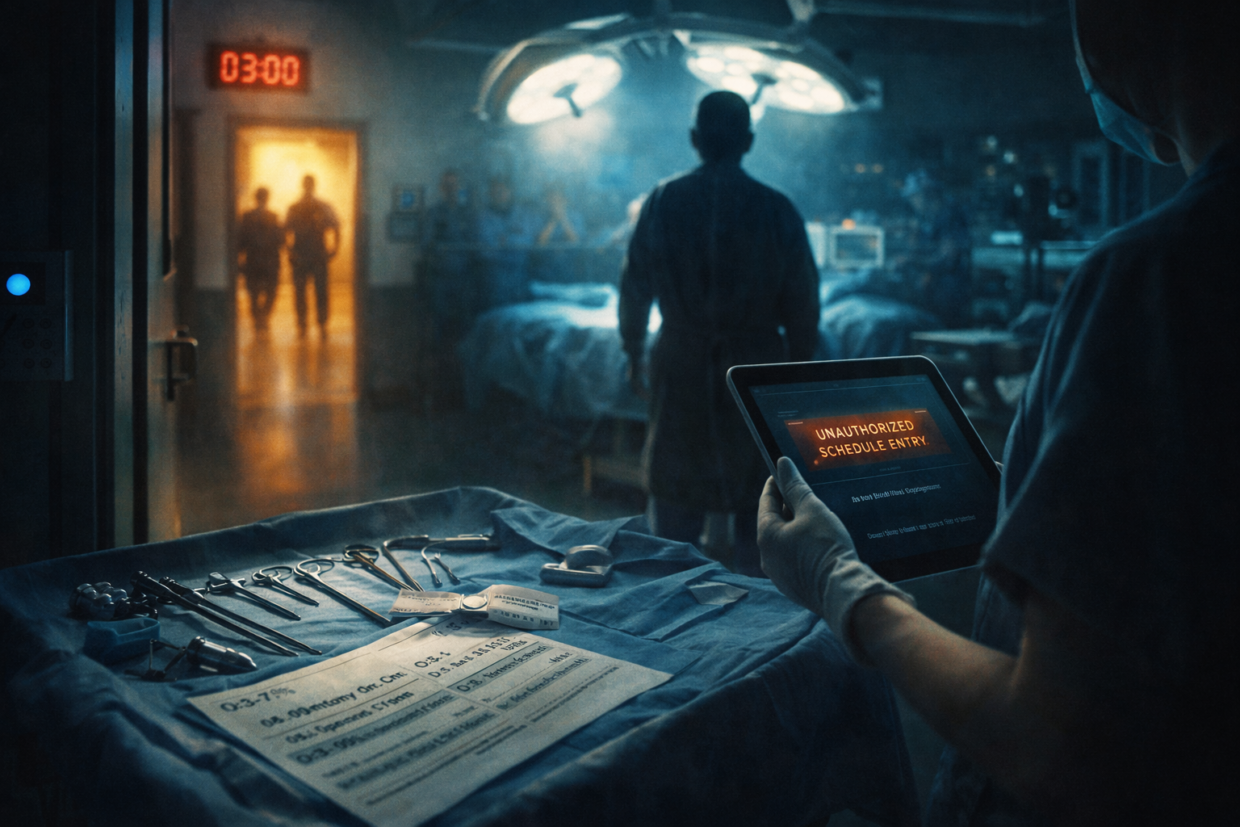
The new surgeon scheduled me for emergency surgery at 3 AM… But the OR was already prepped for someone else.
The new surgeon scheduled me for emergency surgery at 3 AM. The OR was already prepped for someone else.
I stood in the hallway checking my phone for the third time. The assignment came through at 2:47 AM. Emergency appendectomy in OR-7.
The circulating nurse looked confused when I walked in.
Nurse Martinez: Dr. Chen, we’re prepped for gallbladder removal. Dr. Harrison’s case.
The surgical instruments were arranged for laparoscopic surgery. Not appendectomy. The patient chart showed a different name entirely.
Dr. Harrison entered wearing his surgical cap. His eyes narrowed when he saw me.
Harrison: What are you doing in my OR?
I held up my phone showing the assignment notification.
Dr. Chen: Emergency appendectomy. Scheduled for 3 AM in OR-7.
Harrison: There’s no emergency appendectomy tonight. You’re mistaken.
The anesthesiologist checked her tablet. Her face showed confusion.
Dr. Williams: I have two different cases listed for this room. Same time slot.
Harrison stepped closer. His voice carried across the sterile room.
Harrison: Dr. Chen, you seem disoriented. Perhaps you should go home.
The nursing staff exchanged glances. Three residents observed from the viewing gallery above.
I pulled up the surgery scheduler on the wall monitor. The system showed my case clearly assigned to OR-7 at 3 AM.
Harrison’s jaw tightened. He moved to block my view of the screen.
Harrison: The system has glitches. My case takes priority.
Dr. Williams: Should I prep for gallbladder or appendix?
The patient on the table was already under anesthesia. The wrong prep for the wrong procedure.
I checked the patient wristband. The name didn’t match either case in the system.
Dr. Chen: This patient isn’t scheduled for surgery tonight.
Harrison’s hands clenched at his sides. Sweat appeared on his forehead despite the cool OR temperature.
Harrison: You’re questioning my judgment in front of my team?
The head nurse entered carrying a tablet. Her expression was urgent.
Nurse Rodriguez: Dr. Harrison, administration needs to speak with you immediately.
Harrison: I’m about to begin surgery.
Nurse Rodriguez: They said it’s regarding tonight’s scheduling irregularities.
The residents in the gallery leaned forward. One was recording on her phone.
I stepped toward the patient to check the medical bracelet again. The information didn’t match any surgical request.
Harrison moved to intercept me.
Harrison: Dr. Chen, you’re disrupting my OR. Leave immediately.
Dr. Williams looked between us. The monitors showed the patient’s stable vitals.
Dr. Williams: Should I reverse the anesthesia? This patient isn’t on my surgery list.
The OR door opened. Dr. Patricia Kim, the Chief of Surgery, entered with two security officers.
Dr. Kim: Nobody move. We’re investigating unauthorized surgical scheduling.
Harrison’s face went pale. He stepped back from the surgical table.
Harrison: There must be some misunderstanding.
Dr. Kim: Dr. Harrison, you’ve scheduled seventeen surgeries this month that weren’t approved by the surgical review board.
The security officers positioned themselves near the exits. The residents continued filming from above.
Dr. Kim: Dr. Chen, how did you receive tonight’s assignment?
I showed her my phone. The notification came from Harrison’s administrative account.
Dr. Chen: The message came at 2:47 AM. Emergency appendectomy in OR-7.
Dr. Kim examined my phone. Her expression hardened.
Dr. Kim: Dr. Harrison, you’ve been sending fake surgical assignments to multiple residents.
Harrison: That’s impossible. I don’t have access to the assignment system.
Dr. Kim held up her tablet. The screen showed Harrison’s login credentials accessing the system at 2:43 AM.
Dr. Kim: You’ve been logged in for the past hour, creating false emergencies.
The nursing staff began documenting everything. Nurse Martinez took photos of the surgical setup.
Harrison’s voice rose in pitch.
Harrison: This is a setup. Someone is framing me.
Dr. Kim: The patient on this table isn’t scheduled for any surgery. You ordered anesthesia without proper authorization.
Dr. Williams immediately began reversing the anesthesia. The monitors showed the patient’s improving consciousness levels.
The security officers stepped forward.
Security Officer Davis: Dr. Harrison, you need to come with us.
Harrison backed toward the wall. His surgical cap fell to the floor.
Harrison: I was trying to provide additional training opportunities.
Dr. Kim: By scheduling fake emergencies and unauthorized procedures?
The patient began stirring on the table. Dr. Williams monitored the reversal process carefully.
I realized the pattern. Three weeks of impossible assignments. Night shifts that didn’t exist in the schedule. Cases that disappeared from my rotation.
Dr. Chen: He’s been sabotaging my surgical schedule for weeks.
Dr. Kim nodded. She’d been investigating complaints from multiple residents.
Dr. Kim: Dr. Harrison, you’re suspended pending a full investigation.
Harrison’s shoulders slumped. The residents in the gallery had captured everything on video.
Harrison: My career is over.
The security officers escorted him from the OR. His footsteps echoed in the hallway.
Dr. Kim addressed the remaining staff.
Dr. Kim: This OR is closed for investigation. Please document everything you witnessed tonight.
The patient fully awakened thirty minutes later. No surgery had been performed. No harm done.
Dr. Williams: The patient is stable and confused about why they’re in an OR.
I helped wheel the patient back to their room. The family was relieved to learn no emergency surgery was necessary.
The next morning, Dr. Kim called me to her office.
Dr. Kim: Dr. Harrison admitted to creating false assignments to discredit residents he considered threats.
She handed me a folder containing evidence. Screenshots of fake schedules. Testimony from other targeted residents.
Dr. Kim: Your surgical rotation returns to normal immediately. You’ll be compensated for the disrupted shifts.
Three days later, the medical board revoked Harrison’s license. The hospital implemented new scheduling safeguards.
I returned to OR-7 for my first legitimate surgery in weeks. The same nursing team welcomed me back.
Nurse Martinez: Good to have you back, Dr. Chen. For real this time.
The surgery proceeded without incident. No fake emergencies. No unauthorized procedures.
My confidence returned with each successful case. The residents who witnessed Harrison’s downfall spread the story throughout the hospital.
Six months later, I was promoted to senior resident. The position Harrison had been blocking became mine.
Dr. Kim: Your performance under pressure impressed the entire surgical board.
The fake emergency that night exposed Harrison’s scheme. His attempt to sabotage my career backfired completely.
My surgical schedule now runs smoothly. No more 3 AM confusion. No more unauthorized cases.
The OR where it all happened was renamed in honor of patient safety protocols. A reminder that truth always surfaces in the end.
Six Months Later
Dr. Chen stood outside OR-7, staring at the scheduling board. Her name was listed for a routine gallbladder removal at 2 PM. She’d checked the assignment four times that morning.
Nurse Martinez noticed her hesitation.
Martinez: Dr. Chen? Your case starts in ten minutes.
Dr. Chen: I know. Just… confirming.
Martinez: It’s real. I promise.
Dr. Chen managed a small smile, but her hand still reached for her phone to verify the assignment one more time.
Inside the OR, the familiar faces of the surgical team assembled. Dr. Williams was on anesthesia. The same residents who’d witnessed Harrison’s breakdown were observing from the gallery.
Dr. Chen scrubbed in, her movements automatic after years of training. But her mind kept cycling through the same checklist: Right patient? Right procedure? Right authorization?
Dr. Williams: Patient is stable and ready when you are.
Dr. Chen approached the table. The patient’s wristband matched the chart. The imaging confirmed gallbladder inflammation. Everything was correct.
But her hands trembled slightly as she made the first incision.
One of the residents in the gallery whispered to another. Dr. Chen heard it through the intercom.
Resident: Is she okay? She seems nervous.
The other resident responded: After what happened with Harrison, can you blame her?
Dr. Chen’s jaw tightened. She forced her focus back to the procedure.
The surgery went perfectly. Textbook laparoscopic cholecystectomy. Forty-three minutes from incision to closure.
But when she left the OR, Dr. Chen felt exhausted in a way that had nothing to do with the physical work.
Dr. Kim was waiting in the hallway.
Dr. Kim: Dr. Chen, do you have a moment?
Dr. Chen’s stomach dropped. Even after six months, summons from the Chief of Surgery triggered anxiety.
Dr. Kim: Your performance reviews have been excellent. But your surgical volume is down 30% from where it should be.
Dr. Chen: I’ve been completing all my assigned cases.
Dr. Kim: You’ve been declining elective additions. Turning down extra shifts. Avoiding complex cases that aren’t specifically required.
Dr. Chen: I… didn’t realize.
Dr. Kim: Your peers are taking on twice your caseload. The senior resident position requires initiative, not just competence.
Dr. Chen felt the words like a physical blow. She’d been promoted six months ago, but she hadn’t truly stepped into the role.
Dr. Kim: I’m not criticizing. I’m concerned. You’re an exceptional surgeon, but you’re operating like someone who doesn’t trust the system anymore.
Dr. Chen: Can you blame me? Harrison manipulated the schedule for weeks. He put a patient under anesthesia for a surgery that didn’t exist.
Dr. Kim: I understand that. But you can’t let his actions define your entire career.
Dr. Chen: Easy for you to say.
The words came out sharper than intended. Dr. Kim’s expression softened.
Dr. Kim: Dr. Chen, I want you to start seeing Dr. Patel. She’s our staff psychologist.
Dr. Chen: I don’t need therapy.
Dr. Kim: Every resident who was targeted by Harrison is seeing her. It’s not optional.
Dr. Chen: It feels like punishment.
Dr. Kim: It’s support. There’s a difference.
That evening, Dr. Chen sat in her apartment reviewing case files. Her phone rang—an unknown number. She stared at it for three full rings before answering.
Dr. Chen: Hello?
Voice: Dr. Chen, this is Marcus Webb from the State Medical Board.
Her chest tightened immediately.
Webb: I’m calling to inform you that Dr. Harrison’s appeal hearing is scheduled for next month. You’ll need to testify.
Dr. Chen: His license was revoked. What appeal?
Webb: He’s arguing that his actions were misinterpreted. That the scheduling irregularities were system errors, not deliberate sabotage.
Dr. Chen: That’s insane. There’s video evidence.
Webb: Which is why we need your testimony. You were the primary witness.
Dr. Chen: I already gave a statement six months ago.
Webb: This is formal testimony under oath. Harrison’s legal team will cross-examine you.
Dr. Chen felt nauseous. The case she thought was closed was reopening.
Webb: The hearing is October 15th. You’ll receive formal notification by mail.
After hanging up, Dr. Chen sat in silence. The case files blurred in front of her.
Her roommate Julia, also a resident, came home from her shift.
Julia: You okay? You look like you saw a ghost.
Dr. Chen: Harrison is appealing. I have to testify again.
Julia: Jesus. I thought that was over.
Dr. Chen: Apparently not.
Julia: You know what people are saying, right?
Dr. Chen: I try not to listen.
Julia: Some of the attendings think you overreacted. That Harrison was just being a difficult mentor, not actively sabotaging you.
Dr. Chen: He scheduled fake emergencies and put an unauthorized patient under anesthesia.
Julia: I know. But hospital politics are complicated. Harrison had friends in administration.
Dr. Chen: Had?
Julia: Some of them are still defending him. Quietly.
Dr. Chen’s phone buzzed with a text from an unknown number: “You ruined a good man’s career over a misunderstanding. I hope you can live with yourself.”
Julia saw her face change.
Julia: What is it?
Dr. Chen showed her the text.
Julia: You need to report that.
Dr. Chen: To who? Security? The police? It’s just a text.
Julia: It’s harassment.
Dr. Chen: It’s someone’s opinion. And they’re not the only one who thinks it.
Over the next week, Dr. Chen attended her first session with Dr. Patel, the staff psychologist.
Dr. Patel: How are you sleeping?
Dr. Chen: Fine.
Dr. Patel: Your medical records show you requested Ambien three months ago.
Dr. Chen: I had trouble adjusting to the new schedule.
Dr. Patel: And now?
Dr. Chen: I still take it sometimes.
Dr. Patel: How often?
Dr. Chen: Most nights.
Dr. Patel leaned forward slightly.
Dr. Patel: Dr. Chen, trauma responses don’t disappear just because the immediate threat is removed.
Dr. Chen: I’m not traumatized. I’m just being cautious.
Dr. Patel: You check your schedule multiple times before every surgery. You decline additional cases. You avoid situations that require trusting the administrative system. Does that sound like caution or hypervigilance?
Dr. Chen didn’t answer.
Dr. Patel: What are you afraid will happen?
Dr. Chen: That it will happen again. That someone else will manipulate things and I won’t catch it in time. That I’ll walk into an OR and everything will be wrong and everyone will blame me.
Dr. Patel: Has anyone blamed you?
Dr. Chen: Some people think I should have noticed Harrison’s pattern earlier. That I should have questioned the assignments instead of just showing up.
Dr. Patel: Do you blame yourself?
Dr. Chen: Sometimes. I was so focused on being a good resident—following orders, not questioning authority—that I didn’t see what was happening.
Dr. Patel: And now you question everything?
Dr. Chen: Now I don’t trust anything.
The session continued for another thirty minutes. When Dr. Chen left, she felt emotionally exhausted but slightly lighter.
Two weeks later, she ran into Dr. Williams in the physicians’ lounge.
Dr. Williams: Dr. Chen, I wanted to talk to you about something.
Dr. Chen: If this is about my surgical volume—
Dr. Williams: It’s not. It’s about the Harrison hearing.
Dr. Chen: You’re testifying too?
Dr. Williams: Yes. And I wanted you to know—his lawyers are going to argue that you misinterpreted his intentions.
Dr. Chen: How can you misinterpret fake surgical assignments?
Dr. Williams: They’re claiming he was creating training scenarios. Testing residents’ ability to handle unexpected situations.
Dr. Chen: That’s absurd.
Dr. Williams: I know. But they’re going to make you defend every decision you made that night. Every moment of doubt, every second of hesitation—they’ll use it against you.
Dr. Chen: Are you trying to scare me?
Dr. Williams: I’m trying to prepare you. Harrison’s career is over if he loses this appeal. He’s going to fight hard.
That night, Dr. Chen couldn’t sleep despite the Ambien. She reviewed the events of that night repeatedly in her mind, searching for any moment where she could have been wrong.
Julia found her at 3 AM, sitting at the kitchen table with case files spread everywhere.
Julia: You’re spiraling.
Dr. Chen: I’m preparing.
Julia: You’re obsessing. There’s a difference.
Dr. Chen: What if they’re right? What if I did overreact?
Julia: You didn’t. Harrison was gaslighting the entire surgical department. You exposed him.
Dr. Chen: By being in the right place at the right time. If Dr. Kim hadn’t investigated, if those residents hadn’t been filming—
Julia: But they did. And you were vindicated.
Dr. Chen: Was I? Or did I just get lucky?
Julia sat down across from her.
Julia: Listen to me. Harrison targeted five different residents over two years. You weren’t special. You were just the one who finally caught him.
Dr. Chen: The others moved to different programs. I’m the only one still here.
Julia: Because you refused to let him win.
Dr. Chen: Or because I was too stubborn to admit I should leave.
Julia: You’re a senior resident now. You’re exactly where you should be.
Dr. Chen: Except I’m performing at half capacity and second-guessing every decision I make.
Julia: Then fix that. But don’t let Harrison’s appeal hearing undo six months of progress.
The next day, Dr. Chen requested a meeting with Dr. Kim.
Dr. Kim: What can I do for you?
Dr. Chen: I want to increase my surgical load. Add me back to the elective rotation.
Dr. Kim looked surprised.
Dr. Kim: I’m glad to hear that. What changed?
Dr. Chen: I realized I was letting Harrison continue to control my career even after he’s gone. I’m done with that.
Dr. Kim: Good. I’ll have scheduling add you back starting next week.
Dr. Chen: And I need access to the complete investigation file. Everything related to Harrison’s case.
Dr. Kim: Why?
Dr. Chen: Because I’m testifying at his appeal hearing, and I need to remember exactly what happened. Not the version I’ve created in my head over the past six months, but what actually occurred.
Dr. Kim: That file contains information about other residents he targeted.
Dr. Chen: I know. I should have talked to them months ago. I need to know I wasn’t alone in this.
Dr. Kim: You weren’t. But they may not want to relive it.
Dr. Chen: I’ll reach out carefully.
Dr. Kim pulled up the file on her computer and sent it to Dr. Chen’s secure hospital email.
Dr. Kim: One more thing. The hospital’s legal team wants to prep you before the hearing. Don’t go into that courtroom without support.
Dr. Chen: When?
Dr. Kim: Next week. They’ll walk you through the cross-examination process.
Dr. Chen spent the evening reading through the investigation file. It was worse than she remembered.
Harrison had targeted eight residents total over three years. Two had left the program entirely. Three had transferred to other hospitals. One had switched to internal medicine after losing confidence in surgery.
Only Dr. Chen and one other resident—Dr. James Park—remained in the surgical program.
She sent Dr. Park an email: “Are you testifying at the Harrison hearing?”
His response came thirty minutes later: “Yes. Want to compare notes?”
They met at a coffee shop near the hospital the next morning.
Dr. Park: I almost didn’t come back this year.
Dr. Chen: Why did you?
Dr. Park: Same reason you did, probably. Refusing to let him win.
Dr. Chen: Do you still doubt yourself?
Dr. Park: Every single day. I second-guess every surgical decision. I check schedules obsessively. I’ve developed a mild panic response to late-night assignment notifications.
Dr. Chen: So it’s not just me.
Dr. Park: It’s definitely not just you.
They talked for two hours, comparing experiences, validating fears, sharing coping strategies.
Dr. Park: The worst part is the people who still defend him. The attendings who say he was “old school” or “demanded excellence.”
Dr. Chen: As if psychological abuse is just tough mentoring.
Dr. Park: Exactly. And now we have to face him in court and prove it all over again.
Dr. Chen: Are you nervous?
Dr. Park: Terrified. You?
Dr. Chen: Same.
Dr. Park: At least we’re terrified together.
The hospital’s legal team met with Dr. Chen three times before the hearing. They rehearsed questions, practiced responses, warned her about common defense tactics.
Attorney Morrison: Harrison’s lawyers will try to paint you as oversensitive. They’ll suggest you were struggling academically and looking for excuses.
Dr. Chen: My surgical scores were in the top 10%.
Morrison: They’ll say you felt threatened by Dr. Harrison’s high standards.
Dr. Chen: He scheduled fake emergencies.
Morrison: They’ll claim those were training exercises you misunderstood.
Dr. Chen: What about the patient who was put under anesthesia without authorization?
Morrison: They’re arguing that was a scheduling error, not intentional.
Dr. Chen: That’s insane.
Morrison: That’s defense strategy. Your job is to stay calm, stick to facts, and don’t let them provoke you into emotional responses.
The week before the hearing, Dr. Chen’s anxiety spiked. She started having nightmares about being cross-examined, unable to remember basic facts, looking incompetent in front of the medical board.
Dr. Patel increased their sessions to twice weekly.
Dr. Patel: You’re catastrophizing. What’s the actual worst-case scenario?
Dr. Chen: Harrison wins his appeal, gets his license back, and I have to see him in hospital hallways for the rest of my residency.
Dr. Patel: Is that likely?
Dr. Chen: No. The evidence is overwhelming.
Dr. Patel: Then why are you so anxious?
Dr. Chen: Because this whole process proves he still has power over me. Six months later, and I’m still organizing my life around him.
Dr. Patel: What would taking your power back look like?
Dr. Chen: Testifying confidently. Not checking my schedule four times a day. Trusting that the system works more often than it fails.
Dr. Patel: Those are all achievable goals.
The night before the hearing, Dr. Chen barely slept. She arrived at the State Medical Board building at 8:30 AM, wearing a professional suit that felt like armor.
Dr. Park was already there, along with Dr. Williams and two of the nurses from that night.
Morrison approached them.
Morrison: Harrison just arrived with his legal team. Don’t engage with him directly.
Dr. Chen: I wasn’t planning to.
Morrison: His lawyers are going to try to intimidate you in the hallway. Ignore them.
At 9:15 AM, Dr. Chen saw Harrison for the first time in six months.
He looked smaller somehow. Older. His expensive suit couldn’t hide the defeat in his posture.
Their eyes met briefly. Harrison looked away first.
The hearing began at 9:30 AM. Dr. Chen was the third witness called.
Board Chair: Dr. Chen, please describe the events of March 17th.
Dr. Chen took a breath and began. She described the 2:47 AM notification, the confusion in OR-7, Harrison’s attempts to block her from examining the patient.
Harrison’s attorney stood for cross-examination.
Defense Attorney: Dr. Chen, isn’t it true that you were struggling with time management during your residency?
Dr. Chen: No.
Defense Attorney: Your surgical log shows several missed conferences in the months before this incident.
Dr. Chen: Those conferences conflicted with required OR time. Dr. Harrison himself approved those absences.
Defense Attorney: So Dr. Harrison was accommodating your schedule conflicts?
Morrison objected. The board sustained it.
Defense Attorney: Dr. Chen, when you received the 2:47 AM notification, did you question whether it was legitimate?
Dr. Chen: I verified it in the hospital scheduling system.
Defense Attorney: But you didn’t call Dr. Harrison directly to confirm?
Dr. Chen: Residents don’t typically call attending surgeons at 3 AM to verify assignments they can see in the official system.
Defense Attorney: Perhaps if you had, this entire misunderstanding could have been avoided.
Dr. Chen: It wasn’t a misunderstanding. It was deliberate manipulation of the surgical schedule to create a situation where I would appear incompetent.
Defense Attorney: That’s your interpretation.
Dr. Chen: That’s what the investigation concluded.
The cross-examination continued for another hour. Dr. Chen maintained her composure, stuck to facts, refused to be provoked.
When she stepped down, Morrison gave her a subtle nod. She’d done well.
Dr. Park testified next, describing similar experiences. Then Dr. Williams. Then the nurses.
Harrison himself didn’t testify. His lawyers advised against it.
The board deliberated for ninety minutes.
Board Chair: We find insufficient grounds to overturn the license revocation. Dr. Harrison’s appeal is denied.
Harrison’s shoulders slumped. His attorneys gathered their papers quickly.
Outside the building, Dr. Chen found herself surrounded by the other witnesses.
Dr. Park: We did it.
Dr. Chen: We did.
But the victory felt hollow. Six months of anxiety, sleepless nights, therapy sessions, damaged confidence—none of that could be reversed by a board decision.
Morrison approached them.
Morrison: The board’s decision is final. Harrison can’t practice medicine in this state.
Dr. Chen: Can he appeal again?
Morrison: Technically yes, but it’s extremely unlikely to succeed. This is over.
Dr. Chen wanted to feel relief. Instead, she just felt tired.
That evening, Dr. Kim called her.
Dr. Kim: I heard about the hearing. Well done.
Dr. Chen: Thank you.
Dr. Kim: How are you feeling?
Dr. Chen: I’m not sure yet.
Dr. Kim: That’s normal. Closure doesn’t always feel the way we expect it to.
Dr. Chen: When does it start feeling better?
Dr. Kim: Gradually. With time and continued work. You’re already doing better than you realize.
The next morning, Dr. Chen walked into OR-7 for a scheduled surgery. Her name on the board. Her patient prepped correctly. Everything in order.
She still checked the schedule three times.
But this time, she noticed herself doing it. Recognized the compulsion. Chose to stop at three instead of four.
Small progress. But progress nonetheless.
Nurse Martinez met her at the scrub sink.
Martinez: Ready for today?
Dr. Chen: Getting there.
Martinez: That’s all anyone can ask.
The surgery went perfectly. When Dr. Chen left the OR, she felt something she hadn’t experienced in months: confidence without constant second-guessing.
It wasn’t complete healing. She still checked schedules obsessively. Still declined some extra cases. Still woke up sometimes at 3 AM in a panic.
But she was moving forward.
Dr. Patel had told her: “Healing isn’t linear. Some days you’ll feel strong. Some days you’ll feel like you’re back at square one. That’s normal.”
Six months after Harrison’s exposure, Dr. Chen was learning to live with the aftermath. The hypervigilance. The trust issues. The anger at a system that had let someone like Harrison operate unchecked for years.
But she was also learning something else: resilience doesn’t mean bouncing back to who you were before. It means building something new from what remains.
She wasn’t the same surgeon she’d been before Harrison’s sabotage.
She was more cautious. More aware. More willing to question authority when something felt wrong.
Maybe that wasn’t entirely a bad thing.
That night, Dr. Chen updated her therapy journal:
“The hearing is over. Harrison’s appeal was denied. Everyone keeps telling me I should feel victorious. Instead, I just feel tired. But also, maybe, a little bit hopeful. Dr. Patel says that’s progress. I’m choosing to believe her.”
She closed the journal and set her alarm for 6 AM.
Tomorrow was another surgery. Another chance to prove—to herself more than anyone—that she belonged in that OR.
The schedule anxiety would probably never fully disappear.
But neither would her determination to keep showing up.