She heard her missing daughter’s voice through Alexa… But the recording revealed a terrifying truth about her own brother.
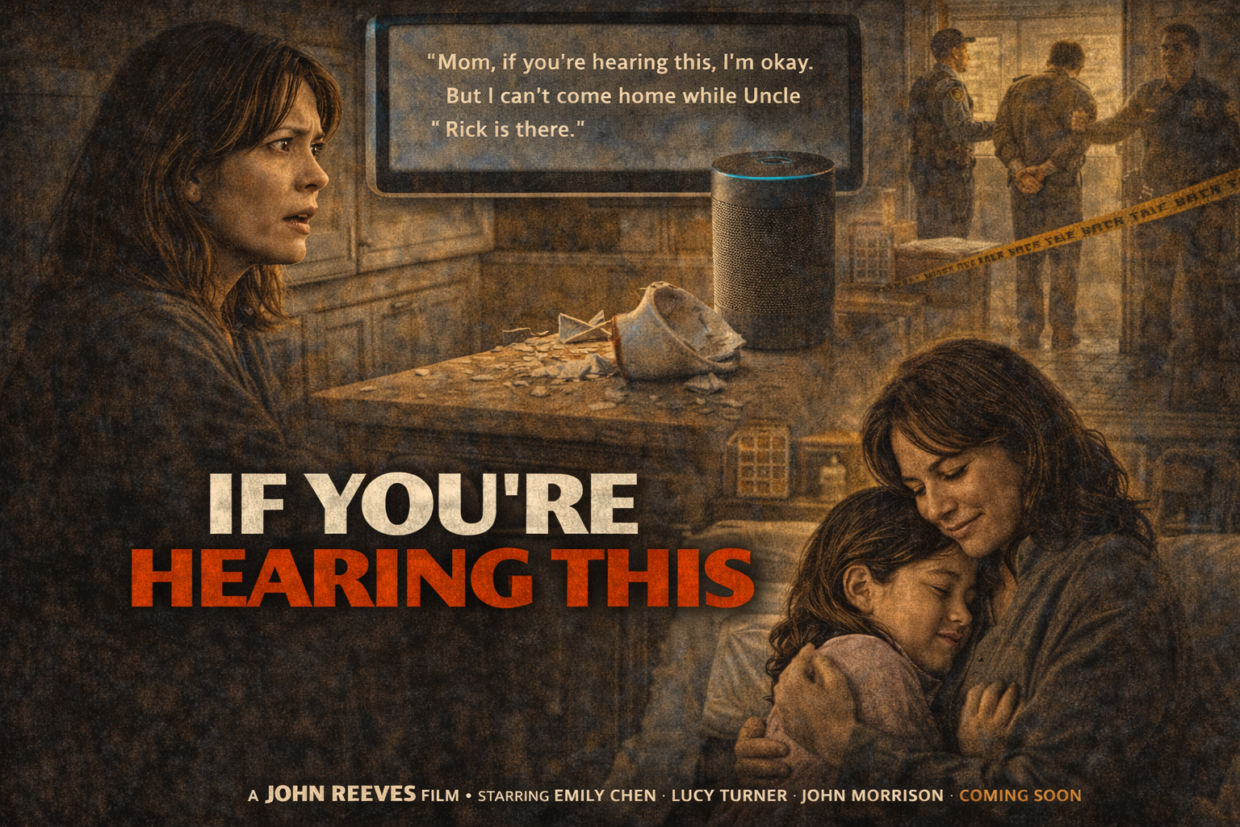
“Mom, if you’re hearing this, I’m okay. But I can’t come home while Uncle Rick is there.”
Sarah dropped her coffee mug. The ceramic shattered across the kitchen floor as her daughter’s voice filled the room through the smart speaker.
“Alexa, stop!” But the recording continued.
“I programmed this to play when you said ‘goodnight sweetheart.’ That’s what you always said before bed.”
Sarah’s hands shook. Emma had been missing for three weeks. The police had questioned everyone, including Rick, who’d been staying with them since his divorce.
“He comes into my room at night, Mom. I tried to tell you, but you said I was imagining things.”
The room spun. Sarah gripped the counter, her brother’s voice echoing from yesterday: “Kids make up stories when they’re upset about change.”
“I left clues in the metadata. Detective Morrison will know how to find them. I’m hiding somewhere safe until Uncle Rick is gone.”
Sarah’s phone was already in her hand, dialing 911.
“This is Sarah Chen. I need Detective Morrison immediately. My daughter… she’s alive, and I know who hurt her.”
Within hours, tech forensics traced the GPS coordinates embedded in the audio file. Emma was found safe in an abandoned cabin, surviving on supplies she’d stockpiled.
Rick was arrested that evening, his shocked protests falling on deaf ears as Emma’s recorded testimony played in the interrogation room.
“I always knew you were smart, baby,” Sarah whispered, holding her daughter tight in the hospital room.
“I learned from the best,” Emma replied, finally safe in her mother’s arms.
The uncle who’d called her paranoid was now facing twenty years in prison, while Emma’s courage had saved herself and potentially countless other victims.
The weeks that followed were quieter, but not peaceful. Quiet in the way a house feels after a storm has torn through it — the wind gone, but the damage still raw and visible in every corner.
Sarah removed the smart speaker from the kitchen. She couldn’t look at it without hearing Emma’s voice in that recording, small and careful and terrifyingly calm for a thirteen-year-old who had been afraid in her own home. She put it in a box in the garage and told herself she’d deal with it later. She never did.
Emma came home to a bedroom Sarah had repainted. Soft yellow, Emma’s favorite color when she was seven. It was a clumsy gesture and Sarah knew it, but she needed to do something with her hands during those first desperate days, needed to feel like she was fixing something tangible while everything invisible remained broken.
Emma stood in the doorway looking at the walls for a long moment.
“Thanks, Mom,” she said simply, and dropped her bag on the bed.
They started therapy the following Tuesday. A woman named Dr. Reyes with a calm voice and an office full of plants. Emma took to her immediately. Sarah found it harder — sitting in that chair, being asked gentle questions that nevertheless felt like splinters working their way out.
“Did you notice any signs?” Dr. Reyes asked during their third joint session.
Sarah had rehearsed her answer a dozen times. But sitting there beside her daughter, she found she couldn’t deliver it cleanly.
“I noticed she seemed uncomfortable around him,” Sarah said slowly. “I told myself it was the divorce. That she was picking up on adult tension.” She paused. “I chose the easier explanation.”
Emma didn’t say anything. She was picking at a loose thread on the couch cushion.
“I’m sorry,” Sarah said. It was the eleventh time she’d said it, but this time it landed differently — not as an apology for a specific moment, but for something larger and harder to name.
Emma looked up. “I know you are.” She reached over and took her mother’s hand, her grip surprisingly firm. “I’m not okay yet. But I don’t blame you.”
It wasn’t forgiveness exactly. It was something more honest than that — an acknowledgment that things had gone wrong, that they would take time, and that they were still, despite everything, on the same side.
Dr. Reyes let the silence sit for a moment before speaking.
“That,” she said quietly, “is a very good place to start.”