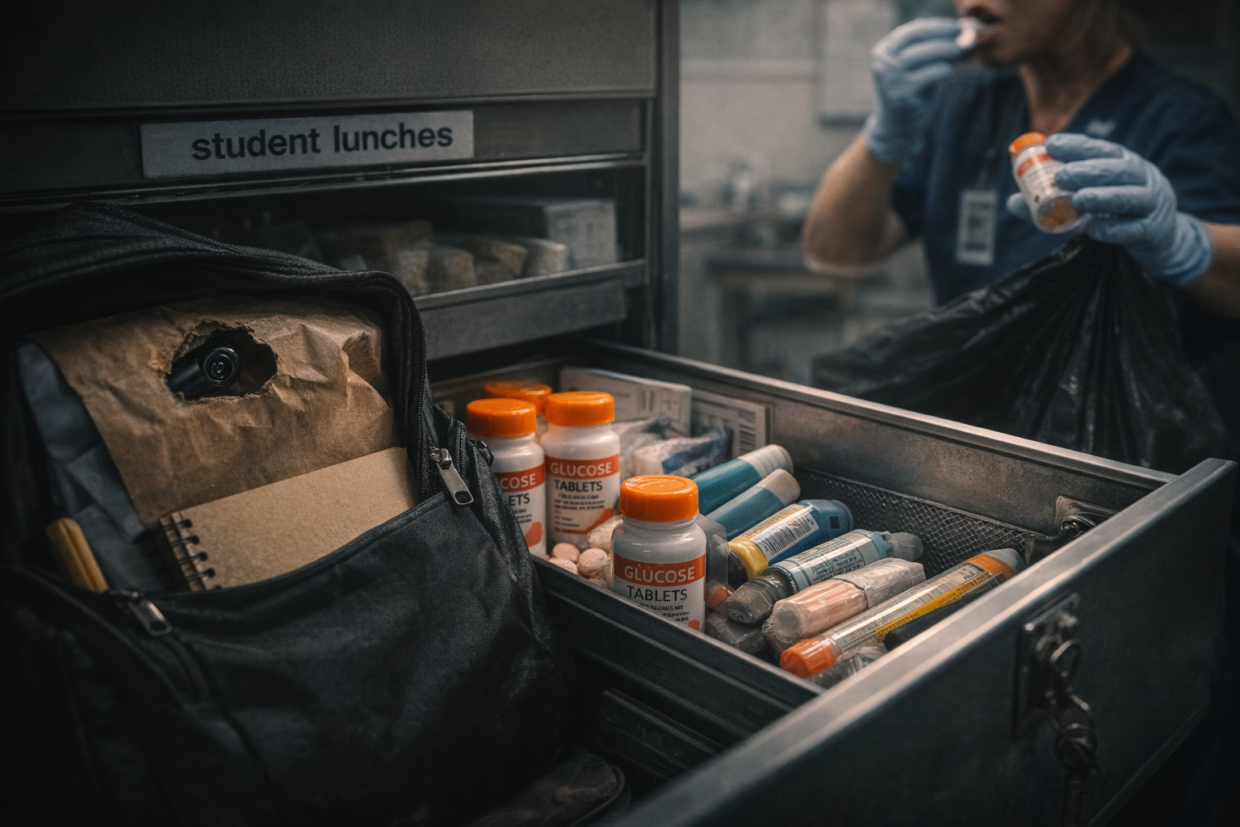
The school nurse kept confiscating diabetic students’ emergency snacks… But a hidden camera revealed she was hoarding them for herself.
“Mom, she took my glucose tablets again,” eight-year-old Marcus whispered as Sarah picked him up from Riverside Elementary.
Sarah’s stomach dropped. This was the third time this month.
“Honey, are you sure? Maybe you just forgot them at home.”
Marcus shook his head firmly. “No, I showed them to Nurse Patterson when I got to school. She said they weren’t allowed and put them in her drawer.”
That evening, Sarah called the school. “This is Sarah Chen. My son Marcus is diabetic, and his emergency glucose tablets keep disappearing.”
“Mrs. Chen,” Principal Williams sighed, “we’ve discussed this. Nurse Patterson follows strict protocols. Perhaps Marcus is misplacing them.”
“He’s eight years old with Type 1 diabetes. Those tablets could save his life.”
“I understand your concern, but I trust my staff completely.”
Sarah hung up, frustrated. She’d already spent over $200 replacing Marcus’s emergency supplies this semester.
The next morning, she met with three other parents in the school parking lot.
“Same thing happened to Emma,” said Janet Rodriguez. “Her inhaler went missing twice last week.”
“And Tommy’s EpiPen,” added Mike Sullivan. “The nurse claimed it was ‘expired’ and confiscated it. I had to buy a new one for $300.”
Sarah pulled out her phone. “I’m calling Dr. Martinez. This is medical negligence.”
Dr. Martinez, Marcus’s pediatrician, listened grimly. “Sarah, this is extremely concerning. Those glucose tablets aren’t just snacks—they’re emergency medication.”
“The school won’t listen. They keep defending the nurse.”
“I have an idea. Can you get proof?”
The next day, Sarah tucked a tiny camera into Marcus’s backpack, hidden behind his pencil case.
“Remember, sweetheart, just act normal. If Nurse Patterson takes your tablets, don’t argue.”
Marcus nodded solemnly.
At 10:30 AM, the camera captured everything.
“Marcus, what’s this?” Nurse Patterson’s voice was sharp as she rummaged through his backpack during his routine blood sugar check.
“My glucose tablets. Mom packed them in case my sugar drops.”
“These aren’t approved. I need to confiscate them.”
The camera angle shifted as Marcus protested. “But my doctor said—”
“I don’t care what your doctor said. I’m the medical professional here.”
The footage showed Nurse Patterson walking to a large filing cabinet, unlocking the bottom drawer with a key from her pocket.
Sarah’s breath caught as the camera captured the drawer’s contents: dozens of glucose tablets, inhalers, EpiPens, and other medical supplies—all belonging to different students.
But the most shocking part came next.
Nurse Patterson grabbed a handful of glucose tablets and popped them in her mouth like candy.
“These are actually pretty tasty,” she muttered to herself, taking several more.
Sarah immediately called Dr. Martinez.
“Doctor, you need to see this footage right now.”
Twenty minutes later, Dr. Martinez was on the phone with Principal Williams.
“Mr. Williams, this is Dr. Martinez from Riverside Pediatrics. I’m looking at video evidence of your nurse stealing emergency medication from diabetic children and consuming it herself.”
“That’s impossible. Nurse Patterson is—”
“She’s putting children’s lives at risk. I’m calling the state medical board and the police. You have one hour to remove her from the premises before I file formal charges.”
The line went quiet.
“Dr. Martinez, I… I had no idea.”
“One hour, Mr. Williams. And I want every single confiscated medication returned to those families today.”
By 2 PM, Nurse Patterson was escorted from the building by security. The police arrived shortly after to collect the evidence.
The following week, Sarah received a call from the new school nurse.
“Mrs. Chen, this is Nurse Johnson. I wanted to personally apologize and assure you that Marcus’s medical needs will be properly supported. I’ve reviewed his care plan with Dr. Martinez.”
“Thank you. That means everything.”
“Also, the school board voted unanimously to implement new protocols. All medical supplies will be properly stored and accessible, and parents will receive daily confirmation that their children’s emergency medications are available.”
Marcus bounded into the car that afternoon, grinning. “Mom! Nurse Johnson let me keep my glucose tablets in my backpack, and she showed me where the extras are stored in her office!”
Sarah smiled, finally feeling the weight lift from her shoulders. “That’s wonderful, sweetheart.”
Three months later, Sarah learned that Nurse Patterson had been fired from two previous schools for similar behavior. The state medical board revoked her license permanently.
The $50 camera had saved not just Marcus, but twelve other students who depended on their emergency medications to stay safe at school.