



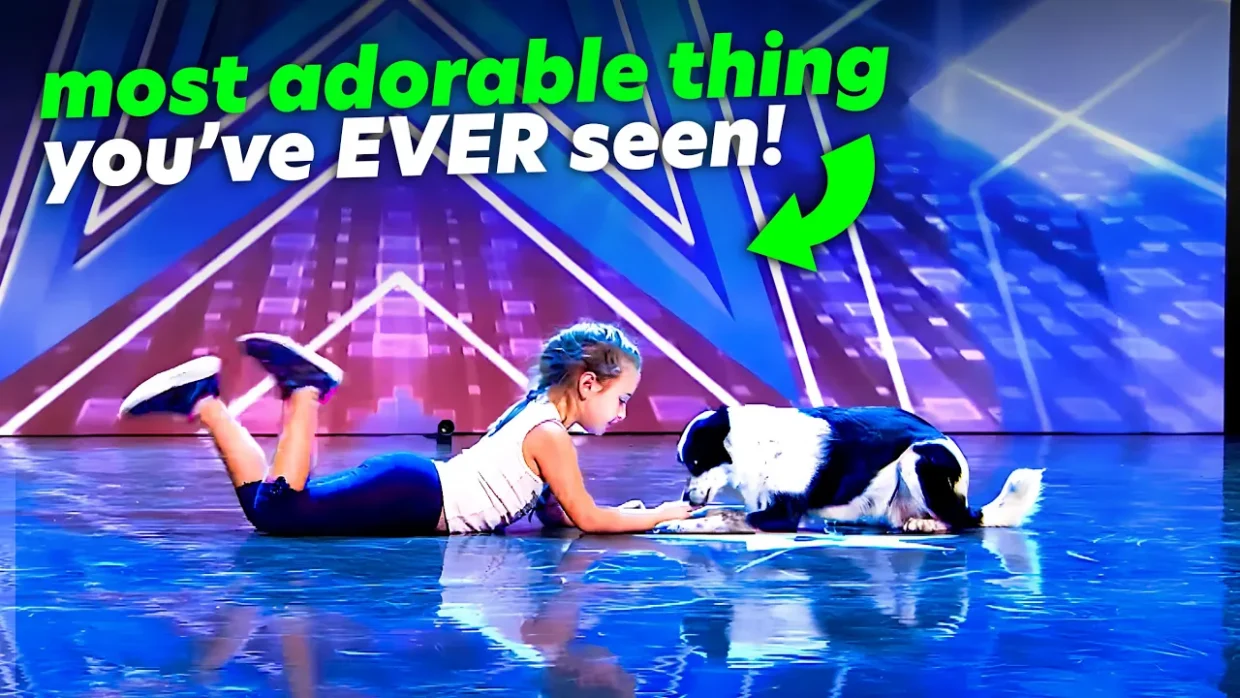
The judges are flat on their stomachs when the dog makes its jump. Moments earlier, they were told to lie very, very still. Now a flying disc gives the dog a target beyond them, and it leaps over the row to catch it. For once, the people who assess the danger and difficulty of an act have put themselves directly underneath it.
That leap captures the appeal of This Is Why Dogs Are BETTER Than Humans!, a talent-show compilation packed with animals doing things their owners might struggle to imagine, much less teach. Dogs dance, balance on shoes, race across acrobats and ride miniature scooters. Their human partners kneel, tumble, hold them aloft and occasionally surrender the joke to them.
Simon Cowell supplies a useful comparison from home. He has two dogs, Squidly and Diddly, and says it took him a year to persuade one to raise a paw. “I thought that was a result,” he says. After watching one of the routines here, he calls its canine performer “the smartest dog I’ve ever seen.”
From a raised paw to a human pyramid
The distance between a household trick and a stage routine becomes clear in the physical acts. An Australian Shepherd rises onto its hind legs to dance with its trainer. Elsewhere, a dog clears a kneeling trainer in a golden dress. A small Papillon balances upright on a woman’s raised feet as she lies on the floor.
Each performer gives the dog a different kind of support. Sometimes it is a hand, sometimes a back, sometimes the soles of a pair of shoes. One small fluffy white dog balances on its hind legs atop a boot. Another dog plants its front paws in a performer’s hands while standing upright, turning a familiar gesture into a dance position.
The acrobats push that partnership further. A white dog jumps over a gymnast holding a headstand. In another sequence, a dog runs across the arched backs of acrobats arranged in a human pyramid. The humans have to hold their positions while the dog follows a route across their bodies.
A breakdancing trainer performs beside a dog balancing on its front paws. A small terrier later holds a one-paw handstand on a trainer’s raised palm. The difference in scale is striking: one dog needs a whole row of bodies for its run, while another has only a hand beneath it.
The footage shows the finished performances, without explaining how the trainers taught each movement. It does show the task they share onstage. The person must be in place, and the dog must reach that place at the right moment, under lights and in front of a noisy crowd.
When the dog gets a character
Physical skill carries only part of these acts. In a dog-catcher routine, a dog slips inside the catcher’s cage wagon on its own. The animal becomes a character in a story, and the judges respond to that story as much as to the training.
“I kind of felt like I was nine years old again,” one judge says afterward, praising a “faultless story and routine.” Another points to the relationship between dog and trainer and says the audience became involved because they told a story. The praise is specific: they made the judges care about what happened next.
The poodle performers work through a busier set of props. One pushes a rolling drum while another runs through it. Poodles in colorful outfits ride miniature kick-scooters across the stage. In their comments, the judges praise the quick changes and the dogs dancing together.
Then the dogs keep entertaining them after the formal routine has ended. The panel talks to the animals and delights in their apparent attention. “We’ve never ever had an act where the animals actually have listened to what we’ve had to say,” one judge says. “Normally, just ignore us.”
There are distractions, too. During a sports-themed routine, a trainer empties a bag of tennis balls onto the stage while the dog guards a net. “He’s watching the puck,” someone observes. Even with props scattered around it, the dog has a particular object to follow.
The judges become part of the act
Putting judges on the floor for the disc-catching finale changes their role. They have to follow instructions, hold still and wait for the dog to finish. The audience gets both the jump and the sight of familiar television faces serving as an obstacle.
Afterward, one judge calls it “the best dog act I’ve ever seen.” Another notices how well the dogs maintained their attention despite the audience’s roars. She also praises the differences between them: each dog had something unique to do. That variety gives the group act more shape than a succession of animals repeating the same trick.
Elsewhere, a border collie backflips over its trainer’s back. In the judging that follows, Amanda calls the dog “a little genius.” Another judge raises “the prospect of a nonhuman possibly winning Britain’s Got Talent.” Addressing a trainer named Katie, Cowell reaches for a canine screen star: “All my life, I’ve searched for another Lassie.”
These are reactions from judges caught up in a performance, rather than measured claims about animal intelligence. Their language does reveal how readily they treat a dog as a contestant with its own stage presence. They discuss timing, character and the possibility of winning.
A hypnotist, a heckler and a singer
The video also ventures into acts whose appeal depends on theatrical illusion. In the dog-hypnosis routine, volunteers apparently fall asleep onstage. A human performer tells them that, when asked to count, they will find the number seven no longer exists. They then count upward without it, reaching eleven.
The spectacle draws Cowell into an attempted demonstration. He kneels in front of the dog, waits and reports that nothing is happening. His description is rather less mysterious than the setup: a dog with a huge tongue is staring at him. The sequence presents a hypnosis act; it does not establish that a dog can hypnotize a person.
Wendy, the small white dog in a ventriloquism routine, offers a different kind of make-believe. Her human partner asks for cooperation and gets resistance. When he asks, “You think I am stupid?” the answer comes back immediately: “Yes.”
The joke works because Wendy has been cast as the more difficult member of the partnership. Her partner wants her to speak, then sing. She refuses, changes her mind and meows when he expects a canine sound. His corrections give her another chance to disobey.
They move on to “Feelings,” with the performer coaxing her through the song. The apparent talking and singing belong to the ventriloquism performance. Wendy’s open mouth and lifted ears complete the comic picture, while her partner handles the conversation.
One judge reminds Cowell that he has spent nine years wanting a dog that could meow or sing. Wendy has apparently supplied both. “How does she know the words?” another asks. “She’s very clever,” comes the reply, keeping the act’s fiction intact.
What the trainers share with their dogs
Among the jumps and jokes are quieter pictures of cooperation. A dog stands on its trainer’s sneakers and walks forward with her in lockstep. A cat and a dog ride a miniature tricycle together. Those moments require no judge lying in the flight path to hold attention.
After another performance, a judge describes the bond in plain language: “They love you. You love them.” The video offers only the public performance, but the comment identifies what the audience is responding to: dogs and people staying close, watching each other and completing a routine together.
The compilation eventually moves into human stand-up, so the dogs do not occupy its entire 47-minute running time. Watch for the range within the animal acts: the tiny adjustments during a balance, the trainer waiting in position for a leap, and Wendy’s partner setting up her next refusal. Then watch the judges lie down and trust a dog to finish the show above their heads.