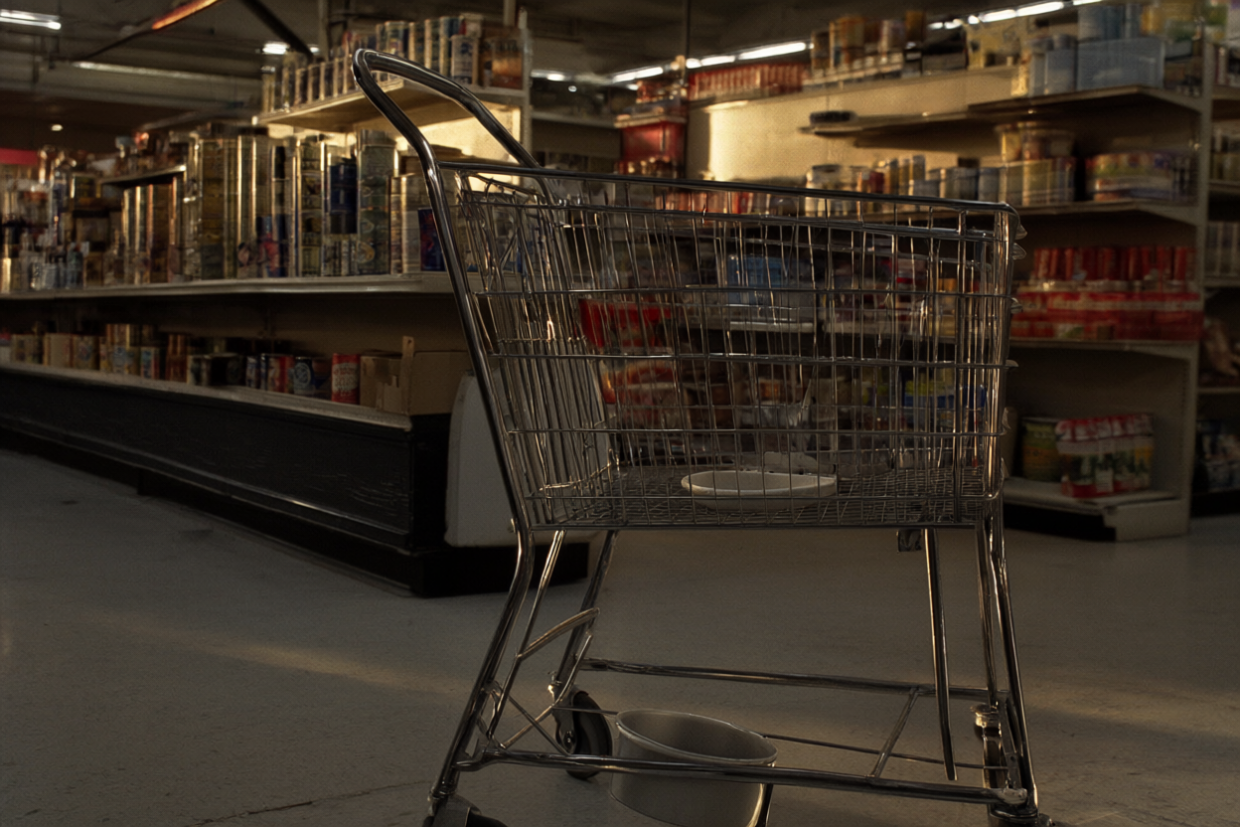
In 1937, an Oklahoma grocer watched customers stop shopping once their hand baskets grew too heavy to carry. His fix was a basket on wheels. Shoppers took one look and refused to push it — so he tried something no one expected.
The grocer was Sylvan N. Goldman, and the setting was Oklahoma City. In the summer of 1937 he watched the same small drama repeat itself in his aisles. A shopper would take a hand basket at the door, fill it, and then stop. He had seen shoppers stop buying when their hand baskets grew too full or heavy. The basket set a ceiling on the order, and the sale ended at the handle.
Every grocery store ran on the same arithmetic. The basket was light when empty and heavy when full, and the shopper carried all of it in one hand. When the handle cut into the fingers, the trip was over.
Goldman knew the grocery trade from the ground up. He was born in 1898 in Ardmore, in the Chickasaw Nation, to immigrant parents. He left school after the eighth grade. By 1934 he had bought the faltering Humpty Dumpty chain, and he was looking for a way to keep customers buying once their hands were full.
The answer took shape with an employee named Fred W. Young. The two men put two wire baskets on the frame of a wheeled folding chair. The result was a cart that could hold what two hands could not. On May 4, 1937, Goldman filed a patent for the “Combination Basket and Carriage.”
The name described the trick exactly. The basket held the groceries. The carriage, a folding chair frame on wheels, held the basket. The shopper held only the handle — and the handle did not fill up.
The first version was not elegant. The prototype could fold up on impact and tip over on corners. It was an idea that worked better than the machine that carried it.
Goldman had the prototype and the paperwork, but he did not yet have a shopper. The gap between a working model and a used product was the part the patent could not cover.
On June 4, 1937, the Oklahoma City Times carried an advertisement teasing the cart’s debut. Goldman expected a line at the door.
Shoppers looked, and then they walked on. Men thought the cart looked unmanly. Women likened it to pushing another baby carriage. Goldman later recalled that not one shopper used a cart on the first day. The invention sat there, empty.
So Goldman changed tactics. A follow-up advertisement claimed the plan had met “instant approval.” That claim was false, and he knew it. He also hired actors, reportedly “manly bachelors,” to push the carts through his stores. The actors were not there to shop. They were there to be seen shopping.
A greeter offered carts to shoppers at the door. The offer was simple, and it removed the need to explain anything. A customer who took the cart had a place to put the next item, and then the item after that.
Goldman did not need every shopper to be convinced. He needed enough of them to be seen, so that the next shopper at the door had an example to follow.
The weight moved from the arm to the wheels. A shopper with a cart kept both hands free, and the basket at the door stopped being the end of the trip.
Within weeks, carts were in use across all of Goldman’s stores. The customers who had walked past the cart were now pushing it down the aisle.
The cart did not need a slogan or a new patent. It needed time and a few shoppers who were willing to go first.
The idea kept moving after it left Oklahoma City. By August 1940, a double-decker version of the shopping cart had made the cover of the Saturday Evening Post. A contraption that had failed on its first day in a single store had become a national image of the American grocery aisle.
Goldman lived long enough to see what the cart became. He died in 1984, and his estate topped $400 million. He had given $1.5 million to the Oklahoma Blood Institute, which named a center for him.
The numbers tell one story. The daily scene tells another. In 1937 a grocer could not persuade shoppers to take a basket on wheels. Decades later, the same object waits at the door of the supermarket, and shoppers reach for it without breaking stride.
What changed was not the cart. What changed was the sight of other people using it. Goldman could not argue shoppers out of their embarrassment, so he showed them a store where the cart was already normal. The actors pushed, the greeter offered, and the customers followed.
It is a strange kind of invention that needs a performance to survive. The patent covered a combination of basket and carriage, not a change in how people felt about being seen with one. Goldman supplied the second part himself, with an advertisement that stretched the truth and a cast of hired hands.
The cart outlasted the stores it was built for. Its principle was simple enough to keep: put the weight on wheels, and the shopper keeps shopping.
Today the cart is everywhere, and the embarrassment that greeted it in 1937 is gone. The cart is now so ordinary that nobody turns to look — no small thing for an invention that once sent shoppers walking the other way.
Sources: History.com, Snopes, Fox News, Oklahoma Historical Society