On the morning of June 26, 1974, a cashier in Troy, Ohio, ran a 10-pack of Juicy Fruit across a new machine and waited. The register beeped, a price appeared, and the line moved. Some shoppers soon suspected the little beep was a trick.
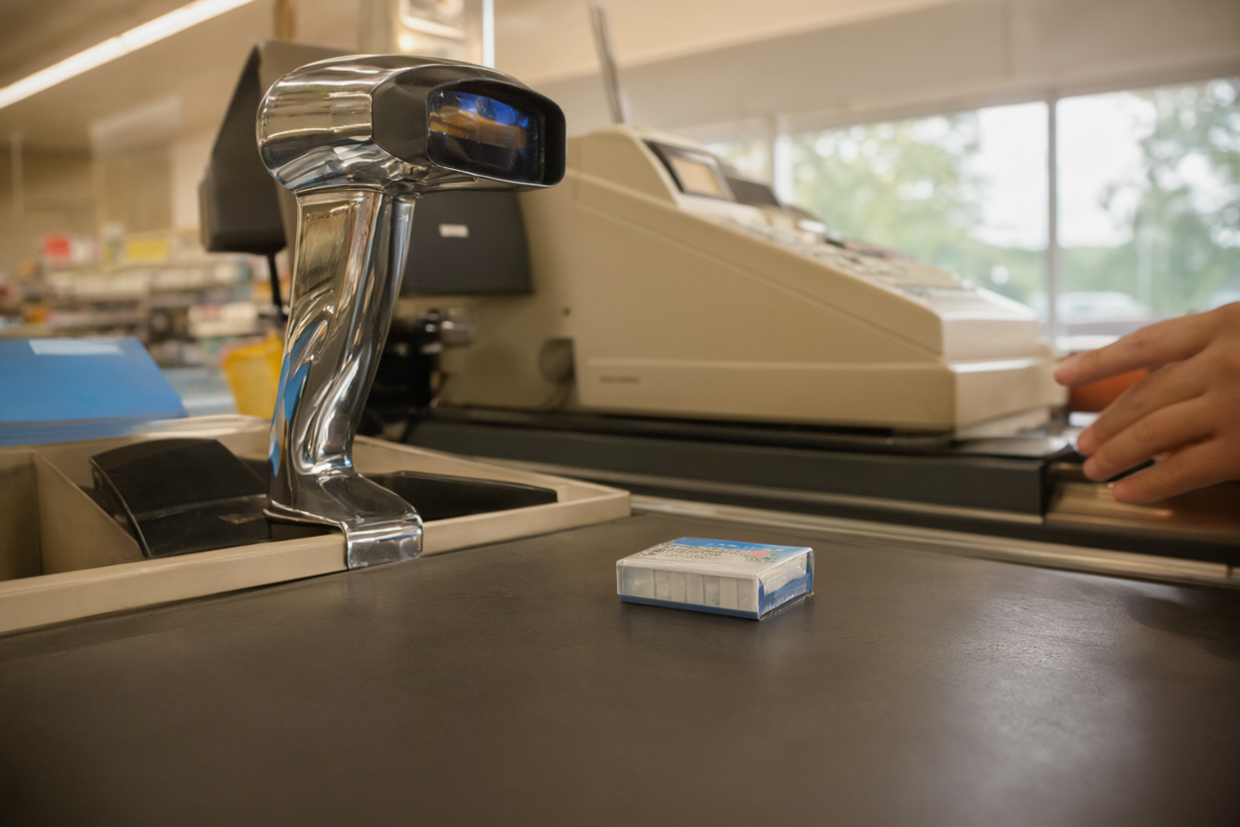
At 8:01 a.m. on June 26, 1974, the checkout lane at the Marsh supermarket in Troy, Ohio, was open and moving. A silver plate sat flush in the counter beside the register. Shoppers stood in line with their carts, waiting their turn.
The lane was ready before the store filled. The silver plate in the counter was the only sign that this register was different. Sharon Buchanan was working it. Clyde Dawson, Marsh’s head of research and development, stepped up and set a 10-pack of Wrigley’s Juicy Fruit chewing gum on the belt.
It was an ordinary purchase in an ordinary lane. Buchanan ran the pack across the scanner. The machine, a Spectra-Physics Model A, read the stripes printed on the wrapper. The register found the price, the sale went through, and the pack of gum became the first retail item ever sold with a UPC scan.
The sale was small: one pack of gum, one price, one customer. The change it marked was not in the size of the purchase but in the way the price was found. The register read a pattern and answered with a number.
The scanner was one of ten installed in the Troy store. Each cost Marsh about $4,000, or roughly $25,000 in today’s money. Most of the machine was air, mirrors and light. The Model A was not a sleek handheld reader. It was a fixture at the lane, and the store had bought ten of them.
The idea behind those stripes had begun far from an Ohio checkout. It came from Norman Joseph Woodland and Bernard Silver, engineering graduates of Drexel. Woodland, a former Boy Scout, thought about Morse code and its dots and dashes. He turned that rhythm into wide and narrow lines, sketching four of them in the sand at Miami Beach.
Woodland had learned Morse code as a Boy Scout. The system used short and long signals, dots and dashes, to carry a message. He applied that idea to a printed symbol. The sketch was simple: four lines pulled through wet sand. Wide lines and narrow lines could stand for the dots and dashes of a message, and a reader could learn to tell them apart.
In 1952, the two men patented a bull’s-eye design, a code built from concentric rings. The concept worked on paper. The technology to read it did not yet exist, so the idea waited while the rest of the world caught up.
Two decades passed before lasers and cheaper computers arrived. In July 1972, Kroger tested RCA scanners at its Kenwood Plaza store in Cincinnati. The test store outsold its comparison stores. The result gave the industry something it could measure.
The original bull’s-eye had a practical flaw. It smudged when printed, and a code that smears is a code that fails at the register. IBM engineer George Laurer redrew the design as a rectangle, and the rectangular, 12-digit UPC was chosen instead.
The rectangle was easier to print and easier to read. It became the standard that stores would build toward.
Then came the surprise. Shoppers did not universally welcome the beep. Some thought the stripes were the “mark of the beast.” Others feared stores would use barcodes to rip off customers. The Consumer Federation of America campaigned against barcodes. Protesters picketed stores. The U.S. Senate held a symposium on the system.
Adoption slowed. By the end of the 1970s, only about 1 percent of U.S. grocery stores had scanners. The checkout lane of the future was still rare, and the machines were costly enough that most stores stayed with the old way.
The spread took years. The first store had ten scanners; by the end of the 1970s, nearly all other stores still had none. For most shoppers, the old way remained the familiar way.
A decade later, more than half of U.S. grocery stores had them. Checkout lines and inventory changed for good. The beep had moved from one lane in Troy to the ordinary sounds of a store.
The scale today is hard to picture. The UPC now identifies over 1 billion products and is scanned more than 10 billion times a day worldwide. What began with one pack of gum in Ohio became one of the most repeated actions in global commerce.
Retailers aim to accept new 2D QR-style barcodes at checkout by 2027. Those codes can carry details such as recalls and expiration dates, information that the old stripes could not hold.
The 2D codes are meant to hold more than a price. A recall notice or an expiration date could travel with the product itself.
Consumers say that information matters. A 2024 GS1 US survey found 77 percent of consumers say detailed product information matters when buying.
The Smithsonian’s National Museum of American History holds a 1974 supermarket scanner in its collections. Fifty years on, that kind of scanner is a museum object.
It is a plain object now, but it marks the moment when a checkout lane learned to read.
The beep is ordinary now, and that is the point: a small pack of gum taught a machine to read a stripe, and we have been moving through the line ever since.
Sources: Smithsonian Magazine, HISTORY.com, WYSO, GS1 US