In November 1967, a 24-year-old graduate student named Jocelyn Bell noticed a squiggle on her chart paper that no one could explain: radio pulses arriving about one and a third seconds apart. She labeled the mystery LGM — Little Green Men — half as a joke. Then the signal came back.
Jocelyn Bell was 24 years old and a PhD student at Cambridge when she found the pulses. The chart paper came off the pen recorder in long strips, and the only way to find a pattern in it was to read it, strip after strip, by eye. It was slow work, and it depended on noticing a mark that did not belong. On 28 November 1967, she recorded a string of radio pulses arriving about one and a third seconds apart.
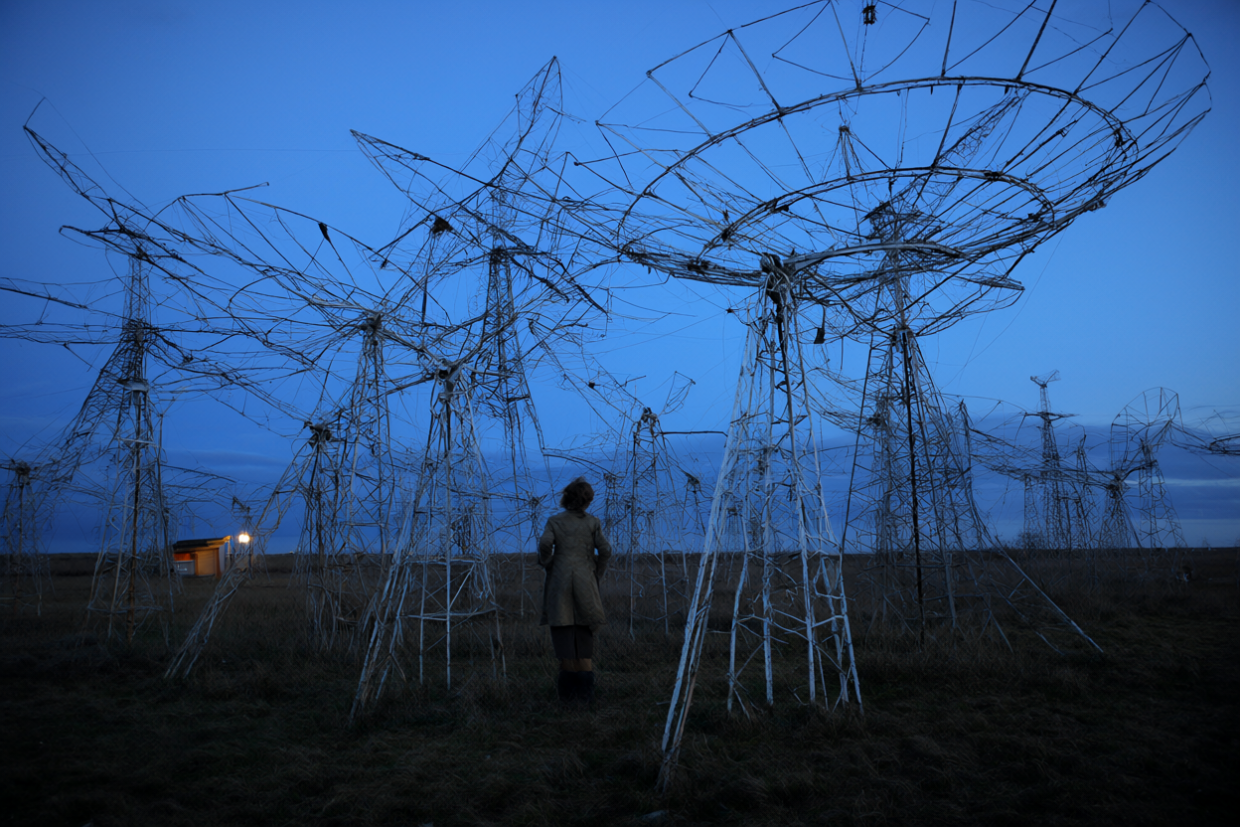
The telescope behind the paper was a field of wire and posts, not a polished instrument in a dome. Bell had spent two years helping to build it at the Mullard Radio Astronomy Observatory. When it was finished, 120 miles of wire and posts stretched over ground the size of 57 tennis courts, and the array was ready to record. The wire and the posts were the instrument, and she knew them as well as anyone.
The signal was small enough to miss. It took up about one part in 10 million of her chart recordings, a repeated squiggle inside a very long run of paper. Most of that paper was not the signal; the squiggle was a tiny part of the record. A mark that small could sit there without being explained. When Bell brought it to her supervisor, Tony Hewish, his first suspicion was that she had wired the telescope wrong.
Bell checked the telescope and the pulses were still there. They arrived at the same interval, one and a third seconds apart, and they kept arriving after the check. She labeled the unknown source LGM, for Little Green Men. The name turned a measurement into a question. It was half a joke, and it was also a shorthand for the possibility that the signal was artificial.
The team tested the signal with a second telescope at the site. The second instrument was pointed at the same part of the sky and watched for the same pulse. Two telescopes, the same patch of sky, the same expected pulse. If the source was in the sky, the second telescope should see it too. At first it showed nothing.
Then the pulse appeared, five minutes later than the team had expected. The delay was not in the signal; the pulse had been there all along. The team had miscalculated when that telescope would see the source, and for those five minutes the check had looked like a failure.
The signal kept its place among the stars. It did not wander across the sky or change its rhythm. Whatever was sending it stayed fixed while the Earth turned beneath it, and the pulse kept its beat. That was the turn.
Within two months, Bell had found the first four pulsars. What had been one squiggle on one strip of paper was now a group of objects, each sending its own regular pulse. Four sources in two months, all found by reading paper. She was still a graduate student.
The explanation was not a message. Pulsars are rapidly spinning neutron stars about ten miles across, with roughly the Sun’s mass packed into a city-sized sphere. A star had been compressed until a city could hold it. The pulses came from the star itself, not from anyone out there.
They sweep a beam of radio waves around the sky like a lighthouse. Each time the beam points at Earth, a telescope records a pulse. Bell’s LGM signal came from one of those stars, spinning in the dark and sweeping its beam across space. The little green men were never there. A lighthouse does not signal; it simply turns.
About 3,000 pulsars are known today. The first of them were the four she found, and the telescope she had spent two years helping to build.
In 1974, the Nobel Prize in Physics went to Antony Hewish and Martin Ryle for the discovery of pulsars. Bell Burnell was not included. Her name was not on the award, although the first four pulsars had been found on her chart paper. The prize honored the discovery; it did not honor the student who made it.
Prominent scientists protested her omission. Bell Burnell answered with a line that has outlasted the argument. She said she was proud that it was “my stars” that convinced the prize committee astrophysics had good physics. The stars were the ones she had found.
The second act came in 2018, more than fifty years after the chart paper. Bell Burnell won the Special Breakthrough Prize in Fundamental Physics, worth £2.3 million, about $3 million.
She gave the entire sum away. The money funds physics graduate students from under-represented groups, including women, ethnic minorities and refugees. It is administered by the Institute of Physics as the Bell Burnell Graduate Scholarship Fund.
“I don’t want or need the money myself and it seemed to me that this was perhaps the best use I could put to it,” she told BBC News.
The pulses she found are still arriving, one and a third seconds apart, and the prize money she gave away is still putting new physicists behind telescopes of their own.
Sources: University of Cambridge, Encyclopaedia Britannica, BBC News