He fixed her broken lock seventeen times and never took a dollar… but the last thing he left behind changed her life forever.
The buzzer rang at 11:23 p.m. I was still awake, staring at the water stain on my ceiling that looked like a hand reaching.
“Yeah?”
“It’s Marcus. Your lock again?”
I pressed my forehead against the door. The wood was cold. “I’m sorry. I know it’s late.”
“Buzzer’s broken too?”
“Everything’s broken.”
“I’ll be right up.”
The sound of his toolbox clanging in the stairwell was almost comforting now. Fourth time in three months. Same ex-boyfriend. Same rage. Same splintered doorframe where the deadbolt tore through.
Marcus appeared on the landing, seventy-something, suspenders over a flannel shirt, reading glasses hanging from a chain around his neck. He moved slow but steady, like he’d climbed these stairs a thousand times.
“Evening, Amy.”
“I’ll pay you Friday. I promise this time.”
He waved me off and knelt by the door, knees cracking. “You called the police?”
“They said it’s a civil matter. He has mail here sometimes, so technically—”
“Technically nothing. He breaks your door, that’s a crime.”
“That’s what I said.”
“What’d they say to that?”
“That I should get a restraining order.”
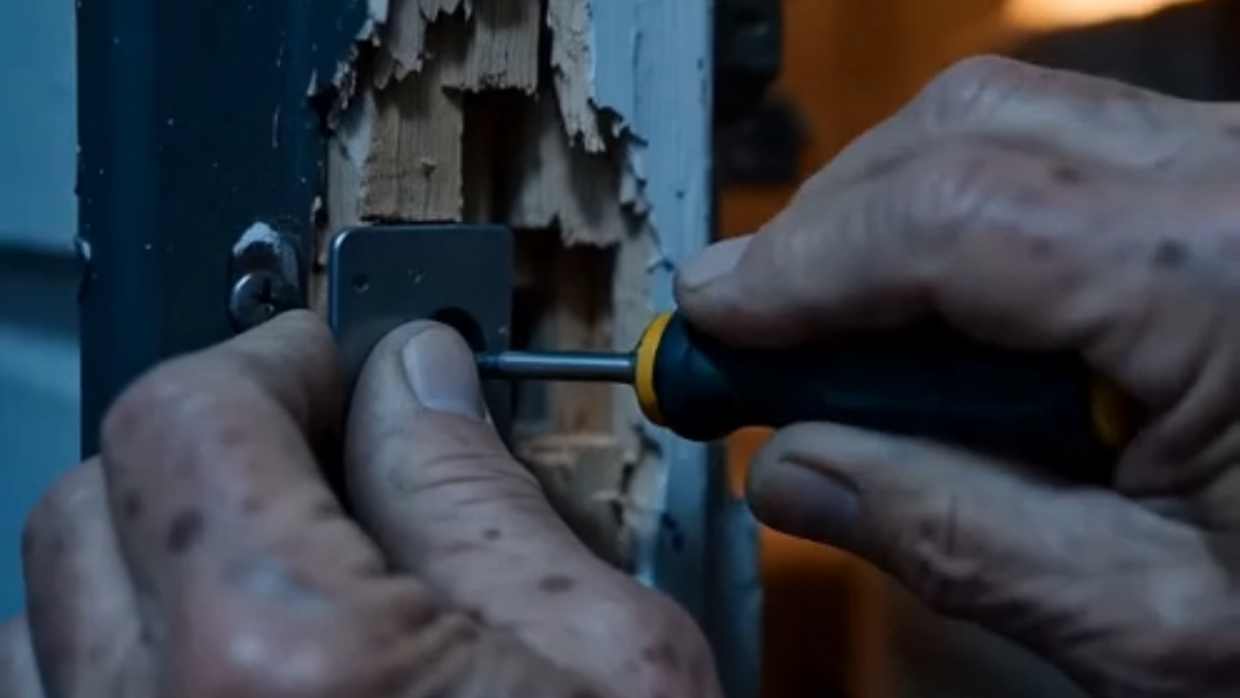
Marcus grunted, fitting a new striker plate into the chewed-up wood. “You should.”
“I tried. Judge said I didn’t have enough evidence of immediate danger.”
“Your door would disagree.”
I almost smiled. “Yeah. Well.”
He worked in silence for twenty minutes. I made coffee I knew he wouldn’t drink and watched him reset the bolt, tighten the screws, test the lock twelve times. His hands were spotted with age but steady.
“That should hold,” he finally said.
“How much do I owe you?”
“Same as last time.”
“Marcus—”
“Nothing, Amy. You owe me nothing.”
“You can’t keep doing this for free.”
He stood slowly, bracing himself on the doorframe, and looked at me with dark eyes that had seen too much.
“My daughter was in your situation once. Twenty years ago. Her landlord charged her two hundred bucks every time her ex broke the lock. She couldn’t afford it. Couldn’t afford to leave either.”
He packed his tools carefully, each one in its place. “One night he broke more than the lock.”
The air went out of the room.
“She lived. But she’s got scars she’ll carry forever.”
“Marcus, I’m so sorry.”
“So am I. Which is why you don’t owe me a dime. Not now, not Friday, not ever.”
He left before I could argue.
That was three years ago.
He came back seventeen times after that. Sometimes for the lock. Sometimes for the radiator that wouldn’t heat. Once for the window that wouldn’t close. Once just to install a chain latch when I asked.
I tried to pay him every single time.
He never accepted a penny.
“Put it toward getting out,” he’d say. “Save every dollar. One day you’ll have enough to disappear.”
I tried. I did. But between the hospital bills from the night Derek broke my wrist and the lawyer fees from trying to get that restraining order, my savings account stayed at two hundred and forty-three dollars.
Derek finally got arrested for something unrelated eight months ago. Assault outside a bar. Six months in county.
The apartment was quiet after that. No more 3 a.m. pounding. No more threats shoved through the mail slot. No more wondering if tonight was the night.
Marcus still came by, though. Usually on Sundays. He’d check the locks, tighten the loose cabinet hinges, replace the batteries in the smoke detector I couldn’t reach.
“You don’t have to keep checking on me,” I said one afternoon in September.
“I know.”
“Derek’s locked up.”
“For now.”
“You think he’ll come back.”
Marcus looked at me over his glasses. “Men like that always come back. Unless you’re gone before they get out.”
“I’m working on it.”
“Work faster, Amy. He gets out in four months.”
“I know.”
The last time I saw him was a Tuesday in October. He’d stopped by to replace my peephole—the old one was clouded over and useless.
“There,” he said, testing it from both sides. “Now you can see who’s knocking.”
“Thank you.”
He paused at the door, toolbox in hand, and turned back.
“You’re a good kid, Amy. Smart. Kind. You help Mrs. Chen with her groceries every week. You watch the Rodriguez kids when Maria has night shift. You deserve better than hiding in this place.”
“I’m not hiding. I’m just… regrouping.”
“You’ve been regrouping for three years.”
“I’ll get out. I promise.”
He smiled, sad and knowing. “I believe you.”
That was the last thing he said to me.
Three weeks later, the knock came at 9 a.m. on a Sunday.
I looked through the new peephole Marcus had installed. A woman in a gray blazer, dark hair pulled back, detective’s badge clipped to her belt.
My stomach dropped. Derek. Something happened with Derek.
I opened the door with the chain on.
“Amy Salazar?”
“Yes.”
“I’m Detective Christina Vega. May I come in?”
“Is this about Derek Chen?”
“No. It’s about Marcus Delgado.”
The floor tilted. “Is he okay?”
Her expression answered before her words did. “I’m very sorry. Mr. Delgado passed away Friday night. Heart attack. Paramedics said it was quick.”
I heard the words but they didn’t connect. Marcus. Dead.
“He… no. He was just here. Two weeks ago. He was fine.”
“I’m sorry for your loss. Were you family?”
“I—no. He’s my landlord’s locksmith. He just… he helped me sometimes.”
“I see.” She pulled out a folder. Thick manila, official stamps on the tab. “Miss Salazar, Mr. Delgado left specific instructions with his attorney. Instructions that include you.”
“Include me how?”
“May I come in? This will take a few minutes.”
I unhooked the chain—the chain Marcus installed—and let her in.
She sat at my kitchen table, the one that wobbled until Marcus fixed it last year.
“Mr. Delgado owned several properties in the city. This building is one of them.”
“Wait. Marcus owned this building?”
“Yes. For the past thirty years. He left very specific instructions about what should happen to his assets after his death.”
She opened the folder and slid a paper across the table. Legal letterhead. Stamps. Signatures.
“This building, all four units, has been transferred into your name. You’re the new owner.”
I stared at the document. My name. The address. Deed of transfer. Notarized Friday morning.
“That’s not possible.”
“It’s already done. The deed transferred Friday morning, hours before he died. His attorney said he’d been planning it for six months.”
“Why would he—I don’t understand. I’m just a tenant. I owe him money.”
Detective Vega pulled out an envelope. Cream colored, my name written in shaky handwriting across the front.
“He left this for you. His attorney asked me to deliver it personally.”
My hands shook as I took it. The paper was thick, expensive. I opened it carefully.
*Amy,*
*If you’re reading this, my heart finally gave out. Doctor said it would, just didn’t know when. Could’ve been a year. Could’ve been a week. Turned out to be somewhere in between.*
*I need to tell you something I should’ve said three years ago.*
*I don’t just own your building. I own six buildings in this neighborhood. Bought them in the nineties when nobody wanted property here. Fixed them up. Rented them to people who needed a safe place to land.*
*My wife Rosa and I, we never had much. But we had enough. And we figured the best thing to do with enough was help folks who didn’t have any.*
*Rosa died twelve years ago. Cancer. After she was gone, I kept doing the work because it’s what she would’ve wanted.*
*I’ve been watching you, Amy. Not in a creepy way—in a landlord way. I see how you help Mrs. Chen even though you can barely carry your own groceries. I see how you babysit those kids for free because their mama works nights. I see how you put money in the building’s “take a dollar, leave a dollar” jar even when you don’t have dollars to spare.*
*You remind me of Rosa. She would’ve liked you.*
*My daughter lives in Seattle now. We talk once a year if I’m lucky. She’s got her own life. I don’t blame her. After what happened with her ex, she needed distance from everything, including me.*
*I don’t have grandkids. I don’t have siblings. I’ve got six buildings and nobody to leave them to.*
*Except you.*
*The other five buildings go to other tenants. People like you. People who’ve been kind when they didn’t have to be. People who deserve a chance.*
*This building is yours now. Do what you want with it. Sell it. Rent it. Live in it. I don’t care.*
*But if you want my advice? Keep it. Rent it cheap to people who need a safe place. Fix their locks when they break. Don’t charge them when their ex-boyfriends are monsters.*
*Be the soft place to land.*
*That’s what Rosa would’ve done.*
*— Marcus*
*P.S. — Derek gets out in three months. You own the building now. That means you can evict him if he comes back. The detective has the restraining order paperwork. New judge. She actually gives a damn. Get it done.*
I read it twice. Then three times. The words blurred.
Then I put my head down on the table and cried for a man who’d fixed my locks for free and never told me he owned the walls around me.
Detective Vega waited. She’d probably done this before.
When I finally looked up, my face soaked, I whispered, “He left me a building.”
“Four units. Fully paid off. Property taxes current through next year. Maintenance fund established with forty thousand dollars. His attorney has all the details.”
“I work at a call center. I make fourteen dollars an hour. I don’t know how to be a landlord.”
“Mr. Delgado thought you’d figure it out.”
She slid another paper across. “This is the restraining order application. Pre-filled. All you need to do is sign. Judge Torres is expecting it. She’s signing them this week. You’ll have it before Derek’s release date.”
“He set this up.”
“He set everything up. He wanted you protected.”
I stared at the papers. The building deed. The restraining order. The letter in his shaking handwriting.
“Why me?”
“I think he explained that pretty clearly.”
“But I didn’t do anything. I just… I was just trying to survive.”
Detective Vega stood, closed her folder. “Miss Salazar. Most people in your situation wouldn’t have had the energy to help Mrs. Chen with groceries. They wouldn’t have babysat for free. They wouldn’t have given a damn about anyone but themselves.”
She headed for the door, paused with her hand on the knob. “Marcus Delgado spent thirty years watching people. He knew what kindness looked like. And he saw it in you.”
She left me sitting at the wobble-free table with a deed to a building and a letter from a dead man who’d believed in me when I didn’t believe in myself.
The attorney’s office was in a converted brownstone downtown. His name was James Park. Mid-fifties, kind eyes, patient voice.
“You’re the fourth person I’ve met with this week,” he said, gesturing to a leather chair. “Four tenants. Four buildings. Marcus was very thorough.”
“Did he… did he help all of us?”
“In different ways. One had a broken furnace he fixed every winter for six years. One had a leak he patched a dozen times. One had a son who needed after-school care, so Marcus paid for it anonymously through a ‘scholarship fund’ he invented.”
“He never told anyone.”
“That was the point.” Park opened a file cabinet. “He left instructions for each building. Suggestions, really. You’re not obligated to follow them.”
He handed me a folder. Thicker than the first one.
Inside was a list. Tenants he thought deserved a break. Rent reductions he recommended. Repairs he’d been planning. At the bottom, in his handwriting:
*Trust your gut. Help people who can’t pay you back. That’s when it matters most.*
“There’s also this.” Park slid a checkbook across the desk. “Maintenance account. Forty thousand dollars. For repairs, emergencies, whatever the building needs.”
“I can’t—”
“You can. You will. Marcus set this up because he knew you’d use it the right way.”
I looked at the checkbook. My name printed on every check.
“What if I screw this up?”
“Then you’ll fix it. That’s what Marcus did. He screwed up plenty. But he always fixed it.”
I worked my two weeks at the call center. I didn’t tell anyone why I was leaving.
On my last day, I took my final paycheck—six hundred and forty-two dollars—and went to the hardware store. I bought a professional locksmith kit. Top of the line. Eight hundred dollars. I used the maintenance account to cover the difference.
Then I went home to my building—*my building*—and knocked on Mrs. Chen’s door.
“Amy! Come in, come in.”
“Mrs. Chen, I need to tell you something.”
I told her about Marcus. About the building. About what he’d left me.
She cried. Then she hugged me so tight I couldn’t breathe. Then she made tea and told me stories about how Marcus had helped her when her husband died, how he’d never raised her rent in fifteen years, how he’d paid for her husband’s funeral flowers and pretended they were from the neighborhood association.
“He was a saint,” she said, wiping her eyes with a tissue.
“He was.”
“What will you do now?”
“I’m going to do what he did.”
I started small.
I cut Mrs. Chen’s rent by thirty percent. She’d been paying nine hundred a month for twenty years. Now she paid six-thirty.
I cut Maria Rodriguez’s rent by half—she was raising two kids alone on a grocery store salary. Her rent dropped from a thousand to five hundred.
I used the maintenance fund to replace every lock in the building with heavy-duty deadbolts. Commercial grade. The kind that don’t splinter when someone kicks them.
I installed security cameras in the lobby. Motion-activated. Feeds to my phone.
I hired a lawyer to file restraining orders for two other tenants who needed them. Women I’d seen with bruises. With excuses. With fear in their eyes.
The lawyer’s name was Sandra Kim. She took one look at the cases and said, “I’ll do these pro bono. Marcus helped my sister once. I owe him.”
“You knew him?”
“Everyone knew Marcus. Not everyone knew what he was doing, but we all knew he was doing something.”
Derek got out of county jail six weeks later.
He showed up at the building at 2 a.m. on a Thursday, drunk, pounding on the front door.
The cameras caught everything.
I called the police from my apartment. I didn’t go downstairs.
They arrested him in the lobby for violating the restraining order Judge Torres had signed three weeks earlier.
He screamed my name the whole way to the patrol car.
I watched from my window. I didn’t feel scared. I felt nothing.
Judge Torres gave him two years.
I sent her a thank-you note on nice cardstock. She wrote back: *Marcus was a good friend. I’m glad he found someone to carry on his work.*
Over the next year, I tracked down the other tenants from Marcus’s files. The ones in the other buildings.
There was David in the building on Ashland. Veteran. PTSD. Marcus had soundproofed his apartment after a bad episode.
There was Keisha in the building on Clark. Single mom. Three kids. Marcus had paid for daycare for two years under a fake grant program.
There was Lin in the building on Halsted. Elderly. Diabetic. Marcus had installed grab bars and a walk-in shower when she couldn’t afford the modifications.
There was Carlos in the building on Western. Immigrant. No credit. Marcus had rented to him anyway and helped him get his contractor’s license.
We met at a diner on a Saturday morning. Five of us. Five buildings. Five people who’d been drowning until an old man threw us a rope.
“What do we do now?” David asked.
“We do what he did,” I said.
We formed a network. Property managers who gave a damn. Landlords who saw tenants as people.
We shared resources. We helped each other with repairs. We kept rent affordable. We created a fund for tenants in crisis—medical bills, job loss, domestic violence.
We called it the Rosa and Marcus Delgado Housing Initiative.
It started with five buildings. By the end of the second year, it was twelve. By the end of the third year, twenty.
I learned how to fix locks. How to patch drywall. How to snake a drain. How to replace a toilet flapper and fix a leaky faucet and reset a tripped breaker.
I learned because Marcus had known these things, and I wanted to honor that.
I still live in the same apartment. Unit 2A. I could move—I own the building—but it feels right to stay.
Mrs. Chen bakes me cookies every Sunday. Chocolate chip. She leaves them outside my door in a tin with a note: *For my favorite landlord.*
Maria’s kids draw me pictures. They’re taped to my fridge. Crayon houses with smiling suns.
The new tenant in 3B, a woman named Jessica fleeing her own nightmare, brought me flowers last week and cried when I told her the security deposit was waived.
“Why?” she asked.
“Because someone did it for me once. And he taught me that the whole point is to pass it on.”
I go to Marcus’s grave on Sundays. It’s in a quiet cemetery on the east side, next to Rosa’s stone. Hers has flowers carved into the granite. His is simple. Just his name and dates.
I bring fresh flowers. Daisies. Rosa’s favorite, according to Mrs. Chen.
I tell him about the buildings. About the tenants. About the lives that are changing because he decided to give a damn.
“You were right,” I told him last week, kneeling on the grass. “About helping people who can’t pay you back. That’s when it matters most.”
The wind moved through the trees. Somewhere a bird sang.
I like to think he heard me.
I still think about that night three years ago. The splintered door. The fear. The certainty that I’d never get out.
And then the knock. The toolbox. The old man who asked for nothing and gave me everything.
Marcus taught me that kindness isn’t a transaction. It’s not about getting paid back. It’s about seeing someone who’s drowning and throwing them a rope, not because they can repay you, but because it’s the right thing to do.
He threw me a rope. And then he taught me how to throw ropes for other people.
Now I spend my days doing just that. Fixing locks. Waiving fees. Cutting rent for single mothers and seniors and people just trying to survive.
I don’t do it for recognition. I do it because Marcus showed me that this is what it means to be human.
Last month, a tenant in David’s building lost her job. Laid off. No savings. Two kids.
I got a call from David. “What do I do?”
“What would Marcus do?”
Silence. Then: “Cut her rent until she’s back on her feet.”
“There you go.”
“What if she never pays it back?”
“Then she never pays it back. But she’ll remember. And maybe someday she’ll help someone else.”
That’s the thing Marcus understood. Kindness isn’t a loan. It’s a seed.
You plant it. You water it. You don’t stand there demanding fruit.
You just trust that somewhere, somehow, it’ll grow into something beautiful.
And sometimes, late at night, when I’m replacing a broken lock for a scared tenant who can’t pay me, I swear I can hear his voice:
*Put it toward getting out. Save every dollar. One day you’ll have enough to disappear.*
Except I didn’t disappear. I stayed. And I’m helping other people do the same.
Because Marcus was right about something else too.
You don’t have to disappear to be free.
Sometimes freedom is a safe door. A fair landlord. A chance to breathe.
Sometimes freedom is someone who fixes your lock for free and teaches you that the world still has good people in it.
And if you’re very, very lucky, you get to become one of them.
Derek got out after eighteen months. Good behavior.
He showed up at the building on a Tuesday. Sober this time. Quiet.
He knocked on my door.
I looked through the peephole Marcus installed. The one that let me see who was knocking.
“Amy. I know you’re in there.”
I didn’t open the door.
“I just want to talk.”
“You’re violating the restraining order,” I said through the wood. “Leave now or I’m calling the police.”
“I’m not here to cause trouble. I just—I wanted to say I’m sorry.”
“You can be sorry somewhere else.”
Silence. Then footsteps. Then the sound of the lobby door closing.
I called the police anyway. They picked him up two blocks away.
Judge Torres added another year.
I didn’t feel guilty. I didn’t feel anything.
Marcus had taught me that some people don’t deserve second chances. Some people just deserve consequences.
And I’d finally learned the difference.
The Rosa and Marcus Delgado Housing Initiative celebrated its fifth anniversary last month.
Thirty-two buildings now. Two hundred and eighteen units. Affordable rent. Safe locks. Landlords who give a damn.
We had a party in the community center. Tenants. Landlords. City council members. Judge Torres gave a speech.
“Marcus Delgado believed that housing was a human right,” she said. “And he put his money where his mouth was. He didn’t wait for the system to change. He changed it himself. One lock at a time.”
Everyone clapped.
I stood in the back, holding a picture of Marcus and Rosa from 1987. They were young. Smiling. His arm around her shoulders.
Mrs. Chen found me. “He would be so proud.”
“I hope so.”
“I know so.”
We stood there together, two women who’d been saved by an old man with a toolbox and a heart too big for his chest.
“Thank you,” I said.
“For what?”
“For telling me about the funeral flowers. For telling me who he was.”
She patted my hand. “You already knew who he was, Amy. You just didn’t know his name.”
I still fix locks. I still waive deposits. I still cut rent for people who need it.
And every time I do, I think of Marcus kneeling by my splintered door at 11:23 p.m., asking for nothing, giving me everything.
He taught me that the world doesn’t change because of big speeches or grand gestures.
It changes because of small acts of kindness. Repeated. Over and over. Until they become a habit. Until they become a legacy.
Marcus left me a building.
But what he really left me was a blueprint.
For how to be human. For how to see people. For how to love strangers like they’re family.
And now, five years later, I’m passing that blueprint to thirty-two other landlords. Who are passing it to their tenants. Who are passing it to their neighbors.
The ripples keep spreading.
And somewhere, I think Marcus and Rosa are smiling.
Because the soft place to land they built together didn’t die when they did.
It grew.
And it’s still growing.
One lock at a time.