If you have ever looked at your birth chart and understood the circle of signs but not the twelve slices inside it, the houses are the missing half of the picture. They show where each planet lands in your life — money, home, work, friendship, rest — and this guide walks through all twelve in plain English. A free printable 12-house reference worksheet is included so you can fill in your own chart as you read.
This printable is not a substitute for professional help.
What’s inside the printable
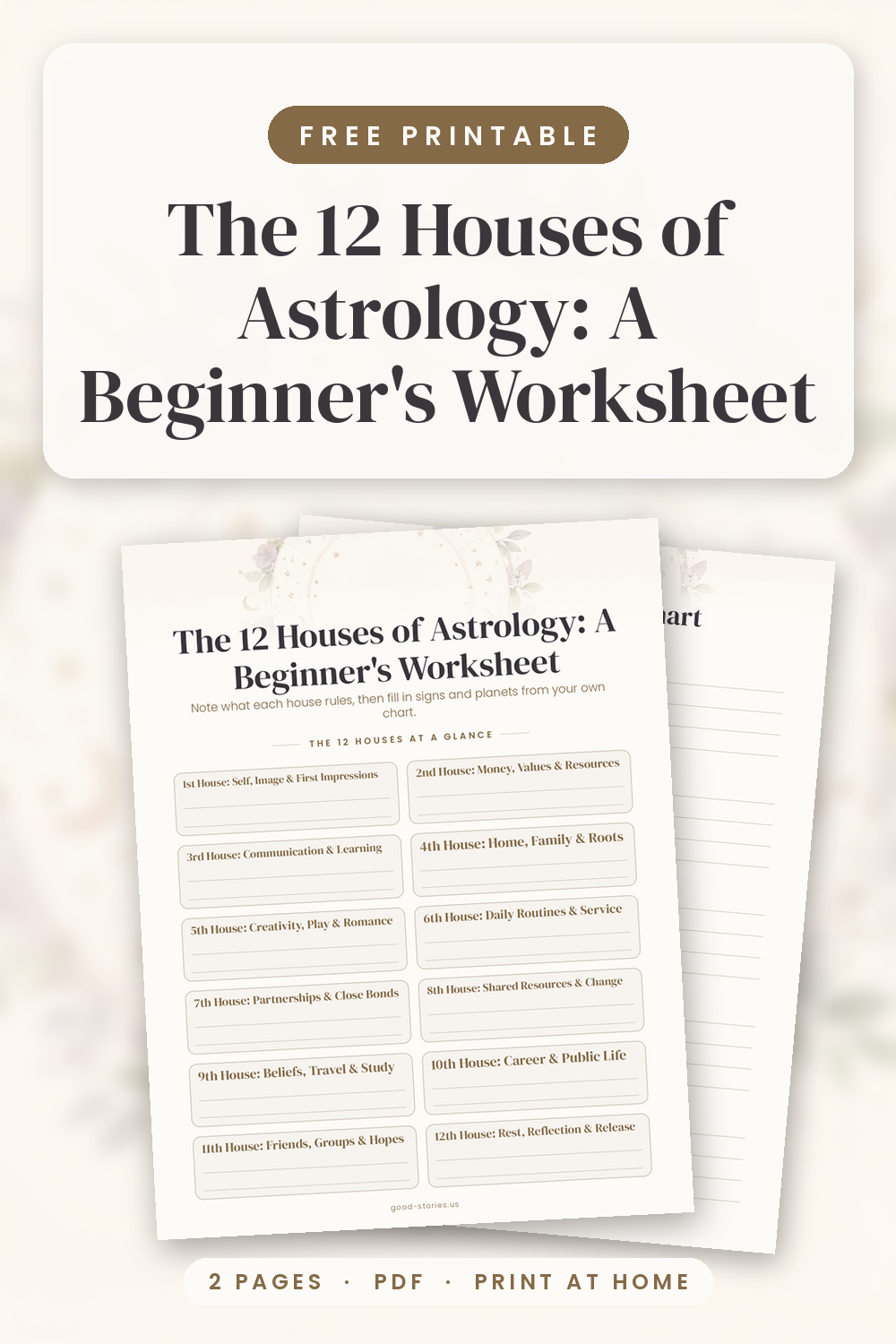
The worksheet is two pages, designed to be written on:
- Page 1: twelve boxes, one per house, each with the house number, its life area and writing lines.
- Page 2: five lined prompts to record the Sun, Moon, rising sign and one planet in your own chart.
The Chart Wheel, Split Into Twelve
The chart wheel looks like a pie cut into twelve uneven slices, and those slices are the houses. Astrologers count them counterclockwise, starting from the Ascendant — the point on the eastern horizon at the moment you were born, which is also your rising sign. The first house begins there and the twelfth ends there, closing the circle.
A useful shorthand: signs describe style, houses describe scenery. Your Moon in Cancer says something about how you process feelings; the Moon in the fourth house says those feelings play out at home and with family. Read together, they become a sentence instead of a label.
Astrologers do not all divide the wheel the same way. Whole-sign houses give each house one whole sign, while Placidus houses use time-based cusps that can place a boundary mid-sign. Neither approach is wrong. They are different lenses, and a beginner can learn on either.
Why the First House Lines Up With Aries
There is a tidy pattern hidden in the wheel. The natural zodiac pairs the first house with Aries, the second with Taurus, and so on around to the twelfth house and Pisces. Aries is the sign of beginnings, so it sits with the house of self and first impressions. Pisces is the sign of dissolving boundaries, so it sits with the house of rest and release.
Each sign brings its traditional ruling planet into that house. Mars rules Aries and therefore the first house; Venus rules Taurus and the second; Mercury rules Gemini and the third. The pattern continues around the wheel, with the Moon for Cancer and the fourth, the Sun for Leo and the fifth, and Jupiter for Pisces and the twelfth.
Modern astrology adds co-rulers for three signs: Pluto for Scorpio, Uranus for Aquarius and Neptune for Pisces. Many readers keep both sets, using the traditional ruler for structure and the modern one for texture. This pairing is a memory aid, not a rule about your own chart. Your real houses depend on your birth time and place.
Houses 1 Through 6 in Plain English
The first six houses cover the personal half of life.
The first house is you as others meet you: your face, your manner and your instinctive approach. The second house covers money, possessions and the values behind what you buy and keep. The third is communication — speech, writing, errands, siblings and the everyday traffic of information.
The fourth house sits at the bottom of the wheel and describes home, family, roots and the private place you retreat to. The fifth is creativity, play, romance and children, anything made for the joy of making it. The sixth covers daily routines, work habits, health rituals and service to others.
Every chart has all twelve houses, and none is more important than another.
Houses 7 Through 12 in Plain English
The upper half turns outward. The seventh house describes partnerships of every kind — marriage, business, close friendship — and the qualities you seek in another person. The eighth covers shared resources: joint money, inheritance, intimacy and the kind of change that arrives whether or not you invited it. The ninth is beliefs, travel, higher study and the search for meaning.
The tenth house is career and public life, the reputation you build over time. The eleventh covers friends, groups, causes and hopes for the future. The twelfth is rest, reflection, solitude and release, the quiet room at the end of the wheel where the year’s noise settles.
Houses 1 through 6 describe the private self; houses 7 through 12 describe how that self meets the world.
Reading Your Own Chart With the Worksheet
Start with three facts: your Sun sign, your Moon sign and your rising sign. You need a birth time and place to place them accurately. Find each one on your chart, then note which house it falls in. The second page of the worksheet has room for exactly that, plus one more planet you are curious about.
Group the houses into three sets as you go. Angular houses, 1, 4, 7 and 10, are the corners of the chart and tend to describe visible, starting-point energy. Succedent houses, 2, 5, 8 and 11, follow the corners and describe what is built and sustained. Cadent houses, 3, 6, 9 and 12, prepare for the next corner and describe learning, adjusting and processing.
If a house is empty, do not skip it. An empty house is not a missing part of life; it simply means no planet is emphasizing that area in your chart. Read the sign on its cusp, and treat the whole exercise as a self-reflection tradition rather than a prediction.
How to use your printable
Print page one on US Letter paper. If you use A4, choose “Fit to page” in your print dialog so the boxes and lines stay on the sheet; the layout is built for one page.
Use a pencil the first time. Write the sign on each house cusp and add any planets you find, then leave the margin free for notes you will want to add later.
- Print two copies and fill one with your own chart and one with a friend’s.
- Keep the worksheet in a binder with your notes on signs, planets and aspects.
- Revisit it each month and add one new detail as your chart reading improves.
- Use page two as a warm-up before reading a full chart for someone else.
Download the worksheet, print it, and keep it beside your chart. The twelve houses stop being an abstract list once you have written your own planets into them.