If the 22 Major Arcana cards feel like a lot to learn, this study worksheet gives you a calm, doable way to meet them one at a time. It includes a free printable with a 22-card checklist and a reflection page, so you can set aside memorizing definitions and start building your own relationship with each card.
This printable is not a substitute for professional help.
What’s inside the printable
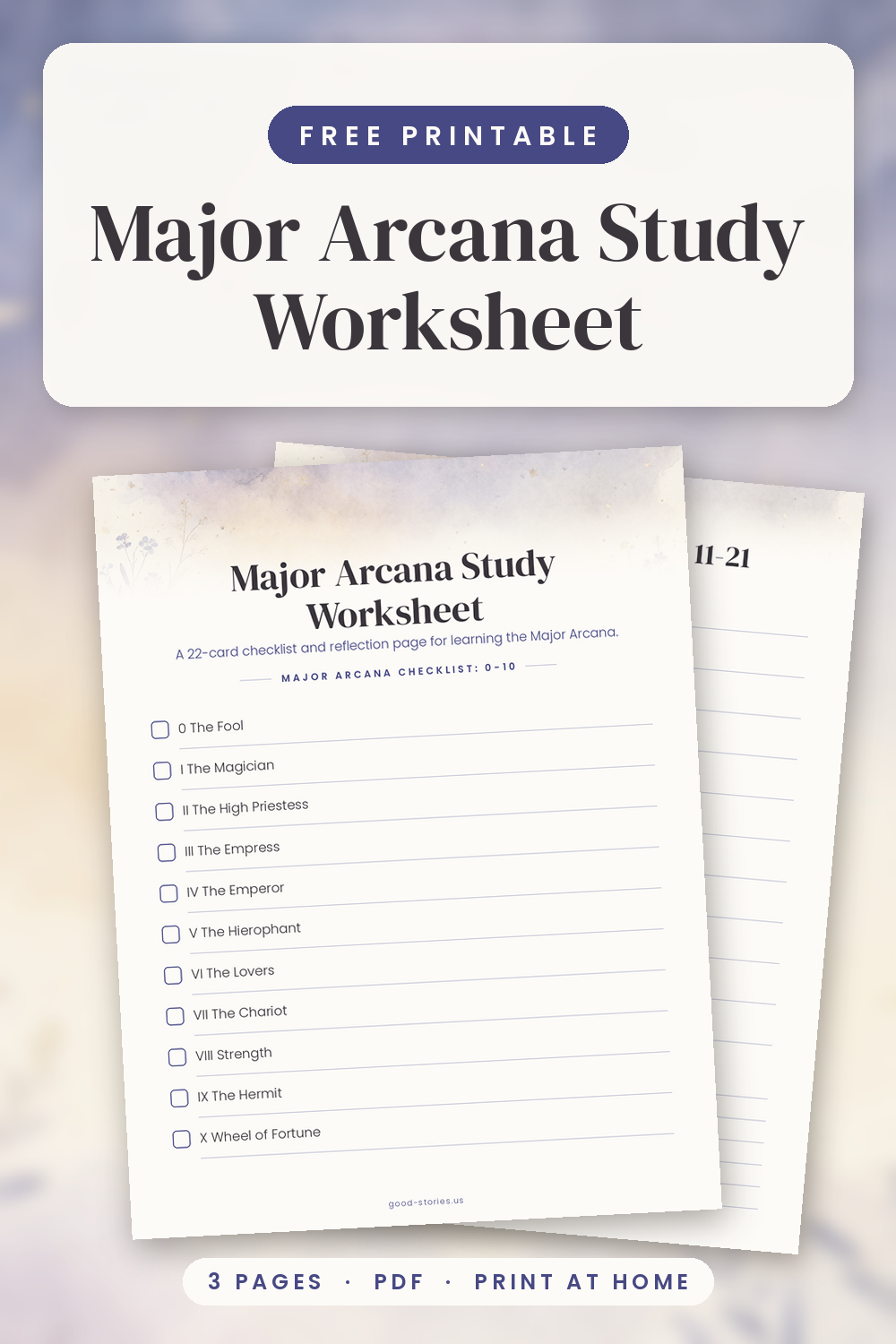
The free PDF is three pages, designed to be printed and written on:
- Page 1 is a checklist of the Major Arcana cards 0-X, from The Fool through Wheel of Fortune, with a box to tick as you study each one.
- Page 2 is a checklist of the Major Arcana cards XI-XXI, from Justice through The World.
- Page 3 is a card study notes page with five prompts and writing lines: card name and number, three keywords you notice, what the imagery shows you, a question the card brings up, and where you saw it this week.
What the Major Arcana Is
The Major Arcana is the group of 22 cards numbered 0 through 21 in a tarot deck. It sits apart from the 56 Minor Arcana cards, which are divided into four suits and tend to describe everyday situations, people, and smaller shifts. The Major Arcana is usually associated with larger themes: identity, choice, change, belief, and the seasons of a life.
That does not mean these cards are fateful or fixed. Many readers treat them as reflection tools, a set of images and stories that help you notice what you already think and feel. A card can be a prompt for journaling, a conversation starter, or simply a way to slow down and look at a situation from another angle. Different decks and teachers describe the cards differently, and your own observations are part of the learning.
A Quick Tour of the 22 Cards
The names and numbers below follow the widely seen Rider-Waite-Smith ordering. Other decks may use different artwork or slightly different titles, but the sequence is usually recognizable.
- 0 The Fool
- I The Magician
- II The High Priestess
- III The Empress
- IV The Emperor
- V The Hierophant
- VI The Lovers
- VII The Chariot
- VIII Strength
- IX The Hermit
- X Wheel of Fortune
- XI Justice
- XII The Hanged Man
- XIII Death
- XIV Temperance
- XV The Devil
- XVI The Tower
- XVII The Star
- XVIII The Moon
- XIX The Sun
- XX Judgement
- XXI The World
The Fool’s Journey
One traditional way to learn the sequence is as a story called the Fool’s Journey. The Fool sets out with curiosity and little else, meets teachers and rulers, falls in love, faces loss and uncertainty, and eventually arrives at The World. Read this way, the cards become chapters in a narrative of growth rather than 22 separate definitions.
It is one interpretive lens, not a prediction and not the only way to read the cards. Some readers find the story helpful because it links the cards together; others prefer to meet each card on its own. You can hold both approaches. The Tower and Death, for example, often sound frightening, but in this lens they tend to represent upheaval and endings that make room for something else. The printable does not assign meanings; it gives you space to record what you see.
Studying One Card at a Time
A steady, unhurried approach works better than trying to learn all 22 in a weekend. Start with a card that catches your eye. Before you reach for a guidebook, look at the artwork for a minute or two. Notice the figures, colors, symbols, weather, and the direction people are facing. What is happening? What is not shown?
Then write three keywords of your own, even if they feel obvious. Follow them with a reflective question instead of a definition. For The Hermit, that might be “Where am I avoiding quiet?” For The Star, “What helps me feel hopeful right now?” A question gives you something to return to, and it keeps the card connected to your life rather than a flashcard.
Keep your notes in one place so you can see your language change over time. Compare a card across two decks if you have them. Read the guidebook after you have made your own observations, not before, and treat its meanings as suggestions rather than rules.
Using the Free Printable
The worksheet is a tracker, not a textbook. Use the two checklists to mark your progress through cards 0-X and XI-XXI, and use the notes page to capture your own keywords, images, and questions. Tick a box only when you feel you have spent real time with the card, not simply when you have read about it.
There is no required pace. One card a day is plenty, and one card a week may suit you better. You can pull a card in the morning and carry the question with you, then write a few lines in the evening. When you finish the 22, start again with the same deck and see what has changed. The notes page is also useful for cards you meet in readings, even if you have already studied them.
If you are learning with a friend, compare your keywords for the same card. The differences are often the most useful part. Pair the worksheet with your deck’s guidebook or a trusted beginner book; the printable gives you the structure, while the deck and its guidebook provide the imagery and traditional meanings.
How to use your printable
A few practical notes before you print:
- Print on US Letter. The pages are sized for standard letter paper.
- On A4 paper, choose “Fit to page” in your printer settings so nothing is clipped.
- Print single-sided if you plan to write heavily or use a fountain pen.
- Slide the checklist pages into a binder or folder, and keep the notes page with your deck.
- Use the notes page as a card-a-day log, a study group worksheet, or a page to return to when a card keeps appearing.
The Major Arcana becomes easier when you stop trying to memorize all 22 at once. Print the worksheet, choose one card, and give it ten quiet minutes. The meanings you build yourself are the ones you will remember.