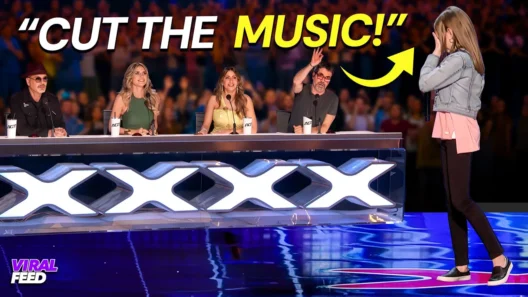
There is a particular quiet that falls over a talent stage when a contestant begins a sentence with, “I’ve been here before.” It isn’t just nerves. It’s history—of a no that lingered, of a detour that didn’t end the way they hoped, of all the thin places where ambition and embarrassment once met. This film strings together those moments when the once-rejected walk back out, face the same bright lights, and try again.
The courage of coming back
Across countries and formats, the faces change but the impulse is the same: to rewrite the last line of an old chapter. When Andrew from Burnley steps into view, he does it with a grin and a confession that is both endearing and disarming.
“Honest to god, people think I’m joking when I say this, but I’m absolutely obsessed with the queen. We have, like, little queen parties and everything in my flat.”
He’s auditioned for Simon Cowell before—on Pop Idol, years ago—when he says he was “pretending to be this straight little boy.” This time, he arrives as himself, a self-described male diva ready to belt Jocelyn Brown. The reaction is immediate and noisy, but the best scenes come after the applause, when the panel tries to steer his comeback into something sustainable.
“Andrew, you were singing for your life there, weren’t you? I mean, it was an extraordinary performance,” one judge says, before adding a soft warning: “Trust that. All the stuff… it’s fun, but it makes you almost a little bit cheesy, and you’re not cheesy. You’ve got a lovely, lovely voice… be confident… in your talent because it is there a 100%.”
Simon—who remembers the scrappier venues Andrew has likely endured—cuts even closer to the bone. In trying so hard to be liked, he says, Andrew sometimes looks “quite desperate.” The note lands. It’s the kind of critique you only really hear when you’ve got nothing left to prove. Then comes the sweep: yes, yes, yes, yes. A circle closes, not just because he’s better, but because he’s more himself.
When second chances still say no
For Adrian, the return is measured in decades, not seasons. He auditioned for Popstars in 2001. Now he comes back with “The Prayer,” standing under a weight of memory that would buckle most singers. He has power—so much that a judge raves about his octave switch—but the panel’s patience narrows when style obscures story.
“Nobody needs to tell you that you have a voice,” a judge says. “What was so distracting for me is your vibrato. It is so slow. A monosyllabic word turns into ‘pray. Yeah. Yeah. Yeah. Yeah. Yeah.’ Instead of ‘pray.’ That is way too distracting for me.”
There’s the other question, too—the one contestants fear because they can’t rehearse for it. “There’s something missing for me,” one panelist says. “I think it’s star quality.” Another promises a shot—“I’m gonna give you a chance”—but the swing vote withholds belief, even as they admit, with a wince, “I would like to sit here and say that I would love to hear you sing again.” The verdict is no. A return doesn’t always give you the ending you wanted. Sometimes it gives you clarity instead.
Roy, the CDs, and the laughter that stays
Then there’s Brenda, who came back because last time the tracks on her audition CD were mixed up—by her boyfriend. The stage becomes a comedy of errors before she even sings.
“What was his name?” a judge keeps asking, through the laughter. “Roy. Roy. Roy?”
She nails the right track at last and sings Julie Rogers’ “The Wedding.” The room quiets. The verdict does not. Simon’s line is unvarnished.
“Look. Brenda, look. The truth is… nobody would pay to hear you sing.”
Every judge says no, though one tries a gallows-humor consolation: “The bad news is I’m gonna say no. The good news is they’re all gonna buy your record.” Brenda exits with a quip—“I have to go to pole dancing next year”—and a dignity that doesn’t dent. Not all comebacks are redemptions. Some are reprises meant to put a rumor, or a bad track list, to bed.
Family, pressure, and letting go
In one of the most uncomfortable scenes, a family returns as a trio. The question that hangs in the air is as heavy as any note.
“Why didn’t you come back on your own?”
The parents answer that they “just wanted to do it as a family.” The critique is swift and humane, aimed not at the child’s dream but at the architecture around it.
“You’d be the best parents in the world if you just let him go.”
It’s a hard watch because it’s honest. And then, months and miles later, honesty has a payoff. The same stage welcomes Kieran back. He’s older now—“I’m 13”—and the transformation is startling.
“Interesting… I thought you were good last year. I thought this year… I thought you were fantastic this year.”
A second chance can be a gift. A second chance at the right time can be a revolution.
Writing your way out of anxiety
The most luminous return belongs to Nicolina, who walked away from American Idol as a top-five finalist and then walked toward something more private. She says that after the TV lights, she went home to write—really write—about what she carries every day.
“I struggle with anxiety,” she says. “So the mental battle with myself about how much it means to me… I turned to writing. And I actually am gonna share a song… that I wrote about my story.”
She sits in the center of a Canada-sized stage and opens a diary she set to melody. The lyric is clean and vulnerable:
“Thoughts that I can’t explain, chemicals in my brain… I’m gonna come out strong, make a diamond out of me.”
The judges don’t rush to praise—they lean in to understand. One hears, inside the hook and the hush, a lifeline for people who have trouble naming what hurts.
“Your gift in this songwriting reaches out to… so many other young people who are navigating anxiety… and even people who are older who maybe didn’t have the language,” the judge says. “It’s really accessible, really current, and you’re such a beautiful voice.”
Another, mid-sentence, stops talking and starts doing.
“I’m so sorry to cut you off, but… I just have to do something for you… you are my golden buzzer.”
Confetti answers before the band can. The host reminds her—and us—what that means: an instant pass and, in this case, a windfall.
“You have just won $25,000. Thanks to CIBC.”
What’s striking here is not just the prize, but the arc. Nicolina didn’t come back to sing a bigger cover. She came back to sing a smaller truth, the kind that makes a giant room feel like a friend’s front porch. The bravery is not just in the note; it’s in the naming.
What second chances ask of us
Threaded through these returns is a quiet thesis about growth. Andrew’s lesson is that charm is not a substitute for trust in your own voice. Adrian’s lesson is that force without focus rarely convinces. Brenda shows that humor and heart can outlast a no, even a brutal one. A family learns that love sometimes means stepping aside so a child can step forward—alone, at the right pace. And Nicolina proves that the bravest path isn’t always up the same old ladder; sometimes it’s through a new door you built yourself.
There’s craft here, too, in how the panels handle the fragile weather of a comeback. The best notes are surgical, not savage—specific enough to build on, honest enough to sting. “I think you over sang it,” Simon tells Andrew, while still saying yes. “Kill that vibrato,” a judge bargains with Adrian, offering a conditional hand. “Nobody would pay to hear you sing,” Simon tells Brenda, and as hard as that is to hear, he’s not dressing it up. The paradox is that in this world, mercy often looks like precision. Sometimes the kindest thing you can do for a returning act is tell the exact truth about where they stand, and then stand back.
But the larger mercy is the stage itself. Every comeback is a public recalibration—a chance to line up who you were with who you are and decide, on-camera, to close that gap. That’s why these scenes are so gripping. You’re not just watching people sing or dance. You’re watching them renegotiate their relationship with fear, with past selves, with rooms that once sent them away.
And every so often, the room changes its mind. Four yeses ring out for a singer once told to be less. A teenager returns and earns a word he didn’t hear before: “fantastic.” A songwriter puts anxiety to music and sees a judge rise to slam a golden button. The sound is final, but the message isn’t. The message is that a no can be a comma, not a period.
Watch what happens next
If you’ve ever sat up late wondering whether to try again, these stories will feel like a hand on your shoulder. Watch the full film to see how each return really lands—who grows, who surprises, who hears “yes” at last, and who walks away with a different kind of win. The lights go down, the quiet comes, and they begin again.