The albatross with band Z333 was already an adult when Dwight Eisenhower was president. She has survived a tsunami, outlived her species’ typical lifespan and flown millions of miles. In November 2024, at about 74, she did something she had not done in four years.
Midway Atoll sits at the far northwest end of the Hawaiian archipelago, a small ring of islands in the North Pacific where millions of seabirds nest. The atoll is small; the colony is vast. One of the birds that returns there is a Laysan albatross, or mōlī, named Wisdom. She is the world’s oldest known wild bird, now at least 74 years old.
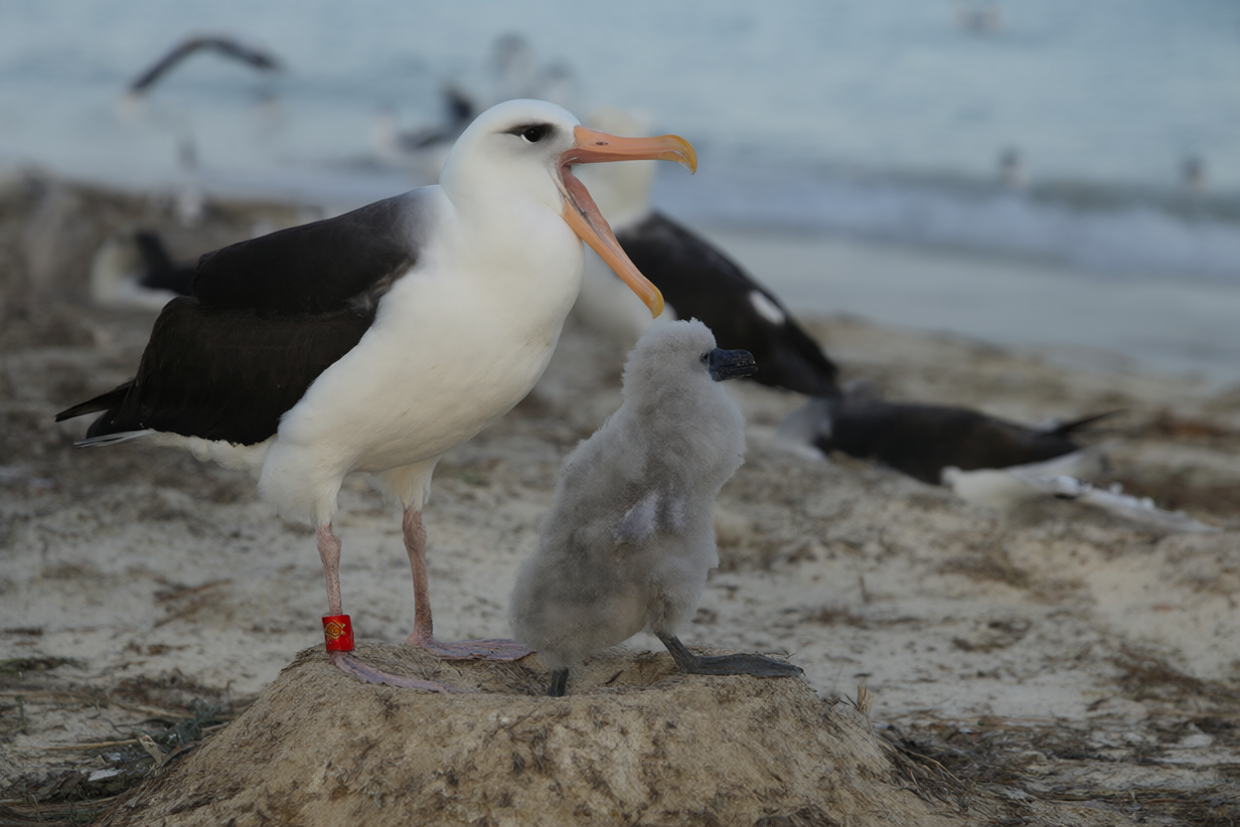
At Midway, she is one bird among millions. The band is what makes her findable. Without it, she would be another albatross on the same ground, and her history would be unknown.
Her record with people began in 1956. That year the ornithologist Chandler Robbins banded an adult albatross at Midway Atoll, after she had laid an egg. The band carried the number Z333. Dwight Eisenhower was president of the United States, and Hawaii was not yet a state.
The bird was already an adult and already breeding when the band closed around her leg. The band was a simple marking, but it became the thread that tied her life to a human record. The egg she had laid was the reason the band went on; she was a breeding adult, not a chance visitor.
For decades the band was only a band. Then, in 2002, Robbins resighted the bird wearing it. The number matched. The record made her famous: she was the oldest known wild bird.
The word known matters. Her title rests on a band and a chain of sightings, not on a guess. The record is a human achievement as much as a bird’s: someone had to band her, and someone had to find her again.
NOAA puts the typical Laysan albatross lifespan at about 68 years, and Wisdom has since passed it. The resighting did not make her a different bird; it made her visible. By 2002, 46 years had passed since her banding.
The dates are easy to line up. The band went on in 1956, and the egg of late 2024 came 68 years after the banding. A bird that was already an adult in 1956 had become, by any measure, the oldest known wild bird.
Wisdom had not spent those decades sitting still. She is believed to have flown more than 3 million miles, enough for six round trips to the moon. The figure is an estimate, but it describes a life measured in long flights over open water. The moon comparison turns an abstract number into something a person can hold in mind.
She has likely laid 50 to 60 eggs and raised as many as 30 chicks to fledging. Those are estimates, but they describe a long reproductive life, one egg at a time. Not every egg became a chick, and not every chick fledged, but the totals are part of her record.
The bird banded in 1956 has been part of the atoll’s nesting colony for decade after decade. She has also survived. Wisdom lived through the 2011 tsunami. She has navigated fishing gear and plastic debris.
The hazards are part of the ocean she crosses, and she has crossed it for decades. Survival is not a single event in a life that long; it is a series of returns. Each return brought her back to the same island.
For years she returned to Midway with a mate named Akeakamai. Laysan albatrosses usually mate for life, and the pair came back to the same nest site for decades, raising one egg a year. The nest site was a fixed point in a life otherwise spent moving.
Then Akeakamai stopped returning. He had not been seen for several years. Wisdom kept coming back to Midway.
At about 74, she found a new partner, an unbanded male. He had no band, so he arrived without a record of his own. The bird that had outlasted presidents and a tsunami had courted again.
In late November 2024, she laid an egg. It was her first in four years. It may have been her 60th. The egg carried another season for a bird already past the usual span of her species.
The pair settled into the long work of incubation, trading duty for about two months. One bird sat while the other went to sea, and then they swapped. Biologist Jonathan Plissner watched the nest. “We are optimistic that the egg will hatch,” he said.
The wait ended in stages. The egg pipped on Jan. 29, 2025. By the next day, Jan. 30, the chick was fully hatched, and the mate recorded as EX25 was nearby.
Wisdom was not on the nest for the hatching. She was at sea. She returned on Feb. 6, 2025, after weeks away. Then she fed her week-old chick for the first time.
The family did not end with that chick. Her son N333, from the 2010/11 season, was incubating her grandchick on the same island. Two generations were at Midway at once.
After weeks at sea, she came home to a chick—and on the same island, her own son was already tending the next generation.
Sources: Associated Press, U.S. Fish and Wildlife Service, NPR, ACAP, Friends of Midway Atoll, ACAP