In the summer of 1977, volunteer Jerry Ehman sat down with the previous night’s computer printouts from Ohio’s Big Ear telescope. One vertical line of six characters made him write “Wow!” in red ink. Decades later, no telescope has recorded that signal again.
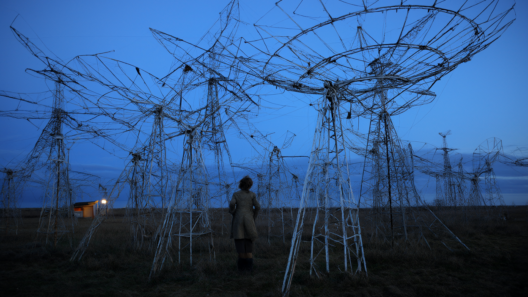
The night behind that printout was August 15, 1977. Big Ear, Ohio State’s radio telescope, stood on farmland and scanned the overhead sky for narrow-band radio signals. It worked through the night, and by morning the previous night’s observations existed as rows of line-printer output.
Jerry Ehman sat down with that output the next morning. The printout showed 50 frequency channels at a time, so the record arrived as characters arranged in rows rather than as an image on a screen. Reading it meant scanning channel by channel for anything that rose above the ordinary. In one channel, six characters stood out: 6EQUJ5.
Ehman circled the six characters and wrote “Wow!” in red ink beside them. The string was not a message or a word. It was the observatory’s compact code for signal intensity, a way of packing measurements into single characters. The U in the middle was the strongest value Big Ear had ever logged.
The code also carried the timing. Each character represented one 12-second sample, so the six characters covered about 72 seconds. The burst sat near the hydrogen frequency that SETI researchers favor. In a search built on long, patient listening, 72 seconds was a brief event, but it was long enough to be sampled six separate times.
The shape of the trace was as striking as its strength. The signal rose and fell in a near-perfect match to the antenna pattern, the curve a fixed celestial source would trace while Earth rotated. That match pointed away from a local transmitter. Director Robert Dixon said it meant the source was at least as far away as the moon and “very unlikely to be any interfering signal.”
A source at least as far as the moon was well beyond the observatory and its surroundings. The measurement did not identify the object. It only pushed the origin out into the sky.
Because the source appeared fixed, the follow-up had a target. Ohio State aimed the telescope at the same coordinates for a month. The signal was never recorded again, and later searches also came up empty.
The repeat was the test that mattered. A signal that appears once can be measured, described and argued over, but it cannot be confirmed the way a signal that returns can.
Ehman’s part in the story was not the usual one. He had been let go when the National Science Foundation cut Big Ear’s funding in 1972, but he stayed on as a volunteer. The man who found the six characters was working without pay. He never claimed the signal was alien.
He remembered the moment plainly. “I mean, without thinking, I wrote ‘Wow!'” he said. He called the signal “the most significant thing we had seen.” He also doubted the most exotic explanation. “Even if it were intelligent beings sending a signal, they’d do it far more than once,” he said.
The signal became famous anyway. It turned into the most celebrated one-off in the search for extraterrestrial intelligence, a 72-second burst that gave the field one of its most recognizable artifacts: six characters on a printout and a red word written beside them.
The evidence is simple: a row of characters, a circle, a word in red ink. Its power comes from what it does not show. There is no second printout to compare, no repeat observation to confirm the first.
For years the case stayed open. Then, in 2024, a team using archived Arecibo data found faint hydrogen-line signals from small, cold interstellar clouds. The clouds themselves were not obvious radio sources, but the team proposed a way one could become visible: a magnetar flare or a similar burst could briefly brighten such a cloud into a Wow-like signal.
That proposal gave the old event a new physical frame. A cold cloud could carry a hydrogen-line signal, and a sudden flare could lift it into view for a short time. The burst would not need a transmitter. It would need the right cloud and the right flare.
The 2024 work did not settle the case by itself. It offered a natural process that could produce a short, narrow signal from a region of sky, and it made the old printout worth another look.
In 2025, the team returned to the Ohio records. It reanalyzed decades of unpublished Ohio data and found a stronger signal than the familiar printout had shown, above 250 Jy, coming from a narrower patch of sky. The new paper favors an astrophysical origin over radio interference.
That still leaves the source unidentified. No confirmed object has been matched to the signal, it has never repeated, and the patch of sky it came from is still being observed. The mystery is smaller now, not closed.
The two papers changed the shape of the argument without producing a confirmed source. The signal now has a plausible natural mechanism and a better measurement, and it still has no identity.
The red “Wow!” remains the center of the story. It marks the moment a volunteer stopped at a row of characters and recognized that something in the ordinary output was different.
The signal never came back, but the red “Wow!” on that old printout still points to a patch of sky we have not stopped listening to.
Sources: SETI Institute, Ohio State University Radio Observatory (Big Ear), Jerry Ehman, Méndez, Ortiz Ceballos and Zuluaga, Méndez et al.