December moves fast. By January, the small details that made this Christmas yours — the funny thing someone said over dinner, the song that played while you decorated, the plate of cookies a neighbor left on the step — have a way of blurring into one warm haze. A Christmas memory journal gives those moments somewhere to land, and these free printable memory pages make it easy to capture them in the middle of the season instead of promising yourself you will do it later. The printable is free, and the download button is right below.
What’s inside the printable
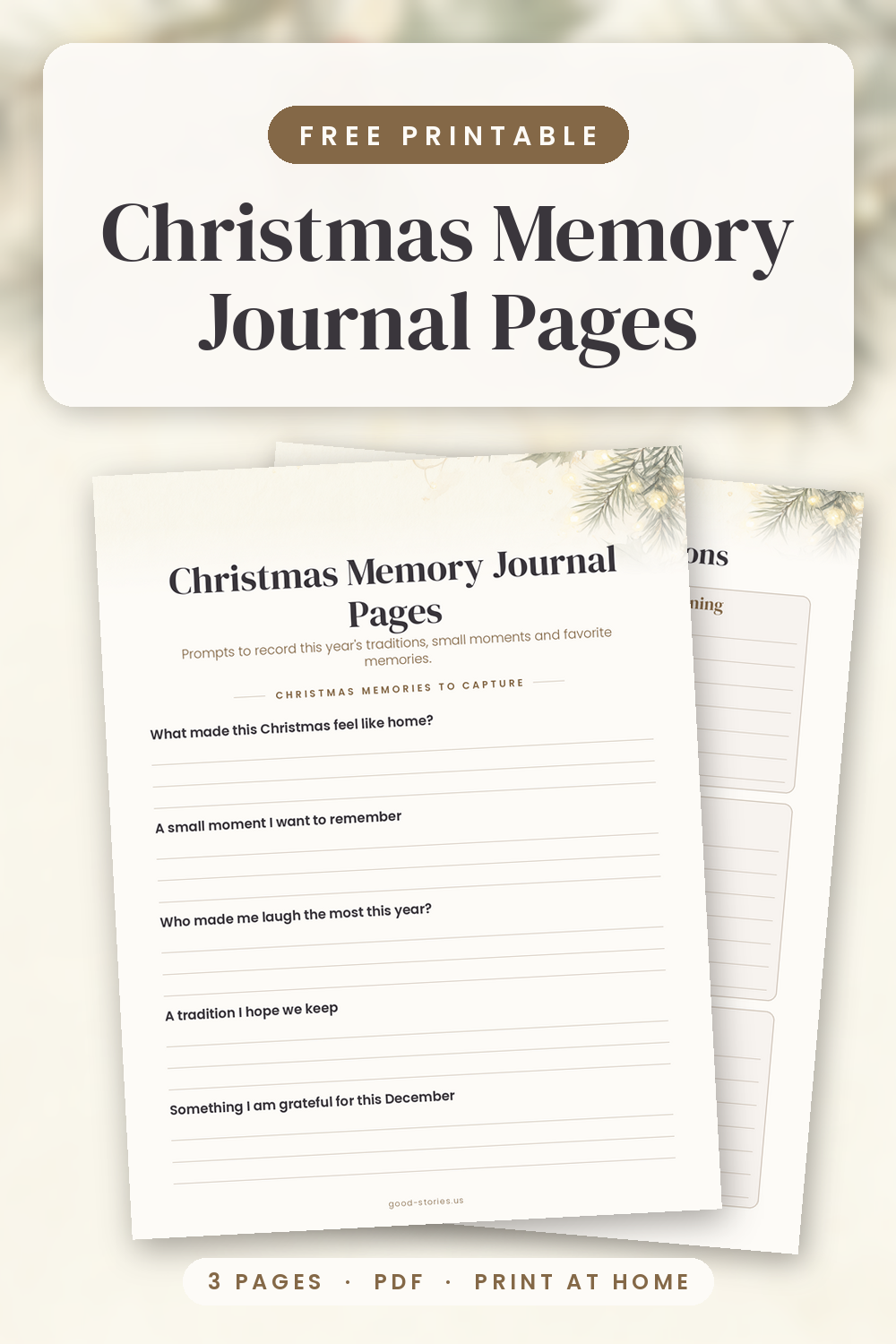
The download is a three-page PDF sized for US Letter paper, printed in soft watercolor greens and berry reds. Every prompt has writing lines under it, so you can fill the pages in with a pen rather than typing them up later.
- Page 1: five open-ended Christmas memory prompts, each followed by writing lines, including questions like “What made this Christmas feel like home?” and “A small moment I want to remember.”
- Page 2: six titled tradition boxes for Christmas Eve, Christmas morning, our favorite meal, the decorations, the people we saw and a new tradition, each with writing lines.
- Page 3: four reflective prompts for next Christmas, each followed by writing lines, including one about a photo you never want to lose and one about a word for next December.
Why a Christmas memory journal is worth the few minutes
Photos catch faces and wrapping paper, but they miss most of what makes a December feel like yours. They do not record the name your child gave the tree, the phrase a grandparent says every year on the phone, or the fact that everyone ate standing up in the kitchen because the table was buried under ribbon. Writing it down takes two or three minutes and fixes those details in place. The real gift arrives later: in three or five years, a page in your own handwriting will bring back a Christmas you thought you had forgotten, and the ordinary sentences will matter more than the polished ones.
How the three pages work together
The printable is built as a small arc rather than a stack of identical worksheets. Page one asks what actually happened this year; page two sorts those moments into the traditions you already keep; page three turns everything forward, toward what you want to repeat, who you want to see, which photo you refuse to lose and the word you want next December to be about. Filling page three while the season is still fresh means you open next December with a plan instead of a vague intention. If you only have time for one page, start with page one and come back to the rest on a quieter evening.
Answering the prompts without turning them into homework
There is no schedule to keep. Some people answer one prompt a day through December like an advent calendar; others fill every page in a single sitting with a mug of something warm. Both work. Skip any prompt that does not fit your year — a question about a new tradition does not need an answer if this December felt like survival mode. Short answers count, and “the kitchen at eleven at night” is a real answer. Children can dictate their replies to an adult, and their wording is usually better than a cleaned-up version. If a prompt brings up someone you miss, write the sentence anyway and close the page afterward.
Making it a family ritual on Christmas Eve
Set the pages out with a few pens on Christmas Eve, or on the last quiet evening before the holiday when the wrapping is done and nobody has anywhere to be. Leave them on the table without announcing a project. Anyone who wants a page takes one, and nobody has to finish it. Read a few answers aloud while the cocoa is still hot; some of the best lines will come from the person who claimed they had nothing to write. Kids can draw in the margins when the lines feel too long. If Christmas Eve is too full, use the drive home or the slow morning after.
Storing it so next December feels like opening a gift
Write the year at the top of each page and add a family photo, a ticket stub or the recipe card you actually used. Put the pages in a folder or album and store that with the decorations, not in a drawer you will forget by February. The point is the unpacking: the box comes down, the old pages come out, and before the tree is even up everyone is reading last year’s answers and arguing about whose memory is right. After a few years the folder becomes the best thing in the box.
How to use your printable
- Print on US Letter paper, which is the size the pages were designed for.
- Printing on A4? Choose “Fit to page” (sometimes called “Scale to fit”) in your print dialog so the margins and writing lines stay intact.
- On Letter paper, use “Actual size” rather than “Shrink to fit” so the lines stay comfortable to write on.
- Print single-sided on slightly thicker paper if you write with a wet pen, and clip the page to a board so it stays steady on the couch.
- Print a spare copy for a guest, for a child who would rather draw than write, or for the relative who always says they have no stories.
- Try one prompt per evening in December, answer the same prompt every year and compare the pages, tuck a recipe card between them, or slide the finished sheets into an album with the year written on the back.
Christmas is a season of doing, and most of it goes by before anyone thinks to write it down. Give yourself one quiet page this week, keep it with the decorations, and let next December start with a story instead of a blur.