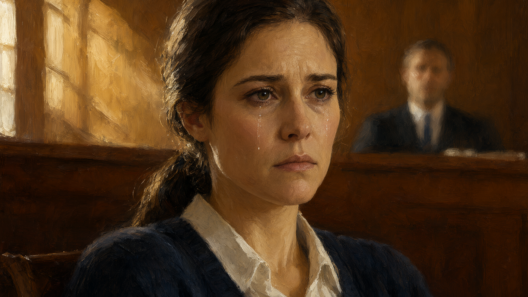
Anita’s gaze held mine. “He told me he needed to know who he was when no one was impressed.”
I swallowed. “How much?” The question felt obscene and unavoidable.
She opened the folder at last. “After taxes and expenses, the estate is valued at approximately twelve million dollars. There are properties, trusts, and the company shares, but the liquid assets alone—”
“Stop,” I whispered, the room tipping.
She stopped immediately.
I stared at the table, at the grooves in the wood, at the faint ring where Calvin’s cup had sat a hundred times. “I serve coffee,” I said, voice cracking. “I can barely keep my family afloat. I can’t— I can’t be that person.”
“You don’t have to become anyone else,” Anita said. “He didn’t choose you because he thought you’d run a corporation. He chose you because he thought you’d do something decent with what he left. There are professionals to manage the business. You only have to decide what kind of steward you want to be.”
Steward. Like my hands weren’t shaking. Like my life wasn’t suddenly split into before and after.
Pete walked by, slowed, and glanced at my face. His mouth opened like he might ask if I was okay, then he thought better of it and kept walking.
After Anita left, I sat in Calvin’s chair until the café lights flickered on and the evening rush started. I moved like a ghost through closing, wiping counters and sweeping floors while my mind kept replaying his words: You were kind when you were tired.
At home, my mom was at the kitchen table sorting bills into piles. My brother was doing homework with his inhaler beside him like it was part of the assignment.
“Long day?” my mom asked.
“Yeah,” I said, because I couldn’t say, I think I just inherited a life I don’t understand.
That night, I didn’t sleep. I lay staring at the ceiling, hearing Calvin’s voice in my head—not the exact words, but the tone. Quiet. Certain. Like he’d already made peace with what he was asking of me.
The next day, I went to work and did my shift.
Pete cornered me behind the espresso machine. “That woman yesterday,” he said. “Everything okay?”
I took a breath. “I need to give you my two weeks’ notice.”
His eyes widened. “What? Lena, what happened?”
I glanced at the window table. Empty again. “Something happened,” I said quietly. “But I’ll work my notice. I’m not leaving you short-staffed.”
He studied my face, then nodded once, slow. “Okay,” he said. “Okay. You’ve earned whatever you’re doing.”
I worked the full two weeks.
On my last day, I did small things that felt like breathing.
I slipped an envelope into Pete’s desk drawer with enough to cover the café’s back rent that he’d been pretending wasn’t overdue. I left another for Marisol, the single mom who worked afternoons and always pretended she wasn’t exhausted. I paid our landlord in full for six months and watched him blink like he’d forgotten how to be human.
I didn’t tell my mom right away. I waited until I had the paperwork in my hands and Anita had explained things twice and I’d signed enough documents to make my wrist ache.
When I finally did tell her, she sat down hard in the chair and stared at me like I’d grown another head.
“From who?” she whispered.
“A man from the café,” I said. “His name was Calvin.”
Her eyes filled. “You fed him,” she said, like it was an accusation and a prayer.
“I did,” I whispered back.
A week later, Anita drove me out to Calvin’s house.
It sat behind a line of old oaks in a neighborhood where the lawns looked like somebody brushed them. The home wasn’t flashy—no marble columns or iron gates—but it had the kind of quiet solidity that made you believe it had always been there and always would be.
Inside, everything smelled faintly of lemon polish and books. The rooms were warm. Lived-in. There were framed photographs on the mantle—Calvin younger, smiling beside a woman with dark hair. A dog I’d never known he had. A Christmas tree glowing in a corner of one photo like a memory he’d kept for himself.
A woman in her fifties stepped out of a hallway, wiping her hands on a dish towel.
“You must be Lena,” she said gently. “I’m Beth. I… I helped care for him.”
Her eyes were kind, and tired, like mine.
“He talked about you,” Beth said. “Said you made him feel… ordinary. In the best way.”
My throat tightened. “I didn’t know,” I managed.
“No,” she agreed. “He liked it that way.”
Beth led me to a small office at the back of the house. A desk sat beneath a window that looked out over a garden just starting to wake up for spring. On the desk was a simple black notebook, closed neatly, a pen laid beside it like someone would be back any minute.
My name was written on the first page in Calvin’s handwriting.
Lena.
I sat in his chair. It fit me too well.
The notebook was thick with names, dates, short descriptions.
A mechanic in Dayton who fixed a flat tire for free when Calvin was “short on cash.”
A school janitor in Cincinnati who let him sit inside when it was freezing.
A grocery clerk in Lima who quietly slid a loaf of bread into his bag.
Dozens. Maybe hundreds. Proof of people being good in small, invisible ways.
I ran my fingers over the ink until it blurred, and something in me steadied.
Anita had said steward. Calvin had said keep the chain unbroken.
So I opened my laptop right there at his desk and started with the first name in the notebook.
It took me a month to find her—the grocery clerk. Her name was Tasha. She worked two jobs and lived with her grandmother, who needed home care they couldn’t afford. When I finally walked into the grocery store, she was scanning items with that same tired efficiency I’d lived in for years.
I bought a carton of milk I didn’t need and waited until my turn.
When she handed me the receipt, I slid an envelope across the counter with it.
“What’s this?” she asked, wary.
“Just… something that belongs to you,” I said.
She opened it, and her hand flew to her mouth. Her eyes darted up to me, wide and panicked.
“I can’t—” she started.
“I know,” I said softly. “But it’s yours.”
Inside was a check for thirty thousand dollars and a note in Calvin’s handwriting, copied onto my own stationery because I didn’t want it traced to him like a spectacle:
You were kind when you didn’t have to be. The world keeps score.
— A friend
I didn’t wait for her to find words. I walked out before the tears could spill in front of strangers, before the moment could become a performance.
Over the next year, I found forty-two people from Calvin’s notebook.
I paid for dentures. I cleared medical debt. I covered rent so a family wouldn’t be put out on the street with their furniture on the curb. I bought a used van for a mechanic who’d been walking to work for months. I set up a scholarship at my brother’s school for kids who needed “field trip money” without having to ask for it.
I didn’t do it loudly. Calvin hadn’t done anything loudly.
I started something small at first—just a bank account labeled The Window Table Fund. Then a lawyer helped me make it official. No applications. No essays about why you deserve help. Just names, stories, quiet verification, and money sent where it could loosen the tightness of someone’s life for a while.
The company Calvin built? I didn’t touch the day-to-day. I sat in meetings I didn’t understand at first, asked questions until I did, and insisted that a portion of profits go into the fund every quarter. The executives looked at me like I was naïve until they realized I wasn’t going away.
The house? I kept it, but I opened the guest wing to women trying to get back on their feet after leaving bad situations—short stays, no questions, just a safe door and a bed and someone like Beth to make soup and remind them they weren’t invisible.
And me?
I still go to Maple & Main sometimes, usually on Thursdays. I sit at the window table while the morning sun makes everything too bright. I order a coffee with two creams and no sugar.
And when I see someone hovering by the counter, digging for change with hands that shake from cold or hunger or pride?
I don’t wait for them to ask for hot water.
I just say, the way I did the first time, “Sit. I’ll bring it out.”
Because Calvin was right.
The world keeps score, even when nobody’s watching.
And sometimes, if you’re very lucky, the kindness you throw out into it finds its way back home.
Three years after Calvin’s death, I sat in his office—my office now—and opened the black notebook one more time. I’d tracked down every single name. Some I’d helped financially. Others I’d simply found and thanked, watching their faces light up with the memory of a small kindness they’d forgotten they’d given.
The last page had one entry I’d been avoiding.
Lena Mercer. Maple & Main Café. Gave tea and croissants to a stranger who counted pennies. Never asked for anything in return.
Below it, in Calvin’s careful handwriting:
She doesn’t know it yet, but she saved me before I was gone. Not my body—that was already lost. But the part of me that needed to believe the world was worth the life I’d lived in it.
I closed the notebook and pressed my palm flat against the cover.
“I hope I’m doing this right,” I whispered to the empty room.
The garden outside was in full bloom now. Beth had planted roses along the fence, and they opened like small fists unclenching in the morning light.
My phone buzzed. A text from Anita: The scholarship fund just cleared another hundred applicants. You’re changing lives, Lena.
I typed back: We’re changing lives.
Because it wasn’t me. It was Calvin’s notebook. It was Tasha and the mechanic and the janitor and every person who’d chosen to be kind when the world didn’t require it.
It was the window table at Maple & Main, where the sun still hit wrong in the mornings and made everything too bright.
It was the proof that the world keeps score.
And sometimes, when you least expect it, the score comes back in your favor—not because you earned it, but because someone saw you when you thought you were invisible.
I stood, straightened Calvin’s pen beside the notebook, and walked out into the garden where Beth was pruning the roses.
“Lena,” she called. “You staying for lunch?”
“Yeah,” I said. “I’m staying.”
And for the first time since Calvin died, I felt like I was exactly where I was supposed to be.