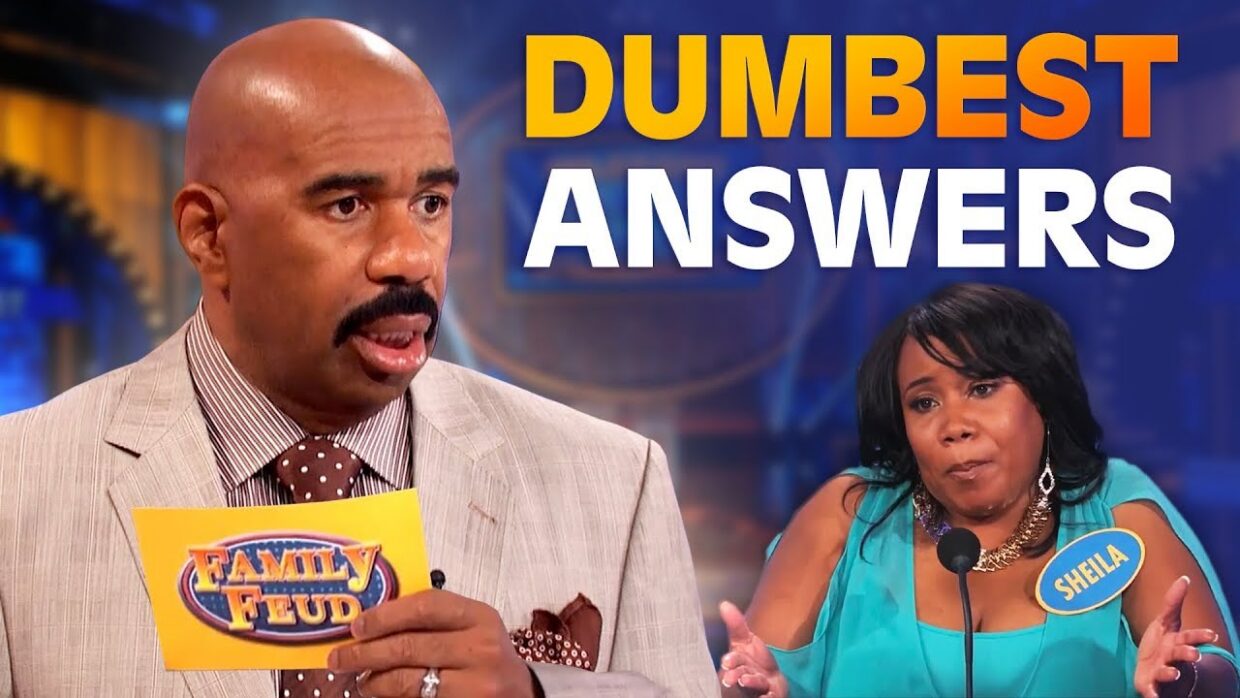
Family Feud is built on the gap between a question and the answer it deserves. Most contestants close it with something sensible. Every so often, someone closes it with a word Steve Harvey has never heard, and the host has to decide whether to argue, laugh, or repeat the answer until the room surrenders.
The answer that became a catchphrase
The first question sounds harmless: “Name something that follows the word pork.” Pork chops, pork belly and pork rinds are all reasonable. The contestant offers “Q-Pine.”
Steve repeats it, turns the syllables over, and tries the word from another angle. It does not improve. Then he gives it an endorsement most answers can only dream of:
“This is the greatest answer I’ve ever heard.”
He predicts it will be “number one on YouTube” and starts to bet every dollar he has that nobody else said it. “Q-Pine” is not a food or a cut of meat, but for one round it is the only answer in the room.
France is a country. Paris is not.
The next question asks for a country a man with a mustache should visit to meet a woman with a mustache. The contestant answers “France,” then adds “Paris.”
Only one of those is a country. Paris is a city, and the question was explicit. The second answer becomes more specific and less correct at the same time, which is its own kind of achievement.
Reading with your eyes open
“Name something that’s hard to do with your eyes open” sounds like a question about driving or crossing a busy street. The contestant says “Read.”
Steve asks him to demonstrate. That is the joke, but the host does not stop there. He adds a warning that lands harder than the buzzer:
“When this airs and they see this at your school, it’s gonna be a rough life for you after this.”
The answer is not merely wrong. It is wrong in a way that requires a live demonstration.
The politician who belongs in the White House
A fill-in-the-blank about politicians produces a perfect loop. Some belong in the White House, others belong in… the White House. The contestant repeats it: “Others belong in the White House,” then “in the White House.”
The second half simply walks back into the first. The crowd laughs, and Steve calls it “a good answer”—not because it satisfies the survey, but because it satisfies the rhythm.
The President is a little busy
Dirk is asked to name someone a man might not want to know that he uses Viagra. His answer: “the President of the United States.”
Steve’s verdict is immediate:
“That was, by far, the suckiest answer since I’ve been the host.”
Then he explains the practical problem. Who in the room even knows the President? The President has two wars, a bad economy and an oil spill to handle. He is not worrying about Dirk. Steve imagines the Oval Office anyway, with the President interrupting a day of decisions to ask, “Is Dirk on Viagra?” and sign it into law.
The answer confuses fame with intimacy. A question about a secret depends on someone close enough to keep it, and the President is the least plausible confidant in the country. Steve’s mock apology closes the bit before the hole gets deeper.
The engine is already on
Rashad is asked what a pilot might turn on after the plane takes off. His answer is “the engine,” since the engine is already running.
That is technically true and completely useless, which makes it perfect. A plane cannot reach 33,000 feet without engines. Steve leans into the absurdity, noting that everyone is at 33,000 feet in a seat belt before concluding:
“Rashad suggested that we turn on the damn engine.”
He calls it a “good answer” first, then spends the rest of the round treating it like a flight instruction.
Nancy and the husband exception
The setup is a classic Feud fill-in-the-blank: “I could never make love to someone who looked like my…” The question is designed to be uncomfortable. Nancy answers “husband.”
Steve restates it slowly, giving her every chance to hear what the room heard. Nancy does not take it. She says there is nobody better than her husband. She insists the answer is up there. When Steve warns that he will ask the exact same question and she cannot change her response, she says “husband” again.
By then the audience is part of the bit. Steve tells them to act like they really believe the answer is on the board. Then the board is flipped. Nancy’s certainty is the scene: not a slip of the tongue, but a full commitment to the most uncomfortable possible response.
Nana, “my me,” and the war over inflection
Sheila is asked for another way people say mother. She offers “Nana.” Steve points out that he said the same word, that it will be spelled the same way, and that changing the pronunciation does not create a new answer.
“You just can’t go changing the inflection.”
Sheila’s next attempt is “my me.” Steve repeats it in several tones, stretching the phrase as if it might become legitimate. The crowd laughs. He tells them to stop, then keeps going: “watch how I do this. My me.” It is not a word, but it is a performance.
When Sheila returns to “Nana,” Steve warns the kids watching at home not to try this at school. The answers are collapsing into variations on the same sound, and he says the show will cut it down to something survivable: one or two nanas and two mommies.
Then Sheila says “mom.” The answer is already up there. Steve flips the card and delivers the line that sums up the episode:
“I’m gonna end up on YouTube.”
The answers are ordinary words—mother, husband, engine, President—arranged in ways that make them impossible to forget.
Why the wrong answers win
Family Feud is a survey game, but the survey is not why people remember it. The show’s real currency is the detour: the moment a contestant ignores the obvious answer and offers something so specific, so confident, or so literal that the host has to stop and negotiate with it.
“Q-Pine” is funny because it is inexplicable. “Husband” is funny because Nancy refuses to blink. “The engine” is funny because it is true and useless. And “Nana” is funny because Steve will not accept a second answer that sounds exactly like the first.
Steve Harvey’s gift is not the punchline. It is the cross-examination. He repeats the answer, asks the contestant to defend it, brings the audience in, and finds the one comparison that makes it worse. By the time he says he will end up on YouTube, the answer has already done the work. The board can agree or disagree. The room has decided.
Source: Family Feud on YouTube