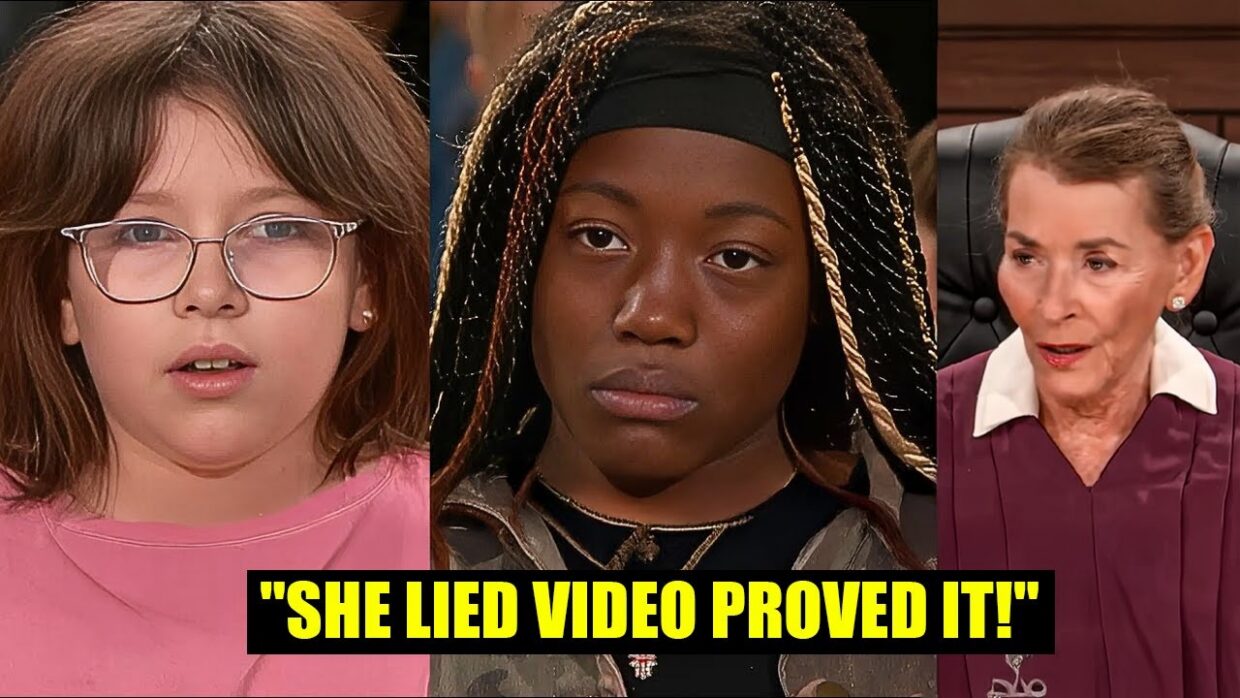
The strongest moments in these courtroom exchanges begin with a simple question. What did that phrase mean? Who paid the bill? What does the recording show? Each answer narrows the distance between the story someone brings to court and the facts Judge Judy has to weigh. Across three disputes, admissions, unsupported accusations and a witness’s firsthand account produce some decisive turns.
“Give me two minutes” gets an explanation
A confrontation between two girls becomes much clearer when Judy stops to examine a repeated phrase: “Give me two minutes.” It sounds incomplete until she asks what it meant. The girl’s answer is blunt: “Let me hit you.” She says the other girl had previously hit her at school.
Judy then puts the sequence into plain language. The girl approached the other person, used that phrase and hit her. Asked to confirm that account, she answers yes. That admission gives Judy something specific to compare with the explanation submitted by the girl’s mother.
The mother’s written answer says Juliana became aggressive and threatened Adriana, forcing Adriana to defend herself. Judy reads that claim against what she has just heard. The daughter’s account describes approaching and striking the other girl; it does not describe the immediate threat asserted in the answer.
“So where did you get the fact that this young lady became aggressive?” Judy asks. The mother agrees there was nothing aggressive about the conduct being described and acknowledges that her answer was mistaken. The exchange is compelling because Judy makes the discrepancy explicit, then asks the mother to account for it. By the end, the mother acknowledges that her daughter hit the plaintiff.
An accusation changes the result
The assault admission does not settle everything. Another part of the dispute concerns an accusation that a mother was sitting at home smoking crack instead of paying attention to her daughter. Judy asks to see the statement and establishes who wrote it.
Then comes the question that matters: “What’s your proof?” The person who made the accusation answers, “I don’t have any.” Judy responds, “Well, that’s defamation.” The exchange is brief, but it changes the financial outcome of the case.
Judy explains that the daughter’s assault award was going to be $500. She notes that the girl was not injured and did not go to the doctor, while describing the conduct as nasty. She also says she would have hoped the money would be put away for the daughter who endured the assault.
But Judy awards $500 on the defamation counterclaim as well. The two judgments cancel each other out. Neither side leaves with a net monetary award. The ending gives the earlier admission a second consequence: establishing the assault does not erase responsibility for an unsupported accusation made afterward. Judy closes by telling the parties they leave with nothing except, hopefully, some good lessons.
A couch arrangement meets a precise question
Another dispute centers on a promise to help with the boys after being allowed to stay on a couch while getting back on his feet. The plaintiff treats that understanding as a contract. Judy asks her to spell out the arrangement, then rejects it as “void for vagueness.”
Her explanation draws a distinction between a general promise and an agreement to cover a particular expense. Saying someone must continue to help with the boys leaves the obligation undefined. Judy contrasts that with a specific request to pay an outstanding dental bill followed by an agreement to pay it.
The plaintiff returns to the expectation that he would help and adds that his mother knew about it. Judy stays with the terms of the arrangement: the mother’s knowledge does not supply the specificity she says is missing. The exchange makes clear why a promise that felt meaningful to one person still fails to establish the obligation she is claiming in court.
The witness who had already paid
The dental bill produces an even sharper turn when the defendant’s mother stands up. Asked whether she remembers being contacted about it, she answers, “Of course, I remember because I paid it.” She recalls paying approximately $2,300 for the extraction, attending the appointment and taking him home afterward.
The plaintiff confirms that account. Judy immediately asks why she is suing him. The plaintiff says money remains owed for prescriptions and a copay, but Judy focuses on the earlier presentation of the dental extractions as an expense he was expected to pay.
Judy dismisses the case and says she does not believe the plaintiff. She explains that the payment by his mother should have been disclosed when she asked about the bills. The plaintiff responds that she owes the mother that money. The revealing moment is the witness’s direct answer: it introduces a payment that changes how the claimed expense must be understood.
A boast, then the dashcam evidence
In the collision dispute, Judy asks Keegan whether he posted anything online afterward. He mentions a hospital photograph posted weeks later and says there was nothing else. The plaintiff then supplies a recording she says she received within 24 hours, in which he boasts, “I made that car my bitch.”
Asked what he meant, Keegan initially says he does not really know and starts to guess. Judy insists on an answer. He explains that he meant he was pretty okay after being hit by a car. His explanation addresses the boast, while the dashcam recording gives Judy evidence about the collision itself.
Reviewing that recording, Judy emphasizes that traffic was moving under a green light when he ran across the street. Two cars had already gone before the plaintiff’s vehicle. She has his father look again and acknowledge what happened.
The plaintiff confirms a $1,000 deductible and says she borrowed her father’s car while hers was being repaired. Judy awards her $1,000. Before closing, she tells Keegan he is a very lucky kid. It is a pointed final moment: the judgment resolves the expense, while her warning brings the attention back to the danger of the crossing.
Source: The Final Verdict on YouTube