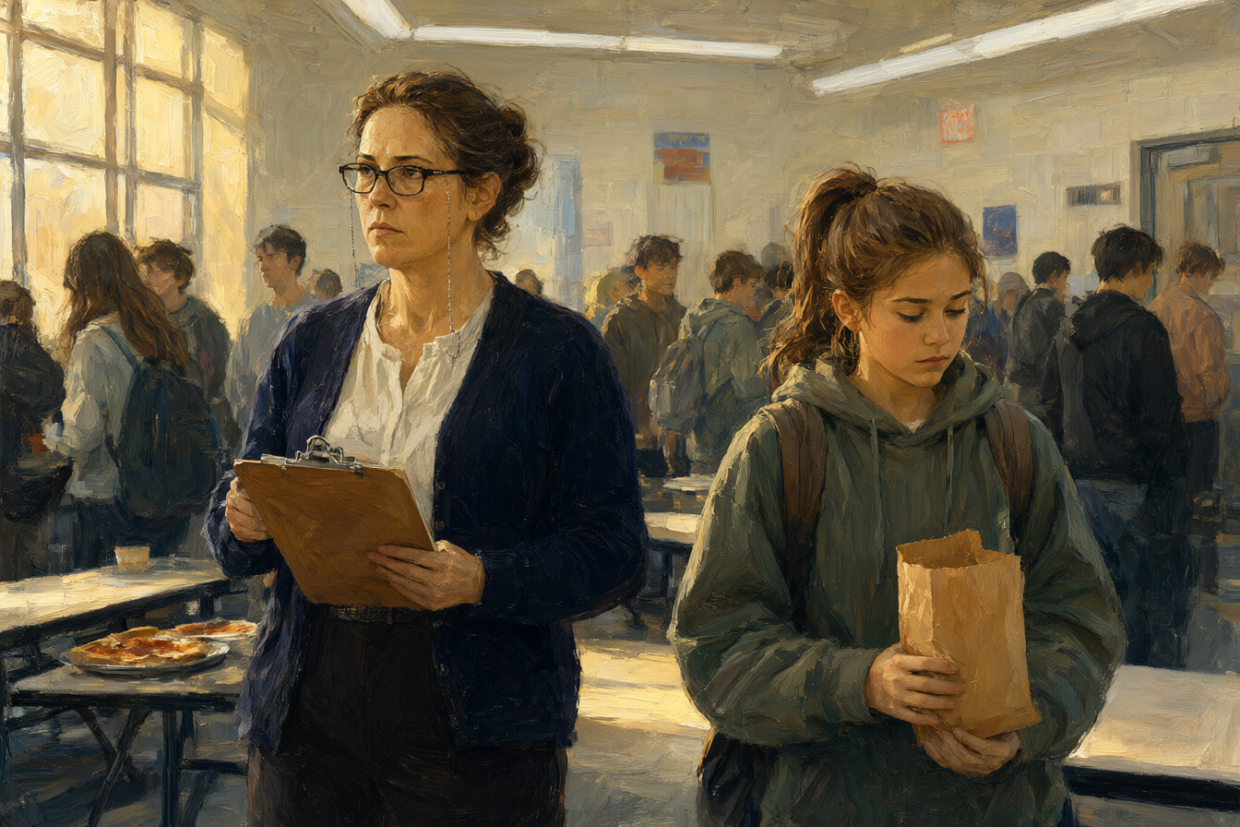
A teacher tossed a student’s lunch in the trash during roll call… But the girl said five words that made her freeze mid-turn.
The fluorescent lights in Roosevelt Middle School’s cafeteria buzzed at the same pitch they had for thirty years. Ms. Brennan stood near the lunch line entrance, clipboard in hand, scanning student IDs as sixth graders shuffled past with their trays.
It was pizza day. The smell of grease and marinara filled the air.
At 11:46 AM, a girl named Sophie Chen walked past the line entirely. She was small for eleven, with dark hair pulled into a ponytail that had started to come loose. She carried a brown paper bag.
Ms. Brennan’s voice cut across the noise. “Sophie. Stop.”
Sophie froze three steps from an empty table.
“Bring that here.”
Sophie turned slowly, clutching the bag against her chest. Her sneakers squeaked on the linoleum as she walked back. Around them, conversations dimmed. Students slowed, watching.
Ms. Brennan held out her hand. “You know the rule. Pizza day means everyone eats the same meal. It’s about equity and inclusion.”
“I brought my own,” Sophie said quietly.
“I can see that. Hand it over.”
Sophie’s fingers tightened on the bag. “Please, Ms. Brennan. I can’t—”
“Now, Sophie.”
The girl’s hands trembled as she passed it over. Ms. Brennan didn’t open it. She walked directly to the large trash can near the drink station and dropped the bag inside. It hit the bottom with a soft thud.
“You’ll eat what everyone else eats,” Ms. Brennan said. “Go get a tray.”
Sophie stood completely still. Her face had gone pale. “I don’t have lunch money.”
“Then you should have thought of that before you broke the rule.”
“My grandma packed that.” Sophie’s voice was barely audible. “She skipped her blood pressure medicine this month to buy the food for it.”
The cafeteria went silent.
Ms. Brennan’s expression flickered. “That’s not—”
“She gets three hundred dollars a month,” Sophie continued, still speaking in that same flat, quiet tone. “Her medicine costs sixty. She didn’t refill it so I could have lunch this week.”
A student near the front whispered to another. Someone’s phone came out.
Ms. Brennan’s face flushed. “Sophie, I’m sure that’s not—”
“She has high blood pressure,” Sophie said. “Really high. The doctor said she has to take it every day. But she said I needed to eat more than she needed pills.”
Ms. Brennan glanced at the trash can. Then back at Sophie. “Why didn’t you just buy school lunch?”
“Because we can’t afford it. Not this week.”
“There are programs—”
“We applied. We’re waiting.” Sophie’s voice cracked. “It takes six weeks. We’re on week four.”
The room was so quiet that the hum of the refrigerated units became the loudest sound.
Ms. Brennan took a step toward the trash can, then stopped. She looked around at the dozens of students watching. Her hand hovered near the bin’s edge, but she didn’t reach inside.
“Go to the office,” she said finally. “They’ll figure something out.”
Sophie didn’t move. “Can I have my lunch back?”
“It’s… it’s contaminated now. I can’t—”
“It was in a bag.”
Ms. Brennan’s jaw tightened. “Go to the office, Sophie.”
The girl turned and walked toward the exit. She didn’t cry. She didn’t look back.
The moment she disappeared through the double doors, the cafeteria erupted in whispers.
Ms. Brennan stood frozen for three seconds. Then she walked quickly toward the hallway, leaving her clipboard behind.
She didn’t make it far.
Principal Alvarez was already in the corridor, standing outside the cafeteria entrance with her arms crossed. Next to her stood the school nurse, Mrs. Okafor, and the district’s family services coordinator, a woman named Janet Ruiz.
“Ms. Brennan,” Principal Alvarez said. “My office. Now.”
Ms. Brennan’s face went white. “I was enforcing the equity policy—”
“Walk.”
They moved in silence down the hallway. Sophie sat on a bench outside the main office, staring at her hands. Mrs. Okafor stopped and crouched beside her.
“Sophie, honey, come with me. We’re going to get you something to eat.”
Sophie looked up. Her eyes were red but dry. “Is my grandma okay?”
Mrs. Okafor blinked. “What do you mean?”
“She didn’t take her medicine. I’m scared something’s going to happen.”
Mrs. Okafor glanced at Janet Ruiz, who immediately pulled out her phone. “What’s your grandmother’s name, Sophie?”
“Lin Chen. She lives with us. She watches me after school.”
Janet was already dialing. “I’m calling adult protective services and our community health liaison. We’ll send someone to check on her today.”
Sophie nodded slowly.
Mrs. Okafor took her hand. “Let’s get you fed first. Then we’ll make sure your grandma’s safe. Okay?”
“Okay.”
They walked toward the nurse’s office, where Mrs. Okafor kept a stash of granola bars, crackers, and juice boxes for exactly this kind of situation.
Behind them, the principal’s office door closed with a heavy click.
Inside, Principal Alvarez sat behind her desk. Ms. Brennan stood in front of it, hands clasped.
“Sit,” Alvarez said.
Ms. Brennan sat.
Alvarez opened a file folder. “Sophie Chen. Sixth grade. Straight A’s. Never been in trouble. Grandmother is her legal guardian after her parents died in a car accident two years ago. Grandmother is seventy-one, on a fixed income, and has been trying to keep them afloat ever since.”
Ms. Brennan opened her mouth. Alvarez held up a hand.
“The family services coordinator flagged Sophie’s file three weeks ago because they applied for free lunch. It’s still processing. In the meantime, the grandmother has been packing lunches. Every day. Without fail.”
Alvarez closed the folder.
“You threw away a lunch that a seventy-one-year-old woman packed after skipping her medication.”
“I didn’t know—”
“You didn’t ask.”
Ms. Brennan’s hands twisted in her lap. “The policy says pizza day is a shared meal. It’s about equity. Making sure no one feels left out because they can’t afford—”