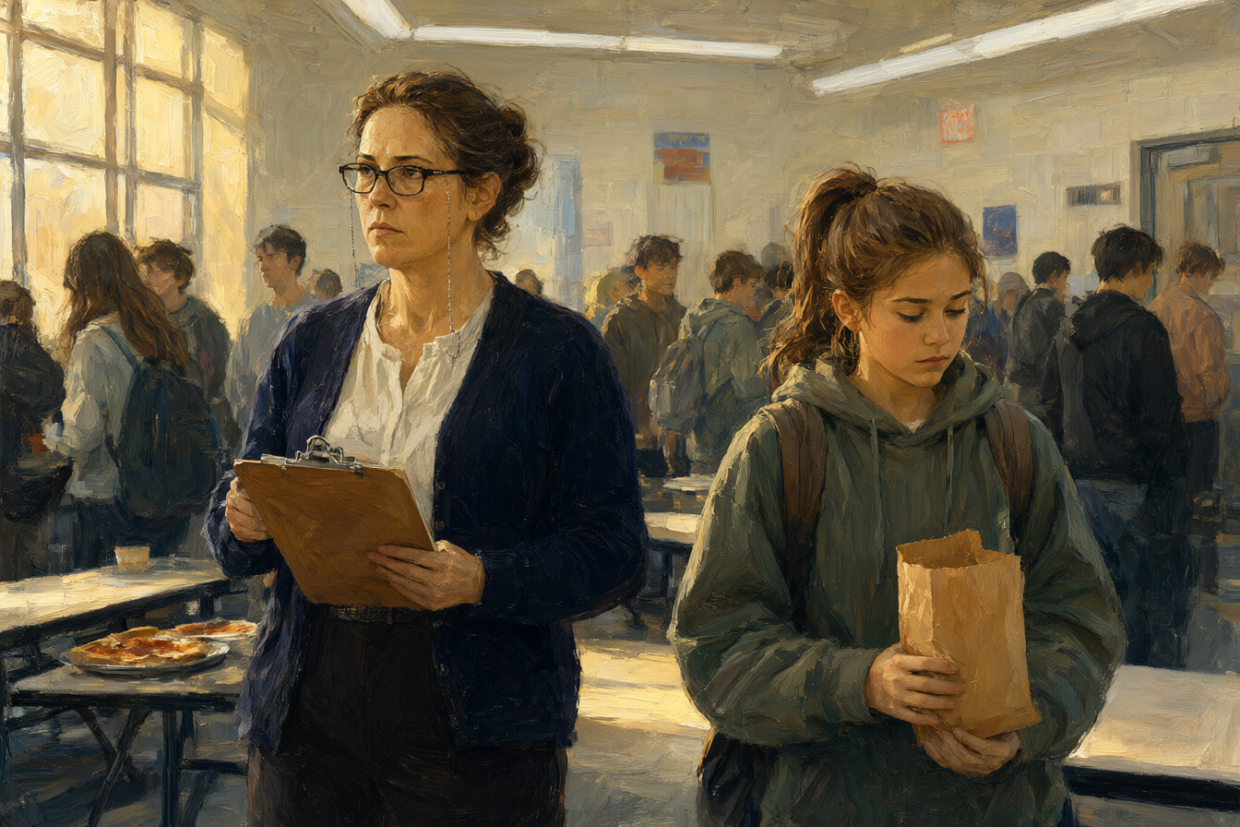
“The policy,” Alvarez interrupted, “is designed to prevent kids from being excluded. Not to punish kids who are already struggling.”
“I was trying to enforce it fairly.”
“Fairly.” Alvarez leaned forward. “Tell me, Ms. Brennan. What’s fair about throwing away food that a child needs? What’s equitable about humiliating a girl in front of her peers because you didn’t take ten seconds to ask why she brought her own lunch?”
Ms. Brennan said nothing.
Alvarez continued. “You’ve been teaching here for eight years. You’ve had sensitivity training. You’ve attended workshops on trauma-informed education. And you still chose to throw a child’s food in the trash rather than pull her aside and have a private conversation.”
“I thought I was doing the right thing.”
“You thought you were following a rule. There’s a difference.”
A knock on the door interrupted them. Janet Ruiz stepped inside.
“Update,” she said. “I reached Mrs. Chen. She’s at home. Blood pressure is elevated but not critical. I’ve arranged for a community health worker to visit this afternoon and for an emergency prescription refill through the county program. She’ll have her medication by tonight.”
Alvarez nodded. “And Sophie?”
“Eating in the nurse’s office. Mrs. Okafor is staying with her.”
“Good. Thank you, Janet.”
Janet left. Alvarez turned back to Ms. Brennan.
“Here’s what’s going to happen. You’re going to write a formal apology to Sophie and her grandmother. You’re going to attend a mandatory retraining on food insecurity and trauma-informed practices. And you’re going to meet with me every week for the next month to review how you’re implementing what you learn.”
Ms. Brennan’s voice was tight. “Am I being formally disciplined?”
“Not yet. But this goes in your file. And if I ever hear about you humiliating a student over food again, we’ll be having a very different conversation.”
Ms. Brennan nodded stiffly.
“You’re dismissed. Send Sophie’s teacher in on your way out. I need to make sure Sophie has support when she goes back to class.”
Ms. Brennan stood and walked to the door. She paused with her hand on the knob.
“I really didn’t know,” she said quietly.
Alvarez didn’t look up. “That’s the problem.”
The door closed.
Three hours later, Sophie sat in the nurse’s office with a blanket around her shoulders and an empty juice box on the table beside her. Mrs. Okafor had called her grandmother, who cried on the phone and promised Sophie that everything was going to be okay.
A county health worker had already visited the apartment. Mrs. Chen’s prescription was being filled. A social worker had expedited the free lunch application. Sophie would start receiving school meals the next day.
At 2:30 PM, Principal Alvarez walked into the nurse’s office and sat down across from Sophie.
“How are you feeling?” she asked.
Sophie shrugged. “Okay, I guess.”
“Your grandma’s going to be fine. She’ll have her medicine tonight.”
Sophie’s shoulders relaxed slightly. “Thank you.”
“You don’t have to thank me. This is what we’re supposed to do.” Alvarez leaned forward. “Sophie, I need you to know something. What happened today was wrong. You should never have been put in that position. And it’s not going to happen again.”
Sophie looked down at her hands. “Is Ms. Brennan in trouble?”
“She’s learning how to do better.”
“She was just following the rule.”
“Sometimes rules need to be applied with common sense. That’s what adults are supposed to do. We’re supposed to think about the kids in front of us, not just the policies on paper.”
Sophie nodded slowly.
Alvarez stood. “You’re going to be okay. And if you ever need anything—food, supplies, someone to talk to—you come to me. Understood?”
“Understood.”
“Good. Mrs. Okafor is going to walk you to your grandma’s friend’s house. She’s going to stay with you until your grandma gets her medicine and feels better.”
Sophie stood, still wrapped in the blanket. “Principal Alvarez?”
“Yes?”
“Can I bring my own lunch tomorrow? Even though it’s pizza day?”
Alvarez smiled. “You can bring your own lunch any day you want.”
That evening, Ms. Brennan sat at her kitchen table with a blank piece of paper in front of her. She’d been staring at it for twenty minutes.
Finally, she picked up her pen.
Dear Sophie and Mrs. Chen,
I made a terrible mistake today.
She paused. Crossed it out. Started again.
Dear Sophie and Mrs. Chen,
I owe you both an apology.
Another pause. Another cross-out.
On the third try, she wrote:
Dear Sophie and Mrs. Chen,
Today I hurt you, and I’m sorry. I threw away something precious without asking why it mattered. I made a choice that caused harm, and I can’t take it back.
Sophie, you deserved better. You deserved to be heard. You deserved kindness.
Mrs. Chen, you made a sacrifice for your granddaughter that I can’t imagine. You put her needs above your own health, and instead of honoring that, I disrespected it.
I’m going to do better. I’m going to learn from this. And I hope that one day, you’ll both be able to forgive me.
Sincerely,
Ms. Brennan
She folded the letter, put it in an envelope, and set it aside to deliver the next morning.
It wasn’t enough. She knew that. But it was a start.
The next day, Sophie walked into the cafeteria with a brown paper bag. Inside was a sandwich, an apple, a small bag of pretzels, and a note from her grandmother written on a napkin:
Eat well, my love. I’m okay. I love you.
Sophie sat at her usual table. Around her, students chatted and laughed. No one said anything about the day before.
Ms. Brennan watched from across the room. When Sophie pulled out her lunch, Ms. Brennan looked away.
Principal Alvarez stood near the doorway, arms crossed, watching everything.
Sophie took a bite of her sandwich. It was peanut butter and jelly, made with the cheap bread her grandmother bought in bulk. It was the best thing she’d tasted all week.
She ate every bite.
And when the lunch period ended, she threw away her trash, folded the napkin with her grandmother’s note, and tucked it carefully into her pocket.
No one threw anything away for her.
Not anymore.
The end