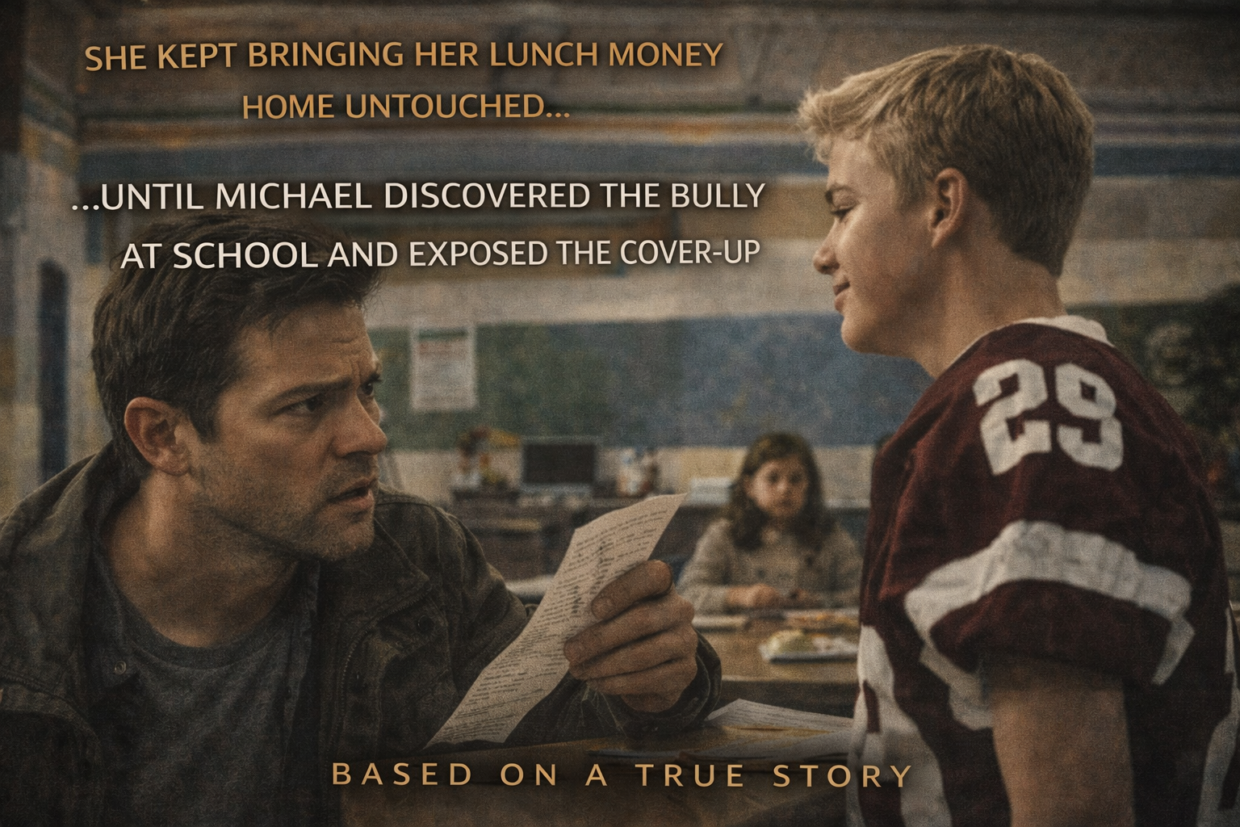
Grace brought her lunch money home every day for two weeks… But the IT logs showed someone had been deleting the proof of why.
Michael found the money on a Tuesday.
He’d set Grace’s backpack on the counter the way he always did — unzip the front pocket, check for permission slips, drop her water bottle in the sink. Three crumpled dollar bills fell onto the counter. He stared at them.
“Grace.” He called up the stairs. “Come down here a minute.”
She appeared in the kitchen doorway still in her coat, backpack half off one shoulder.
“Why is your lunch money still here?”
“I wasn’t that hungry today.”
She wouldn’t look at him. She almost never looked at him anymore when he asked about school.
“Grace. This is the fourth time this week.”
“The cafeteria food is gross anyway.” She reached past him for the bills. “Can I just—”
“Leave them.” He set his hand flat on the counter. “Sit down.”
She sat. She pulled at a loose thread on her sleeve and said nothing.
“Are you feeling sick? Is something happening at school that’s making you not want to eat?”
“I’m fine, Dad. I’m just not hungry.”
“That’s not normal for a growing kid.”
“Can I go do homework?”
She was already sliding off the stool. He let her go, but he stood in the kitchen for a long time after, looking at the three crumpled bills.
He called the school the next morning.
The secretary transferred him to Principal Anderson — a man with the careful, unhurried voice of someone who had learned to sound concerned without committing to anything.
“Mr. Chen, Grace is a wonderful student. I haven’t heard of any issues.”
“I keep giving her lunch money and she brings it home. Two weeks in a row.”
“Kids go through phases. Appetite changes are very common at her age.”
“For two weeks straight?”
“I’ll make a note and have someone keep an eye on her. I’m sure it’s nothing to worry about.”
The call ended. Michael didn’t feel better.
Two days later Grace came home with a bruise on her arm. Three marks, close together, slightly curved. Not from a fall. He knew what a fall bruise looked like.
“What happened?”
“Gym class. I tripped.”
“Those look like grip marks, Grace.”
“Dad.” Her voice went flat. “Please. I’m fine.”
But her hands were shaking as she zipped her jacket back up.
He called Anderson again. Anderson said he’d look into it. He never called back.
So Michael drove to the school himself.
He signed in at the front office and walked the long hallway toward the cafeteria, past the trophy case, past the bulletin boards with their bright construction paper borders. He could hear the lunch period before he reached it — the low roar of two hundred kids in an echoey room.
He found her through the window before he even pushed through the doors.
Grace was at a corner table, alone, with a small bag of crackers in front of her. Not even a full lunch — just crackers. At the table beside her, four boys in football jerseys were loud and laughing. One of them, big kid, blonde, kept glancing over at her and saying something to the others. They’d laugh. He’d look over again.
Michael watched the blonde boy stand up, walk past Grace’s table, and with one casual sideways motion knock the crackers off the table onto the floor.
Grace didn’t flinch. Didn’t make a sound. Just sat there staring at the empty table like she’d been expecting it.
Michael pushed through the cafeteria doors.
“Hey.” He walked straight toward the table. “What just happened here?”
The blonde boy turned around with a smile that wasn’t a smile.
“Nothing, sir. Total accident.”
“That wasn’t an accident.”
Grace looked up. Her face went white when she saw him.
“Dad. Please don’t.”
“Did he knock your food on the floor?”
“It’s fine. I wasn’t that hungry.”
The lunch monitor materialized beside him, a woman in her fifties with a lanyard and a practiced neutral expression.
“Is there a problem?”
“This student just knocked my daughter’s food on the floor. She’s been afraid to eat lunch for weeks.”
“I didn’t see anything happen.”
“You were standing fifteen feet away.”
“Maybe you should bring your concerns to the principal.”
Michael looked at the monitor. He looked at the boy — still smiling. He looked at Grace, who was staring at the floor with the particular stillness of someone waiting for something worse to happen.
“Come on,” he said to Grace, quietly. “We’re going to the office.”
Anderson’s office had two chairs across from a wide desk. Michael sat in one. Anderson sat behind the desk with the careful, arranged posture of a man who had done this many times.
“I need you to tell me exactly what you observed, Mr. Chen.”
“A boy in a football jersey deliberately knocked Grace’s food on the floor. She’s been bringing her lunch money home for two weeks. She has bruises on her arm that look like grip marks. I need to know what’s being done about this.”
“Those are serious accusations. Do you have proof that the incident today was intentional?”
“I was standing at the window. I watched it happen.”
“I understand. I’ll need to investigate properly. Can you file a formal complaint?”
The secretary slid a form across the counter. Michael filled it out slowly, deliberately, printing each letter so there could be no misreading. He handed it back personally. He watched the secretary set it in the inbox tray.
“I want that processed today,” Michael said. “I want to know by tomorrow what action is being taken.”
“Of course,” Anderson said. “We’ll be in touch.”
They weren’t in touch.
That evening, Michael called Williams. They’d gone to college together; Williams had spent the last eight years in the school district’s IT department.
“I filed a bullying complaint this afternoon,” Michael said. “Can you check that it’s in the system?”
“What’s the student name?”
“Grace Chen. Sixth grade. The complaint involves a football player — I think his name is Tyler Morrison.”
“Give me until tomorrow. I’ll check.”
Williams called back the next morning before Michael had finished his coffee.
“It’s not there.”
“That’s impossible. I filled out the form. I watched them take it.”
“I know. Let me check the deleted files folder.”
Four minutes of hold music.
“Found it.” Williams’s voice had changed. “Filed yesterday at 2:47 PM. Deleted this morning at 8:23.”
“Deleted by who?”
“An administrator account. And Michael — there’s a phone log. The deletion happened eleven minutes after an external call came into Anderson’s direct line.”
“From who?”
“The caller ID logs show the athletic booster club. Call lasted twelve minutes.”
Michael put down his coffee cup.
“Williams. Can you recover the deleted complaint?”
“Already done.” A pause. “But I kept looking. Michael, there are seventeen deleted incident reports involving Tyler Morrison. All filed in the last six months. All deleted within 24 hours. And every single deletion follows a phone call from the same number.”
Seventeen.
Michael sat very still.
“I need all of it. Timestamps, phone logs, the recovered files. Everything.”
“I’ll pull it together tonight. But Michael — this needs to go above Anderson. Straight to the superintendent.”
That night he sat Grace down at the kitchen table.
“I need you to tell me everything. How long has this been happening?”
Grace looked at her hands. “Dad, if you do something, it’s going to get worse.”
“Grace.” He kept his voice steady. “How long?”
“Since September.” She pulled at the loose thread on her sleeve again. “He takes my lunch money. If I don’t give it to him, he pushes me or knocks my stuff over or says things in front of everyone.” She paused. “His dad donates a lot of money to the school. Tyler told me even if I tell someone, it just disappears.”
“His name is Tyler Morrison.”
She looked up sharply. “How did you know?”
“I’ve been doing some checking.” He reached across the table and covered her hands with his. “He was right that complaints were disappearing. But he was wrong about what happens when someone finds proof.”
The next morning Michael drove straight to the district office with Williams’s documents in a folder on the passenger seat.
Superintendent Johnson was a compact woman in her sixties with reading glasses on her desk and the expression of someone who had learned to measure problems precisely. Michael spread the documents in front of her without preamble.
“Seventeen deleted incident reports. All involving the same student. All deleted within 24 hours of being filed. Phone logs showing the deletion followed a call from the athletic booster club to Anderson’s direct line every single time.”
Johnson picked up the top sheet. She read without speaking.
“Where did you get this?”
“A district IT employee. Everything in that folder came from your own system’s backup logs.”
Johnson set the sheet down. She took off her reading glasses. She looked at Michael for a moment with the particular expression of someone doing a rapid, private calculation.
“I’m launching an investigation today,” she said. “Tyler Morrison is suspended pending outcome. Anderson is on administrative leave effective immediately.”
“What about Grace? She goes back to that school tomorrow.”
“I’ll have security staff specifically assigned to monitor the cafeteria. And I’m calling every family whose complaint was deleted. They deserve to know what happened to their reports.”
Michael nodded. He picked up his folder.
“Mr. Chen.” Johnson stopped him at the door. “If Anderson deleted official incident reports, that’s not a disciplinary matter. That’s tampering with educational records. I want you to know I’m referring this to the district attorney’s office.”
“Good,” Michael said.
The investigation took three weeks.
The school board voted unanimously to terminate Anderson’s contract. Tyler Morrison was expelled. The Morrison family’s attorney released a statement calling Grace’s account fabricated — and then twelve other families came forward with the same story, and the statement disappeared from the family’s social media within an hour of the other families going public.
Morrison’s father caught Michael in the school parking lot on the day of the board vote.
“You destroyed my son’s future over lunch money.”
“Your son terrorized my daughter for six months,” Michael said. “The evidence is public record. Talk to the IT department.”
Morrison opened his mouth. Closed it. His lawyer touched his arm and he walked away.
Three days after the board vote, Michael picked Grace up from school.
She climbed into the car and set her backpack on the seat beside her, and Michael started to ask how her day was — and then he saw the empty jacket pocket. He looked at the backpack. He looked at her.
“Did you eat lunch?”
Grace buckled her seatbelt. She thought about it for a second, the way she thought about math problems — methodically, without drama.
“Yeah,” she said. “I did.”
“How was it?”
“The pizza was pretty bad.” She pulled out her homework folder. “But I ate it anyway.”
Michael kept his eyes on the road. He said nothing for a moment.
“There’s a new girl who sits near me,” Grace said, not looking up from her folder. “Emma. She saved me a seat.”
“Yeah?”
“She said she heard what happened and she thinks I was brave.” Grace ran her finger down a column of math problems. “I don’t know if I was brave. I just told the truth.”
“That’s what brave is.”
Grace considered this. She uncapped her pencil.
“She asked if I want to sit with her tomorrow.”
“What did you say?”
“I said yes.” She started working the first problem. “I’m going to bring the good crackers. The ones with the rosemary. She said she likes rosemary.”
Michael drove. Outside the windows, the afternoon was flat and gold, October light on ordinary streets. Grace’s pencil moved steadily down the page. She wasn’t hiding anything. She wasn’t watching the door. She was just doing her homework in the car the way she used to, before September, with her lunch money spent and her backpack empty of anything except what it was supposed to hold.
He didn’t say anything. There was nothing to say.
She was just hungry again, and that was enough.