A senior boy slapped my quiet daughter at the school science fair in front of everyone… But I walked in still wearing my Olympic training jacket with five rings on the chest.
I had one rule about my jacket. I wore it to competitions, training sessions, and team events. Never to school functions.
Tonight I broke that rule.
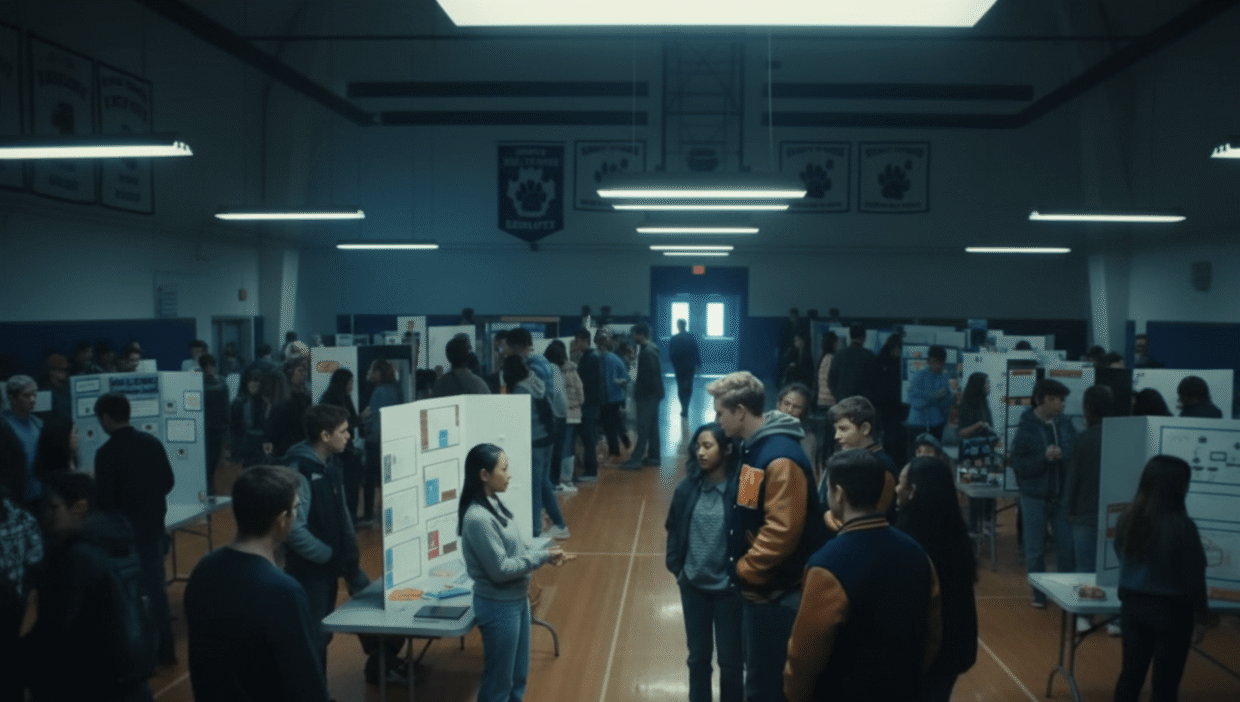
Soo-Yeon had texted twice asking where I was. I grabbed my keys straight from the training facility, forgetting to change. I pushed through the gymnasium doors, scanning for my daughter among the science fair crowd.
What I saw made me freeze.
Soo-Yeon gripped her project table, face turned away. A senior boy stood over her, laughing. His friends clustered behind him like a pack. Students formed a circle around them, phones rising.
I set down my protein bar and Soo-Yeon’s forgotten permission slip on the nearest table. I walked directly to her.
I cupped both hands around her face—the clinical assessment I’d given training partners for twenty years. Eyes tracking. Jaw response. Impact evaluation.
Her eyes were clear. Jaw intact. One cheek bright red.
I straightened. Turned around.
The boy was still performing for his audience, building his story. He hadn’t noticed my arrival. He hadn’t noticed my assessment.
He noticed when the crowd shifted. That unconscious movement of people making space.
He looked up.
I stood eight feet away. Five-foot-four, forty-one years old, training jacket hanging open. The five Olympic rings on my left chest caught the fluorescent light perfectly.
I wasn’t moving toward him. I didn’t need to.
He stared at the jacket. Then my face. I wore my competition expression—the look I saved for mats that mattered. No anger. No performance. Just absolute clarity.
“That’s your mother?” one friend whispered urgently.
He didn’t answer.
“Dude, that’s Elena Park.”
The name hit him. Recognition spreading across his face. He looked at the jacket again. The five rings. The context clicking into place.
I waited for him to finish the math.
His face went through complicated calculations before settling on the expression of a sixteen-year-old who’d discovered an unacceptable answer.
He looked for his friends. They’d vanished—that specific disappearing act of people deciding they’re uninvolved.
“I should—” he started.
“You should apologize to my daughter,” I said quietly. The voice I used before matches. Never needed volume because it never needed convincing.
He turned to Soo-Yeon. His apology was three sentences. Specific. He named what he’d done without qualification.
Soo-Yeon listened. Nodded once.
I watched him walk across the gymnasium. Past frozen crowds. Past recording phones. Through the doors.
Then I turned back to my daughter.
Soo-Yeon was studying my jacket.
“You came straight from the facility.“
“You texted twice. I was late.“
“You forgot to change.“
“I brought your permission slip.“
She looked at her scattered project materials. Three weeks of work disrupted by one entitled senior.
“Help me fix it?” she asked.
I retrieved the protein bar from the table. “Eat first. Then fix.“
We stood at the project table as the gymnasium carefully returned to science fair business. Conversations resumed. Parents browsed displays. Judges moved between stations.
As if nothing had happened.
Except for the video spreading from seventeen different angles.
Two hours later, Soo-Yeon’s project won second place. The judge praised her precise methodology and thorough documentation. I stood in the back, watching my daughter accept the ribbon.
I thought about three weeks of work. Scattered materials. The red cheek I’d assessed with both hands.
I thought about forty-one years of mats and judges. Winning and losing and standing back up every time.
I thought about the permission slip in my pocket—grabbed without thinking because someone needed me and I was already moving.
Second place.
Someone tapped my shoulder. A woman I recognized from parent-teacher conferences.
“That was incredible,” she said. “How you handled that situation.“
“I just stood there.“
“Exactly.” She smiled. “Sometimes that’s all it takes.”
The next morning, I got a call from the principal. The boy had been suspended for three days. His parents had insisted on a longer suspension after watching the video.
“They were mortified,” Principal Chen said. “His mother called me at six AM demanding to know why their son thought that behavior was acceptable.“
“What did you tell her?“
“That we’d be having serious conversations about respect and consequences.”
Soo-Yeon came home that afternoon with her second-place ribbon pinned to her backpack. She set it on the kitchen counter next to my five Olympic medals.
“Looks good there,” I said.
“It does.” She studied the display. “Mom?“
“Yeah?“
“You can wear the jacket to school functions whenever you want.“
I laughed. “I’ll try to remember to change next time.”
“Don’t.” She picked up her ribbon, turning it in the light. “I like knowing you’ll come straight from wherever you are. No matter what you’re wearing.”
The video hit two million views by Thursday. The top comment made me smile: “She came straight from training and still remembered the permission slip AND a protein bar. That’s not just an Olympian. That’s a MOM.”
The school invited me to speak at an assembly about bullying and intervention. I declined. I wasn’t interested in being anyone’s hero or example.
But I did agree to help with the girls’ self-defense workshop they’d been planning. That felt right. Teaching skills instead of making speeches.
Three weeks later, I ran into the boy at the grocery store. He was with his mother. She recognized me immediately.
“Mrs. Park,” she said. “I wanted to apologize personally for my son’s behavior.”
The boy stared at his shoes.
“He apologized already,” I said. “To the person who mattered.“
“I know. But I wanted you to know we’ve had long conversations about respect and consequences. He understands what he did was wrong.”
I looked at the boy. He met my eyes this time.
“I really am sorry,” he said. “Not just because of who your mom is. Because of what I did to Soo-Yeon.“
I nodded. “Apology accepted.“
His mother looked relieved. They walked away toward the produce section.
That night, I told Soo-Yeon about the encounter.
“How did he seem?” she asked.
“Embarrassed. Sincere.“
“Good.” She returned to her homework. “That’s appropriate.”
I thought about the jacket hanging in my closet. The five rings that represented years of work, sacrifice, and determination. The jacket I’d worn without thinking because my daughter needed me.
Sometimes the most important competitions aren’t on mats at all.
They’re in gymnasiums where science fair projects scatter. Where entitled boys learn consequences. Where quiet daughters discover their mothers will always show up.
Still wearing the jacket that matters most.