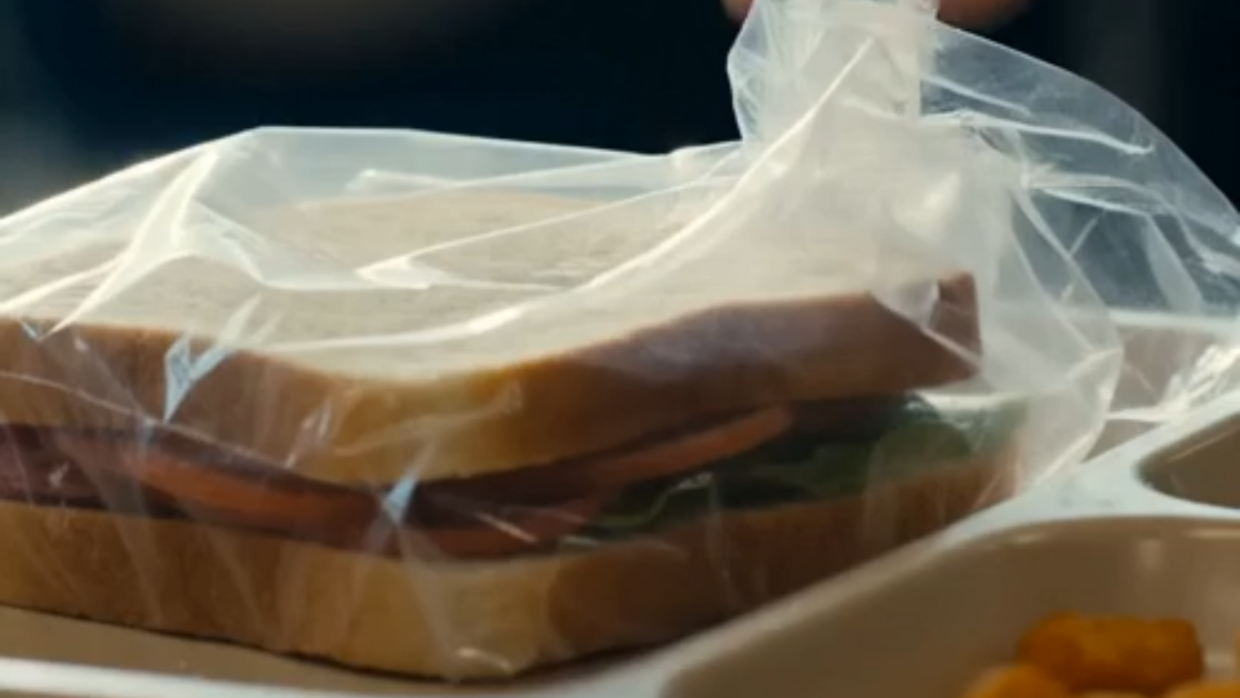
She dumped the girl’s lunch in the trash and walked away smiling… But the principal’s voice came through the speaker calling that same girl’s name.
Emma sat at the corner table in the cafeteria, the same spot she chose every day. Quiet. Out of the way. She unwrapped the peanut butter sandwich she’d made that morning in her foster home, careful not to tear the plastic bag because she’d need it again tomorrow.
The cafeteria hummed with the usual chaos—trays clattering, voices bouncing off tile walls, the smell of industrial pizza and canned corn. Emma took one bite and set the sandwich down, watching the clock. 11:47 AM. The announcement was supposed to happen at noon.
Mrs. Patterson appeared beside her table without warning. Mid-forties, reading glasses hanging from a beaded chain, clipboard tucked under one arm. She had that look—the one Emma recognized from a dozen schools before this one. The look that said *I’ve already decided you’re the problem.*
“Emma,” Mrs. Patterson said, not asking, just stating. “What is that?”
Emma looked down at her sandwich. “Lunch.”
“You know the rule. If you’re not buying school lunch, you need a signed permission slip for outside food.” Mrs. Patterson’s voice carried across three tables. Other kids turned to watch. “Do you have a permission slip?”
Emma’s face went hot. “No, ma’am. I didn’t know—”
“Didn’t know, or didn’t bother to ask?” Mrs. Patterson reached down and picked up the sandwich, holding it between two fingers like it was contaminated. “This is exactly the kind of thing we’ve talked about. Responsibility. Following procedures.”
“I can put it away,” Emma said quietly. “I’m sorry.”
“Sorry isn’t the same as learning.” Mrs. Patterson walked three steps to the trash can and dropped the sandwich in. The plastic bag made a soft sound hitting the bottom. “Maybe next time you’ll take the time to follow the rules like everyone else.”
Emma stared at the empty space on the table where her lunch had been. She didn’t cry. She’d learned a long time ago that crying made things worse. She just folded her hands in her lap and looked down.
Mrs. Patterson returned to the table, leaning down slightly. “I know your situation is difficult, Emma. But foster care isn’t an excuse for not following school policy. If anything, you need structure more than the other students. Do you understand?”
“Yes, ma’am.”
“Good.” Mrs. Patterson straightened, adjusting her glasses. “I’m doing this because I care about your future. You’ll thank me later.”
She walked away, clipboard swinging, heels clicking against linoleum.
Emma sat very still. Her stomach felt hollow, but that wasn’t new. She’d been hungry before. The clock now read 11:51. Nine minutes.
Across the cafeteria, near the double doors that led to the main hallway, Principal Hayes stood with two other adults. One was Superintendent Caldwell, a tall woman in a gray suit holding a wooden plaque. The other was Mrs. Ramirez, Emma’s caseworker, wearing the same bright yellow cardigan she always wore to meetings.
All three of them had watched the entire interaction.
Principal Hayes’s jaw was tight. Superintendent Caldwell’s expression was unreadable, but her knuckles were white around the plaque. Mrs. Ramirez had her phone out, typing rapidly.
“Did that just happen?” Superintendent Caldwell said quietly.
Principal Hayes nodded once. “Yes.”
“The girl we’re about to honor in front of the entire district,” Superintendent Caldwell continued, voice flat, “just had her lunch thrown away because she didn’t have a permission slip.”
“A permission slip,” Mrs. Ramirez added, still typing, “that we don’t require. I checked the parent handbook this morning. Outside food is allowed. There’s no permission slip policy.”
Principal Hayes closed his eyes briefly. “I’ll handle this.”
“You will,” Superintendent Caldwell said. It wasn’t a question.
The intercom crackled at exactly noon. Principal Hayes’s voice filled the cafeteria, warm and clear.
“Good afternoon, students and staff. I have a very special announcement. As many of you know, today we’re recognizing a student who has shown exceptional perseverance, kindness, and academic excellence despite facing significant challenges.”
Emma’s head came up slowly. She knew the words. She’d been told she was receiving an award, but they hadn’t said when or where. She thought it would be in the office, quiet, just a handshake and a certificate.
“This year’s Foster Student of the Year, recognized by the district and the state Board of Education, is Emma Chen, sixth grade.”
The cafeteria went silent.
Every head turned toward Emma’s corner table. She sat frozen, hands still folded, eyes wide.
“Emma,” Principal Hayes continued over the intercom, “please come to the main office. We have some very special guests here to meet you.”
Mrs. Patterson, halfway across the cafeteria, stopped walking. Her face drained of color. She turned slowly and looked at Emma, then at the trash can, then back at Emma.
Emma stood up carefully, like she wasn’t sure her legs would hold her. She walked toward the double doors. Every step felt too loud.
As she passed Mrs. Patterson, the teacher reached out. “Emma, wait, I didn’t—”
Emma kept walking. She didn’t look at her.
The cafeteria erupted into whispers the moment the doors closed behind her.
Mrs. Patterson stood alone in the middle of the room, clipboard hanging loose in her hand, staring at the trash can.
In the main office, Emma found herself surrounded by people. Principal Hayes, Superintendent Caldwell, Mrs. Ramirez, and two other adults she didn’t recognize—one holding a camera, the other a large bouquet of flowers.
“Emma,” Superintendent Caldwell said, kneeling down to her eye level. “We are so proud of you. Do you know why you’re receiving this award?”
Emma shook her head.
“Because in the last two years, you’ve attended four different schools, lived in three different foster homes, and maintained a 4.0 GPA. Because your teachers—most of your teachers—tell us you’re the first one to help other students, even when you’re struggling yourself. Because you volunteer at the elementary school tutoring program every Thursday. Because you are exactly the kind of student we want every child to look up to.”
Emma’s eyes filled with tears for the first time that day. “I didn’t know.”
“We wanted it to be a surprise,” Mrs. Ramirez said gently, putting a hand on her shoulder. “A good surprise.”
Principal Hayes handed her the plaque. It was heavy, real wood, with her name engraved in gold lettering. *Emma Chen. Foster Student of the Year. For Outstanding Academic Achievement and Community Service.*
“There’s going to be a ceremony on Friday,” Principal Hayes said. “Your photo will be in the district newsletter. The mayor is coming. But we wanted to tell you first, here, so you’d have time to let it sink in.”
Emma held the plaque against her chest. “Thank you.”
“You earned it,” Superintendent Caldwell said firmly. “Every bit of it.”
The photographer took pictures. Emma stood between Principal Hayes and Superintendent Caldwell, holding her plaque, smiling a real smile for the first time in weeks.
Mrs. Ramirez stayed close. “Are you okay, sweetheart? You look pale.”
“I’m fine,” Emma said. Then, quieter, “I’m just hungry.”
Mrs. Ramirez frowned. “Didn’t you eat lunch?”
Emma hesitated. “I brought a sandwich, but… I wasn’t allowed to eat it.”
Principal Hayes’s expression changed immediately. “What do you mean?”
“Mrs. Patterson said I needed a permission slip for outside food. She threw it away.”
The room went very still.
Superintendent Caldwell stood up slowly. “She threw away your lunch.”
“Yes, ma’am.”
“When?”
“Right before the announcement. Maybe five minutes ago.”
Principal Hayes and Superintendent Caldwell exchanged a look.
“Emma,” Principal Hayes said carefully, “there is no permission slip required for outside food. That’s not a rule.”
Emma looked down. “Oh.”
Mrs. Ramirez’s voice was tight. “Did she know you’re in foster care?”
“Yes, ma’am. She said foster care isn’t an excuse for not following rules.”
Superintendent Caldwell turned to Principal Hayes. “I want her in your office. Now.”
“Agreed.”
“Emma,” Mrs. Ramirez said gently, “let’s get you some food first. Real food. My treat.”
Twenty minutes later, Emma sat in the counselor’s office with a turkey sandwich from the deli across the street, eating slowly while Mrs. Ramirez sat beside her. Through the window, she could see into Principal Hayes’s office.
Mrs. Patterson sat in the chair across from his desk. Superintendent Caldwell stood near the door, arms crossed.
Emma couldn’t hear the words, but she could see Mrs. Patterson’s face—red, tears streaming, hands gesturing frantically. Principal Hayes sat very still, hands folded on his desk, listening.
“Don’t worry about that,” Mrs. Ramirez said softly. “You just focus on your sandwich.”
But Emma kept watching.
In Principal Hayes’s office, the conversation was not going well for Mrs. Patterson.
“I didn’t know,” she said for the fourth time. “If I had known she was being honored—”
“That’s the problem,” Superintendent Caldwell interrupted. “The fact that she was being honored shouldn’t matter. You humiliated a child in front of her peers over a rule that doesn’t exist.”
“I thought—”
“You thought what?” Principal Hayes’s voice was quiet, which somehow made it worse. “That a foster child needed to be taught a lesson about responsibility? That throwing away her lunch in front of the entire cafeteria was appropriate?”
“I was trying to help her understand structure—”
“She understands structure,” Superintendent Caldwell said sharply. “She’s lived in three homes in two years and maintained perfect grades. She tutors other students. She volunteers. What exactly did you think she needed to learn?”
Mrs. Patterson’s hands twisted in her lap. “I made a mistake.”
“You made several,” Principal Hayes said. “You enforced a policy that doesn’t exist. You publicly shamed a student. You singled out a foster child and used her circumstances against her. And you did all of this minutes before she was supposed to be honored for being an exemplary student.”
“I’ll apologize.”
“Yes,” Superintendent Caldwell said. “You will. But that’s not all you’ll do.”
Mrs. Patterson looked up, face blotchy. “What do you mean?”
Principal Hayes opened a folder on his desk. “You’ll be placed on administrative leave pending a full review. You’ll complete mandatory training on trauma-informed teaching practices and implicit bias. And you’ll write a formal apology to Emma, which will be reviewed before it’s delivered.”
“Administrative leave? That’s—”
“Non-negotiable,” Superintendent Caldwell said. “I watched you humiliate that child. If it were up to me, the consequences would be more severe.”
Mrs. Patterson’s voice cracked. “I’ve been teaching for eighteen years.”
“Then you should know better,” Principal Hayes said simply. “This meeting is over. Please collect your personal items and leave the building. HR will contact you by tomorrow morning.”
Mrs. Patterson stood shakily. She looked at Superintendent Caldwell, then at Principal Hayes, searching for some softness, some room to negotiate.
She found none.
“I really didn’t mean—”
“Mrs. Patterson,” Principal Hayes said, standing, “Emma Chen is eleven years old. She’s been through more trauma than most adults will experience in a lifetime. She comes to school every day, works harder than almost any student I’ve ever met, and asks for nothing. And today, on the day she was supposed to be celebrated, you made her feel small and ashamed for being hungry.”
His voice didn’t rise, but every word landed like a gavel.
“There is no apology that will undo that. But you will try anyway. Now please go.”
Mrs. Patterson left, shoulders shaking, door closing softly behind her.
Superintendent Caldwell sat down in the chair Mrs. Patterson had vacated. “That was restrained.”
“I’m a professional.”
“Barely.” She smiled grimly. “What do we do about Friday?”
“We make sure Emma has the best damn ceremony this district has ever seen,” Principal Hayes said. “And we make sure every staff member understands why this matters.”
“Agreed.”
On Friday afternoon, the district auditorium was packed. Students from all six elementary schools filled the seats. Teachers lined the walls. Parents crowded the back rows.
Emma stood backstage in a new dress—light blue, with small white flowers—that Mrs. Ramirez had helped her pick out. Her foster mother, Ms. Tran, stood beside her, beaming with pride.
“You ready?” Ms. Tran asked.
Emma nodded, clutching her plaque.
The mayor gave a short speech about the importance of supporting foster youth. Superintendent Caldwell spoke about resilience and academic excellence. Then Principal Hayes called Emma to the stage.
The applause was thunderous.
Emma walked out into the lights, and for a moment she froze. There were so many people. So many eyes on her.
But then she saw Mrs. Ramirez in the front row, grinning and giving her a thumbs-up. She saw Ms. Tran wiping her eyes. She saw her classmates clapping, genuinely happy for her.
And she saw the empty seat in the teacher section, the one that should have been Mrs. Patterson’s.
Emma took the microphone Principal Hayes offered her. Her hands shook slightly.
“I didn’t prepare a speech,” she said quietly. The microphone made her voice echo. “I didn’t know what to say.”
The auditorium went silent.
“I’ve been in foster care for three years. I’ve lived in six different homes. I’ve gone to five different schools. And most of the time, I just try to be invisible. I try not to cause problems. I try to follow the rules and stay quiet and not make anyone mad.”
Her voice grew steadier.
“But this week, someone told me that I don’t have to be invisible to be safe. That I’m allowed to take up space. That I’m allowed to be proud of what I’ve done.”
She looked at Mrs. Ramirez. “So I’m going to try. I’m going to try to believe that I deserve this.”
She held up the plaque.
“Thank you for seeing me. Thank you for picking me. Thank you for making me feel like I matter.”
The applause started before she finished the last word. It rolled through the auditorium like thunder, and Emma stood in the center of it, letting it wash over her.
Ms. Tran met her at the bottom of the stage stairs and pulled her into a hug. “I’m so proud of you, sweetheart. So proud.”
Emma buried her face in Ms. Tran’s shoulder and finally let herself cry. Not sad tears. Not scared tears.
Relief.
Three weeks later, Emma walked into the cafeteria with her lunch—another peanut butter sandwich in a plastic bag. She sat at her usual corner table.
But this time, three other girls sat down with her.
“Is it okay if we sit here?” one of them asked.
Emma looked up, surprised. “Yeah. Of course.”
They unpacked their lunches. One of them had brought cookies and offered Emma one.
“I saw your speech,” the girl said. “It was really brave.”
Emma took the cookie. “Thanks.”
They ate together, talking about nothing important—homework, weekend plans, a funny video someone had seen. Normal things. Easy things.
Emma glanced at the trash can across the cafeteria. It was just a trash can now. Nothing more.
She took a bite of her sandwich and smiled.