Gratitude rarely arrives on its own. It usually starts with a pause — a moment when we stop rushing and actually notice what is already around us: a warm drink, a friend’s message, the roof over our heads. The three quotes below come from different corners of the world, but each one asks the same gentle question: what if what we already have is enough to be thankful for? We do not need a special occasion to practice gratitude; ordinary moments are where it usually begins. Read them slowly, and let them settle.
A Blossom from the Soul
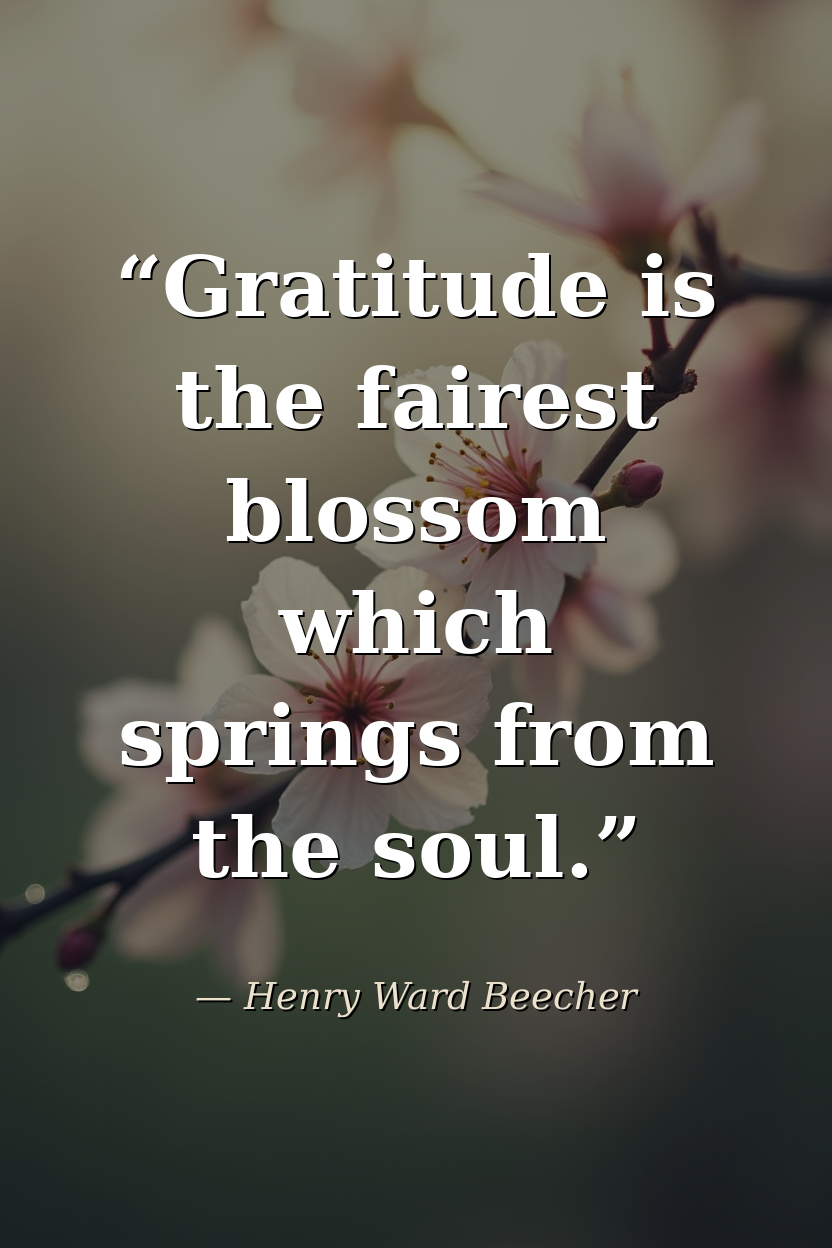
“Gratitude is the fairest blossom which springs from the soul.”
— Henry Ward Beecher
Henry Ward Beecher (1813–1887) was one of the most famous American preachers of his day. From the pulpit of Plymouth Church in Brooklyn, New York, he spoke out against slavery and drew crowds so large that his sermons were printed in newspapers across the country. Plymouth Church became a gathering place for reformers of many kinds. He was also the brother of Harriet Beecher Stowe, the author of Uncle Tom’s Cabin, the novel that helped fuel the abolitionist movement. He was known for plain, vivid language that ordinary people could carry home with them. The line about gratitude is widely attributed to him, and it captures his belief that thankfulness is not a duty performed for others but something beautiful that grows from within.
Try this today: before bed, write down one small thing that went right in the last twenty-four hours — a warm cup of coffee, a kind word from a colleague, a task you finally finished — and read it aloud once before you turn off the light.
Remember the Planter
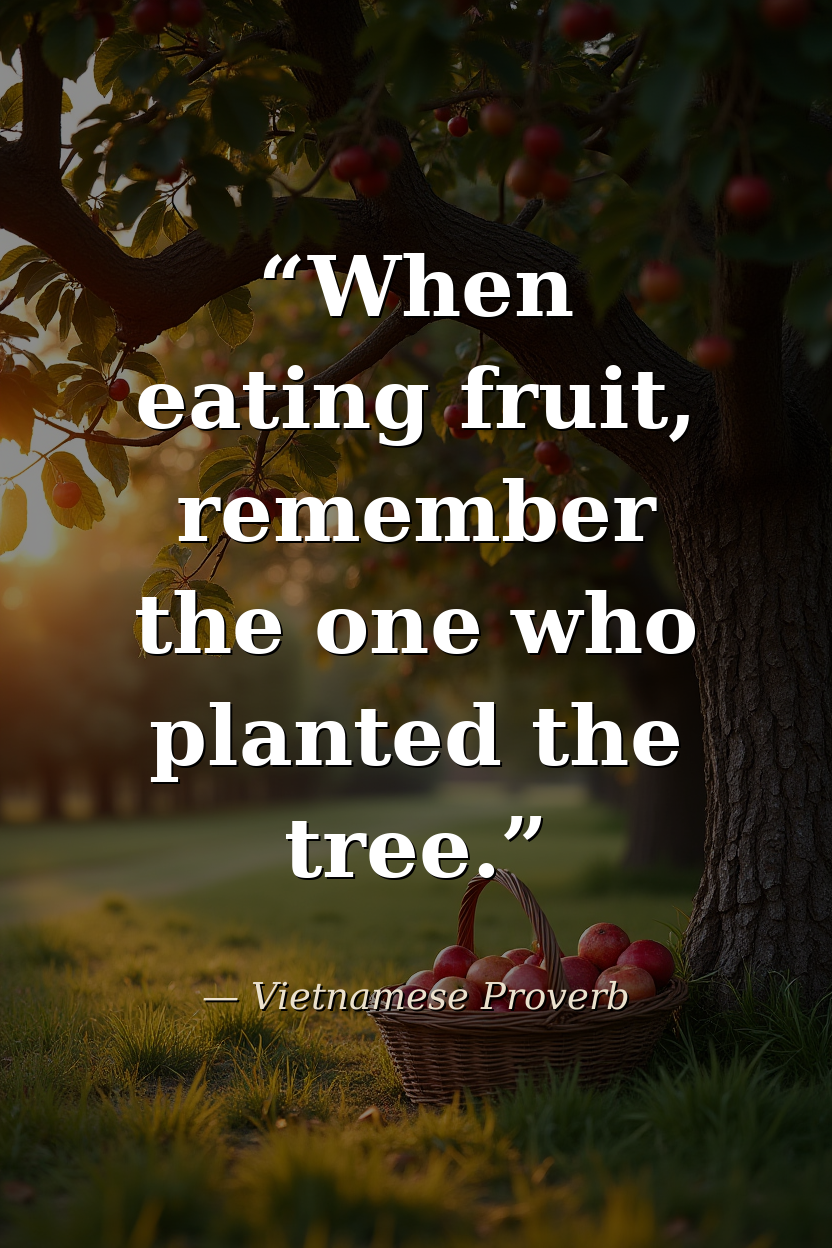
“When eating fruit, remember the one who planted the tree.”
— Vietnamese Proverb
This proverb belongs to Vietnam’s rich tradition of tục ngữ, or folk sayings, passed down through generations. In Vietnamese it reads Ăn quả nhớ kẻ trồng cây, and it is usually learned alongside its sister line, Uống nước nhớ nguồn — “When drinking water, remember the source.” Together they express a value at the heart of Vietnamese life: honoring ancestors and everyone whose work made your own life possible. The image is simple: whoever enjoys the fruit owes a thought to the hands that planted and tended the tree. You can see that value in the traditions of Tết, the Lunar New Year, when families welcome the new year while remembering those who came before, and in the national holiday that honors the Hùng Kings, the legendary founders of the nation. Many Vietnamese children learn these two lines in school, and they still appear in speeches, songs and family gatherings today.
Try this today: choose one everyday thing you use without thinking — the coffee in your cup, the bus that gets you to work, the meal on your plate — and silently thank the people who planted, brewed, drove or cooked it.
Enough Is Already Here
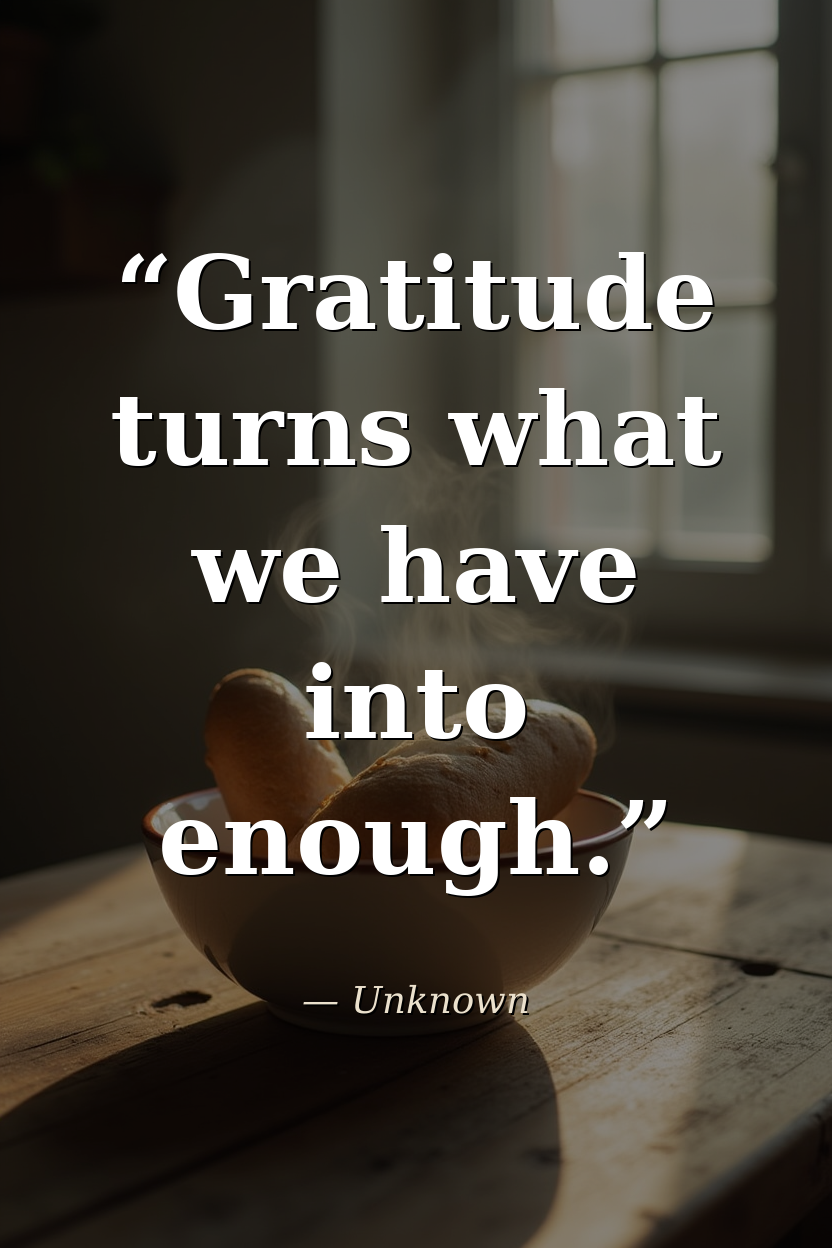
“Gratitude turns what we have into enough.”
— Unknown
No one knows who first wrote this little saying. The line has traveled for years through journals, classrooms and quote collections, usually without a name attached, which is part of its charm — it seems to belong to everyone who has ever needed it. It is the kind of sentence that feels homemade, and perhaps that is why it sticks. Though its author is anonymous, the idea itself is well studied. In a 2003 experiment, psychologists Robert Emmons and Michael McCullough asked participants to write down things they were grateful for each week. Those participants reported feeling better about their lives and more optimistic about the coming week than people who recorded hassles or neutral events. Psychologists still cite that study today as an early demonstration that gratitude can be practiced, not just felt.
Try this today: before buying anything new, pause and name one thing you already own that quietly does its job every day — a worn jacket, a reliable mug, a book you love — and use it with a little extra care.
Gratitude does not ask us to pretend that life is perfect or that hard days are easy. It simply asks us to look again — at the blossom, the fruit, the simple bowl on the table — and notice how much is already here, often more than we remembered.