Hope is stubborn in the best way: it appears in a bird’s song before the sun comes up, in a spring that refuses to run dry, and in the quiet dreams we carry into our waking hours. The three voices gathered below each found their own words for that stubborn light — a nineteenth-century poet who rarely left her garden, an eighteenth-century wit who wrote about all of humankind, and a Greek philosopher who taught kings — and their words have traveled across centuries to reach us. Here they are, along with a little of the story behind each one and one small way to turn each line into action today.
A Song That Never Stops
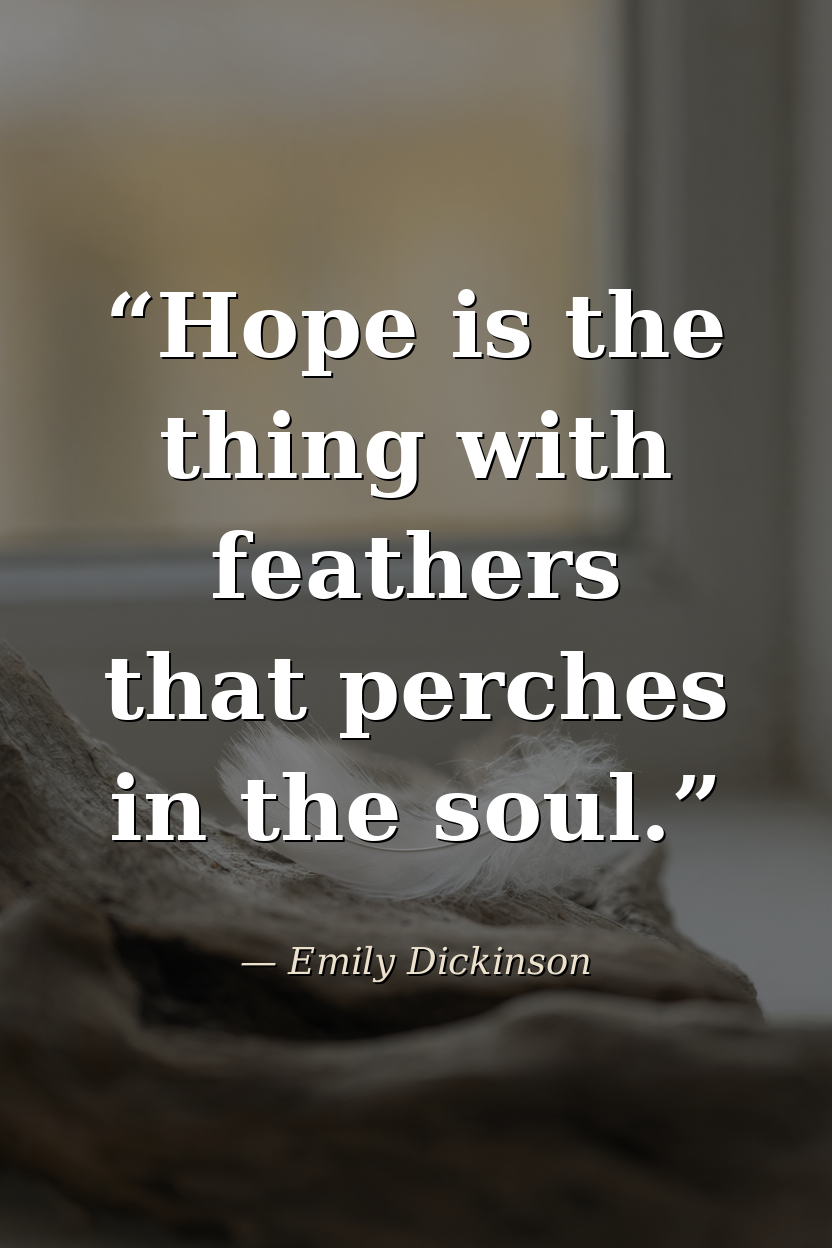
“Hope is the thing with feathers that perches in the soul.”
— Emily Dickinson
The story behind it: Emily Dickinson wrote “Hope is the thing with feathers” around 1861, yet the poem did not appear in print until after her death, when it was included in the 1891 collection Poems, Second Series. She lived most of her life in Amherst, Massachusetts, and composed nearly 1,800 poems, the great majority of which were discovered in her room after she died in 1886. In the full poem, hope is a bird that “sings the tune without the words” and “never stops at all,” weathering every storm without asking anything in return. Readers ever since have found in those lines a picture of hope that is small, persistent, and almost impossibly generous.
Try this today: write a few honest lines of encouragement and tuck the note somewhere a person you love will find it — a lunch bag, a bathroom mirror, or the pages of a book they are reading. You do not need to sign it or explain it; the surprise is part of the gift. Like the little bird of the poem, a few kind words can sing in someone’s soul long after you have gone.
An Eternal Spring
“Hope springs eternal in the human breast.”
— Alexander Pope
The story behind it: Alexander Pope published An Essay on Man anonymously in 1733, and the poem’s first epistle contains the couplet “Hope springs eternal in the human breast: / Man never is, but always to be blest.” The essay sets out to “vindicate the ways of God to man,” and its argument rests on the idea that human beings are happiest when they are looking forward to something. Pope was one of the great poets of the English Enlightenment, celebrated for his wit and his precise, polished couplets. Few lines in English poetry are quoted more often than these four words.
Try this today: speak your hope out loud to someone who is waiting on hard news — a friend between test results, a neighbor between job interviews. Tell them plainly what you are hoping for and why you believe it. Hope shared out loud stops being a private feeling and becomes something two people can carry together.
A Waking Dream
“Hope is a waking dream.”
— Aristotle
The story behind it: The saying “Hope is a waking dream” is attributed to Aristotle, the Greek philosopher who lived from 384 to 322 BCE and taught Alexander the Great before founding his own school in Athens. It survives because Diogenes Laërtius, writing centuries later, gathered it into his Lives of Eminent Philosophers, a collection of biographies and sayings of the Greek thinkers. In Book V, among the short observations credited to Aristotle, the line captures something simple and lasting: hope is what the mind pictures while the eyes are open. It is a dream, but one that belongs to waking life, where a person can still choose what to do with it.
Try this today: take one small physical step toward something you have only imagined — open the application, sketch the first lines, walk to the studio, or send the first message. The point is not to finish; it is to turn a waking dream into something your hands have touched. Hope, at its best, is a beginning rather than a daydream.
Hope does not need much room to grow: a feather, a spring, a waking dream. May one of these words land exactly where you need it today, and may you pass a little of that light on to someone else before the week is over.