Every morning I photograph the cars rolling onto the ferry, a habit my captain calls a waste of time. When a commuter shouted that I had scraped his car, a hundred strangers believed him. Then I remembered what was already on my phone.
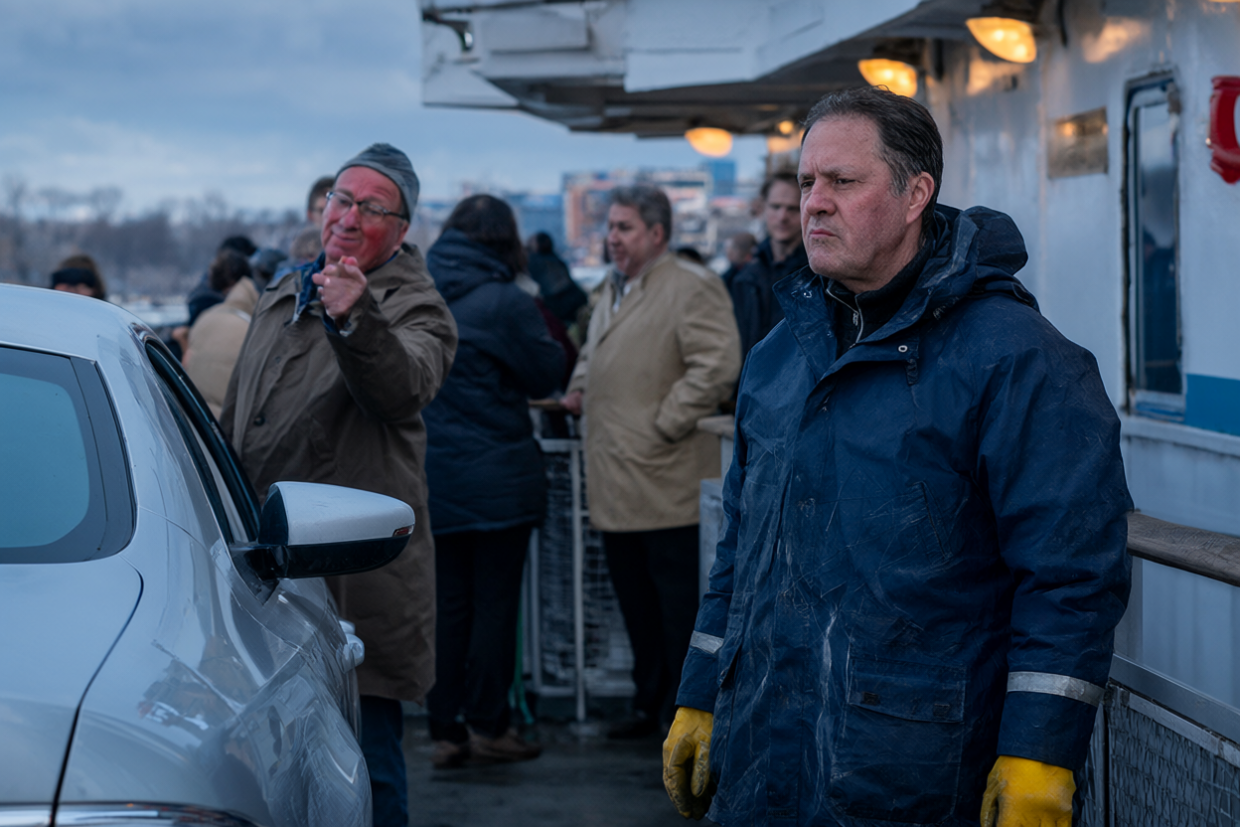
The 6:10 ferry was loading at the Arrowhead Landing slip while the sky was still the color of dishwater. I stood at the top of the ramp in my navy rain jacket, both yellow gloves on, waving the cars down one at a time.
“Easy now, take the center,” I called to a woman in a green wagon. She lifted two fingers off the wheel. Behind her a silver sedan came down the incline too fast and stopped short at the bottom with a squeal that carried all the way up to the cabin stairs.
The driver’s door swung open before the car stopped rocking. He was a tall man in a canvas coat, gray at the temples, and he came up the ramp at me with his thumb raised like a man flagging down a bus.
“You scratched my car,” he said. “Right there. That white line on the door. You did that.”
I looked. A long scratch curved through the silver paint on his rear door, pale as chalk, running from the handle back toward the wheel arch.
“I never touched your car,” I said. “I stand at the ramp. I don’t walk between the rows.”
“Then it happened on this boat.” He spun around to face the line of cars and the passengers coming up the stairs. “Somebody’s going to pay for this. This ferry is going to pay.”
His name, I learned later, was Dale Swindell. He said it twice, loudly, as if repeating it made the claim official. A teenager near the stairs already had his phone up, filming.
Every morning before we cast off, I photograph the loaded rows. It started as a joke with the deck crew and became a habit: one picture of each row, my phone held at chest height, the time stamp saved on every frame. Captain Opal Reyes called it a waste of a good minute. “Rita, the cars aren’t going anywhere in the next ten seconds,” she would say, and I would say, “No, but the truth might.” She never once told me to stop.
This morning’s 6:10 batch was already in my camera roll, forty-one frames, the last one taken at 6:12 while the deck crew chocked the wheels.
By 6:16 half the cabin was at the rail. Dale walked the length of his sedan dragging his thumb along the scratch, over and over, and each time he held the thumb up as if it had come away bloody.
“Look at that,” he said to the rail. “Brand new car. Bought it last week, and now look at that.”
“Brand new?” a woman in a red scarf asked.
“New to me,” Dale said. “Doesn’t matter. It’s mine.”
“I never touched it,” I said again. My voice came out thinner than I wanted, and it cracked on the last word. I hated that.
Captain Reyes came down from the wheelhouse in her whites, hat under her arm. She looked at the scratch, then at the crowd, then at the clock over the car deck: 6:17, three minutes to cast off. “Rita, come with me,” she said. “Everybody else, back from the rail, please.”
In the stairwell she kept her voice low. “I have to file a report. Until it’s filed, you’re off the deck. I can’t have a crew member in a shouting match with a passenger while we’re loading.”
“I didn’t do it, Opal.”
“I know you didn’t. That’s not the same as the report saying so.” She put her hat on. “Sit in the booth. Don’t make it worse.”
The booth sits at the forward end of the cabin, glass on three sides, and from it I watched the morning go on without me. Dale stood by the coffee urn telling his story to anyone who would listen, and the story grew with each telling. Somewhere between the second and third version, my loading cart became a metal bar I had swung against his door out of spite.
“They should just pay him,” a man near the window said, not quietly. “It’s a scratch. The ferry can afford it.”
By 6:25 Dale had moved to the ticket window, and through the vent I heard him say he was calling the port authority, his lawyer, and the state inspector. A woman offered him her card and said her cousin worked in claims.
I felt every eye in that cabin come through the glass and rest on me, and I kept my hands flat on the counter like a woman at a hearing.
Etta Boone came up at 6:31, as she did every crossing, in her gray coat with the collar turned up. She is seventy-one, retired from thirty years of hemming wedding dresses, and she has a way of looking at a thing until it gives up its shape. She bought her tea, then opened the booth door a hand’s width.
“I believe you,” she said. “For whatever that’s worth.”
“It’s worth something,” I said. My throat was tight. She squeezed my fingers, and then she went to her seat by the window, and nobody else said a word.
At 6:58, with the boat under way and the water the color of slate, I opened my camera roll because I had nothing else to do with my hands. The 6:10 batch sat at the top: the green wagon, a white pickup, the silver sedan on the ramp with its rear door flat to the camera, three cars behind the wagon.
I zoomed until the pixels went soft, and there it was. The scratch. Pale, curved, running from the handle toward the wheel arch, already on the door at 6:12, two minutes before Dale Swindell got out of the car.
I stared at the screen, then looked closer. The scratch was not bright white under the deck lamps. It was gray, packed with road dust, and its edges had gone the dull brown of old rust. Paint torn off this morning would have been raw and clean. This one had been out in weather for weeks.
I found Captain Reyes at the stairwell at 7:04 and held the phone up without a word. She took it in both hands, held it at arm’s length, brought it close, and swiped between two frames like a woman reading a page twice.
“That’s his car,” she said.
“That’s his car at 6:12 with the scratch on it. He got out at 6:14.”
Opal handed the phone back and walked down the ramp, and I followed, because I was not going to miss this. Dale was standing by the sedan with a clipboard he had borrowed from somewhere, writing something down. “Mr. Swindell,” she said. “Would you come look at your door with me? In the daylight.”
He came. The bottom of the ramp is open to the sky, and the morning had finally brightened to a hard, honest gray. Opal pointed. “Look at the edges of that scratch. Look at the dust in it.”
Dale leaned in. Then he crouched. Then he was quiet for a while, and the quiet did more than the shouting had done.
“It was on there when I bought it,” he said finally. “The fella at the lot called it lot wear. Said it was nothing. I told myself I’d get it fixed.” He straightened up, and his face had gone the color of the scratch. “I bought it Friday. I’ve been looking at it all weekend. When I saw it here, I guess I decided this was the place it happened.”
“It’s not,” Opal said. “And I’d like you to say so where you said the other thing.”
He did. He stood at the foot of the stairs where he had stood at 6:15 and said, loud enough for the cabin and the rail and the teenager’s phone: “I was wrong. The ferry didn’t scratch my car. I apologize to the deckhand. She never touched it.”
The teenager lowered his phone. “I got the first part,” he said. “I’ll post the rest.”
Opal waited until the deck had gone quiet, then she came to the booth and told me I was back on the deck at noon. Before she left she said, “Those pictures. I want them every crossing, every row, with the time stamps. That’s procedure on this boat from now on.”
Dale came up to the booth before we docked. He turned his keys over and over while he talked.
“I’m sorry,” he said. “I’ve been working doubles. I saw the scratch and I just — I don’t know what I saw.”
“Get it fixed,” I told him. “There’s a body shop on Mill Street, Delaney’s. My brother Terry works there. Tell him Rita sent you and he’ll do it right.”
He wrote it on his clipboard. “Thank you,” he said, and it sounded like it cost him something, which I respected.
The 8:10 load rolled on with the sun up over the far bank, and Dale’s sedan came down the ramp a car length behind the green wagon. He lifted one hand off the wheel as he passed, and I lifted mine back.
By the next crossing the deck lights had come up gold on the wet planks, and I took my photo—not for proof anymore, just because the morning had turned kind.