Every December the same thing happens. You sit down to write your holiday cards and realize that half your addresses live in a phone that has changed three times, a stack of envelopes from last year, and your memory. This free Christmas card list printable gives every name, address, stamp and mailing date one tidy home, and you can download and print it at the end of this post.
A card list is one of those small pieces of paper that quietly saves a season. It turns a scattered job into a short, satisfying routine you can pick up for ten minutes at a time, mug in hand.
What’s inside the printable
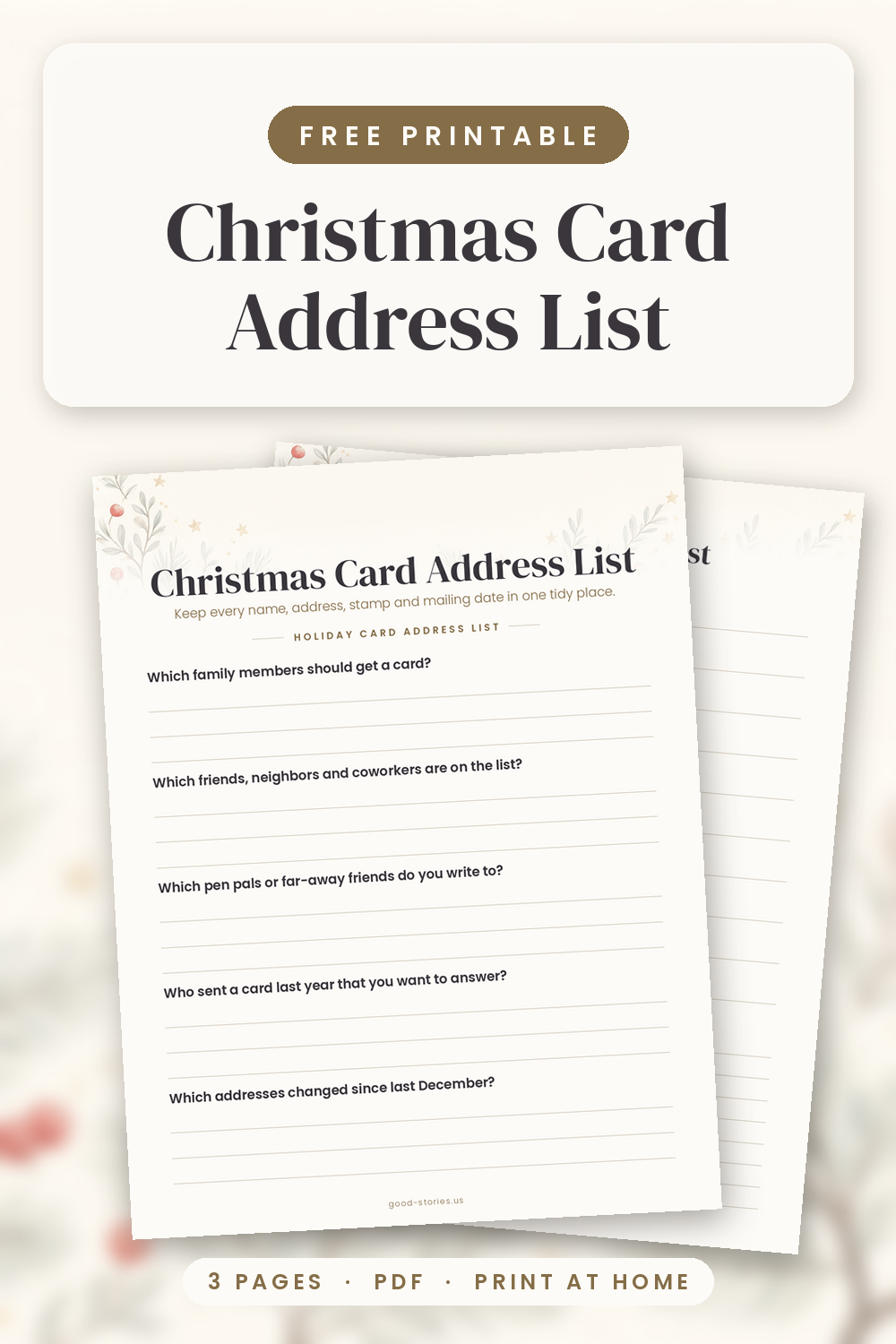
- Page 1: A guided holiday card address list with writing lines for family, friends, neighbors, coworkers and pen pals.
- Page 2: A ten-step holiday card checklist, from choosing a design to storing the list.
- Page 3: A short reflection page for notes to improve next year’s card list.
Why a paper card list still wins
Phone contacts go stale. People change numbers, move apartments, get married and change names, and the address you saved three years ago rarely updates itself. A paper list keeps the pieces that matter for cards in one place: the full name, the street address including the apartment number, and a note of who sent you a card last year so you can be sure to answer it.
It also holds the other half of the exchange: who sent you a card, and whether you have replied. That small column is the difference between a stack of cards you feel guilty about and a stack you have answered. And because the list lives with your decorations, it comes out at the same time as the cards, the stamps and the ribbon, with no searching required.
Build the list in four groups
Start with last year’s cards. Gather the stack you saved, or open the photo you took of it, and work through it in four passes. First, family: parents, siblings, grandparents, aunts, uncles and the cousins you actually write to. Second, friends and neighbors, including the ones you only see at the holidays. Third, coworkers and classmates, past and present, plus anyone from a club or volunteer group. Fourth, pen pals and far-away friends, with a note about which language or customs they use.
Doing it in groups keeps the job from turning into one long, foggy blur. It also makes gaps obvious: if the friends list looks thin, you know exactly where to look next. A realistic number helps, too. If the list comes to forty names, buy forty-five cards and let the extras go to late additions.
Update addresses before the rush
Early November is the sweet spot for confirming details. It is early enough that a quick text still feels casual and late enough that most people know where they will be for the holidays. Check the small things that cause returned mail: apartment and unit numbers, a married name, a street that was renamed, a ZIP code that changed. Write the return address labels at the same time, and tuck a few blank labels in the back of the list for anyone you add late.
A short history of the Christmas card
The first commercial Christmas card was commissioned in 1843 by Sir Henry Cole, a British civil servant who was busy enough to want a shortcut for his holiday correspondence. He asked the artist J.C. Horsley to design it, and about 1,000 cards were printed at a shilling each. The image showed a family party, and it caused a small stir because it included a child taking a sip of wine.
In the United States, Louis Prang is credited with the first American Christmas cards, printed in 1875. Prang was a lithographer, and his cards helped turn the holiday greeting into something ordinary families could afford to send. What began as a shortcut for one busy man is now a tradition that fills mailboxes every December.
What each of the three printable pages does
Page one is the guided holiday card address list: writing lines grouped for family, friends, neighbors, coworkers and pen pals, so the list builds itself as you fill it in. Page two is a ten-step holiday card checklist that runs from choosing a design to storing the list, including buying stamps and checking the current USPS holiday mailing deadlines, which move from year to year. Page three is a short reflection page for notes to improve next year: who to add, which supplies ran out first, and what to change about your timeline. Fill it in before you pack everything away, while the season is still fresh.
How to use your printable
Print on US Letter paper for the cleanest fit. If you use A4, choose “Fit to page” in your print dialog so the lines and checkboxes stay inside the margins. Print one copy for the desk and a second for the box where you keep cards, stamps and labels. Write addresses in pencil at first, then go over them in pen once you have confirmed them, and keep the list in a page protector or a folder so it survives a season of moving between rooms.
You can also treat the pages as a small ritual: fill in the address list on a quiet evening in early November, work through the checklist as December arrives, and finish the reflection page while the last cards are still on the table. Try printing an extra copy for a friend who is starting her own list.
The cards you send are a record of the people you are thinking about. With the names, addresses and dates written in one place, December gets a little calmer and a little more generous. Print the list, pour something warm, and start with the first name.