She returned the birthday doll at 4 p.m. on a Tuesday… But the cashier noticed the wrapping paper was still wet with tears.
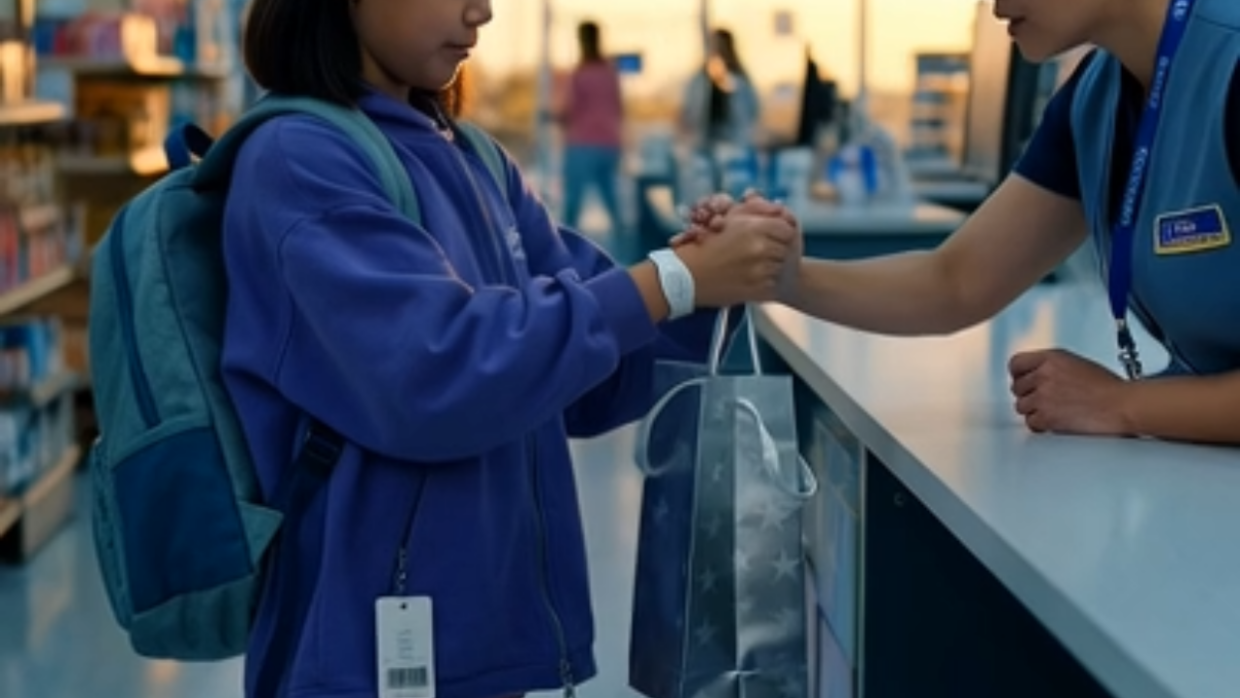
The automatic doors slid open at 4:17 p.m., and Maya Chen watched a girl walk into SaveMore with the kind of careful steps people use when they’re trying not to cry. The child couldn’t have been older than ten, wearing a purple jacket with a price tag still dangling from the sleeve and carrying a gift bag decorated with silver stars.
Maya had worked the customer service desk for six years. She’d seen every kind of return—buyer’s remorse, wrong sizes, duplicate gifts, even a few outright scams. But something about this one made her pause mid-scan of a coupon book.
The girl approached the counter and set the bag down gently, like it contained something fragile. “I need to return this, please.”
Maya smiled the practiced smile she used with children. “Sure, sweetheart. Do you have your receipt?”
The girl produced a crumpled paper from her pocket. Maya smoothed it out and saw the purchase timestamp: today, 1:34 p.m. Less than three hours ago. The item was a deluxe art set, forty-eight dollars with tax, paid in cash. In the gift message section, someone had written in looping cursive: “Happy 10th Birthday, Lily! Love, Grandma Rose.”
“Is something wrong with it?” Maya asked. “We can exchange it for something else if you’d like.”
“No, it’s perfect.” The girl—Lily, apparently—kept her eyes fixed on the counter. “I just… I changed my mind. I’d like the money back, please.”
Maya hesitated. The art set was still in its original packaging, shrink wrap intact, no visible damage. But Lily’s hands were trembling slightly as they rested on the counter’s edge, and there was a hospital bracelet on her left wrist, the kind they give you in the emergency room. The paper band was dated two days ago.
“Are you sure?” Maya asked gently. “This looks like a really nice gift. Art sets like this don’t go on sale very often.”
Lily nodded quickly. “I’m sure. I don’t really need it.”
Maya processed the return, counting out forty-eight dollars in bills. As she handed the money across, Lily’s backpack shifted and a piece of paper slipped out onto the floor. Maya bent to pick it up before the girl could stop her.
It was a printed estimate from County General Hospital. The header read “Pediatric Oncology” and listed a patient name: Emma Reeves, age seven. Below that, a medication schedule and a balance due that made Maya’s stomach drop—$2,847.50 for the current treatment cycle, with a note that the family’s insurance had reached its annual cap.
“That’s not mine,” Lily said quickly, snatching the paper back. But her face had gone scarlet.
Maya looked at the girl more carefully now. The purple jacket was new but cheap, probably clearance rack. The shoes were scuffed and too small, the kind of too-small where the toe box bulges. And that hospital bracelet—Maya could just make out the patient name if she squinted. Not Lily. Emma.
“Is Emma your sister?” Maya asked quietly.
Lily’s jaw tightened. For a moment, Maya thought she wouldn’t answer. Then the girl’s shoulders sagged. “Yeah. She’s at County General. Stage three leukemia. She’s been there for sixteen days.”
“And today’s your birthday.”
“It’s fine.” Lily stuffed the cash into her jacket pocket. “Birthdays aren’t a big deal. Emma needs her medicine more than I need art supplies.”
Maya felt something crack open in her chest. “Sweetheart, did your grandma buy you this gift?”
“Grandma Rose doesn’t have a lot of money. She saved up her social security for three months.” Lily’s voice was steady, but her eyes were wet. “She was so excited to give it to me. But Emma’s out of the anti-nausea medication and Mom can’t afford the refill until Friday when she gets paid, and Emma threw up six times yesterday, and I just thought—” Her voice broke. “I thought maybe forty-eight dollars would help.”
Maya’s training said she should process the return, wish the customer a nice day, and move on to the next transaction. But her training had never covered a ten-year-old choosing chemotherapy drugs over birthday presents.
“Wait here,” Maya said. “Just one minute.”
She walked quickly to the back office where her manager, David Park, was reviewing inventory reports. Maya knocked once and didn’t wait for an invitation.
“David, I need you to come look at something.”
David glanced up, annoyed. “I’m in the middle of—”
“Now, please.”
Something in her tone made him stand. Maya led him to the customer service desk where Lily was still waiting, looking small and anxious. Maya explained the situation in low tones, showing him the hospital estimate that Lily had reluctantly handed over again.
David was quiet for a long moment. Then he turned to Lily. “What’s your sister’s favorite color?”
Lily blinked. “Um. Yellow. Like sunshine yellow. She says it’s a happy color.”
David nodded and pulled out his phone. He made three calls in rapid succession—one to the store’s community outreach coordinator, one to the local news desk at Channel 7, and one to Dr. Patricia Okonkwo at County General’s pediatric oncology unit.
“What are you doing?” Lily asked, confused.
“Fixing this,” David said simply.
Within forty minutes, the store had transformed. David had authorized an emergency community fund activation—something SaveMore corporate allowed for exceptional circumstances. The store’s PA system crackled to life.
“Attention SaveMore shoppers. We have a special situation today. A local family is facing a medical crisis, and we’re asking our community to help. If you’d like to contribute to seven-year-old Emma Reeves’ cancer treatment fund, please see any register. Every dollar goes directly to County General Hospital’s pediatric oncology unit. Additionally, SaveMore will match all donations up to five thousand dollars.”
Lily’s eyes went huge. “What? No, you can’t—”
But customers were already lining up. A woman in yoga clothes handed the nearest cashier a hundred-dollar bill. A construction worker in dusty jeans pulled out his wallet. A teenager working the grocery section emptied his tip jar.
Maya stayed with Lily, who looked like she might bolt at any second. “It’s okay,” Maya said softly. “People want to help.”
“But I don’t even know these people.”
“That’s what community means, sweetheart. We take care of each other.”
The Channel 7 news van pulled up at 5:03 p.m. Reporter Jennifer Walsh came in with a cameraman, and David gave them the story in brief, careful strokes. Jennifer knelt down to Lily’s level.
“Would you be willing to talk to us about your sister?” Jennifer asked. “You don’t have to. But sometimes when people hear a story, they want to be part of the solution.”
Lily looked at Maya, uncertain. Maya nodded encouragingly.
“Okay,” Lily whispered.
The interview lasted six minutes. Lily talked about Emma—how she loved sunflowers and wanted to be a veterinarian, how she was brave during the treatments but scared of needles, how she made their mom laugh even on the hardest days. Jennifer asked about the birthday present, and Lily explained about Grandma Rose’s three months of saving.
“What would you say to people watching right now?” Jennifer asked.
Lily thought for a moment. “I’d say thank you. And I’d say that if they have kids, they should hug them extra tonight. Because being healthy is the best present anyone can get.”
The segment aired on the 6 p.m. news. By 6:30, the SaveMore donation station had collected $3,200 in cash and checks. By 7 p.m., the hospital had received calls from four different donors offering to cover specific parts of Emma’s treatment. By 8 p.m., a pharmaceutical company rep had contacted Dr. Okonkwo to discuss a compassionate care program that would provide Emma’s medications at no cost for the duration of her treatment.
Maya’s shift ended at 9 p.m., but she stayed late to help count the donations. The final total was $8,447 in direct contributions, plus SaveMore’s $5,000 match, plus the pharmaceutical company’s medication coverage valued at approximately $15,000 over six months.
David called County General and spoke directly to Dr. Okonkwo. “We have thirteen thousand, four hundred forty-seven dollars to put toward Emma Reeves’ account. How much does that cover?”
There was a pause on the other end. Then Dr. Okonkwo’s voice, thick with emotion: “That covers her current balance and the next two treatment cycles. With the medication coverage, that takes her through to January. By then, her insurance resets. You just… you just gave this family breathing room they haven’t had in months.”
David’s eyes were suspiciously bright when he hung up. He turned to Lily, who was sitting in the break room with a sandwich Maya had bought her from the deli section. “Your sister’s treatment is covered. All of it. For the next several months.”
Lily stared at him. “What?”
“You heard me. The bills are paid.”
Lily’s face crumpled, and then she was crying—not the quiet, controlled tears she’d been holding back all evening, but huge, gasping sobs of relief. Maya sat down next to her and put an arm around her shoulders, and Lily buried her face in Maya’s uniform vest and cried like the ten-year-old child she was.
When the tears finally subsided, Lily pulled back and wiped her face with her sleeve. “I don’t know how to thank you.”
“You don’t have to thank us,” Maya said. “But I do have something for you.”
She retrieved the deluxe art set from behind the counter where she’d stashed it. “This is yours. Your grandma bought it for you, and you should keep it. It’s your birthday present.”
“But I returned it—”
“And I’m un-returning it. Manager’s privilege.” David smiled. “Consider it a gift from SaveMore. Happy birthday, Lily.”
Lily took the art set with shaking hands, holding it like it was made of gold. “Can I… can I give some of it to Emma? She likes to draw too.”
“It’s yours,” Maya said. “You can do whatever you want with it.”
At 9:47 p.m., Lily’s mother arrived—a tired-looking woman in scrubs with “County General” embroidered on the pocket. Her name tag read “Rachel Reeves, RN.” She looked confused and overwhelmed as David explained everything that had happened.
Rachel listened in silence, one hand over her mouth. When David finished, she turned to Lily. “You tried to return your birthday present?”
Lily nodded. “For Emma’s medicine.”
Rachel pulled her daughter into a fierce hug. “Oh, baby. You shouldn’t have to do that. You should never have to do that.”
“But I wanted to help.”
“I know. I know you did.” Rachel was crying now too. “You’re the bravest kid I know. Both my girls are.”
David handed Rachel an envelope with the donation details and the hospital’s confirmation that Emma’s account had been credited. “Dr. Okonkwo is expecting your call. The pharmaceutical company rep’s information is in there too. They’re setting up a long-term medication program.”
Rachel opened the envelope, scanned the papers, and her knees actually buckled. Maya and David both reached out to steady her. “This is real?” Rachel whispered. “This is actually real?”
“It’s real,” David confirmed. “Your community showed up.”
Rachel looked around at the SaveMore employees who had gathered—cashiers and stock clerks and the deli manager and the pharmacist. “I don’t know what to say. I’ve been working double shifts, and it still wasn’t enough, and I didn’t know how I was going to—” Her voice broke. “Thank you. Thank you so much.”
The next morning, Maya came in for her shift to find the store buzzing. The Channel 7 story had been picked up by the regional news network. By noon, three more families had contacted SaveMore asking if there was a fund they could donate to for other children in similar situations.
David called corporate. By the end of the week, SaveMore had announced the launch of the “Community Care Fund”—a program where customers could round up their purchases to the nearest dollar, with the difference going to local families facing medical crises. The first beneficiary was a five-year-old with cystic fibrosis. The second was a teenager who needed a wheelchair-accessible van.
Maya received a handwritten note two weeks later, delivered to the store in a yellow envelope. Inside was a drawing of two stick figures holding hands under a rainbow. One figure had curly hair and a big smile. The other was taller and wearing what looked like a purple jacket.
The note read: “Dear Maya, Thank you for helping my sister. She got her medicine and she’s not throwing up anymore. The doctors say she’s doing really good. Lily shared the art set with me and we drew you this picture. You’re a hero. Love, Emma (age 7) and Lily (age 10).”
Maya pinned it to the bulletin board in the break room. David saw it and smiled. “That’s going in the company newsletter.”
“It’s just a kid’s drawing,” Maya said, but she was smiling too.
“It’s proof that paying attention matters,” David replied. “You could have just processed that return and moved on. Instead, you asked questions. You saw a child in trouble, and you did something about it.”
Maya thought about that moment at the counter—Lily’s trembling hands, the hospital bracelet, the too-small shoes. The tiny details that added up to a crisis. “I just couldn’t let her walk out of here thinking she had to choose between a birthday present and her sister’s life. No kid should have to make that choice.”
“No,” David agreed. “They shouldn’t. But because you noticed, she doesn’t have to anymore.”
Three months later, Maya was working the evening shift when the automatic doors opened and two girls walked in. The older one wore a purple jacket that finally fit properly. The younger one had a scarf wrapped around her head, but her smile was bright as sunshine.
“Emma!” Maya came around the counter. “Lily! How are you?”
Emma beamed. “I’m in remission! The doctors said the treatment worked really, really good!”
Lily was grinning too. “We came to say thank you again. And to bring you this.”
She handed Maya a framed picture—the same stick figure drawing from the note, but this time professionally matted and framed. At the bottom, someone had added a small plaque: “To Maya Chen, who noticed. With gratitude, the Reeves family.”
Maya felt her throat tighten. “You didn’t have to do this.”
“Yes, we did,” Rachel said, appearing behind her daughters. She looked different—rested, less gray around the edges. “You changed our lives. All of you did. Emma’s prognosis is good. We’re going to be okay. And it’s because you saw my daughter and you helped.”
Maya hung the picture in her living room that night, right where she could see it every morning. It reminded her why she showed up to work every day—not for the paycheck or the benefits, but for the moments when paying attention to the small details meant everything.
Because sometimes, a returned birthday present isn’t really about the present at all. Sometimes, it’s a child trying to save her sister’s life with forty-eight dollars and a breaking heart. And sometimes, if you’re lucky enough to notice, you get to be part of the solution.
The Community Care Fund raised $47,000 in its first year, helping nineteen families. Maya was promoted to community outreach coordinator. Lily started middle school with plans to become a doctor. Emma’s hair grew back, curly and wild, and she declared she still wanted to be a veterinarian who specialized in “really sick animals, because I know what that’s like.”
And every year on Lily’s birthday, Maya sent her a new art set—not because she had to, but because some gifts are meant to be kept, and some moments are worth remembering forever.
The SaveMore on Maple Street became known as the store where miracles happened. But Maya knew better. It wasn’t miracles. It was just people choosing to see each other, choosing to care, choosing to act when it mattered most.
That was the real gift—not the money or the coverage or even the art set. It was the reminder that compassion isn’t complicated. Sometimes, it’s as simple as asking one more question. Sometimes, it’s noticing when a child’s hands won’t stop shaking. Sometimes, it’s refusing to look away from someone else’s pain.
And sometimes, that’s enough to change everything.